Plants get their energy from sunlight, which chlorophyll captures to build sugars such as glucose, while soil supplies nutrients and water rather than energy. If that’s true, what keeps a plant alive all night, and why does a well fed plant in rich soil still fail in a dark corner? Those two questions expose the gap in the usual answer. A plant isn’t eating soil like an animal eats food. It’s running a budget, earning energy in daylight, storing part of it, spending it after dark, and sharing some of it below ground.
Plants Run on Sunlight, Not Soil
Where does a plant’s energy come from if its roots are buried in soil? Roots absorb water and mineral nutrients, but those materials supply matter, not the energy that powers the plant. That energy arrives as sunlight.
Inside leaf cells, chloroplasts contain chlorophyll, a green pigment that absorbs light, especially from the red and blue regions of the visible spectrum. The absorbed light drives chemical reactions that convert radiant energy into chemical energy stored in sugars and other compounds. The plant is not creating energy from nothing. It is changing its form, much as a charging device stores electrical energy for later use.
A Simple Analogy That Keeps the Roles Straight
A leaf works like a small factory powered by sunlight. Carbon dioxide from the air supplies much of the carbon used to build sugars. Water supplies electrons and hydrogen, and oxygen is released when water is split. Soil nutrients, including nitrogen and phosphorus, act more like building materials and tools: they help the plant make and maintain the machinery, but they do not provide its energy.
This difference matters in the garden. Fertilizer can supply nutrients, but it cannot make up for a lack of light. Adding it to a plant in deep shade is like supplying a factory with better tools while leaving its power source switched off. The tools help the factory work when energy is available; they cannot replace that energy.
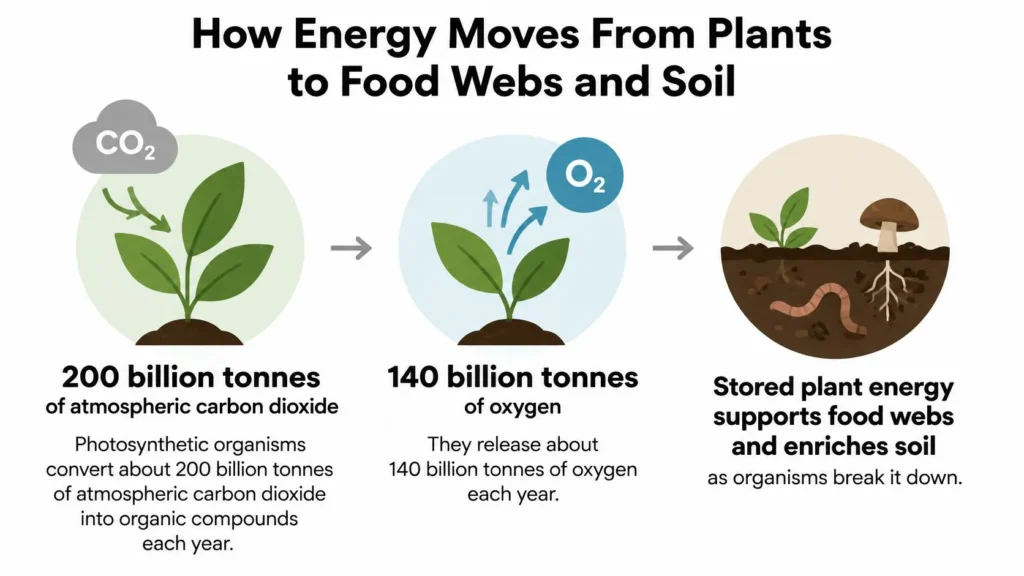
Photosynthesis also matters far beyond an individual plant. Photosynthetic organisms remove large amounts of carbon dioxide from the atmosphere and release oxygen. The sugars and other compounds they produce support plant growth, cell maintenance, and reproduction. They also provide a starting point for food chains, as energy stored in plants becomes available to animals and people that eat them, directly or indirectly.
| Input | Where it comes from | Role in the plant | Energy or matter |
|---|---|---|---|
| Sunlight | The Sun | Chlorophyll absorbs mainly red and blue light to drive the light-dependent reactions | Energy source |
| Carbon dioxide | Air, taken in through leaf pores | Supplies the carbon atoms used to build glucose and other sugars | Matter |
| Water | Roots, moved up to the leaves | Split to replace electrons and supply hydrogen; oxygen is released | Matter, not the primary energy source |
| Soil nutrients (nitrogen, phosphorus) | Soil, taken up by roots | Help build chlorophyll and enzymes that run photosynthesis | Matter, not an energy source |
Only sunlight in the table supplies energy to the process. The other inputs provide atoms or help build the cell machinery that captures and uses that energy. The carbon-building reactions are known as the Calvin cycle. The Lawrence Berkeley National Laboratory history of the Calvin cycle describes how Melvin Calvin, Andrew Benson, and James Bassham mapped those reactions in 1950.
Once sugars are made, the plant can break some down through respiration to release usable energy for its cells. That energy can support the plant’s ongoing work, while other sugars may be stored or used to build new tissue. Soil remains part of the system, supplying nutrients and water, but sunlight is the original energy source for an ordinary green plant.
How Chlorophyll Turns Light Into Chemical Energy
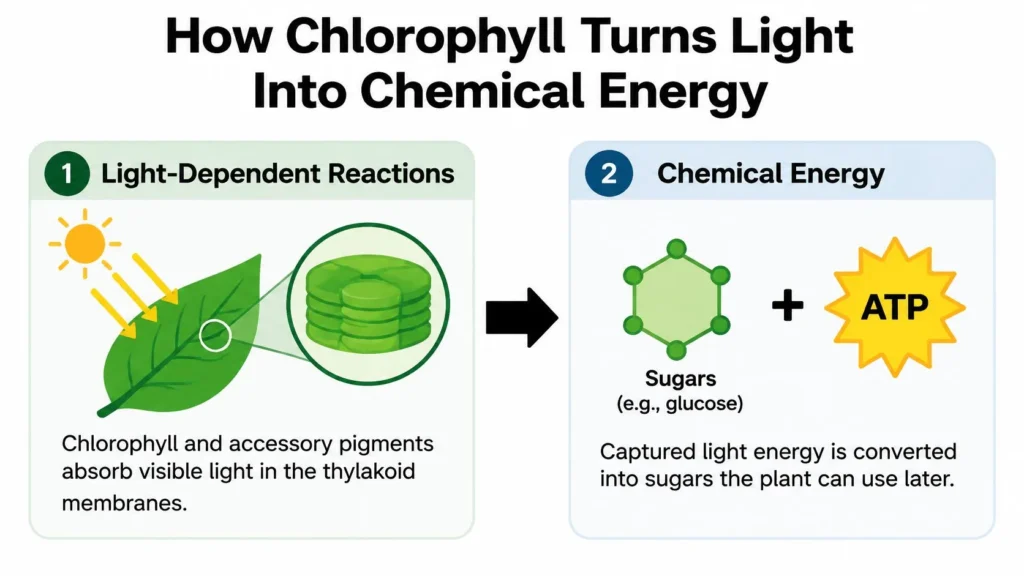
Photosynthesis sounds complicated because textbooks name many molecules at once. It helps to split it into two connected stages. The first stage captures light and makes short term energy carriers. The second stage spends those carriers to build sugar.
The University of South Carolina photosynthesis overview describes plants obtaining usable energy primarily from sunlight through photosynthesis, not from soil minerals. That’s the thread to hold onto through every step below. If a term feels abstract, ask what job it does, capture, carry, or build.
Stage One in the Thylakoid Membranes
Inside each chloroplast are stacked membranes called thylakoids. The light-dependent reactions happen there, and they only run while light is arriving.
- Absorbing photons. Chlorophyll and accessory pigments absorb visible photons, especially in the photosynthetically active radiation range. Accessory pigments widen the range of colors the leaf can use and pass energy toward chlorophyll.
- Exciting electrons. The absorbed energy excites electrons in photosystem II, lifting them to a higher energy state. Those energized electrons now have work they can do as they move.
- Splitting water. Water is split to replace the electrons removed from chlorophyll. This step releases oxygen as a by-product, which is the oxygen that leaves the leaf.
- Making ATP. As electrons flow through the thylakoid membrane, they help pump protons and create a gradient. That gradient drives ATP synthase, an enzyme that makes ATP, the cell’s main short term energy carrier.
- Making NADPH. At the end of the chain, electrons reduce NADP+ to NADPH. NADPH carries both electrons and hydrogen that will be needed for building sugar.
Stage Two in the Stroma
The fluid around the thylakoids is called the stroma, and that’s where the Calvin cycle builds carbon compounds. This stage doesn’t need light directly, but it stops quickly without a fresh supply of ATP and NADPH from stage one.
- Fixing carbon. The enzyme Rubisco incorporates atmospheric carbon dioxide into organic molecules such as G3P, using ATP and NADPH. Fixing means taking carbon from a gas and locking it into a larger organic molecule.
- Building useful products. Those carbon compounds are subsequently converted into sugars, starch, lipids, and structural biomass. Some become immediate fuel, some become storage, and some become new leaf, stem, root, or seed tissue.
Water wheel picture. Light lifts electrons uphill to a high energy state, and as they flow back down through the membrane machinery, the plant stores that fall as ATP and NADPH, then spends both to build sugar.
If you want to understand why particular colors matter so much to a leaf, you can explore fascinating facts about light and then return to the leaf with that color picture in mind. A pigment isn’t green because it uses green light best. Leaves look green largely because green light is reflected more than red and blue light.
The practical lesson is direct. Fertilizer cannot substitute for inadequate light, because nutrients enable photosynthetic machinery and growth but aren’t the primary energy source. Sunlight supplies the energy, water supplies replacement electrons and hydrogen, and carbon dioxide supplies most of the carbon skeleton.
How Photosynthesis Compares With Other Energy Routes
Photosynthesis is one way living things handle energy, but it isn’t the only one you’ll hear about. Confusion often comes from treating photosynthesis and respiration as opposites that cancel out, or from assuming every organism must start with light. The table below puts three processes side by side so you can see what powers each one.
| Process | Energy source | Organisms that use it | Main energy output |
|---|---|---|---|
| Photosynthesis | Sunlight | Plants, algae and cyanobacteria | Sugars such as glucose; oxygen released |
| Cellular respiration | Stored sugars such as glucose | Plants, animals, fungi and most microbes | ATP, with carbon dioxide and water as waste |
| Chemosynthesis | Chemicals such as hydrogen sulfide | Some bacteria and archaea, such as those at deep-sea vents | Organic molecules and ATP |
Photosynthesis Builds the Store
Photosynthesis is the only process in the table that starts from light. A plant, alga, or cyanobacterium captures photons and uses that energy to assemble sugars from simpler materials. You’re left with stored chemical energy that can be moved, saved, or eaten by another organism.
Respiration Spends the Store
Cellular respiration runs in the other direction. Stored sugar reacts with oxygen, releasing energy that the cell captures as ATP, while carbon dioxide and water are produced as waste. Plants do this day and night, because living cells need ATP even while they’re also photosynthesizing. Animals, fungi, and most microbes depend on respiration too, but they must get their starting sugars from food rather than making them from light.
That relationship is why people sometimes ask whether plants produce oxygen or carbon dioxide. The honest answer is that they do both, through different processes. In bright light, photosynthesis usually runs faster, so the plant takes in carbon dioxide overall and releases oxygen overall.
Chemosynthesis Skips Light Entirely
Some bacteria and archaea near deep sea hydrothermal vents use chemosynthesis instead. They take energy from chemical reactions involving compounds such as hydrogen sulfide and use it to build organic molecules, with no sunlight involved. Whole vent communities of tube worms, mussels, and crabs can rest on that chemical base.
The contrast clarifies the plant question. Vent microbes are independent of light but tied to specific chemicals, while green plants are independent of vent chemicals but tied to light. If you’re comparing natural energy systems with human ones, a plain explanation of what renewable energy means makes the sunlight connection easier to place. Photosynthesis remains the route that feeds most land and shallow water ecosystems, while chemosynthesis supports smaller, specialized environments.
Storing Energy by Day and Spending It by Night
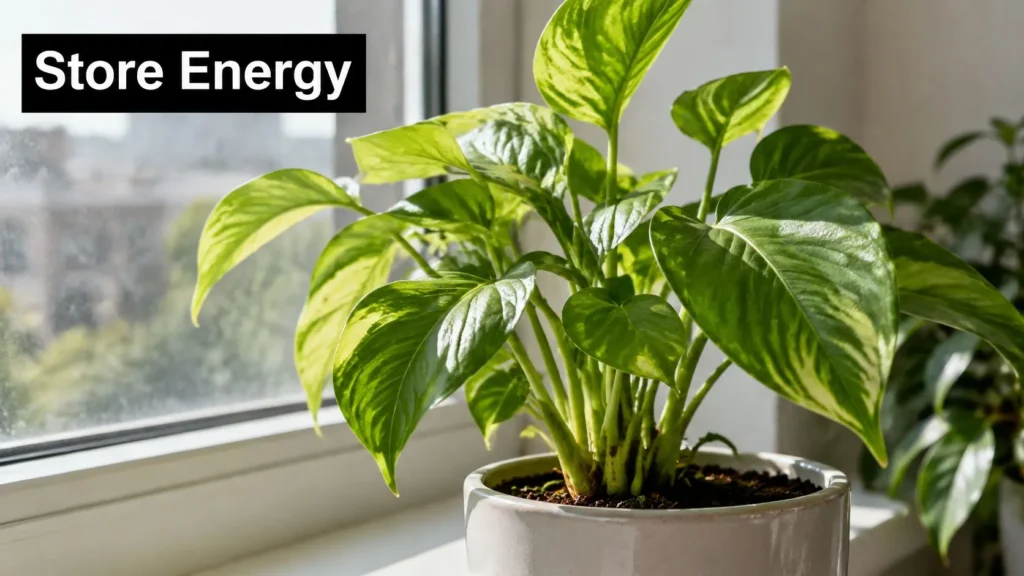
At sunrise, a leaf begins earning. Chloroplasts convert light energy into chemical energy and use carbon dioxide and water to produce sugars. The plant uses some sugar right away, exports some to growing tissues, and stores part of it as starch, often inside the chloroplasts themselves.
By late afternoon, that starch reserve is the plant’s savings for the night ahead. Nothing about this requires the plant to harvest moonlight. Moonlight is far too weak to run the daytime system in any meaningful way for an ordinary plant.
The Night Shift Runs on Starch
After dark, photosynthesis stops because its first stage needs photons. The plant doesn’t stop living, though. It breaks starch back down into sugars, then uses those sugars in respiration to support growth and cellular maintenance through the night.
A review in the U.S. National Library of Medicine collection on plant carbon allocation describes this breakdown as tightly regulated by the plant’s internal clock. Starch must be consumed slowly enough to last until dawn, but quickly enough to prevent a shortage of sugars during the night. Spend too fast and the plant faces an energy shortfall before sunrise. Spend too slowly and usable sugar stays locked away while cells that need it go short.
Think of starch as a bank account with a daily budget. Daylight is income, night is a series of withdrawals, and the internal clock sets the spending rate so the account reaches morning close to empty but not overdrawn.
What Disrupts the Budget
- An unusually long night. The reserve has to stretch further than the schedule the clock prepared for, so late night sugar supplies can run low.
- Heavy shade during the day. Less light means less income, so the plant enters the night with smaller starch savings even if its roots sit in moist, nutrient rich soil.
- An early dawn disruption. A sudden change in timing can leave starch unspent or misalign spending with the actual length of darkness.
Each case can slow growth without anything being wrong with the soil. That’s why a houseplant on a dim shelf may stall despite regular watering and feeding. Its problem is a daily energy deficit, not a missing mineral. For a closer look at that household version of the same process, read how houseplants use stored energy overnight and compare it with the budget picture here.
So where do plants get their energy from at midnight? From sunlight they captured hours earlier and stored as starch. Income by day, withdrawals by night. That single rhythm explains much of what looks mysterious about slow growth in low light.
How Much Sunlight Plants Actually Turn Into Growth
If sunlight is abundant, why don’t plants turn most of it into new tissue? Because photosynthesis is inefficient, and several losses are built into the system. A leaf reflects some light, absorbs only part of the spectrum, loses energy as heat, and spends some of its own sugar on respiration just to stay alive.
An analysis of 164 studies in the U.S. National Library of Medicine collection found absorbed-radiation-to-biomass conversion efficiencies of approximately 4.9 to 6.6% for biofuel crops under relatively unstressed conditions. The same analysis reported lower ranges for other crop groups. Those percentages measure absorbed photosynthetically active radiation converted into dry matter, not every ray of sunlight that falls on a field.
| Crop group | Efficiency range | Photosynthetic pathway |
|---|---|---|
| Biofuel crops | 4.9 to 6.6% | Mixed C3 and C4 crops |
| C4 food crops | 4.6 to 4.9% | C4 |
| C3 non-legumes | 3.6 to 4.1% | C3 |
| C3 legumes | 2.8 to 3.5% | C3 |
Why the Percentage Stays Low
- Spectral absorption. Pigments capture mainly certain wavelengths, so part of incoming solar energy is never absorbed for photochemistry at all.
- Respiration and photorespiration. The plant burns some sugar for its own maintenance, and photorespiration wastes some fixed carbon, especially under hot, dry conditions.
- Heat dissipation and stress. Excess energy can be shed as heat, and drought, nutrient shortage, or temperature stress lower the rate further.
Whole field efficiency is lower still. Canopy shading, reflection, and incomplete absorption reduce the share of total sunlight that ever becomes biomass. Upper leaves may receive more light than they can use while lower leaves sit in shade, and bare soil between young plants receives light that no leaf captures.
The analysis identified incident solar radiation and growing-season temperature as major sources of efficiency variation. More incoming light helps only up to the point where the machinery saturates. Beyond that point, excessive light can trigger photoprotection, and the plant deliberately dissipates energy as heat to avoid damage.
A Field Example
Say two fields receive the same sunlight across a week. One has a dense canopy where top leaves intercept almost everything and lower leaves respire nearly as much as they photosynthesize. The other spreads light more evenly through the canopy, so more leaves work at a productive rate. The second field can produce more biomass from identical sunshine.
For growers, the useful move is matching canopy density, light distribution, temperature, water supply, and nutrient availability rather than increasing light intensity alone. The highest yielding fields balance capture against waste. They don’t win by maximizing light alone.
How Energy Moves From Plants to Food Webs and Soil
What happens to the energy a plant captures after it becomes sugar? Some stays in the plant, and some moves through the food web. A caterpillar eating a leaf takes in part of its stored chemical energy. A bird may then eat the caterpillar, and a hawk may eat the bird. At every step, organisms use some energy for movement and body heat, build some into new tissue, and pass some along in waste or remains.
Decomposers help return materials to the cycle. Fungi and bacteria break down fallen leaves, dead roots, and animal remains, releasing nutrients that living roots can absorb. Energy does not cycle in the same way: it flows through organisms and gradually escapes as heat. The atoms in nutrients are reused, but ecosystems need a continuing supply of energy from the Sun.
Roots Are Not Just Drinking Straws
A familiar school diagram shows water and minerals entering the root, with nothing leaving it. In a living plant, sugars made through photosynthesis also travel down to the roots. There, roots release carbon-rich organic compounds into the rhizosphere, the thin zone of soil around them. Microbes use these compounds as food, so the plant’s energy supports life below ground as well as growth above it.
A Forschungszentrum Jülich announcement on how plants shape microbial life at their roots describes research showing that the distribution of photosynthate, the products of photosynthesis, shapes how microorganisms are arranged around maize roots. In plain terms, the places where a plant sends sugar can influence where microbes gather.
Roots are trading posts, not just intakes. The plant spends hard-won sugar below ground, while a living soil community can affect how available nutrients are to that same root.
Why spend energy feeding microbes? They break down organic matter and help cycle nutrients. Some also form partnerships that improve a root’s access to resources. The exchange links the plant’s daily energy supply to soil life: sunlight provides the energy for making sugars, while soil provides nutrients rather than food in the same sense.
Gardeners can see a related recycling process in how to compost at home, where plant material breaks down and returns nutrients to the soil. Composting is not identical to the exchange around living roots, but both involve decomposers working on organic matter.
Seen as a whole, energy flow is a plant and soil system process, not just something happening inside one leaf. Living roots keep sending sugars into the soil, where microbes use them as they cycle nutrients. When plants are absent, that steady input from roots is absent too. The plant, its consumers, and the soil community are connected by energy moving outward from sunlight and by nutrients moving through the living system.
Check Your Plant’s Light Before Changing the Soil
When a plant grows slowly, many people reach for fertilizer first. Reverse that order. Light is the energy source, so check energy income before you change anything in the pot or bed.
- Check placement first. Put the plant where it receives direct or bright indirect light for most of the daytime, suited to its type.
- Read the leaves. Pale growth or stems stretching toward a window signal too little energy capture, a pattern plant growers call leggy growth.
- Test soil only after light. Once light is clearly adequate, look for nutrient gaps such as pale older leaves and test before feeding.
Balance still matters. Excessive direct light in a hot spot can scorch leaves and stress the plant, so the aim is enough light for a healthy daily budget, not maximum exposure at all costs. The same order of checks applies outdoors, whether you’re troubleshooting a herb bed or learning how to grow tomatoes from seed and wondering why seedlings stretch on a windowsill.
Do one thing today. Move your slowest plant to the brightest suitable spot you have, leave the fertilizer alone for now, and watch the new growth over the next few weeks.
If this day and night budget changed how you look at the plants on your windowsill, you’ll find more clear, curiosity led explainers across science, nature, health, and everyday technology at maxijournal.com. Visit to keep reading practical guides that connect the underlying science to decisions you make at home and in the garden.
Discover more from Maxi Journal
Subscribe to get the latest posts sent to your email.