A white dwarf can still glow brilliantly even though it no longer makes energy through the kind of nuclear fusion that powers the Sun. That contrast is the key to understanding this stellar remnant: its light is leftover heat, while its mass, chemistry, and surrounding debris preserve clues to what happened before it became a compact core.
What a White Dwarf Star Is at a Glance
A white dwarf star is the hot, dense core left when a star like the Sun has used up its fuel and shed its outer layers. It’s a little like a cinder after a fire: it can still glow, but it’s no longer burning fresh fuel to keep the fire going.
The scale is surprising. NASA describes a typical white dwarf as about half the Sun’s mass but only slightly larger than Earth, an extraordinary amount of stellar material packed into a planet-sized body, as explained in NASA’s overview of white dwarfs. The comparison isn’t exact in every case, but it gives a useful first picture: a white dwarf is small in size, not in substance.
Here’s a quick profile of the usual features:
| Characteristic | Typical value | What it means |
|---|---|---|
| Size | About Earth’s radius, only slightly larger | Packs a star’s worth of mass into a planet-sized body |
| Mass | About half the Sun’s mass | Much of a star’s remaining material is compressed into a small volume |
| Density | Extremely high | A great deal of matter is crowded into a small space |
| Surface temperature | Hot when young, cooler as it ages | A new remnant can glow intensely before it gradually fades |
| Energy source | Stored heat only, no ongoing fusion | It radiates thermal energy left over from its earlier life |
| Typical composition | Carbon and oxygen core, often with a thin hydrogen or helium outer layer | The core contains material made during the star’s earlier evolution |
| Cooling lifetime | Cooling can continue for roughly 10 billion years | Its fading can help astronomers estimate when stars formed |
The density row explains why “small” doesn’t mean “light.” A white dwarf’s material is squeezed so tightly that a planet-sized remnant can hold a large fraction of a star’s mass. The details depend on the individual object, but its compactness is one of the defining differences between a white dwarf and a star like the Sun.
The temperature and energy rows answer another common question: if it’s dead, why does it shine? “Dead” means the star’s ordinary core fusion has stopped, not that the remnant has instantly gone cold. A newly exposed core can be very hot, then gradually lose its stored heat and grow dimmer. The glowing cinder analogy is useful here, as long as you remember that a white dwarf is supported by pressure inside its matter, not by the heat of a flame.
The table’s final row points to a bigger use. White dwarfs cool over long periods, so their fading can help astronomers reconstruct the history of groups of stars. To understand why these objects have such unusual properties, start with the life of the star that made them.
How a Star Becomes a White Dwarf
A white dwarf is the remnant of a star that has shed its outer layers, leaving a compact core behind. The exact path depends on the star’s starting mass, but the basic sequence is straightforward: fusion changes the core, the outer star expands, and much of the envelope is lost.
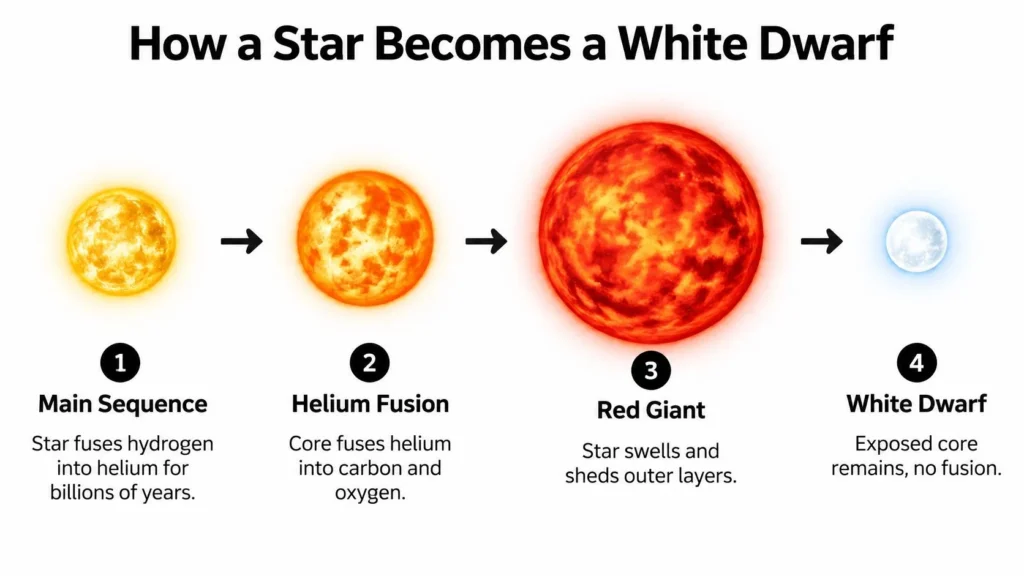
The life cycle, one change at a time
Main-sequence fusion. For most of its life, a star fuses hydrogen into helium in its core. Fusion releases energy that helps balance the inward pull of gravity. For a clearer explanation of the process, see this guide to how a fusion reaction works.
Core helium burning. When the core’s hydrogen runs low, the star changes. Under the right conditions, helium in the core begins to fuse, producing heavier elements, including carbon and oxygen.
Red giant expansion. The star’s structure shifts as its fuel supply changes. Its outer layers expand, and the star becomes a red giant.
Outer layers shed. During its later stages, the star loses its outer material. This leaves behind the compact central core rather than a smaller version of the original star with all its layers intact.
Exposed hot core. The remaining core is initially hot and luminous. It no longer relies on ordinary core fusion to sustain itself, and its long-term path becomes one of cooling.
Long cooling. Over time, the remnant radiates stored heat. Its cooling history can preserve information about the age of the wider population of stars it belongs to.
The mass of the original star helps determine what kind of core remains. Research estimates that stars with initial main-sequence masses up to approximately eight solar masses can end as white dwarfs, and that white dwarfs represent the fate of at least 95% of all stars, according to this study of white dwarf evolution and cooling.
| Progenitor mass | Core composition | Remnant that forms |
|---|---|---|
| Up to about eight solar masses | Carbon and oxygen | Carbon-oxygen white dwarf, the most common type |
| Low-mass star or star stripped in a binary system | Helium | Helium white dwarf |
| Upper part of the white dwarf range | Oxygen and neon | Oxygen-neon white dwarf |
| Above about eight solar masses | Heavier elements beyond oxygen and neon | Neutron star or another remnant, not a white dwarf |
Most white dwarf cores are made largely of carbon and oxygen. Helium-core white dwarfs can form when a low-mass star, or a star in a binary system that loses its envelope, doesn’t develop a more advanced core. Oxygen-neon cores occur toward the heavier end of the white dwarf range.
Stars that begin with more mass generally proceed to later stages of fusion and can leave different remnants. The boundary isn’t a switch that turns every star into the same object, but it helps explain why white dwarfs are the common endpoint for ordinary, lower- and intermediate-mass stars.
Why a Dead Star Does Not Collapse
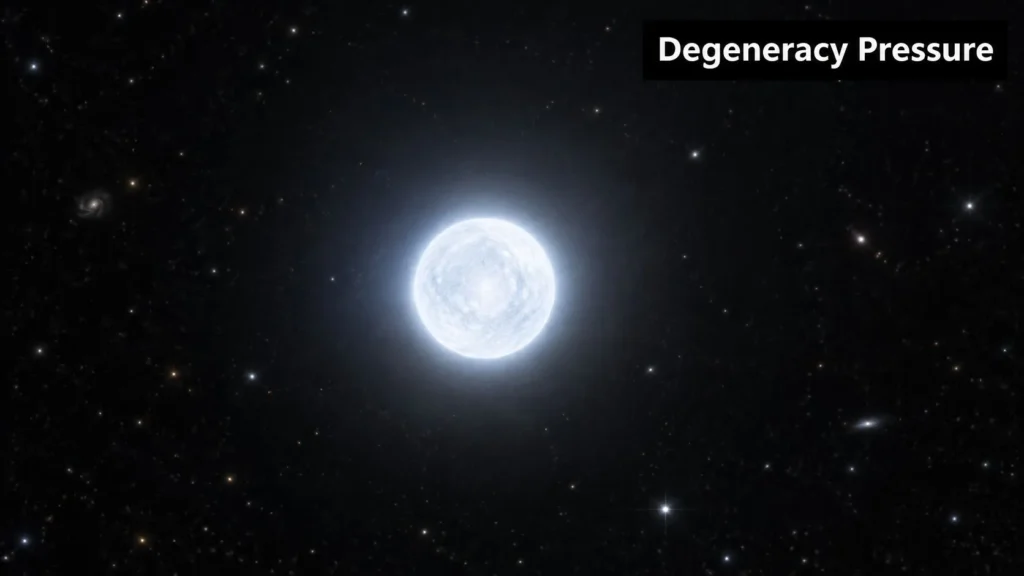
A dead star has lost the fusion that once helped balance gravity, so why doesn’t gravity keep crushing it? The answer is electron degeneracy pressure, a form of support that comes from the rules electrons obey, not from heat produced by ongoing fusion.
Electrons can’t all occupy the same state. When gravity squeezes the matter in a white dwarf into a very small space, the electrons resist being forced into identical states. That resistance provides pressure against further compression.
Think of a stadium that’s completely packed. People can’t keep moving closer together if every seat is already occupied. The analogy isn’t a perfect description of quantum physics, but it captures the essential point: once the electrons are crowded into the available states, squeezing the matter harder takes more and more effort.
The counterintuitive effect of adding mass
This pressure doesn’t depend on the white dwarf staying hot. The remnant can cool while the electrons continue to provide support. That’s why a white dwarf doesn’t need active fusion to resist an immediate collapse.
But the balance has a surprising consequence. Adding mass makes a white dwarf smaller. More mass means stronger gravity, which squeezes the electrons and the star more tightly. So a heavier white dwarf can have a smaller radius than a lighter one, even though it contains more material.
A useful everyday comparison is a bag that is pressed harder from every side. Add more weight and it becomes more compact, not more spacious. A white dwarf isn’t a bag, of course, but the direction of the change helps: increased mass brings stronger compression.
That’s why a white dwarf doesn’t look like a swollen, puffy version of a main-sequence star. The support inside it comes from densely packed matter, and the relationship between its mass and size runs opposite to what many readers first expect. In some other stellar remnants, gravity overwhelms different forms of pressure; the contrast helps explain why astronomers also study objects such as the nearest black hole.
Electron degeneracy pressure can support a white dwarf only up to a boundary. Beyond it, ordinary support can no longer hold the star in a stable state. That upper limit is the next clue to how astronomers read a white dwarf’s history.
Mass Ranges and the Chandrasekhar Limit
A white dwarf carries its past in its mass. A typical remnant holds about half the Sun’s mass packed into an Earth sized sphere, while a remnant that gained material or formed from two merged stars can sit much closer to the stability edge. Reading that number is like reading a forensic file. It hints at whether one star lived and died alone, or whether companions, mass transfer, or a merger wrote a busier history.
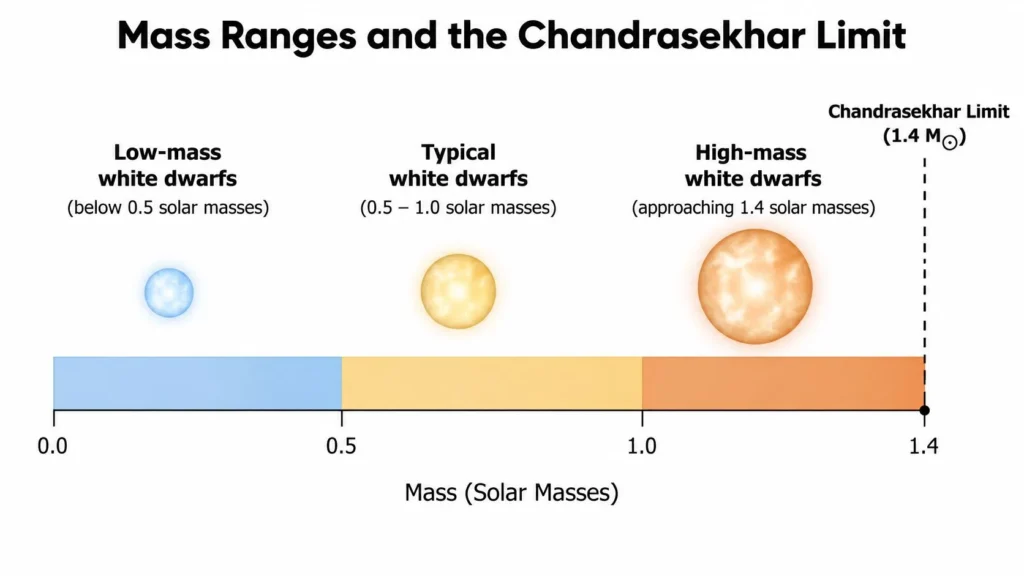
That history sorts into a few broad groups.
| Class | Mass in solar masses | What it shows |
|---|---|---|
| Typical carbon-oxygen white dwarfs | Common low to intermediate range | The standard outcome of single star evolution |
| Oxygen-neon white dwarfs | Higher range, extending toward the limit | Products of heavier parent stars |
| Gaia-selected ultramassive white dwarfs | Very high range, near the boundary | Remnants approaching the stability boundary, often merger suspects |
| Heaviest measured examples | A handful just below the limit | Some of the most extreme measured cases |
| Chandrasekhar limit | About 1.4 | Above this, ordinary electron pressure cannot stably support a white dwarf |
The pattern matters more than any single weighing. Common carbon oxygen remnants cluster well below the limit. More massive oxygen neon remnants and ultramassive objects selected in large surveys stretch upward toward it. Those high mass objects draw attention because their chemistry and weight together suggest a merger or prolonged accretion rather than quiet single star aging.
The Chandrasekhar limit marks where ordinary electron degeneracy pressure stops holding up the star. The value is commonly expressed as about 1.4 times the Sun’s mass, following work associated with Subrahmanyan Chandrasekhar in 1931. A cinder analogy helps here. A small cinder cools in place, while a much larger and hotter pile can break apart or flare. In the same way, a white dwarf pushed past the boundary faces collapse or a thermonuclear runaway, one proposed route to certain supernovae. High mass alone never guarantees an explosion. Composition, rotation, and surroundings shape the result.
So mass works like debris at a scene. A light remnant with a carbon oxygen surface points to an ordinary ending. A heavy remnant with an unusual composition or planetary debris points to interaction. Astronomers read those clues together to reconstruct mergers and planetary fates that the quiet ending story hides.
Cooling White Dwarfs as Cosmic Clocks
A cooling white dwarf is a clock made of leftover heat. A newly formed remnant starts hot and fades as it radiates the thermal energy it stored during earlier stages. Its brightness and color therefore record how long it has been cooling.
This can sound strange: a dead star still glows. The glow does not come from fusion in its core. A young white dwarf can look bright and bluish-white; as it loses heat, it becomes cooler and dimmer. It keeps shining with energy it already has, like an ember that fades as it cools.
Reading a cluster’s cooling sequence
In a cluster of stars that formed around the same time, astronomers can study the white dwarfs and count how many have cooled to different levels of faintness. The pattern works like tree rings: it preserves evidence of time, though the method relies on stellar physics rather than counting visible bands.
The faint end of the cooling sequence carries the most information. The coolest white dwarfs gather there, and the point where that population piles up can help mark the cluster’s age. A tree’s rings record successive growth; a cluster’s white dwarfs record how far its remnants have cooled.
The method has a practical limit. The faintest and oldest white dwarfs are hard to detect, so astronomers need careful observations to tell a real population from objects too dim to see clearly. A missing faint remnant in a survey does not automatically mean the cluster is young. The telescope or survey may have missed it.
The cooling can stretch across billions of years, comparable to the ages of many old stellar populations. That long timescale is why white dwarfs can serve as astrophysical clocks. Their brightness times the cooling, while their mass and surface chemistry can preserve other forensic clues about how they formed.
A fully cooled remnant is sometimes called a black dwarf. That name describes a theoretical endpoint, not an object astronomers have observed: the universe has not existed long enough for a white dwarf to cool all the way to that state.
Surprising White Dwarfs That Challenge the Textbook
Some white dwarfs carry histories that a single-star ending cannot explain. A simple textbook story says a white dwarf’s mass and surface chemistry record the death of one star. That story fits many objects, yet some remnants show signs of mergers or of planetary material that was torn apart. Read their surfaces closely, and they work like cinders after a fire: the chemistry preserves traces of what burned and what fell in afterward.

A revealing case is WD 0525+526. Hubble ultraviolet observations identified it as an unusually massive white dwarf, about 20% more massive than the Sun and roughly 128 light-years away, according to NASA’s report on the Hubble observations. Its atmospheric carbon is hard to explain through ordinary single-star evolution.
Chemistry as stellar forensics
Some hydrogen-rich, ultra-massive white dwarfs carry carbon in their atmospheres. The leading explanation is that convection brought carbon up from the interior after a stellar merger. The surface can therefore carry material from a violent event in the remnant’s past.
Astronomers use ultraviolet spectroscopy to look for carbon signatures that may be hidden in visible-light spectra. Other clues, including unusually high mass, rotation, magnetism, and cooling behaviour, can support a merger interpretation. A single clue does not prove a merger, but the combination helps astronomers test whether the star’s history was more complicated than the quiet ending of one star.
The planetary evidence is equally provocative. Some white dwarfs show irregular dips in light as rocky debris crosses in front of them. The dips can change over time, appearing and fading, which gives astronomers a way to watch debris shift. Such observations turn the white dwarf into a forensic record of destroyed asteroids or rocky worlds.
The surviving-planet picture is complicated, too. Astronomers have found gas-giant candidates near white dwarfs, including cases where a large planet appears to orbit close enough that its atmosphere may be stripped. A Jupiter-sized planet has also been inferred in a tight orbit around a white dwarf. These systems make it harder to tell a simple story in which a star’s death always leaves no planets behind.
Some white dwarfs may be products of stellar collisions, and others can carry traces of destroyed asteroids or rocky worlds. Their surfaces and surroundings turn them into forensic records: evidence that lets astronomers investigate what happened long after the original star has disappeared.
Where to Go Next With White Dwarf Research
Keep the central picture simple. A white dwarf is a compact remnant supported by electron pressure. Its mass has a stability boundary near the Chandrasekhar limit. Its long cooling history helps astronomers trace the ages of stellar populations.
To test your understanding, explain to a friend why a heavier white dwarf can be smaller than a lighter one. The packed-stadium analogy is a useful start: electrons resist being squeezed into the same states, but stronger gravity can compress the object more tightly. For a related look at how another telescope gathers information about distant objects, explore how the James Webb Space Telescope works.
White dwarf research also connects with wider scientific study. Readers considering further education can explore routes into science and health degrees to see how science subjects can lead toward related fields.
New findings about mergers, unusual atmospheric chemistry, and planetary debris can change how astronomers interpret individual remnants. If you use a specific mass range or discovery in your own writing, check the relevant source and confirm that the figure still matches the claim.
Explore maxijournal.com for approachable writing across science, technology, health, and other subjects. Follow its science coverage to keep up with new white dwarf discoveries and the stellar histories they reveal.
Discover more from Maxi Journal
Subscribe to get the latest posts sent to your email.