A suction cup holds because the air around it pushes it onto the surface. Press the cup down, the rubber springs back, the pressure under the rim drops below the pressure of the room, and atmospheric pressure of about 101 kPa at sea level presses the cup against the wall with a force set by the pressure difference multiplied by the sealed area.
Which raises the awkward question. If that’s the whole story, why does the hook that grips a bathroom mirror slide off a painted wardrobe door by morning? The answer people usually reach for, that the cup is weak or too small, is almost always wrong. The cup is fine. The seal is what failed, and until you treat the seal as the key mechanism, every suction cup looks like a lottery.
How a Suction Cup Grips in Four Stages
A plunger on a blocked sink feels welded to the porcelain after you push it down. Nothing is glued to the glaze. You squeezed the air out from under the rubber, the rubber tried to return to its molded shape, and the ordinary air in the room pressed the plunger onto the drain. A suction cup runs that same sequence on a smaller scale. It always runs in four stages.
- Press the air out. Flatten the cup against the surface and hold it for a second or two. You are pushing most of the air out from under the rim, so the trapped cavity starts small.
- Let the rubber spring back. Release, and the elastic cup recovers toward the shape it was molded in. The sealed cavity gets bigger. Same air, bigger volume, lower pressure. A flattened plastic bottle shows the same trick in slow motion. Squash the bottle, cap it, and watch it creep back toward round while the air inside thins.
- Outside pressure takes over. Air in the room keeps pushing on the outside of the cup. Under the rim the pressure is now lower, and that difference presses the cup against the surface. How hard it presses works out as the pressure difference multiplied by the sealed area. Treat that product as the pull on a perfect seal, not as a safe working load for a hook.
- The grip lasts only while the seal is continuous. One pinhole leak, one grain of grit under the rim, or one spot where the lip lifts, and air flows back in until the pressures equalize. Then the cup drops. Usually there is no warning at all.
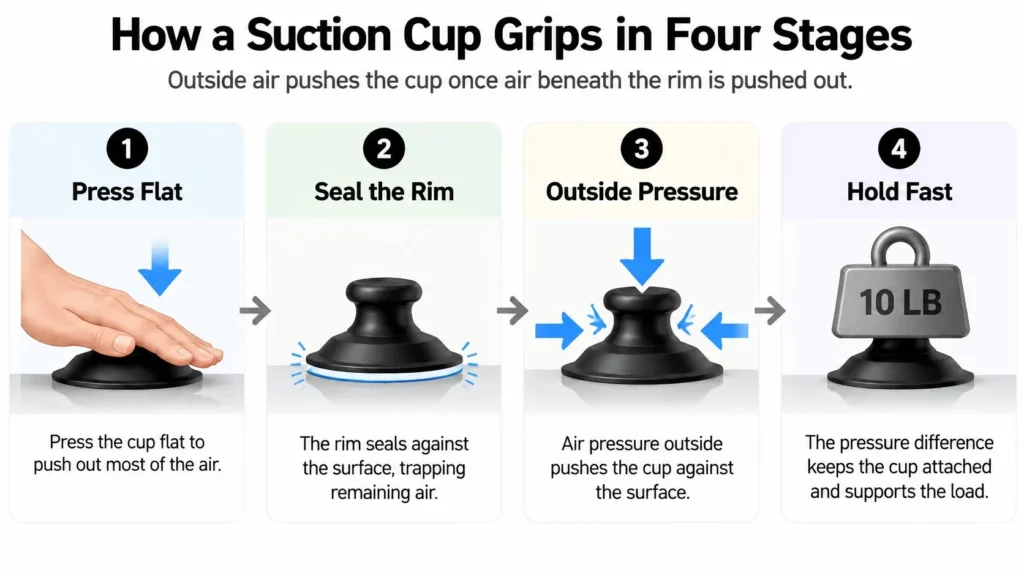
The air pushes the cup. The rubber only shapes the cavity.
Stage 4 is the one people skip. You can press hard and let the rubber recover, and still have no hold if the lip never closed in one continuous line. Engineers who build suction grippers now treat leakage rather than nominal suction power as the central design problem, as a McGill bioengineering hyperbook explainer on suction cups sets out. Rough surfaces are not an absolute ban for the same reason. A liquid film can fill gaps the rubber lip cannot close, so the seal, not a harder pull on the vacuum, decides whether the cup stays up.
How Cup Size and Vacuum Set the Holding Force
The physics fits on the back of an envelope. Holding force equals the pressure difference across the rubber multiplied by the area the rim seals off. Nothing about the brand, the hook design or the lever changes that relationship. Only two things do: how hard a vacuum you pull, and how big a circle you can keep sealed.
Take a 45 mm cup. Its sealed area is about 0.00159 m², roughly 16 cm². Pull it to a 50% vacuum, where the pressure under the rim sits about 50 kPa below the room, and the arithmetic gives about 79.5 N, or roughly 8 kg-force. Take the same cup to an 80% vacuum, about 81 kPa of difference, and you get 128.8 N, or about 13 kg-force. That’s a full carrier bag of shopping hanging off a disc of soft rubber.
Theoretical pull-off force on a perfect, flat, clean surface with a perfect seal, using F = pressure difference × sealed area.
| Cup diameter | Sealed area | Force at 50% vacuum (~50 kPa) | Force at 80% vacuum (~81 kPa) |
|---|---|---|---|
| 25 mm | 4.9 cm² | 24.5 N (~2.5 kg) | 39.8 N (~4.1 kg) |
| 45 mm | 15.9 cm² | 79.5 N (~8.1 kg) | 128.8 N (~13.1 kg) |
| 75 mm | 44.2 cm² | 220.9 N (~22.5 kg) | 357.9 N (~36.5 kg) |
Reading the table without over-trusting it
Every number in that table assumes a perfect seal on a perfect surface, and the area grows with the square of the diameter. Double the diameter and you quadruple the sealed area, which is exactly why a bigger cup looks like the stronger choice. It also explains a common misreading: people compare a 25 mm cup with a 75 mm cup, see a ninefold gap, and assume the small one must be junk. On clean glass, the 75 mm cup is nine times stronger in the pull-off direction. On a bumpy wall, it can be weaker, because a wider rim bridges more gaps and leaks faster.
The other half of the formula is less well behaved than it looks. A 2024 study in the SAGE journal Advances in Mechanical Engineering measured approximately 1,800 pressure points beneath a Bernoulli suction cup across intake pressures of 0.15, 0.20 and 0.25 MPa, mapping a holding surface that is nowhere near uniform. Pressure slumps near the lip and the edges, which is where leaks start. Treat calculated force as a ceiling, never as a promise.
Ratings mislead in other fields too. A magnet’s published pull force has the same optimistic quality, which is why an explanation of what makes something magnetic spends as much time on air gaps and steel grade as on field strength.
Why Rough and Porous Surfaces Break the Seal
Glass and polished tile share one property that matters: the rim can lie flat on them with no gap anywhere along the contact line. Take that away and the cup doesn’t get weaker, it gets leaky, and those are different problems with different fixes.
Air reaches the cavity by two routes. On a ridged or textured surface, it slips between the rim and the peaks of the texture while the rubber bridges the valleys. On a porous surface such as unfinished wood, cardboard or rough concrete, it travels through the material itself, so no amount of pressing helps. Dust, cooking oil, soap film and cleaning residue cause the third version, a fine gritty or slippery layer that opens a channel even on glass.
| Surface | Typical seal result | Why |
|---|---|---|
| Glass | Strong | Smooth, non-porous, flat |
| Polished tile | Strong | Smooth glaze with few micro-gaps |
| Smooth plastic or acrylic | Good | Flat, but oils and dust reduce the seal |
| Gloss painted wall | Weak to moderate | Smooth, but paint can be porous or dusty |
| Textured or matt tile | Poor | Ridges let air pass under the rim |
| Unfinished wood | Poor | Grain and pores leak air |
| Cardboard | Poor | Porous and fibrous, so the rim cannot seal |
| Stone or rough concrete | Poor | Irregular micro-surface |
Try it before you trust it. Wet a clean mirror, press the cup, and see whether it holds. Repeat on dry glass, on matt tile and on a painted door. A rim soft enough to squeeze the water film out of the contact line is a rim that will seal in real conditions.
Some surfaces only fail on humid days, because a paint or plaster layer that is dry in winter becomes slightly conductive to air when moisture swells the film. If a cup that held all last month is now sliding, wipe the rim and the surface with rubbing alcohol, let both dry fully, and press again before you blame the hardware. On stone, reducing the porosity of the surface itself helps, and the Tiles Mate guide to sealing natural stone tiles covers impregnating sealers and how often to reapply them.
Materials and Rim Shapes That Change the Grip
Rubber choice sets two things: how well the lip follows slight unevenness, and how long it stays flexible. Most failures that appear six months after purchase are material failures, not design failures.
| Material | Flexibility and seal | Common use | Main limit |
|---|---|---|---|
| Natural rubber | Soft, follows slight unevenness well | Hooks and general household cups | Ages, cracks, and degrades with sunlight and oils |
| Silicone | Soft, stays flexible across a wide temperature range | Kitchen, bathroom, and heat-exposed uses | Attracts dust, so the rim must be kept clean |
| PVC | Firmer, conforms less | Low-cost hooks and display stands | Stiff rim seals poorly on uneven surfaces |
| TPE | Soft and adjustable by formulation | Mounting and accessory cups | Depends on the formulation, so check the maker’s rating |
Rim shape decides the rest
A thin, soft lip conforms to minor unevenness and forgives a slightly imperfect surface. A thick, stiff rim is fine on flat glass and hopeless on anything else. Bellows cups, the accordion style, store a return force in the folds so a light press rebuilds the vacuum without you leaning on it. Lever-lock and pump cups go further and mechanically enlarge the cavity, so the vacuum doesn’t depend on how hard your hand happened to push.
Buying rule. If the rim feels like a hard plastic coin, it belongs on glass and polished tile only. If it feels like a soft eraser, it will cope with a painted wall.
Manufacturers rarely publish the rubber grade, so judge by feel and by the surface suitability printed on the packet. A stiff PVC hook is a poor buy for a textured wall no matter how neat it looks, and the cheapest silicone cup is often the best value in a steamy bathroom.
Why Cups Let Go and How to Check the Seal
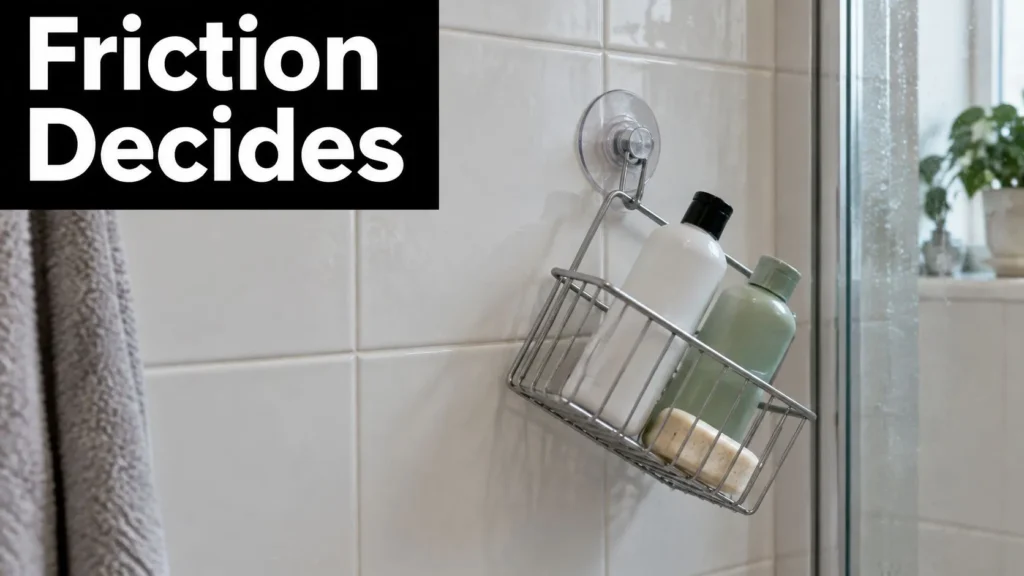
A cup that failed is rarely a cup that lost its vacuum in one instant. Four patterns cover almost every case, and the first two have nothing to do with the rubber’s quality.
Sliding. The load runs sideways, so friction at the rim decides the outcome, not suction. A wire shower caddy creeps down a tiled wall over a week while the cup stays firmly attached the whole way. Weight and water in the bottles make it worse; the cup was never the limiting factor.
Peeling. Under a levered or overhead load, one edge of the lip lifts first and the failure races around the rim. A hook holding a heavy coat is the classic case: the load pulls at the bottom of the cup, the top edge rotates outward, and the whole thing lets go at a fraction of its rated pull.
Slow leakage is the quiet one. A phone mount that tested fine in the shop loses grip by lunchtime as the windscreen warms, the rubber softens and dust works under the lip. Nothing dramatic happens; the pressure equalizes over hours.
Ageing needs no load at all. Natural rubber hardens, cracks at the rim and stops following the surface, and a cold morning stiffens whatever flexibility is left. A cup that lived on a sunny window is a candidate for replacement, not repair.
A study in Advanced Intelligent Systems reports a 2025 variable-stiffness cup that switched between 17.34 N and 32.20 N of hold, plus a 2026 remora-inspired design with liquid-metal microchannel sensors that watch lip deformation and force distribution in real time. Self-sensing cups like these will eventually tell you when grip is fading. None of them is in a hardware shop yet.
The five-minute seal check
- Clean the surface and the rim with rubbing alcohol, then let both dry completely. Alcohol removes the oily film that soap leaves behind.
- Press the cup firmly and hold for about 30 seconds. Rushing this step is the most common reason a good cup fails on day one.
- Check the rim lies flat all the way around, with no lifted edge and no trapped bubble under the rubber.
- Pull gently in the direction the load will run, and increase only while the seal holds. If it slides easily by hand, it will slide with weight on it.
- Recheck after an hour and again after a day. Slow leakage shows up late, not on the first press.
Here’s the press, release and grip sequence in real time.
If you’ve ever searched how do suction cups work after watching a hook drop off a tile wall, this is the answer that matters: the cup held, the seal didn’t, and the fix is almost always cleaning, surface choice or a softer rim.
When a Suction Cup Is the Wrong Choice
A cup is a light-duty fixing for flat, clean, non-porous surfaces. It is not a bracket, and treating it as one is how mirrors, shelves and phones end up on the floor.
- Light, flat and harmless. Use a cup for towels, small bottles, a sponge or a phone on glass, where a fall costs you nothing but a moment.
- Reduce sideways and overhead loads hard. Shear and overhead pulls are limited by friction and peeling, so keep the working load well under the rated figure and mount the cup where the load hangs straight down.
- Never trust one cup alone where a fall could injure someone, including anything above a bed or a bath and any load over a person.
- Skip textured, porous, dusty or painted surfaces unless the seal check passes, and recheck after a hot day, a cold snap or a move to a steamier room.
- Switch to screws, a mechanical bracket or a proper adhesive for anything heavy, permanent or safety-critical.
That last point matters more as the hardware gets more ambitious. The same grip principles show up in climbing robots and pick-and-place grippers, as a look at what robotics covers as a field makes clear, and those systems use pumps, sensors and multiple pads precisely because one passive cup is not dependable enough on its own. For a tea towel on a mirror, a cup is elegant. For a shelf over a doorway, it’s a gamble with a predictable ending.
If you want more explanations like this one, where a familiar object turns out to be a small physics lesson, maxijournal.com publishes that kind of writing every day across science, technology, health and the arts. The magazine treats ordinary hardware seriously, from materials and tools to the forces hiding inside them, so the next hook you buy gets judged on its rim rather than its packaging. Visit maxijournal.com and find something that explains how the world holds together.
Discover more from Maxi Journal
Subscribe to get the latest posts sent to your email.