Can two people eat the same lunches, take the same walks, and still gain fat at different speeds? The usual answer is that one of them is secretly overeating or skipping movement. That answer fails often enough to matter. People get fat when energy in stays ahead of energy out, and the body stores the surplus as fat. Sleep, stress, medicines, illness, and the streets around a home can shift hunger, spontaneous activity, or storage while the visible routine barely changes.
Willpower still shapes what lands on the plate. It doesn’t set the whole equation.
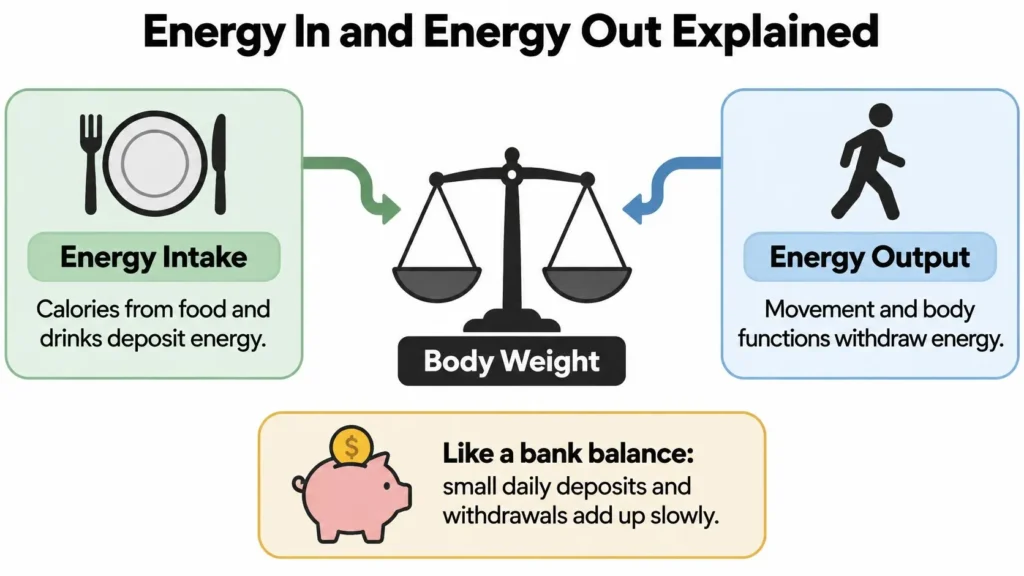
Energy In and Energy Out Explained
Treat body weight like a bank balance. One payday doesn’t rewrite the account, and one skipped lunch doesn’t either. Deposits and withdrawals add up across weeks, and you notice the shift only after many statements.
People gain fat when energy intake exceeds energy expenditure for long enough that the surplus is stored as fat. The U.S. National Heart, Lung, and Blood Institute treats that gap as more than a discipline problem. Daily energy use changes with body size, muscle mass, physical activity, digestion, sleep, and metabolic regulation. Genetics and the surrounding neighborhood change how easily a surplus sticks. Rare conditions such as Prader-Willi syndrome can drive severe obesity on their own. Most obesity is many genes meeting inexpensive, highly palatable food, desk work, and car trips.
What actually moves the balance
That same guidance names diet, physical activity, sleep, and sedentary behavior as the everyday contributors. People living where fast-food restaurants are common and sidewalks or bicycle paths are scarce are more likely to have overweight or obesity. The surplus is often quiet. An extra 100 to 200 calories on many days can accumulate over months, even while metabolism adapts as weight changes. That adaptation is a common reason readers look up why the scale stalls after dieting after the first few weeks of a cut. If movement is the missing withdrawal, fitness tips for beginners are a practical place to add walking before harder sessions.
| Factor | How it tilts the balance | Typical example |
|---|---|---|
| Energy-dense foods | More calories in smaller portions | Fried snacks, sugary drinks, fast food meals |
| Small daily surplus | 100 to 200 extra calories on many days | Adds up to meaningful gain over months |
| Low daily movement | Less energy spent outside planned exercise | Desk work and car commuting |
| Short or poor sleep | Raises hunger and cravings, lowers activity | Several short nights in a row |
| Chronic stress | Increases appetite for calorie-dense food | Eating under deadline pressure |
| Genetic variation | Alters appetite, fullness, and fat storage | Same habits, different results |
| Medications | Change hunger, fatigue, or glucose handling | Steroids or certain antipsychotics |
| Food environment | Makes surplus calories easy to access | Neighborhoods with many fast food outlets |
Weight gain is usually a long-running balance, not a single bad meal.
Sleep and stress can push hunger, food choice, and activity in the same week. The scale is recording biology and schedule together, not a moral score.
Why the Same Habits Produce Different Results
Two people caught in the same rain don’t end up equally wet. One has a coat. The other walks faster and still gets soaked. Food works the same way. The menu can match, and the bodies still don’t.
Genetic variation changes appetite, satiety, food preferences, fat storage, and resting energy use. Obesity is rarely one broken switch. It is many genes meeting a particular set of meals, jobs, and streets. The World Health Organization describes the result as sustained positive energy balance shaped by biology and surroundings, not willpower alone.
Levers that differ from person to person
Four levers explain a lot of the split, and they don’t move in lockstep.
Appetite signaling decides how soon hunger returns and how clearly fullness registers. One person stops at a comfortable plate. Another still feels unfinished.
Spontaneous physical activity is the fidgeting, standing, and extra trips across a room that never show up on a workout log. Hundreds of calories can hide there across a week without a gym visit.
Thermogenesis is energy released as heat while you digest food and keep core functions running. It isn’t a setting you can turn up with a supplement.
Fat-cell storage is the tendency to park surplus energy in adipose tissue rather than burn it off in the background. Two colleagues can share an office kitchen and still store different shares of the same snacks.
Because those levers differ, the same food environment produces different weight outcomes. Someone who feels full early and paces the office all afternoon can hold steady beside a colleague who sits still and stays hungry.
Identical habits don’t guarantee identical outcomes, and that isn’t an excuse to stop trying.
Prevention works better when it hits both sides of the equation. Improve food quality and the energy density of portions, and build regular movement into the day, instead of betting everything on conscious calorie cuts. For adults, WHO sets at least 150 minutes of moderate activity a week as a general health benchmark. Children need substantially more daily activity than that adult floor.
Variation is a reason for patience and an individualized plan. It isn’t a reason to quit. If progress stalls while intake looks controlled, the hidden reasons your weight stalls are worth reading before you slash calories again.
How Food and Surroundings Push Intake Upward
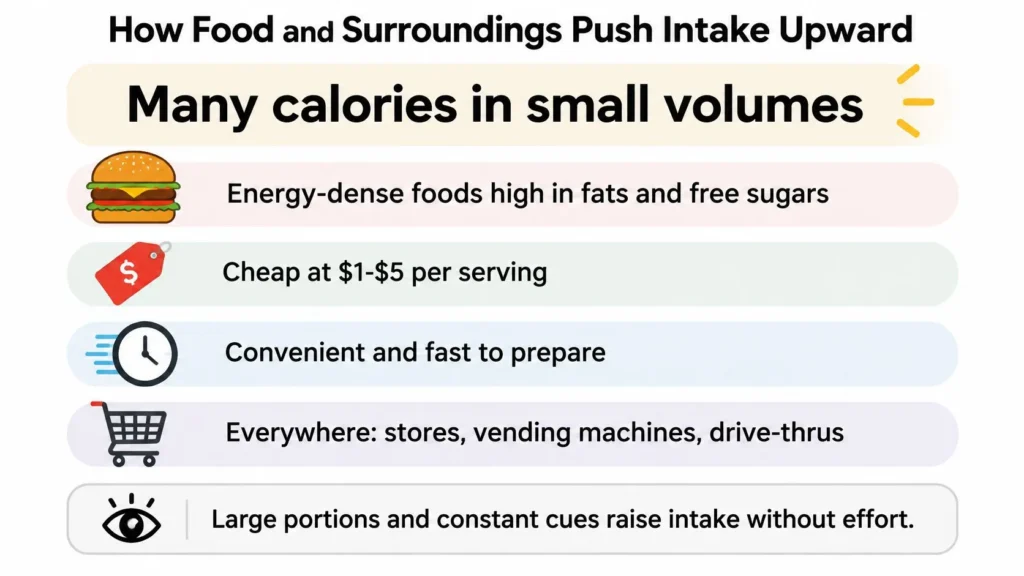
A pastry and a large soda can deliver a meal’s worth of energy in a few bites and sips. Foods high in fats and free sugars pack substantial calories into small volumes, and they’re cheap, fast, and placed where you already stand. Vending machines, drive-thrus, and checkout shelves don’t require a decision to “eat badly.” They require only that you are tired and nearby.
Movement that disappeared from the day
Sedentary jobs, motorized travel, and street design cut routine expenditure without anyone announcing a plan to be inactive. A day of email, a car commute, and an elevator can leave almost no walking outside a scheduled workout. Large portions and constant food cues raise intake in the same hours that those steps vanished.
The pattern isn’t limited to a few careless households. A pooled analysis of 3,663 nationally representative studies covering 222 million people, published in The Lancet02750-2/fulltext), found that global age-standardized adult obesity more than doubled between 1990 and 2022, from 8.8% to 18.5% among women and from 4.8% to 14.0% among men. In 2022 that meant about 504 million women and 374 million men living with obesity.
What the wider numbers show
Younger age groups moved in the same direction over that period. The World Health Organization’s 2024 summary put 43% of adults worldwide in the overweight category in 2022, with more than 1 billion people living with obesity. The World Obesity Federation’s 2024 atlas projects adults living with obesity rising from 0.81 billion in 2020 to 1.53 billion by 2035, alongside more urbanization, inactivity, and consumption of sugars and sweeteners. That 2035 figure is a projection, not a head count already on the books.
| Measure | Figure | Source or comparison |
|---|---|---|
| Adult women, age-standardized obesity | 8.8% in 1990 to 18.5% in 2022 | Pooled analysis of 3,663 studies |
| Adult men, age-standardized obesity | 4.8% in 1990 to 14.0% in 2022 | Same pooled analysis |
| Women living with obesity in 2022 | About 504 million | Increase of 377 million since 1990 |
| Men living with obesity in 2022 | About 374 million | Increase of 307 million since 1990 |
| School-aged girls, obesity | 1.7% in 1990 to 6.9% in 2022 | Same period as the adult analysis |
| School-aged boys, obesity | 2.1% in 1990 to 9.3% in 2022 | Same period as the adult analysis |
| Adults overweight in 2022 | 43% | WHO summary of a Lancet study |
| People living with obesity in 2022 | More than 1 billion | WHO summary of a Lancet study |
| Projected adults living with obesity | 0.81 billion in 2020 to 1.53 billion by 2035 | World Obesity Federation 2024 atlas |
Food systems, urbanization, work, transport, and leisure shifted together. Individual choices still happen. They happen inside surroundings that make a surplus the easy default, which is why gain can spread even when people aren’t unusually careless.
How Sleep and Stress Quietly Shift Hunger
Say a night-shift nurse packs reasonable meals and still gains weight across a year. Her chart looks fine on paper. The nights don’t. Short sleep, irregular breaks, and exhaustion change what she reaches for at 3 a.m. and how much she moves once she’s home.
Short or broken sleep shifts the hormones that govern hunger and fullness. Appetite tends to rise, and cravings lean toward calorie-dense food. Tiredness also cuts spontaneous movement, so the energy-out side shrinks without a canceled workout. Sleep deprivation effects on the body show up in mood and appetite long before they show up as a formal diagnosis.
Stress that keeps the surplus going
Chronic stress adds a second push. Sustained stress hormones can increase appetite for high-calorie food. People under deadline pressure often eat more and move less in the same afternoon. The meal isn’t a celebration. It’s a way to get through the next hour.
Most adults do better with around seven or more hours of sleep a night. The useful clues are practical, not exotic.
- Late-night snacking: Eating after a short shift because you’re wired, not because lunch was small.
- Weekend catch-up: Sleeping half the Saturday away and still feeling behind by Monday.
- Tension eating: Reaching for food when a message pings, before any stomach signal.
Sleep and stress don’t replace the energy balance. They amplify it. Fix the nights and the pressure, and the same lunch can stop behaving like a surplus.
When Medications Change Weight and Appetite
A common assumption says every gain is a lifestyle failure. That assumption collapses when treatment itself changes hunger, fatigue, or how the body handles glucose. Someone can eat and train much as before and still store more fat.
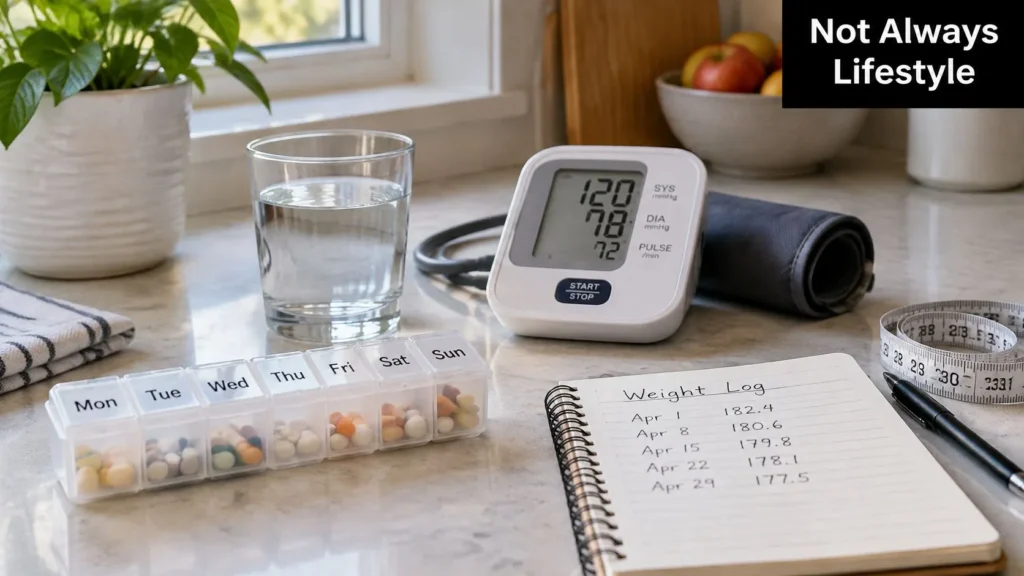
A 2024 peer-reviewed review links several medication groups with weight gain, including antipsychotics, glucocorticoids, beta-blockers, tricyclic antidepressants, antihistamines, insulin, neuropathic-pain drugs, sleep medicines, and steroids. Some raise appetite. Some cause drowsiness that cuts activity. Some alter fluid balance or glucose handling. The drug doesn’t automatically cause obesity. It can move the balance enough to show on the scale.
What to raise with a prescriber
Some of these medicines treat illnesses that affect weight on their own, and a substitute isn’t appropriate for every patient. Track when the weight changed relative to a start date or a dose change, then bring that timeline to the visit.
| Medication group | Why it can add weight | What to discuss with a clinician |
|---|---|---|
| Antipsychotics | Can raise appetite and change metabolism | Weight monitoring and alternative options |
| Glucocorticoids (steroids) | Increase appetite and fat redistribution | Shortest effective course and dose |
| Beta-blockers | May reduce energy and physical activity | Whether a different class suits the condition |
| Tricyclic antidepressants | Can increase appetite and cause sedation | Options with lower weight effect |
| Antihistamines | Sedating types can reduce activity | Non-sedating alternatives |
| Insulin | Promotes fat storage and can increase hunger | Dose matched to meals and glucose readings |
| Neuropathic-pain drugs | Can cause drowsiness and appetite change | Review of dose and benefit |
| Sleep medicines | Next-day grogginess can reduce activity | Timing and dose review |
A short explainer on how appetite signals and treatment can interact is worth watching before that appointment, so the questions are specific.
Don’t stop a prescribed medicine on your own. Ask whether the drug is a likely contributor for you, whether a different dose or class fits the condition, and what monitoring makes sense. People comparing older agents with newer appetite-related treatments can also read about GLP-1 drugs for weight loss as one clinical option to discuss, not as a swap you make alone.
Note the date the weight changed, then ask about the medicine before you blame the meals.
Medical Conditions That Raise Body Weight
Most gain isn’t a disease. A smaller set of conditions still changes appetite, energy use, or fluid enough to matter, and they don’t all look alike.
Prader-Willi syndrome produces constant hunger and a slowed metabolism, with severe obesity that often starts in early childhood. Biology here can override ordinary portion habits. Hypothyroidism slows energy use and many body functions, and the gain is usually gradual and modest, which makes it easy to miss. Polycystic ovary syndrome pairs insulin resistance with a tendency to store fat around the middle. Cushing syndrome comes from excess cortisol, which drives appetite and shifts fat toward the face and abdomen. Depression can raise or lower weight because appetite, sleep, and activity move in either direction depending on the person.
| Condition | How it affects weight | Usual pattern |
|---|---|---|
| Prader-Willi syndrome | Constant hunger and slowed metabolism | Severe obesity, often from early childhood |
| Hypothyroidism | Slows energy use and body functions | Gradual gain, usually modest |
| Polycystic ovary syndrome | Insulin resistance favors fat storage | Central weight gain |
| Cushing syndrome | Excess cortisol drives appetite and fat redistribution | Round face and abdominal fat |
| Depression | Changes appetite, sleep and activity | Gain or loss depending on the person |
When the pattern needs a clinician
Get checked sooner if gain is sudden, if swelling or breathlessness appears, or if fatigue, skin changes, or menstrual changes arrive with the weight. A clinician can review thyroid function, blood glucose, and the medicine list before anyone assumes the cause is lifestyle alone. Readers sorting medical contributors from ordinary plateaus can understand stubborn weight gain as a checklist for that conversation, then confirm the details in person.
Confirm the Likely Cause Before You Change Your Plan
Guessing sends people into harder diets when the shift was a new prescription or a month of four-hour nights. A short sequence keeps the next change pointed at the actual driver.
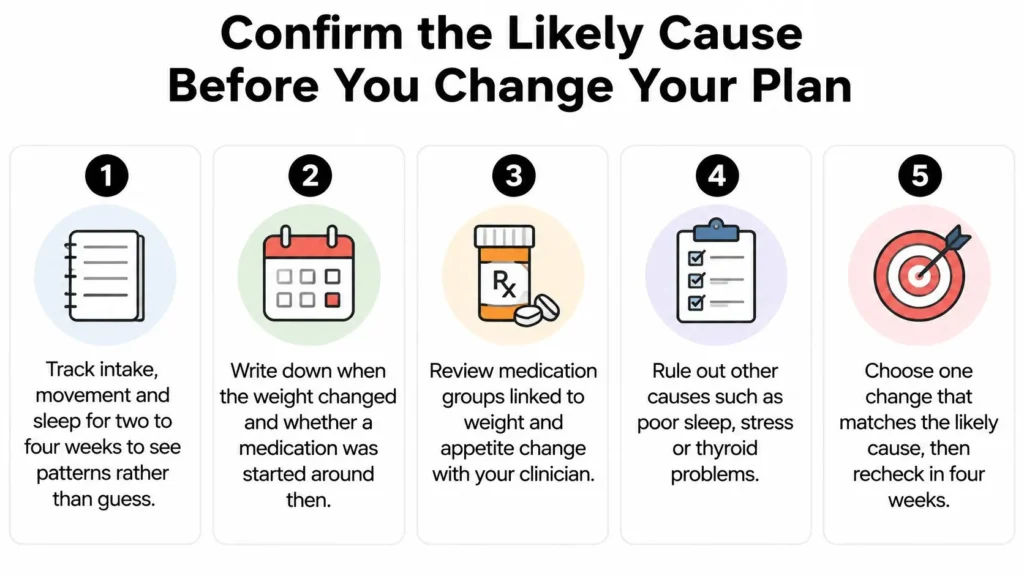
- Track for two to four weeks. Log intake, movement, and sleep so you see a pattern instead of a mood.
- Mark the calendar. Write when the weight changed and whether a medicine was started, stopped, or adjusted around then.
- List history and symptoms. Note family patterns of weight, thyroid, or hormone problems, plus fatigue, swelling, or breathlessness.
- Book basic checks. Ask for thyroid function and blood glucose, and bring the full medicine list. Don’t stop treatment while you wait.
- Ask narrow questions. Is this medicine linked to gain for me? Are there alternatives? What monitoring is sensible?
If the log points to a steady surplus, change portion energy density and daily movement first. If it points to sleep, stress, or a drug, address that cause before you cut harder. Pick one matching change, then recheck in about four weeks with the same log. The target is stable, gradual change a clinician can help you watch, not a dramatic drop that collapses the next month.
Maxi Journal publishes plain-language writing on health, sleep, and everyday science for readers who want context before they change a plan. If the balance between meals, movement, rest, and treatment is the question you’re sitting with, the health desk at maxijournal.com is a useful next stop. Visit and pick one piece that matches the cause you just narrowed down.
Discover more from Maxi Journal
Subscribe to get the latest posts sent to your email.