You’re waiting for a ride, and the car that pulls up has no one in the driver’s seat. The door opens, the route is already on the screen, and the vehicle eases away without a human touching the wheel. That moment feels futuristic, but it’s also the result of a very practical question: how does a machine see the road, understand what’s happening, and make safe driving choices fast enough to matter?
In ai in autonomous vehicles, the important shift is simple to say and hard to build. The software is no longer just helping a human driver, it’s acting as the driving system itself. That means the vehicle has to sense the world, decide what other road users will do next, plan a safe path, and execute the motion with enough precision to stay comfortable and legal.
That’s why this topic matters now. Autonomous driving has moved from demo videos and lab research into public-road testing, fleet deployment, and product planning. It’s also why a serious conversation about AI in autonomous vehicles has to go beyond sensors and neural networks, and ask whether the system can prove safety in odd situations, not just common ones. If you want a useful outside view of how organizations judge readiness before they scale AI, Silicon Prime AI’s guide on What does AI maturity look like for enterprises? is a helpful companion lens.
Why AI Now Drives the Car
A commuter sees the same scene every day, a crowded pickup lane, a cyclist cutting between cars, a bus drifting toward the curb, and a delivery van stopped in the worst possible place. A human driver handles all of that with experience, nerves, and quick improvisation. An autonomous vehicle has to do the same thing with software that can’t get tired, but also can’t guess unless it has learned from data.
That is where AI changes the game. Older driver-assistance systems mostly followed fixed rules, cruise at this speed, keep a lane, brake if something appears close. That works in narrow cases. It breaks down when the road becomes ambiguous, because the world is full of partial visibility, conflicting motion, and messy human behavior.
The scale of real-world learning helps explain the shift. Waymo’s long-running public-road testing reached more than 20 million autonomous miles by 2023, a sign that large-scale road data became central to training and validating self-driving systems, not just lab simulations seosandwitch.com. That same source also describes the market moving from experimental deployment toward commercial scale, with a 2022 estimate of $54.21 billion and a projection of $2.16 trillion by 2030 seosandwitch.com.
For a newcomer, the takeaway is straightforward. AI in autonomous vehicles isn’t a feature you toggle on. It’s the operating layer that lets the car interpret the road and choose actions continuously, mile after mile.
Practical rule: If a driving problem can’t be expressed as a small, fixed checklist, AI is usually the layer doing the heavy lifting.
How a Self-Driving Car Actually Thinks
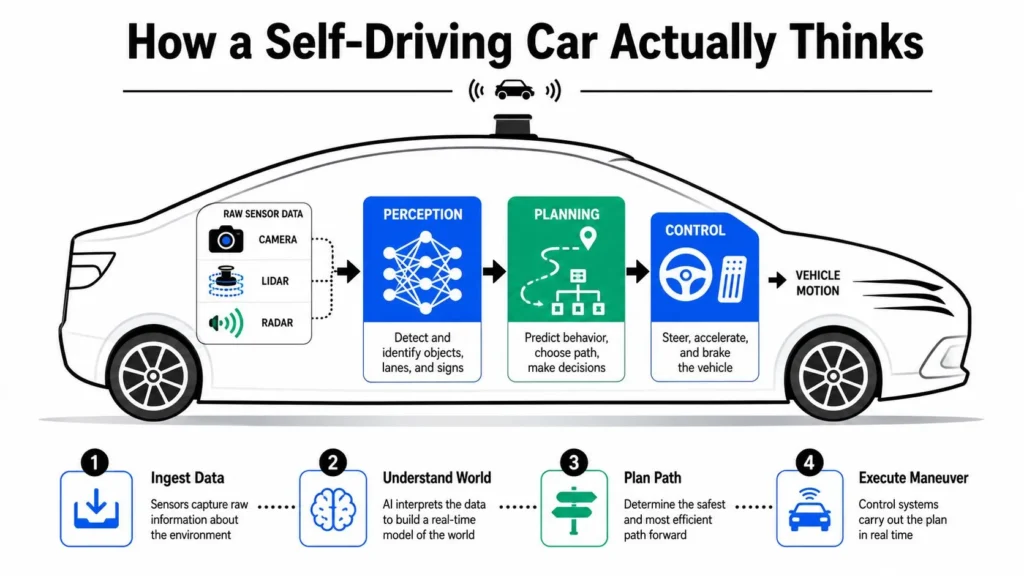
A good way to understand the system is to think of a careful friend riding shotgun who narrates everything they notice. “That car is slowing down.” “The cyclist might drift left.” “The lane is narrowing.” That narration is the raw material for the driving pipeline, and AI helps convert it into action.
From sensing to action
The first stage is perception, which turns camera, radar, and lidar input into an internal picture of the world. The vehicle has to identify lanes, pedestrians, vehicles, barriers, and open space, then decide what matters most right now. That’s not a simple object-recognition task, because the system needs to interpret context, not just labels.
Next comes prediction. The vehicle estimates what nearby agents are likely to do over the next few seconds. A pedestrian stepping toward the curb is not yet crossing, but the plan should respect that possibility. AI is especially useful here, because road behavior is probabilistic, not mechanical.
Then comes planning, the part that chooses the car’s path. It has to balance safety, legality, comfort, and progress. A path that is technically safe but jerky or indecisive is still a poor driving policy.
Finally, control converts that path into steering, throttle, and braking commands. Software meets the physical car. The system has to send smooth, timely signals so the vehicle follows the plan without overshooting or oscillating.
If you want a plain-language primer on the learning side of this pipeline, the machine-learning overview at What is machine learning? is a useful companion. The core idea is that each stage learns from examples instead of relying entirely on hard-coded rules.
The Five Core AI Subsystems Explained
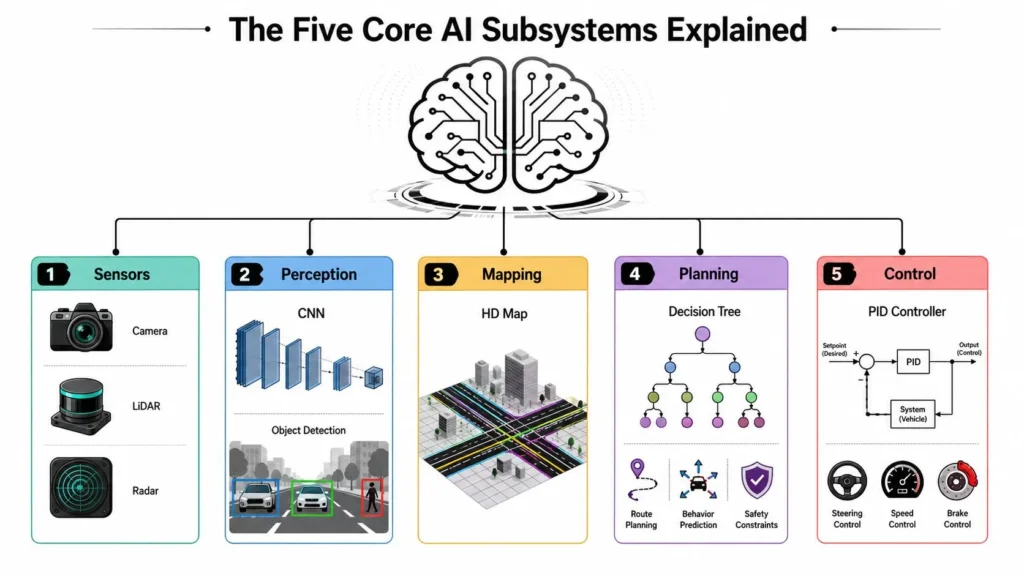
Think of the stack as five connected jobs, each one feeding the next. The car doesn’t “just see.” It senses, interprets, places itself on a map, chooses a maneuver, and then physically executes that maneuver. When one stage is weak, the whole chain suffers.
Sensors and perception
Sensors are the vehicle’s eyes and ears. Cameras capture texture and color, lidar measures shape and distance, radar helps with speed and motion, and ultrasonic sensors are useful for close-range awareness. The point is not to collect data for its own sake, but to give the system multiple ways to observe the same road situation.
Perception then turns those signals into meaning. A lane marking is not just a line of pixels, it’s a boundary the car can follow. A pedestrian is not just a shape, it’s a road user with possible intent. This stage is where neural networks are especially valuable, because they can detect patterns that are hard to encode by hand.
Mapping, planning, and control
Mapping gives the vehicle a sense of place. In many systems, high-definition maps and localization work together so the car knows where it is relative to lane geometry, intersections, and traffic rules. Without that context, the system would be looking at the road but not understanding it.
Planning chooses a trajectory. That trajectory has to be safe, understandable to other road users, and comfortable enough for passengers to tolerate. A planner that overreacts to every small uncertainty may be safe in theory but unpleasant in practice.
Control turns the chosen path into motion. It translates intent into low-level commands and keeps the car close to the intended trajectory. A useful analogy is a pianist reading sheet music, the score is the plan, and the fingers are the control layer making the music happen.
The cleanest way to think about the stack is this, sensors gather evidence, perception names what’s there, mapping says where the car is, planning decides what to do, and control makes it real.
Machine Learning Techniques and Training Grounds
The models inside self-driving systems are not all the same kind of AI. Different jobs call for different learning methods, and the field has borrowed techniques from computer vision, sequence modeling, robotics, and control theory.
The main model families
Convolutional neural networks are the workhorses for image understanding. A camera feed gives the system a rich visual scene, and CNNs are well suited to spotting lanes, signs, vehicles, and pedestrians in that scene. For lidar, specialized architectures process 3D point clouds so the vehicle can understand depth and shape.
For motion over time, recurrent models and transformer-based models help predict trajectories. If a car ahead is drifting toward a turn lane, the model has to look at motion history, not just one frame. That temporal reasoning matters because road users are defined by movement as much as by appearance.
Planning can use imitation learning, where the system learns by copying expert driving data, and reinforcement learning, where it learns by trying actions and receiving feedback. In practice, teams often combine these ideas rather than trusting a single technique to solve the whole problem. The push toward end-to-end neural architectures is especially important here, because they connect perception, prediction, and planning in one model and reduce handoffs between subsystems weforum.org.
Where the models learn
Training depends on both real and simulated driving. Real fleets provide messy, authentic road behavior. Simulators create dangerous or rare situations without risking anyone on the street. That matters because a self-driving system has to learn more than standard lane following, it has to cope with construction, occlusions, merging traffic, and unusual road geometry.
The recent NVIDIA Alpamayo ecosystem shows where the field is going, with reasoning-based VLA models, a large multi-sensor dataset, and simulation tools designed for closed-loop evaluation developer.nvidia.com. The larger lesson is that training grounds matter as much as model size. A model that sees only easy examples will still fail when the road gets strange.
The Hidden Bottleneck Nobody Wants to Talk About
A self-driving car can look confident on a sunny test route and still fail when the road becomes unfamiliar. The hard part is proving that it stays reliable when conditions shift away from the patterns in its training data. That is the question regulators, insurers, and cautious engineers keep pressing.
Rare edge cases are where public trust is won or lost. Construction zones, emergency vehicles, temporary lane shifts, unusual weather, and unusual human behavior can push the system outside the situations it saw most often during training. A model may handle routine drives well and still become brittle the moment the scene turns messy.
Why averages can mislead
A benchmark that scores well on common cases can still hide weak spots in rare ones. Transportation makes that especially dangerous, because the failure mode is not a poor suggestion, it is a moving vehicle making a poor decision. Recent review work and a European Commission and JRC report both say the literature still lacks thorough handling of rare and unpredictable scenarios, sufficient dataset diversity, unified certification frameworks, and clear methods for assessing fairness or bias in safety outcomes ajosr.org.
The same report also points to missing behavioral models for motion prediction across different social agents, along with certification readiness for cyberattacks and natural perturbations ajosr.org. Those gaps matter because a self-driving system does not live inside a clean test chamber, it operates in places where noise, deception, and ambiguity are normal.
The engineering challenge behind trust
AI in autonomous vehicles becomes less about polished perception demos and more about proof. Developers need to show not only that the system recognizes the world, but that it behaves sensibly when the world is incomplete, adversarial, or unfamiliar.
The verification challenge appears in other safety-critical hardware too, such as battery systems, where ideal-condition performance does not guarantee real-world reliability. For a useful background on how lithium batteries handle stress and edge cases, the lesson is similar. Engineers have to check behavior under stress, aging, and awkward usage, because that is where failures appear. Autonomous driving inherits the same logic, and that is part of why verification takes so long.
Bottom line: the next leap in autonomy is not only better driving. It is better evidence that the driving stays safe when the scene is weird.
Real-World Deployments and What They Teach Us
Different programs make different bets, and those bets reveal what the field thinks is possible right now. Some systems lean heavily on mapping and carefully defined operating areas. Others try to generalize with a broader sensor philosophy. A few remain pilots rather than scaled services.
| Program | Operating Domain | Sensor Stack | Notable Lesson |
|---|---|---|---|
| Waymo | Public-road robotaxi service in defined areas | Multi-sensor, with cameras, lidar, and radar | Long-running road testing shows the value of large-scale real-world data collection seosandwitch.com |
| Tesla | Consumer vehicles with driver-assistance features | Vision-centered approach | A different engineering philosophy can scale broadly, but it raises different validation questions |
| Cruise-style robotaxis | Urban robotaxi deployments and pilots | Sensor-fusion approach | Urban autonomy is possible, but only inside a tightly managed operational design domain |
| Trucking pilots | Highway freight and hub-to-hub routes | Mixed, often sensor-fusion and fleet telemetry | Long, structured highway routes are easier to productize than dense city driving |
Waymo’s lesson is the clearest. Public-road testing at scale creates the kind of dataset that exposes weak spots, especially in ordinary-but-variable driving. The company’s history is a reminder that autonomy improves when teams collect more than pretty demos, they collect miles, scenarios, and failures.
Tesla’s lesson is different. A camera-first system lowers some hardware complexity, but it puts enormous pressure on vision and prediction. That makes the validation problem more visible, not less.
Trucking and delivery pilots matter because they show where autonomy may scale first. Highway freight has more structure than city streets, so the problem is often narrower. Even so, the system still has to handle merges, weather, road work, and handoff between automated and human oversight.
Accessibility, Equity, and the Riders Left Out
The next major question in autonomous transport is not only whether the car can drive. It’s whether the rider can use it safely. That’s where accessibility research becomes essential, because mainstream coverage still tends to center the vehicle, not the person trying to get in.
The American Foundation for the Blind points to gaps that are easy to overlook in product demos, including nonvisual navigation, wheelchair securement, route-change communication, human oversight, and redundant emergency-response systems afb.org. Those aren’t niche extras. They’re the difference between a vehicle that merely functions and one that expands mobility.
What good design has to include
A rider with low vision may need audio confirmation that the car has arrived at the correct curb. A wheelchair user may need a pickup flow that detects positioning and guides securement clearly. An older rider may need simpler prompts, stable pacing, and a fallback to human help if the interface gets confusing.
The same design challenge shows up in data. If disabled riders, nondrivers, and older adults are underrepresented during development, the system may optimize for the easiest use case and miss the people who need it most. That is why accessibility isn’t a separate social issue, it’s part of system safety and product quality.
- Nonvisual navigation cues: audio descriptions of surroundings, plus clear route confirmation.
- Physical access interfaces: wheelchair-accessible summoning and voice-guided entry or exit.
- Digital and economic equity: affordable pricing models and coverage beyond affluent zones.
- Data bias audits: training on diverse mobility needs and feedback from real communities.
If a company can’t explain how it serves those riders, the product is incomplete.
Regulation, Ethics, and Your Next Step Into the Field
Autonomy lives inside a policy environment, not outside it. The technical stack may be global, but rules about testing, certification, liability, and data handling still vary by region, and that fragmentation shapes what gets deployed first. The hard question isn’t just “Can the car drive?” It’s “Who is responsible when the AI makes the call?”
The ethics layer starts with data. Autonomous systems collect and process enormous amounts of road imagery and motion data, which means developers have to think carefully about consent, privacy, bias, and governance. The more the vehicle behaves like a decision-maker, the more scrutiny its training data and safety evidence will attract.
For readers who want a policy lens, the most useful next step is to watch how certification evolves around edge cases and fairness. For engineers and researchers, the skills that matter are not only model tuning, but evaluation design, simulation, uncertainty handling, and systems thinking. For contributors who want to write about the field, the strongest explainers connect technical detail to real deployment questions without pretending the hardest problems are already solved.
If you want a compact introduction to the governance side, AI governance and compliance is a practical place to start. It pairs well with autonomy because the same questions keep coming up, evidence, accountability, and the standards needed before a system can safely scale.
The field in 2026 rewards clear thinkers. The people who understand AI in autonomous vehicles best are the ones who can explain both the pipeline and the proof. If you want more plain-English analysis on emerging technology, product trust, and the questions behind real deployment, visit maxijournal.com and explore the latest articles.
Discover more from Maxi Journal
Subscribe to get the latest posts sent to your email.