The most revealing fact in the Andy Murray and Novak Djokovic rivalry isn’t that Djokovic leads 25–11. It’s that the record changes dramatically with the court beneath them. Across 36 meetings, Djokovic dominated hard courts and clay, while Murray’s strongest answers arrived on grass. That makes this less a story of one player overwhelming another than a study in how return position, bounce, movement, and rally tolerance can decide an elite rivalry.
Their relationship took an unexpected turn in 2025, when Murray moved from former rival to Djokovic’s coach. The partnership ended by mutual agreement after only a few months, but its significance extends beyond results. It raised a difficult question for modern tennis: can extraordinary familiarity between two champions become effective coaching chemistry, or does the emotional history of a rivalry make that role impossible to sustain?
The Headline Numbers Behind the Rivalry
Djokovic leads Murray 25–11 overall across 36 meetings, according to the Djokovic and Murray rivalry record. That margin is substantial, but the headline can mislead if it’s treated as a complete description of their competitive relationship. Murray wasn’t a routine opponent. He reached the same late stages, forced Djokovic into extended tactical contests, and won important finals during the rivalry’s most visible years.
The final record complicates the picture further. Djokovic leads 11–8 in finals, while their Grand Slam head-to-head stands at 8–2 for Djokovic. They also met in finals at all four Grand Slam tournaments, a rare concentration of high-level encounters that says more about their sustained relevance than a simple win-loss summary can.
| Category | Djokovic | Murray |
|---|---|---|
| Overall head-to-head | 25 | 11 |
| Finals head-to-head | 11 | 8 |
| Grand Slam matches | 8 | 2 |
| Total meetings | 36 | 36 |
The distribution of those meetings matters because matches between them rarely occurred in neutral circumstances. Tournament round, surface, physical condition, and career phase changed the tactical problem. Djokovic’s advantage became most pronounced when points repeatedly returned to a hard-court baseline pattern. Murray became more dangerous when he could vary height, pace, and court position rather than accept a continuous exchange of heavy, central strikes.
Why the aggregate record needs context
A 25–11 record establishes Djokovic as the clear leader, but it doesn’t prove that every version of the matchup was equally tilted. Their finals record shows that Murray could reach decisive rounds against Djokovic and win there. Their Grand Slam meetings show Djokovic’s stronger long-term control, yet the fact that they contested major finals across every Grand Slam venue demonstrates how often Murray placed himself in position to challenge him.
The useful analytical question is therefore not only who won more. It’s which conditions allowed Murray to disrupt Djokovic’s preferred patterns, and why those conditions appeared more reliably on one surface than another. That distinction turns the rivalry from a list of results into a tactical map.
Surface by Surface Breakdown of Their Matches
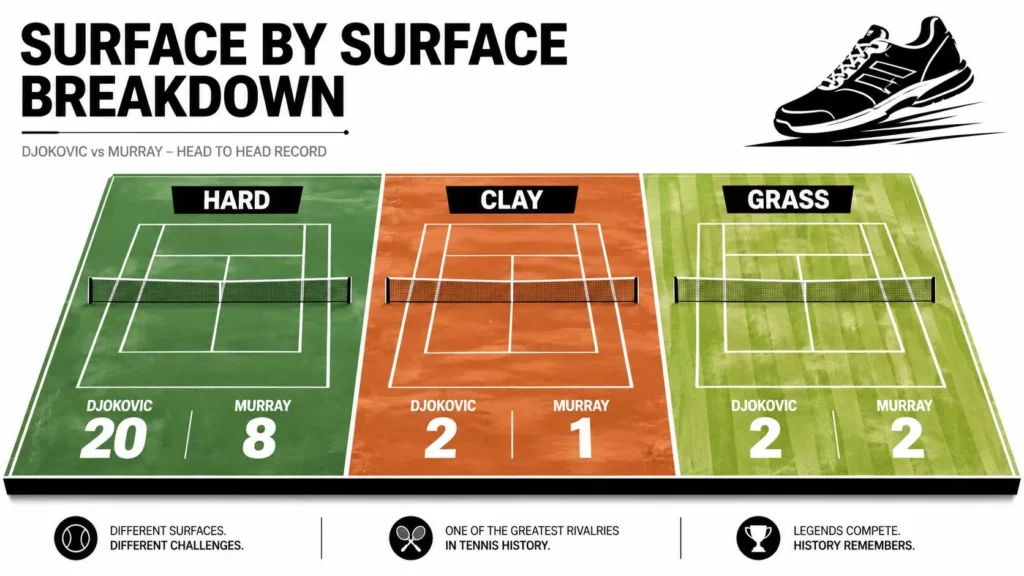
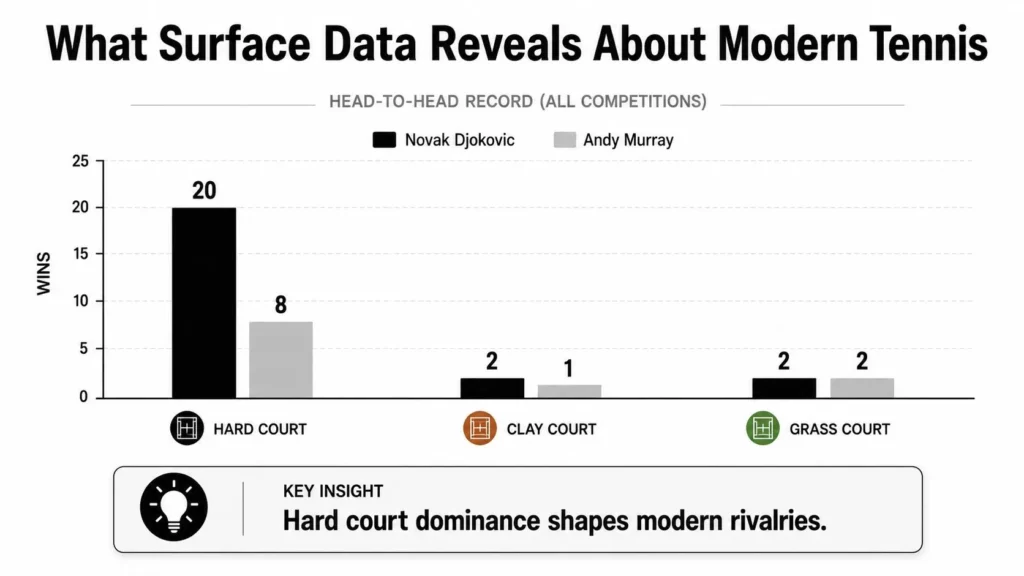
Surface is the clearest explanation for why the rivalry felt more competitive in some settings than others. The available head-to-head breakdown gives Djokovic a 20–8 lead on hard courts, a 5–1 lead on clay, and Murray a 2–0 lead on grass, as recorded by Steve G Tennis’ Djokovic versus Murray head-to-head data.
Hard courts rewarded Djokovic’s repeatable patterns
Hard courts gave Djokovic the largest statistical advantage. His return quality let him start rallies from a position of control, and his movement allowed him to absorb Murray’s changes of direction without surrendering depth. Once points settled into repeated baseline exchanges, Djokovic’s tolerance for pace and his ability to redirect the ball reduced the value of Murray’s counterpunching.
Murray could still create problems by changing the geometry of the point. A sliced backhand, a drop shot, or a sudden move forward forced Djokovic to solve a different problem. But those variations worked best when Murray had already earned time and court position. On hard courts, Djokovic more often prevented that sequence by attacking the second phase of the rally, especially after a deep return.
Clay magnified Djokovic’s physical and positional edge
The clay record, 5–1 for Djokovic, points to a more difficult environment for Murray. The slower surface gave Djokovic additional time to defend, recover, and rebuild the point. His sliding movement and ability to return heavy topspin made it harder for Murray to finish exchanges with a single change of direction.
Murray’s best clay strategy required patience and variation, but patience alone didn’t solve the matchup. Djokovic could extend rallies while maintaining enough depth to keep Murray from turning defense into attack. The surface therefore amplified Djokovic’s baseline stability instead of rewarding Murray’s ability to disrupt rhythm.
Grass created Murray’s clearest tactical opening
Grass changed the exchange. The lower bounce made slice more disruptive, shortened reaction time, and gave Murray greater value from first-strike patterns and forward movement. His 2–0 lead on grass is based on a smaller sample, so it shouldn’t be treated as proof that grass made him universally superior. It does show that the conditions gave him a tactical route that was less available on slower courts.
Murray could use a flatter ball, serve into uncomfortable locations, and approach before Djokovic established his defensive rhythm. That combination prevented Djokovic from turning every point into a test of repeated baseline tolerance.
Surface lesson: Murray’s danger came from changing the point before Djokovic could stabilize it. Grass made that intervention easier, while hard courts and clay more often gave Djokovic time to recover and reset.
Surface conditions also matter to anyone evaluating tennis beyond the rivalry itself. Readers comparing player profiles or considering tournament forecasts can use this trader’s guide to US Open market odds as a separate way to think about how venue, conditions, and matchup dynamics shape expectations.
Grand Slam Finals That Defined the Matchup
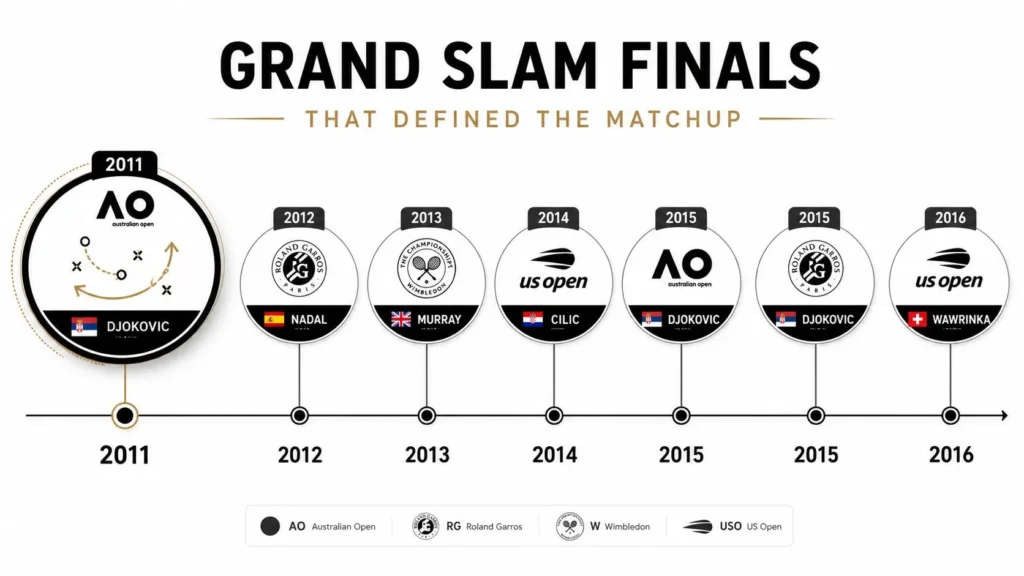
The Grand Slam meetings made the rivalry historically important because Djokovic and Murray met in finals at all four majors. Their major head-to-head was 8–2 in Djokovic’s favor, yet the individual finals carried different tactical meanings, especially when Murray managed to move first and keep Djokovic from dictating return games.
Australian Open 2011
Djokovic’s victory in the 2011 Australian Open final reflected the matchup’s hard-court foundation. His aggressive baseline positioning and ability to sustain pressure prevented Murray from using extended defense as a pathway back into the point. Murray’s response often depended on changing pace, but Djokovic’s ball striking kept those changes from becoming a stable pattern.
The final established a recurring theme. When Djokovic could take control early in rallies, Murray had to solve both the initial pressure and the physical cost of remaining in the exchange.
US Open 2012
Murray’s 2012 US Open final victory was a breakthrough because he sustained aggression over a long contest and converted variation into forward pressure. The five-set match rewarded his willingness to attack rather than wait for Djokovic to make the first structural mistake.
Murray’s serve and forehand created the opening, but the deeper adjustment involved court position. He avoided allowing Djokovic to settle into a predictable return-and-rally sequence, using changes of direction and pace to make the match less linear.
Australian Open 2013
The 2013 Australian Open final became a test of physical endurance and rally construction. Djokovic eventually prevailed in five sets, but Murray’s ability to stay in the match showed why their contests often required more than a single tactical idea.
Djokovic’s advantage came from maintaining quality as the exchanges accumulated. Murray could produce disruptive passages, yet Djokovic repeatedly returned to depth, recovery speed, and pressure on the next ball. That reset capacity separated a temporary swing in momentum from a sustained change in control.
Wimbledon 2013
Murray’s 2013 Wimbledon final win was his most important example of grass allowing him to impose a different rhythm. The straight-sets result reflected disciplined execution, not merely emotional momentum. He served with purpose, protected his first strike, and used the lower bounce to deny Djokovic the comfortable rally height he preferred.
The home crowd added psychological pressure, but the tactical point remains more important. Murray didn’t need to outlast Djokovic in every exchange. He needed to shorten the time available for Djokovic to organize his defense.
Australian Open 2015 and 2016
The 2015 and 2016 Australian Open finals showed Djokovic operating at a level Murray struggled to destabilize. The hard-court setting again favored Djokovic’s return pressure and baseline repetition, while Murray needed a higher risk level to create separation.
Across these matches, the critical difference was not a lack of effort from Murray. It was Djokovic’s ability to make his patterns feel unavoidable. Murray could alter pace and direction, but Djokovic’s court coverage reduced the payoff from each variation.
French Open 2016
The 2016 French Open final completed Djokovic’s career Grand Slam. On clay, the matchup emphasized the Serbian’s patience, movement, and ability to turn defensive positions into deep offensive replies. Murray could extend points, but Djokovic made extension itself costly by maintaining pressure through spin and court coverage.
The finals therefore form a progression. Murray succeeded when he could accelerate the point’s complexity. Djokovic prevailed when he kept the contest inside a repeatable baseline structure. For broader context on Australian Open history and matchups, readers can also consult this Australian Open tennis overview.
Contrasting Playing Styles and Tactical Evolution
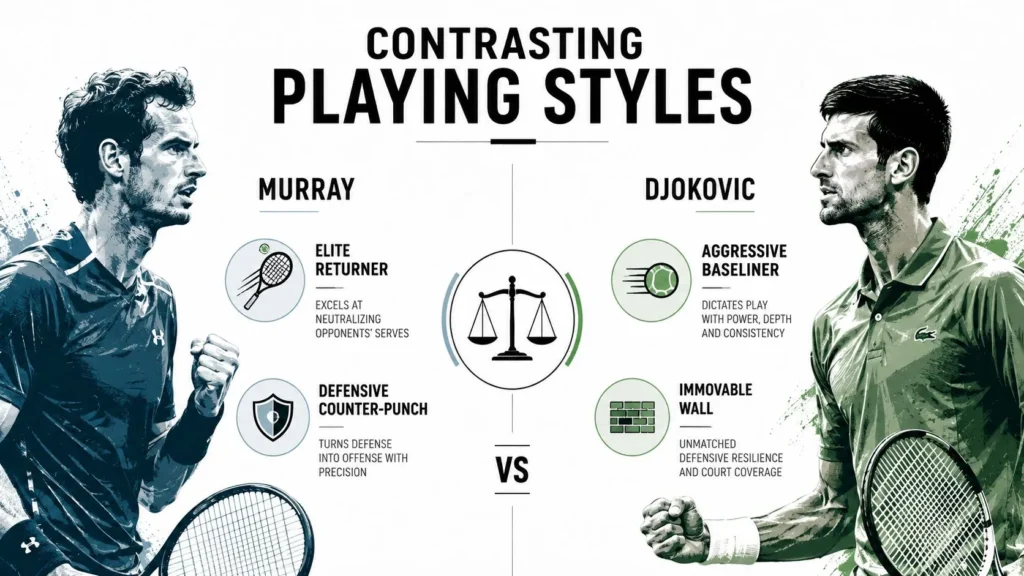
Murray and Djokovic shared an elite foundation. Both returned exceptionally well, defended from difficult positions, and understood how to build a rally rather than chase low-percentage winners. Their rivalry turned on what happened after that foundation was established.
Djokovic’s flexibility gave him a particularly reliable answer to Murray’s changes of direction. He could stretch wide, recover quickly, and redirect with enough depth to prevent Murray from taking the next ball early. That sequence made defensive skill an offensive weapon. Djokovic didn’t merely survive Murray’s variation. He often used it to create the next opening.
Murray’s variety needed time and initiative
Murray’s slice backhand, drop shot, lob, and net approach were most effective when he chose the moment rather than used them as emergency responses. During his strongest period, particularly around his major breakthroughs, he could attack more freely and make Djokovic defend an uncertain pattern.
That freedom had a cost. If Murray’s first aggressive play failed, Djokovic’s return quality often placed him immediately back under pressure. The matchup demanded both creativity and precision, which is why Murray’s best performances felt so tactically complete.
A useful way to understand the contrast is through point shape:
- Djokovic’s preferred sequence: absorb the first attack, recover centrally, redirect deep, then force a shorter reply.
- Murray’s preferred disruption: vary height and pace, move Djokovic laterally, then attack the open court or approach.
- The decisive battle: whether Murray could introduce variation before Djokovic’s depth and movement restored a neutral position.
Efficiency separated their later phases
As Murray’s career developed, his game became more dependent on reaction, defense, and tactical improvisation. Djokovic’s game moved toward efficiency. He didn’t need to hit through every opponent. He needed to make each neutral exchange increasingly uncomfortable.
The rivalry’s available evidence doesn’t provide verified rally-length or average shot-speed figures, so those metrics shouldn’t be presented as measured facts here. The match patterns still support a clear qualitative conclusion: Djokovic’s compact, repeatable construction was more dependable across hard courts and clay, while Murray’s variety gained greater practical value when grass reduced bounce and shortened the exchange.
For readers interested in the technical foundation behind these patterns, this guide to tennis forehand technique offers useful context on how swing shape and contact position influence court control.
The 2025 Coaching Partnership and Why It Ended
Murray joined Djokovic’s coaching team in November 2024, only a short time after ending his own playing career, and the collaboration ended by mutual agreement in May 2025, as reported by the ATP’s announcement of the Djokovic and Murray split. The arrangement was initially expected to cover the Australian Open and additional tournaments, but it lasted only a few months.
That timeline makes the partnership look less like a conventional long-term rebuild and more like an experiment shaped by trust, curiosity, and unusual shared history. BBC coverage described Murray’s decision as a rare, high-risk move, while the ATP confirmed that the separation was mutual. The central question isn’t whether two former rivals respected each other. They clearly did. The question is whether respect can become an effective daily coaching structure.
Familiarity isn’t the same as chemistry
Murray knew Djokovic’s patterns better than almost anyone. He understood the pressure of Djokovic’s return game, the way long rallies can change momentum, and the tactical decisions that make grass different from hard courts. But a former opponent’s insight doesn’t automatically translate into the right intervention during a tense match.
A coach must identify what the player can change immediately, what should remain untouched, and when advice creates more noise than clarity. Djokovic’s habits were developed over a long career and supported by an established team. Murray was entering a new professional role, not merely transferring his old match knowledge into a different chair.
| Metric | Pre-Partnership | During Partnership | Change |
|---|---|---|---|
| Verified overall head-to-head | Djokovic led 25–11 | Not applicable | Not established |
| Verified coaching-period win rate | Not provided | Not provided | Not established |
| Verified serve metrics | Not provided | Not provided | Not established |
| Verified return-position data | Not provided | Not provided | Not established |
| Verified rally-construction data | Not provided | Not provided | Not established |
The table matters because available reporting doesn’t establish a verified statistical change in Djokovic’s serve placement, return position, or rally construction during the partnership. Djokovic still reached a Wimbledon semi-final after the partnership period, but that result alone can’t prove that Murray’s coaching produced a tactical shift.
Results made the experiment difficult to sustain
The partnership encountered physical and competitive obstacles. Djokovic reached the Australian Open semi-final but suffered a hamstring injury during the tournament, and his later results created a difficult environment for a new coach. Murray subsequently said he was disappointed by the results he would have liked for Djokovic, while also describing the experience as valuable and confirming that he had invested fully in it, according to ESPN’s report on Murray’s coaching experience.
That combination explains the ending better than the idea of failure. The arrangement produced an unusual exchange of knowledge, but it didn’t demonstrate that former-rival familiarity could replace established coaching routines. Its historical value may lie precisely in its limits.
What Surface Data Reveals About Modern Tennis Rivalries
The Murray-Djokovic matchup offers a broader lesson: elite rivalries aren’t determined by overall ability alone. They’re shaped by whether a player’s preferred solutions survive the conditions of the court.
Djokovic’s hard-court advantage shows how valuable a repeatable return-and-baseline system can become when the surface allows him to recover, redirect, and begin the next exchange from balance. Murray’s grass success shows the opposite principle. When the bounce is lower and points can change direction quickly, tactical variety and first-strike choices become more influential.
The modern court rewards adaptability
The rivalry doesn’t support a simplistic claim that one surface completely defines modern tennis. Djokovic led on hard courts and clay, while Murray’s advantage appeared on grass in a smaller set of meetings. The more useful conclusion is that small technical differences can become decisive even among players capable of competing everywhere.
Those differences include:
- Return distance: A player who takes the return early can prevent an opponent from building a first attack.
- Bounce management: Lower or higher contact points alter the usefulness of slice, topspin, and flat drives.
- Recovery demand: Surfaces that reward long exchanges favor the player who can return to neutral position repeatedly.
- Transition timing: Faster, lower-bouncing conditions can reward the player who moves forward before the rally settles.
This is why surface data helps explain rivalries that appear puzzling from a career-wide view. A player may possess the serve, movement, and tactical intelligence to defeat an elite opponent, yet lack the conditions needed to make those strengths repeatable across venues.
Conditions matter as much as reputation
Modern men’s tennis has reduced some of the sharp distinctions between surfaces, but it hasn’t erased them. The Murray-Djokovic record shows that hard courts and clay still rewarded Djokovic’s movement and baseline tolerance more consistently, while grass created a narrower but real opening for Murray’s variation.
That insight also applies to emerging rivalries. Players who combine an elite return with efficient recovery and the ability to change direction under pressure should remain difficult to expose across surfaces. Yet a player with exceptional touch, serve-plus-one aggression, and forward movement can still become dangerous when court conditions compress reaction time.
The environmental factor is easy to overlook because fans remember champions and scorelines. The surface data reveals the hidden variable. Rivalry outcomes depend on which player’s preferred point structure the venue makes easier to repeat.
Legacy Implications for Both Players
Djokovic’s 25–11 lead establishes the rivalry’s overall balance, but the surface split gives that record its proper context. He solved Murray more consistently across their meetings, especially on hard courts and clay, where movement, depth, and repeated baseline exchanges aligned with his strengths. Legacy therefore depends on repeatability as much as peak level. A player’s standing reflects how reliably that level survives different court conditions.
Murray’s record points to a different form of significance. His major-final victories, including the 2012 US Open and 2013 Wimbledon, show that an unfavorable head-to-head record did not remove his ability to control the terms of individual matches. At his best, he forced Djokovic to answer unfamiliar combinations of variation, return pressure, and early initiative. His legacy includes the titles, but also the quality of the tactical problems he created for one of the era’s most complete players.
Rivalry as a form of historical evidence
The matchup also argues against judging rivalries through aggregate records alone. Federer and Nadal, along with other defining pairings, are often remembered through emotional narratives and landmark victories. Murray and Djokovic require closer examination because their surface results show where each player’s strengths remained repeatable and where conditions reduced their impact.
For a parallel in great rivalries, see this analysis of Andre Agassi and Steffi Graf. Their comparison reinforces how sporting legacies can include context beyond direct win totals.
The 2025 coaching partnership added another historical layer. It did not erase their competitive history or establish that former rivals automatically make effective coaches. Instead, it showed that professional respect can survive a change in roles, even when the arrangement is short-lived.
A rivalry’s legacy comes from the problems each player forced the other to solve, not only from the final count of victories.
Murray pushed Djokovic into demanding tactical contests when variation and early initiative mattered. Djokovic exposed the limits of that approach when he imposed depth, movement, and sustained baseline pressure. Their rivalry therefore means more than the headline record. It documents how surface conditions shaped the repeatability of each player’s preferred tennis, a question that remains central to modern men’s rivalries.
Maxi Journal publishes accessible analysis across sports, science, technology, health, business, arts, and other subjects. Visit maxijournal.com for commentary on the data and strategy behind tennis rivalries.
Discover more from Maxi Journal
Subscribe to get the latest posts sent to your email.