You’ve probably done this already. You open a sale page, see a row of 4K titles with red discount tags, and within five minutes you’re comparing three versions of the same movie, one steelbook, one standard case, one import, and one suspiciously cheap marketplace listing with almost no specs. The price looks good, but the details are thin, and that’s where most bad buys happen.
Buying 4K Blu-rays on sale gets easier once you stop treating every discount as equal. A cheap disc can still be the wrong edition, the wrong audio setup for your room, the stripped-down release with weak extras, or the version that gets replaced by a better pressing later. The trick isn’t finding more deals. It’s learning how to ignore most of them.
Why 4K Blu Ray Sales Feel Overwhelming and How to Cut Through the Noise
You click into a weekend sale looking for one title, and twenty minutes later you are comparing a standard studio release, a steelbook, an import, and a “special edition” that may only differ by slipcover art. The problem is not the number of deals. The problem is that sale pages lump together editions with very different long-term value.
A routine catalog repress can sit beside a boutique run with better packaging, stronger extras, or a disc that goes out of print faster than the discount lasts. A familiar cover does not guarantee the same contents. Studios reuse art, retailers swap in vague product pages, and marketplace sellers often list the cheapest version under the most desirable title. That is how collectors end up with duplicates, or with the edition they meant to avoid.
The broader market adds to the confusion. In major U.S. and U.K. physical-media markets, a 2026 industry summary reported U.S. 4K Blu-ray sales up 12% in 2025 versus 2024, while overall physical media spending was down 9.3% year over year. In the U.K., physical video sales declined only 4.7%, the slowest fall since 2010, and Blu-ray including 4K UHD reached £84.2 million versus £64.7 million for DVD, according to the cited market summary at 4kfind. That split matters. The format as a whole can soften while specific 4K editions stay in demand and disappear quickly.
Cheap isn’t the same as good value
A low price does not fix a weak edition. Some sale discs look attractive until you realize they are HDR10-only when another release has Dolby Vision, or they drop a better audio track, or they strip out the bonus disc that made the earlier pressing worth owning. Deal lists rarely call out those differences. They just show the markdown.
Practical rule: Buy the edition, not the discount.
That rule saves money because replacement costs are real. Buying the wrong version at $14.99 and upgrading later is usually more expensive than buying the better pressing once. It also helps with scarcity. Premium editions, boutique runs, and slipcovered first pressings do not always follow the slow, predictable price slide people expect from standard catalog stock.
The mindset that actually helps
I shop sales with a short list and a filter. Does this listing match the edition I want. Is it a release with known collector appeal, better presentation, or packaging that tends to dry up first. If the answer is unclear, I skip it until I can verify it.
That approach does three useful things:
- It cuts noise fast because weak listings fail on edition details, not just price.
- It protects your budget because you stop filling the cart with “good enough” discs you would not choose at full price.
- It reduces upgrade regret because you are less likely to buy a placeholder copy with compromised HDR, audio, or extras.
A strong sale buy is not just cheap. It is the version you will still be happy to own after the sale tag is gone.
What to Verify Before You Chase a Deal
A sale goes bad fast when the listing photo shows the right slipcover, but the shipped copy turns out to be a later repress with weaker extras, no Dolby Vision, or a bundled Blu-ray you cannot even play. That is the part casual deal roundups miss. The price is only one line item. The edition decides whether the buy holds up.
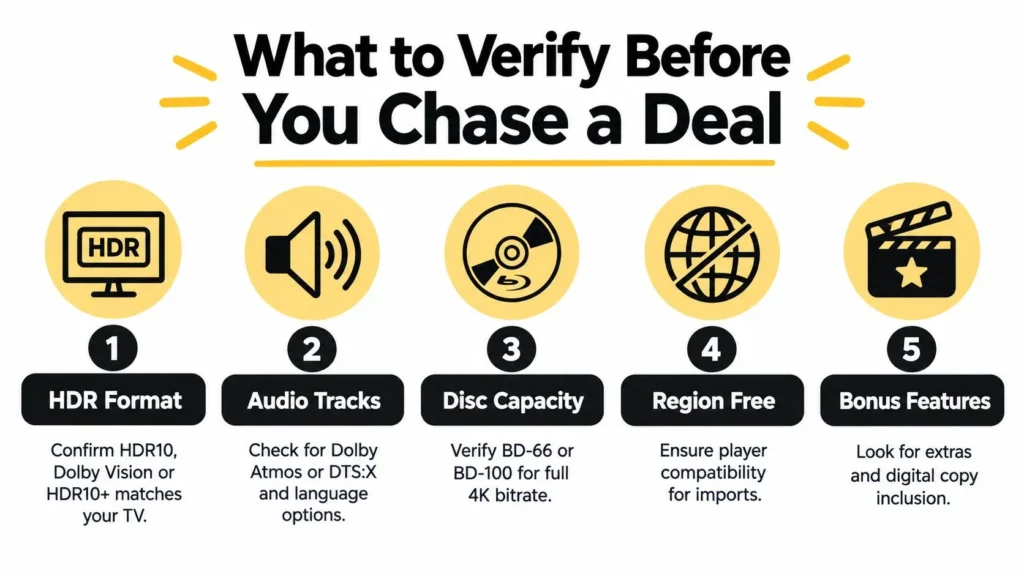
Start with setup fit, then move to edition details
Check whether the disc matches the system you use. A Dolby Vision encode matters if your TV and player support it. If they do not, a cheaper HDR10 edition may be the smarter buy, especially if it keeps the same master and audio. Audio works the same way. Atmos and DTS:X are worth chasing if you have the speakers for them. If you watch through a basic soundbar or TV speakers, transfer quality, subtitle options, and extras usually matter more.
UHD Blu-ray supports 3840×2160 resolution, HDR formats including HDR10, Dolby Vision, and HDR10+, and immersive audio such as Dolby Atmos and DTS:X, with reported bitrate ceilings up to 100 Mbps, compared with standard Blu-ray’s 1080p and 40 Mbps maximum, according to Film Threat’s cited 2026 feature on the format.
Then verify the exact release. The same movie can exist in multiple 4K editions with different HDR formats, different audio, different bonus features, and different discs inside identical-looking outer packaging. Studio reissues are especially messy here.
Check the disc, not just the front cover
Case art is a weak signal. Disc specs are stronger.
If a listing gives you disc capacity, use it as a clue. A BD-100 often leaves more room for a healthier encode, especially on longer films or editions loaded with extras. A BD-66 is not automatically bad, and a BD-100 is not automatically reference quality, but capacity can help separate a strong pressing from a stripped-down repress.
This matters most when two sale listings look interchangeable. One may keep the preferred encode and bonus disc. The other may be a cheaper repack that drops features collectors care about.
A low sale price does not improve a weak master, flat HDR, or missing supplements.
Use a quick pre-buy checklist
When a listing is thin, I check these points before buying:
- HDR format: Does it clearly list HDR10, Dolby Vision, or HDR10+?
- Audio track: Is the featured mix named, and is it the language track you want?
- Disc capacity: Can you confirm BD-66 or BD-100 from the label site, retailer specs, or package photos?
- Region details: The 4K disc may be region free, but the included Blu-ray or bonus disc may not be.
- Extras and packaging: Does this edition include the commentary, booklet, slipcover, reversible art, or bonus disc that separates it from the cheaper copy?
One missing detail is manageable. Three missing details usually means I pass.
Listing red flags worth slowing down for
Be careful with vague listings that say only “4K UHD movie,” use stock images, or show old artwork with no rear-cover photo. Those are the listings that produce the wrong pressing, no slipcover, or a different disc configuration than the one pictured.
Merged product pages are another common problem. Retailers sometimes collapse multiple pressings of the same title into one listing, which makes customer reviews useless for edition-level buying. If the description mixes old and new specs, treat it like an unverified listing.
Imports need one more check. Many UHD discs play fine across regions, but the standard Blu-ray packed in the same case may still be locked. That can turn a cheap imported collector set into a partial win instead of the complete edition you thought you bought.
Where and When to Find 4K Blu Rays on Sale
You spot a “deal” on a 4K title you have wanted for months. The price looks great. Then you notice the slipcover is gone, the bonus disc is missing, or the cheaper pressing uses the older master while the better edition is only a few dollars more. That is how collectors waste money. The best sale is not always the lowest price. It is the right edition before the scarce one disappears.
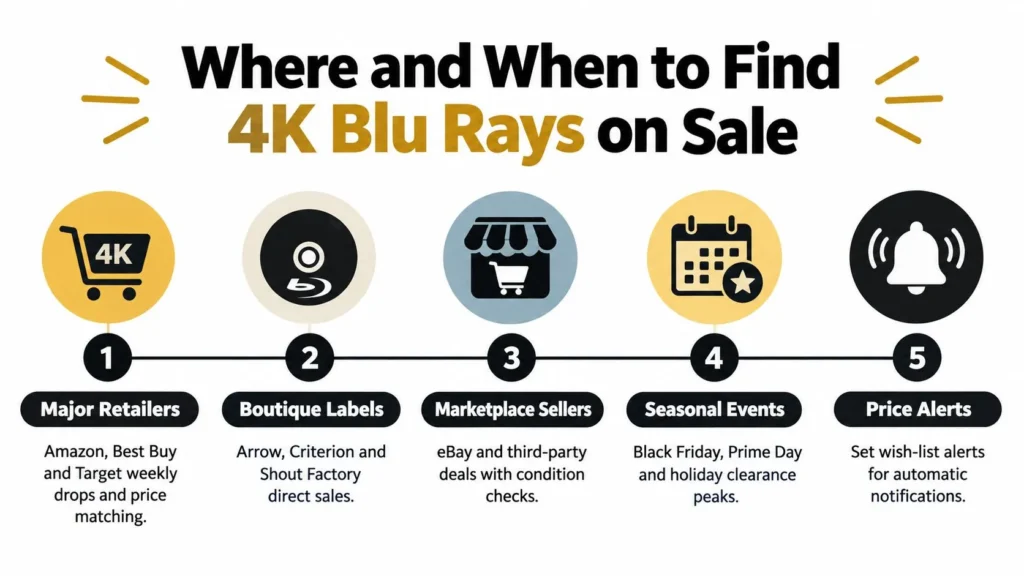
Match the store to the edition
Different stores are good at different kinds of discounts, and that matters more with 4K discs than many deal roundups admit.
Major retailers are still the easiest place to catch studio titles, preorder price drops, and broad holiday markdowns. They are weaker for edition clarity. A listing can merge a standard case, steelbook, and reissue into one product page, which makes a sale look better than it is.
Boutique label stores are where I watch for transfers, packaging, and extras that separate one release from another. Their discounts are often smaller on paper, but the edition quality is usually clearer, and limited stock can disappear fast once collector forums notice a title getting low. If you want a broader buying map before narrowing your watchlist, this guide to the best places to shop for media and deals is a useful starting point.
Marketplace sellers and local used shops serve a different purpose. I use them for out-of-print editions, replacement slipcover copies, and older boutique runs that no longer show up at retail. The trade-off is condition risk, incomplete sets, and vague listings.
| Buying channel | Best for | What to watch |
|---|---|---|
| Major retailers | New studio releases, mainstream catalog, temporary promo pricing | Merged listings, missing edition details, recycled artwork |
| Boutique label stores | Limited runs, booklets, premium extras, label-exclusive packaging | Short sale windows, fast stock changes, stricter shipping costs |
| Marketplace sellers | Out-of-print items, slipcover hunts, older steelbooks | Condition accuracy, reseals, incomplete contents |
| Local used shops | Cheap catalog upgrades, unexpected finds | Swapped discs, damaged cases, missing inserts |
Timing matters, but scarcity matters more
Constant browsing is a poor system. A watchlist tied to predictable sale windows works better.
Studio titles usually cycle back through major retail events, so patience often pays off unless you care about first-run packaging. Boutique editions behave differently. A release can sit at full price for weeks, hit a modest label sale, then vanish because buyers were waiting for that exact pressing with the booklet, hard box, or Dolby Vision upgrade.
That is the part many sale lists miss. Price drops are only half the signal. Low-stock notices, sold-out slipcover variants, and label-specific exclusives often tell you more about whether to buy now or wait.
Collector demand has also kept certain physical editions moving unevenly across stores and regions, as noted earlier in reporting on physical media demand. That is another reason to track the specific release, not just the title.
A routine that keeps the noise down
I keep the schedule simple because sales repeat, but scarce editions do not always come back in the same form.
- Early week check-ins: Scan major retailers for fresh markdowns and check label emails for short promos or restocks.
- Release-week comparisons: Look at the standard case, steelbook, and any label-exclusive version side by side before buying the first discounted option.
- Major sale events: Watch holiday sales, boutique anniversaries, and warehouse clearances closely. Those are the windows where premium editions either become good value or sell through.
- Late-life catalog checks: Revisit older catalog titles after newer restorations are announced. Retailers often clear older stock, and that can be useful if the newer disc adds little.
If you want a quick visual walk-through of sale hunting habits, this video is worth a watch.
Wait on ordinary studio stock. Move faster on the edition that has the packaging, transfer, or extras you actually care about.
How to Track Prices and Stack Savings Without Guesswork
Once you know which edition you want, the next job is deciding whether the current price is real value or just a loud banner. A small system beats instinct.
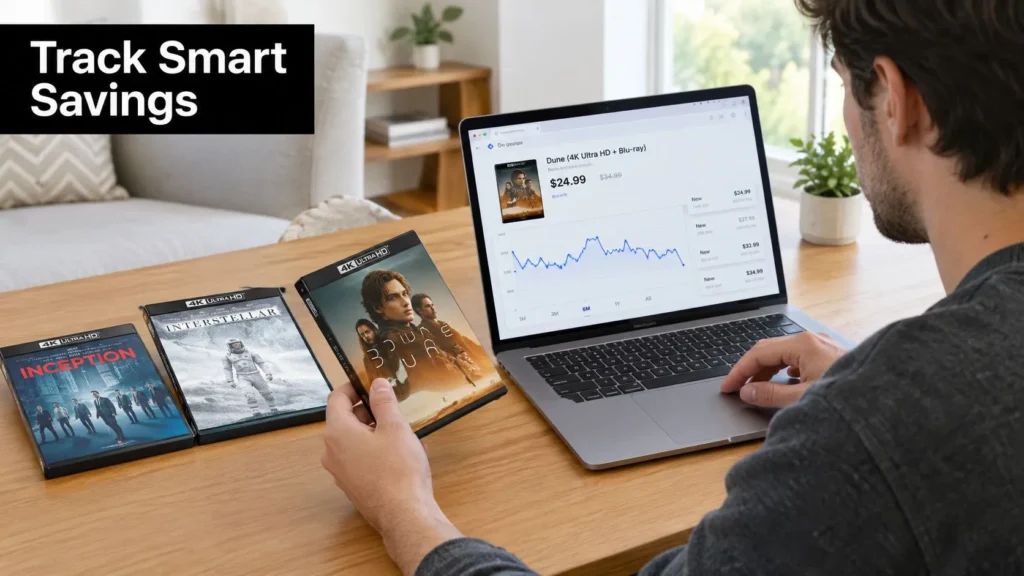
The low-effort tools that pull their weight
I like to compare tactics by how much attention they require.
| Tactic | Effort | Best use | Weak spot |
|---|---|---|---|
| Price-history trackers | Low | Spotting fake markdowns | Not every boutique label is covered |
| Wishlist alerts | Low | Catching dips without daily checks | Can trigger on the wrong edition |
| Store coupons | Medium | Cutting cost on planned buys | Easy to misuse on filler items |
| Loyalty points | Medium | Improving value over repeated orders | Less helpful if you shop many stores |
| Bundle promotions | High | Lowering per-disc cost on targeted lists | Encourages extra purchases |
Price trackers are the easiest win because they answer one question fast. Has this title fallen, or did the retailer inflate the list price before the sale? They also help you build a personal target price so you aren’t deciding in the moment.
Bundle math works only when the list is ready
A buy-two-get-one promotion can be excellent, but only if all three picks were already on your list. If you add a weak third title just to get the deal, you didn’t save money. You diluted your budget.
If that type of promo is part of your buying routine, this overview of buy 2 get 1 free deal strategy is useful for thinking through the math before checkout.
Here’s the comparison I use in practice:
- Single-title alert strategy: Best for one must-have edition, least likely to trigger filler buys.
- Coupon plus points strategy: Better for planned label orders where multiple wanted titles are already available.
- Bundle strategy: Strongest only when your shortlist is deep and every item passes your quality filter.
When to wait and when to buy
I usually wait on standard studio editions unless I think the packaging matters or stock looks unstable. I move faster on boutique releases, collector packaging, or titles where the first pressing is part of the appeal.
Buying rule: If you’d still want the exact same edition at a smaller discount next month, wait. If you’re really paying for the edition itself, not just the movie, hesitation can backfire.
That one question cuts out most impulse mistakes.
How to Vet Sellers and Avoid Costly Return Headaches
A great sale turns bad quickly when the seller ships the wrong edition, uses a stock photo from another release, or packs a steelbook in a thin mailer. Price matters, but seller quality decides whether the transaction stays cheap.
Read the listing like a collector
The first red flag is vagueness. “Brand new 4K movie” isn’t enough if you’re trying to confirm slipcover status, steelbook condition, booklet inclusion, or even the right studio release. If the description doesn’t specify edition details, ask before buying. Serious sellers usually answer clearly.
Second, check whether the photos are actual item photos or recycled promotional art. Stock images are common on large platforms, but when condition matters, especially for boutique sets, steelbooks, and digipaks, real photos reduce surprises.
Return policy matters before checkout
You want to know four things before placing the order:
- Damage standard: Does the seller treat dents, loose discs, and crushed corners as return-worthy?
- Restocking language: Any vague fee policy should make you hesitate.
- Edition disputes: Will they accept a return if the UPC or packaging differs from the listing?
- Shipping method: Thin bubble mailers are a risk for premium packaging.
For general online buying habits that translate well to media purchases, these ecommerce best practices for shoppers are worth keeping in mind.
Protect yourself on arrival
Open collectible packaging carefully and document the condition right away. I photograph front, back, spine, corners, shrink-wrap issues, and any loose disc hubs before I file the item on the shelf. If something’s wrong, you’ll have a clean record without trying to reconstruct the problem later.
A quick message to the seller on the day of delivery usually goes better than waiting. Especially with marketplace transactions, speed and clear photos make returns much easier.
Making the Smart Final Choice Between Sale Discs Bundles and Digital
You find a title at a great price, then notice three competing options on the same page. A cheap single-disc release, a bundle that looks better on paper, and a digital copy that costs about the same. The smart choice comes down to edition quality and what you want to own, not just the lowest number in the cart.
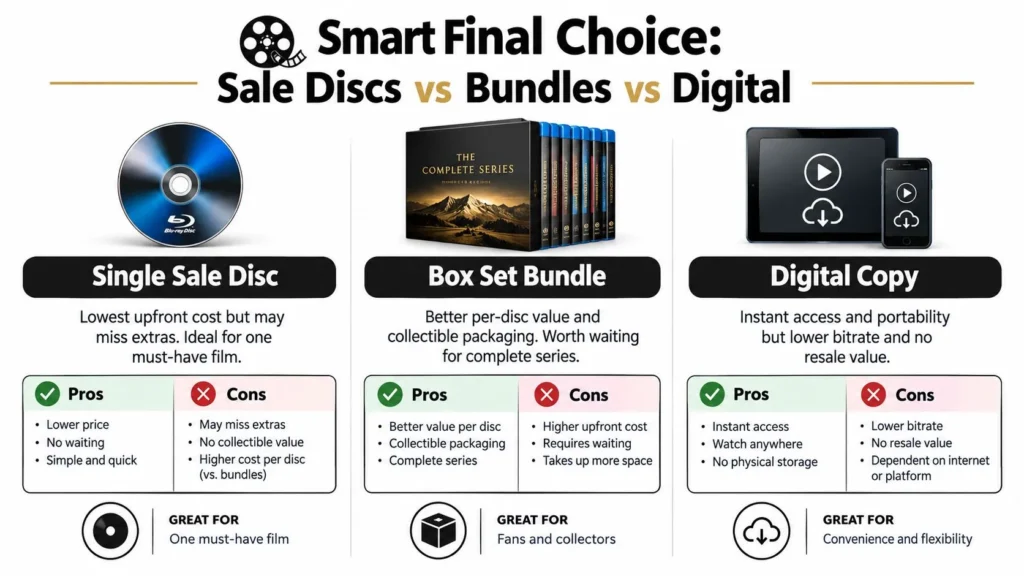
When a single disc is the smart buy
Buy the standalone release if you care about that one film and the specific edition is known to be strong. That means checking the transfer, confirming the audio format you want, and making sure the extras were not stripped out from an earlier release. A low sale price on a weaker reissue is still a weak buy.
This is often the best route for catalog titles with multiple 4K editions in circulation. One version may have better HDR grading, a stronger encode, or the original audio mix, while another drops those details to hit a lower price.
When waiting for a bundle makes more sense
Bundles work best when you know you want the full run and the set itself is well put together. The problem is that not every box set is the best version of each movie inside it. Studios sometimes reuse older discs, compress bonus features onto standard Blu-ray, or swap in less desirable packaging to hit a sale-friendly bundle price.
Scarcity matters here too. If a limited set is already showing signs of going out of print, waiting can cost more than buying now. If the bundle is a standard wide-release franchise set, patience usually wins.
When digital is good enough
Digital is the practical choice for casual rewatches, travel, or titles you like but do not need in their best home presentation. It also avoids shelf space and damaged packaging. Those are real advantages.
Discs still have the edge when a title has reference-level HDR, a standout Atmos or DTS:X track, collectible packaging, or supplements that may not carry over digitally. Collector demand and premium in-home viewing have both gotten more attention lately, and that shows up in how quickly the better physical editions disappear.
The final test is simple. Ask whether you are buying access, or buying a specific edition. If access is enough, digital is fine. If you want the best version, the right sale disc or a carefully chosen box set usually beats the cheaper option that leaves you replacing it later.
If you like practical buying guides like this, maxijournal.com publishes approachable writing across movies, tech, gaming, business, and more, with the same focus on clear decisions instead of hype. It’s a good place to find fresh commentary, useful explainers, and ideas that help you buy smarter the next time you’re sorting through another wall of 4K Blu-rays on sale.
Discover more from Maxi Journal
Subscribe to get the latest posts sent to your email.