You’ve probably just finished a big chunk of Super Mario Galaxy, seen Luigi pop up in bits and pieces, and wondered the same thing most players do. When do I get to play as him, and is it worth doing?
It is. But not for the reason quick guides usually give.
A lot of short answers make Luigi sound like a simple extra character. In practice, Super Mario Galaxy Luigi is a second full run with different movement, a different feel, and a postgame payoff that only makes sense once you understand the whole loop. If you go in expecting a cosmetic swap, you’ll be confused. If you go in expecting a fresh challenge run, you’ll have a much better time.
That’s why this guide takes the longer route. I’m treating Luigi the way longtime players do once they’ve fully cleared both brothers: as the game’s built-in remix mode. He jumps differently, runs differently, and changes how certain missions feel even when the level layout stays the same.
If you’re the kind of player who also likes teaming up in Nintendo games beyond Galaxy, a tool like the Smash Bros squad finder can help you meet other players who enjoy the same style of challenge and character-specific play. And if you like reading more gaming commentary in general, the broader gaming category is a handy place to browse.
Introduction to Luigi in Super Mario Galaxy
The first time many players think seriously about Luigi isn’t when they start the game. It’s when they notice him as part of the adventure, realize he isn’t just background flavor, and start asking whether the game is hiding something bigger.
That instinct is right.
Why Luigi matters more than people expect
Luigi has always carried a different kind of appeal. Mario feels stable and centered. Luigi feels a little riskier. In Super Mario Galaxy, that contrast stands out even more because the game already asks you to deal with odd gravity, tiny planets, curved surfaces, and jump timing that changes from one galaxy to the next.
When you switch to Luigi, those small differences stop being small.
A jump that felt routine with Mario can overshoot with Luigi. A fast landing can drift wider than you expect. A clean platforming line can suddenly need a lighter touch. That’s where the fun starts for a lot of players. You already know the worlds. Now you have to learn them again through a different controller feel.
Practical rule: Don’t think of Luigi as a reward screen. Think of him as the game’s advanced replay mode.
Why players search for Super Mario Galaxy Luigi
Most readers come in with one of three goals:
- Completionists want the end point, not just the first credits.
- Curious players want to know whether Luigi changes anything meaningful.
- Movement lovers want that looser, higher-jumping style that Luigi usually brings.
All three questions lead to the same answer. Yes, Luigi is worth the effort, but the value isn’t just in seeing green overalls in space. The value is in how the second run reshapes your relationship with the levels.
That’s also where confusion starts. Some guides tell you the basic trigger and stop there. They don’t explain the full postgame structure, the bonus reward path, or why Luigi even matters outside casual play. Those missing details are exactly what trip people up later.
How to Unlock Luigi and Start a New Journey
If you want the clean version first, here it is: Luigi becomes playable only after Mario clears the main star hunt and defeats Bowser again. The full sequence is documented on MarioWiki’s Super Mario Galaxy page.
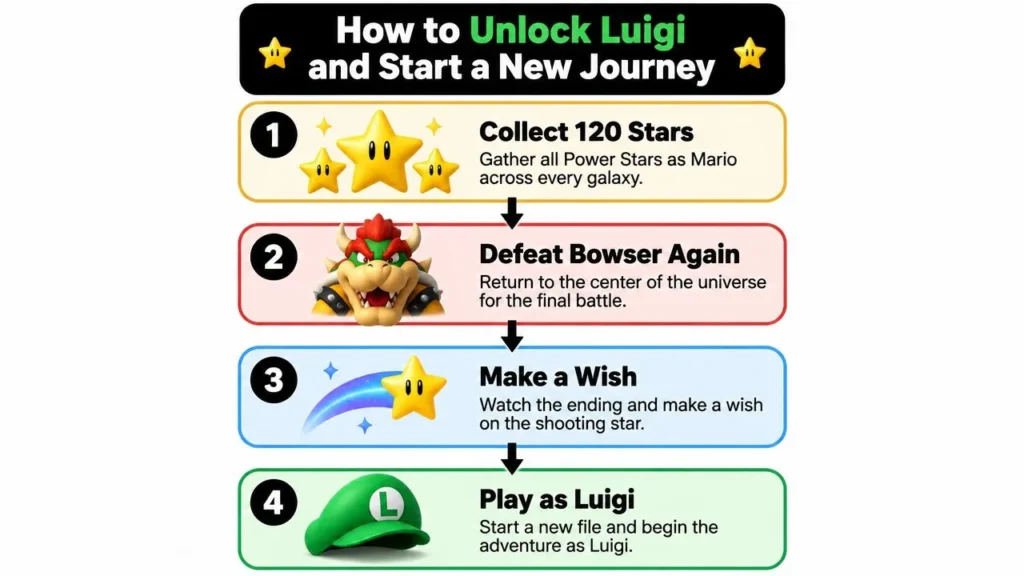
The exact unlock sequence
Many players get the first half right and miss the trigger that follows. The order matters.
Collect all 120 Power Stars as Mario.
This is the core requirement that proves you’ve finished Mario’s main challenge path, as listed on MarioWiki’s Super Mario Galaxy entry.Defeat Bowser again after reaching that total.
The game doesn’t just hand Luigi over the moment the last regular star drops. You still need that final follow-through, which is part of the path noted on the same MarioWiki page.Reload and begin the Luigi run.
At this point, the game opens the path to replay the story as Luigi rather than swapping Mario’s model in place.
Here’s a useful companion video if you want to see the process in action:
Why this feels bigger than a normal unlock
The structure becomes much more interesting than most guides admit.
According to MarioWiki’s Super Mario Galaxy page, once Luigi opens up, the game effectively asks you to do the core star route again. That means the main completion push doesn’t stop at 120 Power Stars. It extends to 240 stars across Mario and Luigi before the bonus content is fully resolved.
That’s the part many players miss. They hear “Luigi” and assume they’ve already reached the finish line. In reality, Luigi is the next major lap.
The unlock is not the endpoint. It’s the handoff from one complete run to another.
What counts as true completion
If your goal is “I want to finish everything,” you need to think in layers.
Here’s the simplest way to read the endgame:
| Stage | What happens |
|---|---|
| Mario complete | You gather all 120 Power Stars and clear the necessary Bowser finish, as outlined on MarioWiki. |
| Luigi playthrough | You replay the adventure as Luigi and collect 120 Stars on that route too, again following the structure documented on MarioWiki. |
| Final bonus reward | After Luigi also reaches 120 Stars, Grand Finale Galaxy unlocks, and the final star comes from the 100 Purple Coins challenge there, bringing the total to 121 Stars for each save path, per MarioWiki. |
That’s payoff. Luigi isn’t separate from completion. He is part of completion.
If you enjoy achievement-style progression in other games too, the piece on achievements in Minecraft makes a nice comparison point because it scratches that same “what counts as done?” itch.
Gameplay Differences Between Luigi and Mario
Once Luigi becomes available, the biggest surprise isn’t where he goes. It’s how he feels.
The character summary on the Super Mario Galaxy Luigi page shows the traits most players notice right away: Luigi has higher jump and speed, but worse acceleration and traction.
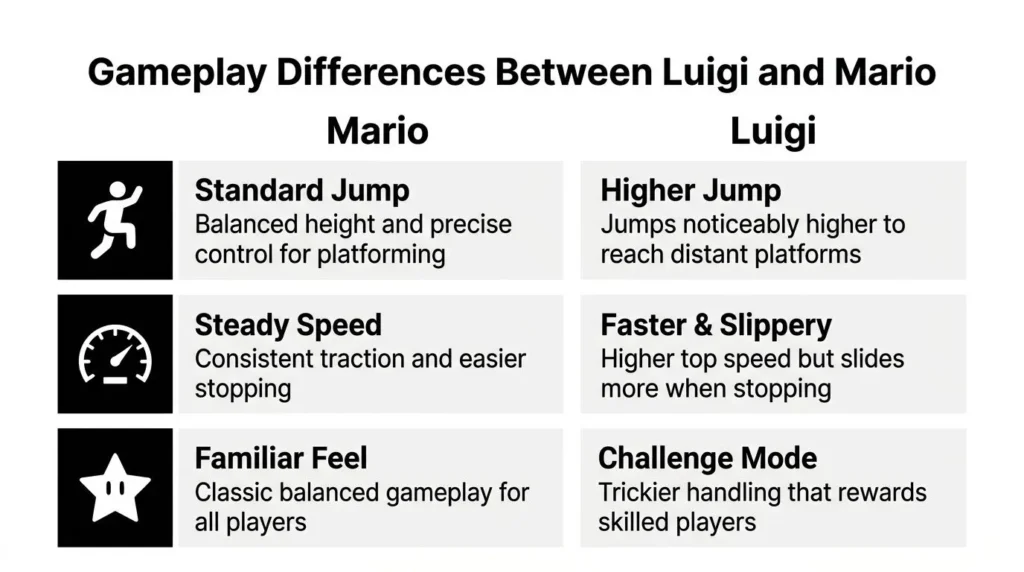
The fast comparison that helps most
If Mario feels like shoes with good grip, Luigi feels more like shoes on a polished floor.
You’ll still reach the same places. You just won’t stop in the same way.
| Trait | Mario | Luigi |
|---|---|---|
| Jumping | More centered and predictable | Higher and easier to overshoot |
| Running | Easier to pace | Faster once moving |
| Starting and stopping | More controlled | Slower to settle, more slide |
| Precision feel | Stable on narrow spots | Strong once mastered, awkward at first |
What this changes in real play
Luigi’s high jump sounds like a pure advantage until you land on a tiny planet edge and slide farther than you wanted. That’s the trade-off. He can rescue a shaky route with extra airtime, but he can also punish heavy stick movement.
A few examples make the difference clearer:
- Long jumps feel bigger. You can cover space confidently, but it’s easier to fly past a safe landing.
- Tight corrections matter more. A hard push on the stick often creates more trouble than a small adjustment.
- Stopping is a skill. Mario lets you brake with less fuss. Luigi asks you to plan your stop before you need it.
Why some players love him and others bounce off him
Luigi tends to split players into two camps.
Some immediately prefer him because he feels lively. They like the extra spring in his jump, the slight chaos, and the sense that each clean landing was earned. Others find him slippery enough that familiar missions suddenly feel off.
Both reactions are normal.
When Luigi feels bad, it usually means you’re driving him like Mario. Once you stop doing that, his strengths show up fast.
If you’ve ever replayed a platformer with a self-imposed rule set, Luigi creates that same effect without changing the actual stage list. The levels stay mostly familiar. Your timing doesn’t.
Where to Find Luigi During Your Adventure
Before Luigi becomes playable, the game uses him in a more playful way. He appears as someone you can look for, rescue, or run into during the adventure. That gives him a story presence long before the full character switch.

Why these sightings matter
These moments do two useful things.
First, they make Luigi feel like part of the galaxy journey instead of a hidden menu bonus. Second, they teach you his role in the game’s tone. He’s not presented as a rival taking over the spotlight. He’s the supportive brother who gets into trouble, helps out, and builds anticipation for later.
That’s why players often remember “finding Luigi” before they remember “verting Luigi.” The game puts his identity into the world early.
What to pay attention to when Luigi appears
The best approach is to treat Luigi encounters as little character beats, not checklist chores.
Watch for these patterns:
- He’s often tied to rescue-style moments. That reinforces his place in the story as someone active within the same world, not a detached extra.
- His presence feels slightly comedic. Luigi usually brings a lighter tone, which fits his personality across the wider Mario series.
- These encounters foreshadow his later importance. The game is telling you that Luigi matters beyond cameo status.
A lot of players rush through these scenes because they’re focused on stars. That’s understandable, but it’s worth slowing down. Luigi’s appearances make the later replay feel less random. You’ve already spent time with him. The game has already framed him as part of the same cosmic adventure.
Where players often get confused
The confusion usually comes from mixing up two separate ideas:
- Seeing Luigi in the game world
- Gaining Luigi as a full playable character
Those are not the same thing. Early encounters are story flavor and side moments. Full control comes much later, after the full completion path discussed earlier.
If you only remember one thing from Luigi’s pre-unlock appearances, remember this: the game is introducing a second perspective, not teasing a quick costume change.
That design choice is smart. By the time Luigi becomes playable, he already feels earned.
Notable Missions Easter Eggs and Luigi Specific Challenges
The best Luigi content in Super Mario Galaxy isn’t a single hidden level. It’s the way familiar missions get reinterpreted once his movement takes over.
Missions that feel easier with Luigi
Any section that rewards reach, bounce, or confident airtime tends to feel friendlier with Luigi. A gap that looked slightly awkward with Mario can suddenly feel natural. Platforms that asked for a measured jump may become less intimidating because Luigi gives you more vertical forgiveness.
That doesn’t mean every jump becomes free. It means Luigi often lets you attack routes more aggressively.
You’ll notice this most when a mission has a rhythm of jump, drift, correct, land. Mario handles that pattern neatly. Luigi turns it into something a bit more expressive. If you like improvising your line through a stage, he can feel fantastic.
Missions that get meaner
Tiny planets, narrow edges, and precision stops are where Luigi asks for real discipline.
Levels that require you to land and halt quickly can become the roughest parts of his run. The jump gets the attention, but his slipperiness is usually what causes actual mistakes. You clear the obstacle, touch down safely, and then slide off because you reacted one beat too late.
That’s why some of the hardest Luigi moments aren’t dramatic. They’re simple landings with no room for careless momentum.
Here are the mission types where that shows up most often:
- Narrow-path platforming where stopping cleanly matters as much as jumping.
- Small circular planets where traction issues are more noticeable.
- Purple Coin cleanup routes where a missed correction can force awkward recovery.
Luigi as more than a completion reward
Luigi becomes more interesting than many postgame characters.
Competitive players don’t treat him as a novelty. The Super Mario Galaxy leaderboard hub on Speedrun.com shows that character choice matters enough to be recognized through subcategories within the current ruleset structure. That tells you something important. Luigi’s movement isn’t just flavor. It can affect route choices, consistency, and timing decisions in serious play.
So even if you never plan to speedrun, the community has already answered a useful question for you: does Luigi materially change the game? Yes. If he didn’t, players wouldn’t care which brother was being used.
Luigi changes the conversation from “Can I replay this?” to “How differently can I play this same game?”
Small joys that make the replay worthwhile
Not every Luigi moment is about challenge. Some of the fun is just tonal.
His body language, his reputation as the less steady brother, and the way his physics amplify that personality all make the second run feel more character-driven than many alternate campaigns do. You aren’t just repeating stars. You’re repeating them through a movement style that matches the character’s identity.
That’s why the Luigi run sticks in memory. It doesn’t need huge new worlds to feel fresh.
Tips and Strategies for Mastering Luigi Gameplay
Luigi rewards restraint more than force. If Mario lets you muscle through your movement a little, Luigi asks for cleaner inputs and earlier planning.
The habits that help immediately
Start with your thumb, not your route.
If Luigi feels slippery, the answer usually isn’t “find easier missions.” It’s “press less and earlier.” Small corrections beat panicked corrections almost every time.
Try these habits:
- Ease into movement: Don’t snap the stick hard unless the situation really needs it. Luigi carries momentum more than Mario does.
- Plan your stop before landing: If the platform is narrow, think about braking while you’re still in the air.
- Use the spin as a stabilizer: A well-timed spin can help you manage awkward motion and settle a jump line.
- Choose the boring route when needed: Safe paths matter more with Luigi because recovery can get messy once he starts sliding.
How to approach difficult star cleanup
Purple Coin missions are where Luigi can expose rushed play. You might be moving well for most of the challenge, then lose control while trying to grab one last coin on a cramped edge.
That’s why coin collection with Luigi works best when you divide the route mentally:
| Situation | Better Luigi approach |
|---|---|
| Wide open stretch | Use his speed and cover ground confidently |
| Cluster near an edge | Slow down early and collect with short adjustments |
| Tiny landing area | Prioritize stable landing over quick recovery |
| Last few pickups | Avoid greedy turns that force a slide |
The final bonus content is a good place to apply that mindset. By then, the game expects precision, and Luigi’s movement asks you to earn it.
Movement cue: If you keep sliding off after a successful jump, your jump wasn’t the problem. Your landing plan was.
Common mistakes that make Luigi harder than he is
A lot of frustration comes from habits that worked fine with Mario.
Watch out for these:
- Overcorrecting mid-air. Luigi often needs a nudge, not a yank.
- Rushing tiny planets. Their curves and edges make traction mistakes more obvious.
- Assuming higher jump solves everything. Extra height helps, but poor landing control cancels that advantage.
- Playing tilted after a slip. Luigi punishes panic inputs. Reset mentally after a mistake.
If you’re newer to platformers in general, beginner-friendly reads like gaming for beginners can help build the kind of movement patience Luigi rewards.
A simple mindset shift
With Mario, you react. With Luigi, you anticipate.
That one change makes the whole run smoother. Once you stop trying to force him into Mario’s rhythm, Luigi starts feeling less slippery and more expressive.
Final Thoughts on Playing as Luigi and What Comes Next
Luigi in Super Mario Galaxy works because he isn’t treated like an afterthought. He arrives late, but when he arrives, he changes the game’s mood, movement, and sense of completion.
For completionists, his value is obvious. If you want the full reward path, Luigi is part of it. For players who care more about feel than checklists, he’s even better. He gives familiar galaxies a second life by making you re-learn them through jump height, speed, and traction trade-offs.
That’s also why the Grand Finale payoff lands so well. It feels less like a bonus tacked onto the end and more like the game acknowledging that you mastered two versions of the same adventure.
Compared with how Luigi is handled in Super Mario Galaxy 2, the first Galaxy makes his role feel more tied to postgame accomplishment and alternate mastery. Galaxy 2 uses him in a more immediately integrated way. In the original, Luigi feels like a reward, a remix, and a challenge run all at once. That distinct identity is a big reason players still search for Super Mario Galaxy Luigi specifically rather than just looking up generic completion info.
If you’ve already gained access to him, the best next move is simple. Start the run and give yourself time to adjust. The first few stars might feel odd. Then the movement starts to click, and the whole second journey opens up.
If you enjoy clear gaming guides like this, maxijournal.com publishes approachable writing across games, entertainment, tech, and more. It’s a good place to keep exploring topics like postgame content, completion paths, and the small design details that make classic games worth revisiting.
Discover more from Maxi Journal
Subscribe to get the latest posts sent to your email.