Something is magnetic when microscopic magnetic moments from its electrons align in the same direction across groups of atoms, creating a net magnetic field. In Fe–Co–Cr–Zr–B amorphous ferromagnets, that organized behavior can persist up to Curie temperatures ranging from approximately 200 to 800 K, or about −73 °C to 527 °C.
A fridge magnet makes magnetism look simple. You place it against a steel door, feel it snap into position, and move on. Yet the magnet isn’t merely “sticking to metal.” Inside the material, countless electron-generated magnetic moments are interacting, aligning, resisting heat, and arranging themselves into regions called magnetic domains.
That leads to the counterintuitive part: magnetic behavior is widespread at the atomic level, but a permanent magnet is unusual. Many materials contain electrons with magnetic moments, but those moments can cancel one another or remain too disorganized to produce a strong field outside the material.
The Secret Life of Magnets
You place a colorful sailboat magnet on the refrigerator. It stays there while a copper coin, an aluminum can, and a glass tumbler fall away if you try the same test. The difference isn’t just that one object is “metal” and the others aren’t. Magnetism depends on whether atomic moments cooperate.

Every atom contains electrons, and electron spin and orbital motion give rise to microscopic magnetic moments. You can think of each moment as a tiny arrow with a direction. The material becomes strongly magnetic only when large groups of those arrows arrange themselves so their effects reinforce rather than cancel.
Practical rule: “Not attracted to a magnet” doesn’t mean “contains no magnetism.”
The refrigerator test detects one visible consequence of magnetism, mainly a strong response from ferromagnetic materials. It doesn’t reveal every magnetic state. In an antiferromagnet, neighboring moments can be strongly ordered while pointing in opposite directions, leaving little or no external field. A paramagnet can respond to an applied field without retaining permanent alignment after the field disappears.
This is why what makes something magnetic is a question about organization, not just ingredients. Iron, cobalt, nickel, chromium, some rare-earth elements, and many alloys can carry useful magnetic moments, but their behavior also depends on crystal structure, defects, composition, temperature, and interactions between neighboring atoms.
The invisible arrangement matters in ordinary technology. Motors use magnetic forces to turn electrical energy into motion. Generators reverse that relationship. Sensors detect fields, storage devices encode information through magnetic states, and medical instruments use controlled magnetic fields to produce images.
The magnet on your refrigerator is therefore a convenient doorway into quantum physics. Its attraction is the large-scale result of tiny particles following rules that aren’t visible to the naked eye.
Electron Spin and Atomic Magnetism
To understand the origin of magnetism, start inside a single atom. Electrons contribute magnetic effects mainly through spin and orbital motion around the nucleus. The word “spin” can mislead beginners, because an electron isn’t a miniature ball rotating like a top. Spin is an intrinsic quantum property, and it gives the electron a magnetic moment.
A useful mental model is a tiny compass needle. It has a direction, and neighboring moments can interact with it. The model isn’t a complete picture of quantum mechanics, but it helps explain why electron arrangements can create a larger magnetic response.
Electrons also occupy atomic orbitals. Their orbital motion contributes to magnetism, although the size and visibility of that contribution depend on the material’s electronic environment. In real crystals, surrounding atoms can modify how strongly orbital motion appears in the total magnetic moment.
At the core, electrons often pair with opposite spin directions. When two opposite contributions occupy the same orbital arrangement, they largely cancel. An atom with unpaired electrons can retain a net magnetic moment, while an atom whose electron contributions pair off may show a much weaker response.
For a refresher on the structure that houses these particles, this overview of the nucleus of an atom provides useful background.
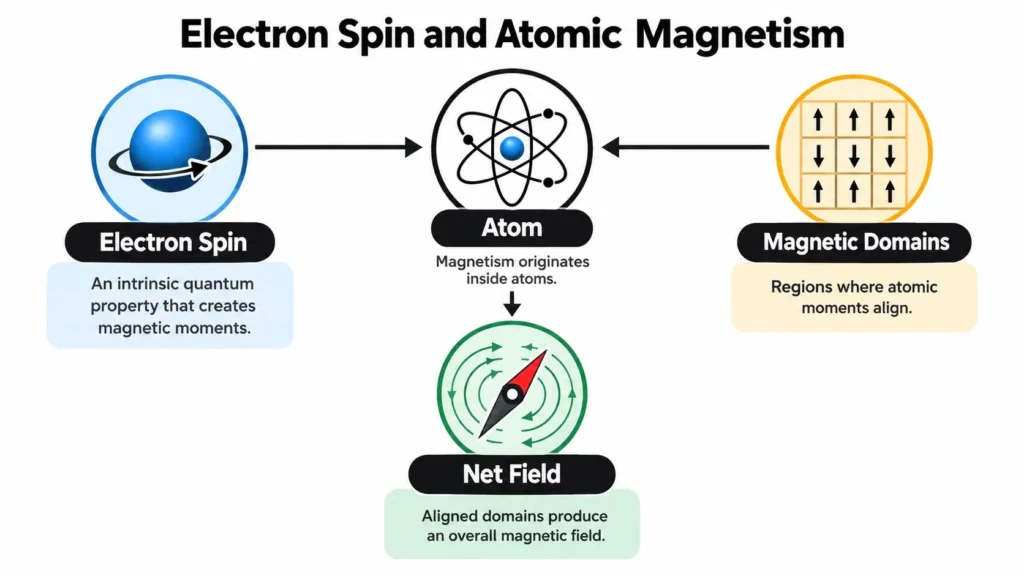
An unpaired electron is only the starting point. It gives an atom a potential magnetic moment, but it doesn’t guarantee that a chunk of the material will act like a bar magnet. Neighboring atoms may orient their moments in opposite directions, or thermal motion may keep the arrangement unstable.
Scientists describe magnetic strength using quantities such as the magnetic moment, often measured in Bohr magnetons, and magnetic susceptibility, which describes how strongly magnetization changes in response to an applied field. These measurements let researchers distinguish a material’s microscopic capacity for magnetism from its large-scale response.
The central lesson is simple: electrons supply the moments, but the surrounding atomic environment decides what those moments can do.
How Atoms Organize Into Domains
A steel nail can contain atoms with magnetic moments without behaving like a permanent magnet. The missing ingredient is large-scale coordination.
In a ferromagnetic material, neighboring moments can align parallel because of a quantum-mechanical effect called the exchange interaction. This isn’t a conventional push or pull between little compass needles. It arises from the quantum rules governing electrons and can make parallel alignment energetically favorable.
Once nearby atoms align, their influence can spread through a region of the crystal. That region is a magnetic domain, an area in which many atomic moments point in a common direction. A piece of iron can contain many domains, each acting like a small magnet.
The domains don’t automatically point in one common direction across the entire object. If one region points north, another points east, and another points south, their external effects can largely cancel. The material may still contain strong local order, but the object won’t produce a large net field.
Why domains matter
A useful analogy is a crowded room. Every person may hold an arrow, but the room looks directionless if people face different ways. If groups turn together, each group becomes visually organized. If enough groups coordinate, someone outside the room can detect a clear pattern.
Magnetization changes that arrangement. An external magnetic field can encourage favorably oriented domains to grow, while domain boundaries shift. Mechanical stress, defects, and the material’s internal structure influence how easily those boundaries move.
This helps explain why iron, cobalt, and nickel can support strong ferromagnetic behavior, while copper and aluminum don’t become permanent magnets in the same ordinary way. The relevant question isn’t whether the sample contains electrons or even whether some electrons are unpaired. The question is whether the material’s quantum interactions and structure support stable collective order.
A permanent magnet is less like a crowd of independent compasses and more like a coordinated society of microscopic directions.
Crystal structure also matters because it determines how atoms are spaced and how electrons move between them. Chemical substitutions can strengthen, weaken, or redirect the interactions that organize moments. Defects can pin domain walls in place, making magnetization persist, or they can create pathways for domains to rearrange.
That is why magnetism is often a property of an element’s chemical environment, not merely of the element itself. Change the arrangement, composition, or processing history, and the same broad family of atoms can show a different magnetic response.
Types of Magnetism and Temperature Effects
Materials can organize their moments in several ways. The categories describe the relationship between neighboring moments and the material’s response to an applied field.
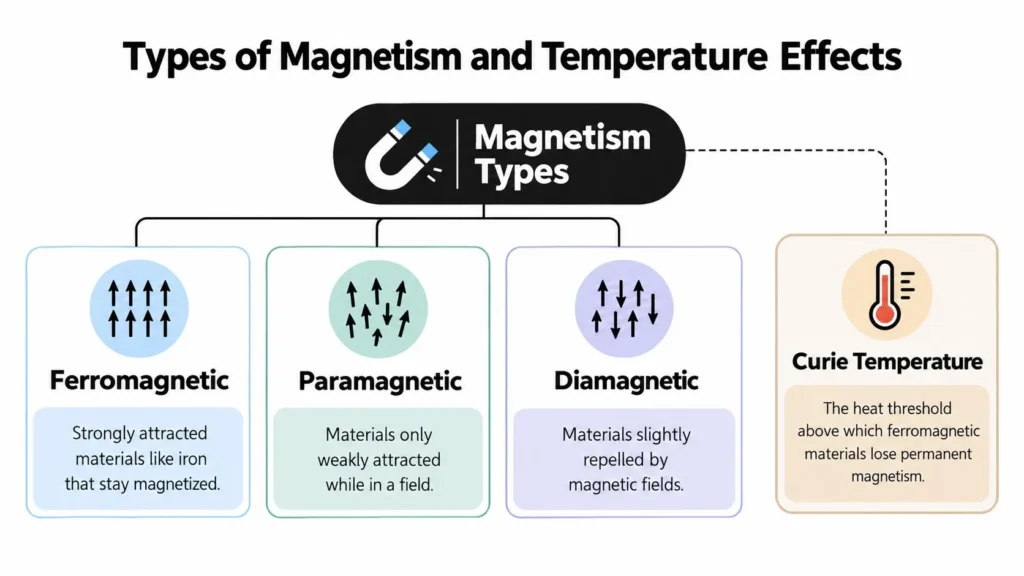
Ferromagnetism produces parallel alignment and a net magnetization. A ferromagnetic material can retain a magnetic state after an external field is removed, although the strength and permanence depend on its structure and domain behavior.
Antiferromagnetism uses opposing alignment. Neighboring moments point in opposite directions, so their contributions largely cancel at the macroscopic scale. The material can still possess strong internal magnetic order even when it doesn’t attract a refrigerator magnet visibly.
Paramagnetism describes moments that are disordered without an applied field but become partially aligned when a field is present. The response disappears when the field is removed, so the material doesn’t behave like a permanent bar magnet.
Heat tests magnetic order
Temperature supplies randomizing energy. As a material warms, atoms vibrate more strongly and electron arrangements become harder to keep aligned. Above a ferromagnet’s Curie temperature, the material becomes paramagnetic, as defined in NIST’s reference material on magnetic properties.
NIST research reports Fe–Co–Cr–Zr–B amorphous ferromagnets with Curie temperatures tunable from approximately 200 to 800 K, equivalent to about −73 °C to 527 °C, and magnetic moments on the order of 100 A·m²/kg. The range shows that engineers can alter magnetic performance through composition and material design rather than treating magnetism as a fixed property.
A separate NIST study found that Mn3GaC changes from a ferromagnetic state to a paramagnetic state near 249 K, while a carbon-deficient version has a Curie temperature near 295 K. The composition change shifts the ordering temperature by roughly 46 K, showing how strongly chemical details influence collective behavior. The NIST study of magnetic structures and transitions also reports moments of 2.56(7) μB per cobalt atom and 2.56(7) μB per manganese atom in one investigated compound, with a Curie–Weiss temperature of 58 K and a total moment of 5.5 μB per formula unit.
These measurements connect the invisible picture to laboratory evidence. A material needs magnetic moments, but it also needs interactions strong enough to organize them against thermal disruption.
For broader context on the quantum particles and statistics involved in matter, see this introduction to bosons and fermions.
Making and Breaking Magnets
Take a steel nail and a strong bar magnet. Stroke the magnet along the nail repeatedly in the same direction, then bring the nail near a few small steel objects. The nail may attract them for a while.

The field encourages domains in the nail to favor a common orientation. Some domains grow, others shrink, and domain walls move through the material. The nail’s final behavior depends on how easily those domains return to their earlier arrangement after the external field is gone.
This simple activity demonstrates the difference between induced magnetism and lasting magnetization. A soft magnetic material changes its response readily but may lose most of that alignment afterward. A harder magnetic material resists domain-wall movement and can retain a stable magnetic state.
What can undo the alignment
Mechanical shock can disturb domain arrangements. Dropping or striking a magnet gives domains energy to move, which can reduce the net field. Heat is more disruptive because thermal motion directly challenges the interactions holding the ordered state together.
A safe classroom demonstration uses a previously magnetized steel object and compares its attraction before and after controlled warming. Don’t heat household magnets casually, since coatings, adhesives, and nearby materials can become hazardous. The scientific principle remains clear: when disorder overwhelms magnetic order, the net magnetization falls.
External fields can also reverse a magnet. Apply a sufficiently strong field in the opposite direction, and domains favor the new orientation. Manufacturers use controlled fields, material composition, and heat treatment to set the balance between easy magnetization and long-term retention.
A paperclip illustrates another subtle point. It can become temporarily magnetic near a strong magnet because its domains respond to the nearby field. Remove the magnet, and the paperclip may lose much of that response. This doesn’t mean the material was “fake magnetic.” It means its domain structure is mobile and not strongly locked in place.
The same distinction helps explain why a material can be useful inside an electrical device without serving as a permanent magnet. Transformers and motors often need materials that respond predictably to changing fields, while a compass or holding magnet needs a stable retained direction.
Magnetic Materials Comparison Guide
The table below separates common materials by their broad magnetic behavior. Real alloys can behave differently from pure elements because composition, crystal structure, processing, and defects alter the interactions between moments.
| Material | Magnetic Type | Common Uses |
|---|---|---|
| Iron | Ferromagnetic | Cores, tools, structural magnetic components |
| Cobalt | Ferromagnetic | Permanent magnets and high-temperature magnetic materials |
| Nickel | Ferromagnetic | Coatings, alloys, sensors |
| Chromium | Can support antiferromagnetic behavior | Specialized alloys and magnetic research |
| Steel | Depends on alloy and treatment, often ferromagnetic | Tools, appliances, motors, structures |
| Aluminum | Paramagnetic response | Lightweight structures and electrical applications |
| Copper | Weak magnetic response, not a permanent ferromagnet | Wiring, coils, heat transfer |
| Hematite | Magnetic behavior varies with form and composition | Mineral study and specimen collecting |
A visual mineral reference can help distinguish appearance from magnetic behavior. For readers comparing naturally occurring specimens, compare hematite mineral specimens as a useful reminder that a metallic-looking surface doesn’t by itself identify the underlying magnetic state.
The table is a guide, not a substitute for measurement. “Steel” covers many compositions, and two steel objects can respond differently because their crystal structures and heat treatments differ. A magnet tests the combined result of electron moments, exchange interactions, domains, and temperature.
That combination explains why a copper wire can sit beside a magnet without clinging to it, while an iron nail can become temporarily magnetized. The material’s identity matters, but its internal arrangement matters just as much.
Real World Applications and Next Steps
Magnetic order turns microscopic physics into useful machines. Electric motors use fields to produce rotation, generators use motion to produce electrical output, and MRI systems rely on controlled magnetic fields to probe the body. Data-storage technologies also depend on stable magnetic states that represent information.
Engineers choose materials according to the behavior they need. A motor component may require strong, durable magnetization. A transformer core may need to follow changing fields efficiently. A sensor may need to respond to a small field without holding onto the previous state.
Research continues beyond the familiar bar magnet. Antiferromagnetic materials, spin-based electronics, and electrically controlled magnetic states show that a material doesn’t need a large external field to be technologically valuable. This guide to new discoveries in quantum physics offers a broader view of the field’s continuing development.
The essential answer is now compact: electrons create magnetic moments, quantum interactions organize them, domains produce collective behavior, and temperature can disrupt that order. A magnet isn’t defined only by attraction. It’s defined by how microscopic moments arrange and respond.
Maxijournal.com offers approachable writing on science, technology, education, and other subjects that make complex ideas easier to understand. Visit maxijournal.com to discover more clear, curious explanations and independent articles.
Discover more from Maxi Journal
Subscribe to get the latest posts sent to your email.