You’re using particles right now.
The light from your screen reaches your eyes because one family of particles can pile into the same state and move in lockstep. Your chair holds you up because another family refuses to be squeezed into identical states. The air in the room, the atoms in your hands, the glow of a lamp, the solidity of a wall, all of it depends on a quiet split deep inside quantum physics.
That split is the difference between bosons and fermions.
Most first encounters with this topic feel abstract. You get a sentence about spin, a sentence about the Pauli exclusion principle, and then the lesson moves on. But the true wonder starts when you ask a more physical question: what do those rules accomplish? How does an invisible quantum rule become the reason matter has structure, light can act coherently, and extreme cold enables bizarre collective behavior?
That’s the version of the story worth telling. These aren’t just labels in a particle chart. They are two different sets of social rules for nature.
If you’re reading this while studying physics, chemistry, or astronomy, you’ve probably felt the frustration of dense material that seems to assume you already know the punchline. Some readers even transform your study routine with audio to slow the material down and hear it explained in a more natural rhythm. That makes sense here, because bosons and fermions become much easier once you picture them as crowds following opposite rules.
One family bunches together. The other spreads out.
One helps produce collective quantum effects. The other gives ordinary matter its shape, layering, and resistance to compression.
Those opposing habits build much of the world you know.
Introduction The Unseen Rules of Everything
Look around the room for a second. Your phone or laptop is shining. Your clothes keep their shape. The floor doesn’t let you fall through it. Even your own body has stable form instead of collapsing into a tiny featureless lump.
Quantum physics says that this familiar stability is not automatic. Nature could have behaved very differently. The reason it doesn’t comes down, in large part, to two kinds of particles obeying two very different rulebooks.
Two particle personalities
A useful way to begin is with personality, not mathematics.
Fermions behave like strict individualists. They don’t allow duplicates in the same quantum state. If one fermion is already occupying a given state, another identical fermion must choose a different one.
Bosons behave almost the opposite way. They can share the same quantum state, and under the right conditions they tend to gather into it together.
That sounds small. It isn’t.
Practical rule: When quantum particles gather, their statistics become architecture. The microscopic rule becomes a macroscopic world.
The stable layers of electrons in atoms, the reason chemistry has structure, and the reason matter resists being compressed all trace back to fermionic behavior. The coherent behavior of light and the strange collective effects seen in ultra-cold systems trace back to bosonic behavior.
Why this matters outside a textbook
Students often meet bosons and fermions as vocabulary terms. Then they wonder why physicists care so much. The answer is simple. These categories tell you how nature fills space, stores energy, and builds complexity.
If particles all behaved like bosons, matter wouldn’t organize itself the same way. If particles all behaved like fermions, many collective wave-like effects would disappear or look radically different.
So when physicists talk about bosons and fermions, they’re not slicing up nature for convenience. They’re pointing to one of the deepest organizing principles we know.
The Fundamental Divide What Separates Bosons and Fermions
The cleanest starting point is spin. In quantum physics, bosons and fermions are separated by spin: bosons have integer spin such as 0, 1, 2, while fermions have half-integer spin such as 1/2, 3/2, 5/2, and that difference dictates how they behave in quantum states according to this overview of quantum statistics.
Spin is a dangerous word because it sounds like a tiny ball physically rotating. That picture misleads more than it helps. A better way to think about spin is as an intrinsic quantum trait, something built into the particle the way electric charge is built into the electron.
Spin is the label, behavior is the consequence
Once the spin category is fixed, the social rule follows.
Fermions must obey the Pauli exclusion principle. No two identical fermions can occupy the same quantum state. Bosons don’t face that restriction, so they can share a state and bunch together.
That’s the first great divide.
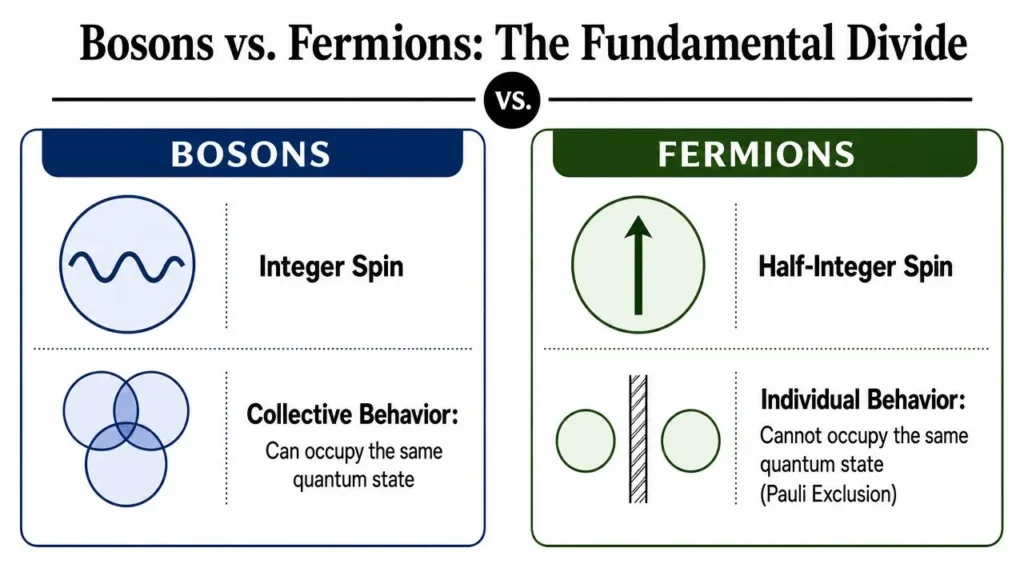
If you like analogies, think of a concert venue.
- Fermions are assigned-seat guests. If a seat is taken, the next person must find another one.
- Bosons are enthusiastic fans at the front rail. If a state is favorable, many can gather there together.
- The result changes the whole crowd. The rule for one particle becomes the pattern for a huge collection.
Bosons vs Fermions at a Glance
| Property | Fermions (The Loners) | Bosons (The Socialites) |
|---|---|---|
| Spin | Half-integer | Integer |
| Sharing a quantum state | Cannot share the same quantum state | Can share the same quantum state |
| Signature rule | Pauli exclusion principle | Bunching into the same state is allowed |
| Big consequence | Builds stable matter structure | Enables collective quantum behavior |
There’s a second layer that physics students eventually meet. It lives in the wavefunction.
In three-dimensional quantum systems, the deeper separator is exchange symmetry. When you swap two identical particles, the many-body wavefunction responds differently. Fermions have antisymmetric wavefunctions, bosons have symmetric ones, and that difference directly determines the counting rules for how they can arrange themselves, as explained by the U.S. Department of Energy’s overview of bosons and fermions.
If the phrase “antisymmetric wavefunction” feels intimidating, keep the physical meaning in view. For fermions, swapping particles builds in exclusion. For bosons, swapping particles allows sharing.
That’s the conceptual heart of the subject.
You can also connect this to nuclear structure. If you want a refresher on how matter is organized at the atomic center before building outward to particle behavior, this plain-language guide to the nucleus of an atom is a helpful companion.
Quantum Crowds How These Particles Behave in Groups
A crowded elevator and an empty concert hall follow very different rules. Quantum particles do too.
The difference between bosons and fermions becomes easiest to see when you stop looking at one particle at a time and watch what happens in a group. Bosons tend to pile into the same state. Fermions are forced to spread out across different states. Those simple social rules shape the large-scale world, from the solidity of matter to the eerie coherence of laser light.
Crowds reveal the rule
Physicists describe these patterns with Bose-Einstein statistics and Fermi-Dirac statistics. The names sound technical, but the physical picture is straightforward.
A bosonic crowd works like people gathering around the best view in a public square. If one spot is especially favorable, more bosons can join it. A fermionic crowd works more like assigned seating in a theater. Once a seat is taken by one identical fermion, the next one has to look elsewhere. In quantum language, the “best view” or “seat” is an available energy state.
That single difference changes everything in a many-particle system.
As more fermions are added, they fill higher and higher states because the lower ones are already occupied. As more bosons are added, many of them can settle into the same low-energy state together. One rule creates layered structure. The other allows striking collective behavior.
Why group behavior changes reality
This is the part that gives the labels boson and fermion their real importance. The names are not just a sorting system for particle physicists. They tell you what matter and radiation can do in bulk.
For fermions, crowding produces resistance to compression and a built-in architecture. Electrons in atoms do not all collapse into one identical state, so atoms develop shells and chemistry gets room to exist. More broadly, ordinary matter stays extended and stable instead of crumpling into a much simpler lump.
Bosons lead to a different kind of drama. Because many can share one state, they can act in sync. That is the basic reason physicists talk about condensates, superfluid behavior, and the coherence behind lasers. A single boson is one quantum particle. A huge collection of bosons can start to resemble one organized quantum wave.
So the “so what?” is concrete. Fermionic crowd rules help make chairs, planets, and your own body stable. Bosonic crowd rules help produce some of the cleanest, most coordinated signals and states in physics.
And this tidy two-category story has limits. In some special systems, especially in reduced dimensions, particles can follow stranger collective rules that are neither the standard boson pattern nor the standard fermion pattern. The basic divide still carries most of the weight, but nature leaves hints that quantum crowds can be even richer than this first binary suggests.
A Particle Bestiary Meet the Bosons and Fermions
A good way to make this abstract divide feel real is to meet the particles themselves, like meeting the characters in a story after learning the rules they must obey.
Fermions build the framework of matter
Start with the particles that give matter its durable structure.
Electrons are fermions. They occupy the allowed quantum states around an atomic nucleus one by one, which is why atoms have layered shells instead of a single blurred arrangement. That simple rule is part of why chemistry has variety.
Protons and neutrons also behave as fermions in ordinary matter. They are composite particles rather than elementary ones, because each is made of quarks held together by gluons. Even so, they still belong to the fermion family in the ways that matter for nuclear structure. For a closer look at those ingredients, see this guide to quarks and gluons.
These are the particles that make the world stack, resist, and hold shape.
Bosons coordinate rather than compete
Bosons play a different role. They often show up as the particles associated with interactions, and their shared-state behavior lets them act in strikingly coordinated ways.
Photons are the bosons of light. Because many photons can occupy the same quantum state, light can become highly ordered rather than remaining a random spray. That possibility sits behind some of the cleanest and most controlled forms of light physicists can produce.
Gluons are bosons too. They belong to the strong interaction and help bind quarks inside protons and neutrons.
Then there is the Higgs boson, famous partly because it confirmed an important piece of the Standard Model and partly because it reminds us that the boson family is broader than “particles of light.”
Composite particles follow the crowd rules too
This is the point where many readers pause. If a particle is built from smaller parts, why should the whole object count as a boson or a fermion at all?
The answer is that a bound system has an overall quantum identity. In many situations, the composite object behaves as one particle, and what matters is the combined effect of its constituents. A nucleus, an atom, or another assembled object can therefore fall into either camp.
Helium gives a beautiful example. Helium-4 behaves as a boson, while helium-3 behaves as a fermion. The ingredients differ only slightly, but the quantum “social rule” of the whole object changes, and that change leads to very different collective behavior under the right conditions.
Composite particles show why bosons and fermions are not just a list of names. They are patterns of behavior that can apply to whole assemblies as well as to elementary particles.
That is part of the deeper lesson of this bestiary. The boson-fermion divide is not only a way to sort the zoo of particles. It is a way to explain why some ingredients of nature build stable matter, while others excel at acting together in unison. And once physicists study more exotic quantum systems, even this tidy split starts to look like the first chapter rather than the whole story.
From Theory to Reality Cosmic and Laboratory Phenomena
The payoff comes when these abstract rules stop sounding abstract.
Fermionic exclusion and bosonic sharing shape the everyday world, the coldest laboratory systems, and some of the densest objects in the cosmos.
Fermions make matter roomy enough to exist
Start with the most ordinary miracle: matter has structure.
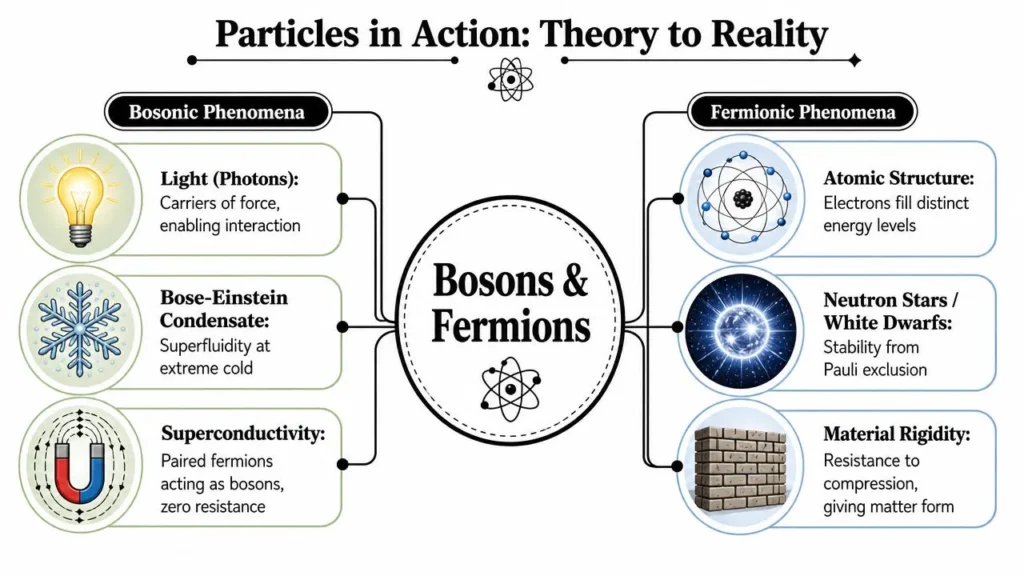
Electrons do not all collapse into the same atomic state because they are fermions. Their exclusion-driven arrangement creates layered atomic structure, and that structured filling is part of why chemistry is rich rather than trivial. Matter also resists compression because identical fermions can’t all be crammed into one quantum state.
That doesn’t just matter for atoms. It scales up.
White dwarfs and neutron stars are famous examples of dense objects where fermionic rules remain central. Gravity pushes inward, but fermionic matter resists unlimited collapse because exclusion prevents identical particles from all occupying the same state. The result is a form of quantum support that matters on an astronomical scale.
Bosons produce collective quantum behavior
Bosons shine in the opposite direction. Because they can share states, they can act together in ways fermions cannot.
Photons provide an intuitive example. Light is bosonic, and coherent light becomes possible because many photons can occupy the same state. That’s one reason lasers feel so different from ordinary scattered light.
At very low temperatures, bosonic atoms can go further and form a Bose-Einstein condensate. The first such condensate was created in 1995 using rubidium atoms cooled to about 170 nanokelvin, and the achievement was recognized with the 2001 Nobel Prize in Physics, as described in this history of Bose-Einstein statistics and condensates.
That experiment mattered because it turned a subtle quantum rule into a macroscopic phenomenon. A large fraction of bosons occupied the same lowest-energy state. Quantum statistics became visible.
Paired behavior and the surprises in between
The story gets even more interesting in materials.
Some striking phenomena, such as superconductivity, are often discussed in terms of coordinated quantum behavior. A useful intuition is that when fermions pair up under the right conditions, the pair can behave collectively in a boson-like way. That opens the door to effects that look much more like collective bosonic motion than ordinary fermionic crowding.
Here’s the big contrast:
- Fermionic outcome: layered structure, stability, resistance to compression
- Bosonic outcome: coherence, condensation, collective occupation of one state
- Mixed or emergent outcome: complex materials where interactions create new effective behavior
Bosons are often the particles of “together.” Fermions are often the particles of “apart.” The world needs both habits.
Without fermions, matter would lose much of its scaffolding. Without bosons, nature would lose some of its most dramatic forms of collective order.
The Future Built on Quantum Rules
The distinction between bosons and fermions isn’t settled history that physicists filed away long ago. It’s part of the working language of modern technology research.
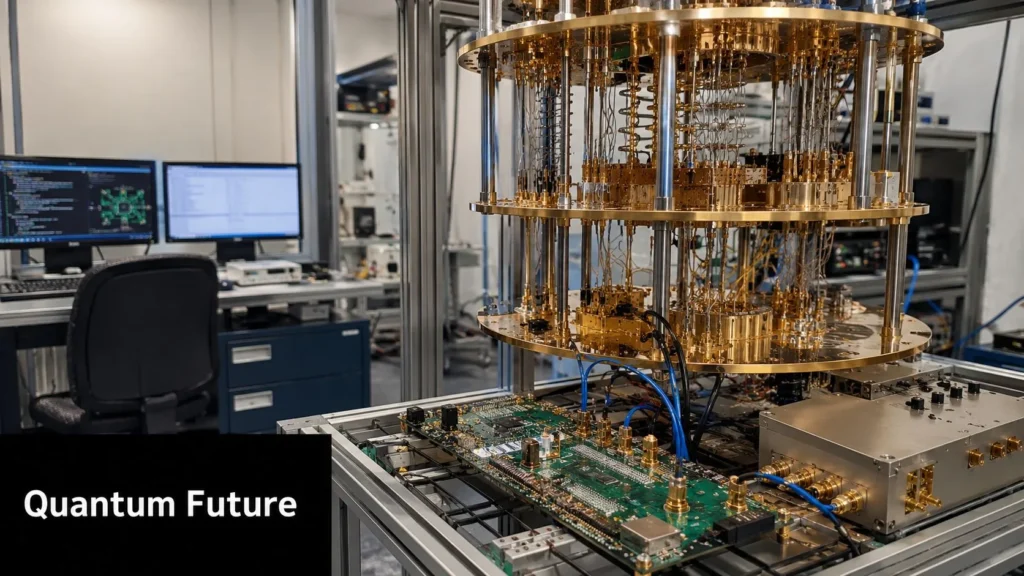
Why engineers care about quantum statistics
Many popular explanations stop at definitions. But what readers usually want is the link to real materials and real devices. Teaching resources still often leave that gap, even though the many-body consequences of these statistics are what make the topic practically important, as noted in this LibreTexts discussion of fermions and bosons in real materials/19:_Atoms/19.01:_Fermions_and_Bosons).
Quantum computing is a good example. Different hardware platforms rely on carefully controlled quantum states, and understanding how particles crowd, exclude, pair, or move collectively is part of the challenge. Researchers don’t just need the word “fermion” or “boson.” They need to know how those statistics reshape the behavior of a full device.
If you want a reader-friendly overview of the broader field, this introduction to quantum computing explained simply is a useful companion.
Materials science lives here too
The same logic drives work on unusual materials.
Superconductivity, superfluidity, and other collective phenomena all depend on how quantum states are occupied and shared. In practice, the future of faster computation, more sensitive measurement, and novel electronic behavior depends on controlling systems where many particles interact under these rules.
A short visual explainer helps if you want to see how physicists frame this frontier:
The broader lesson is simple. If you want to understand the next generation of quantum devices, you can’t stop at particle names. You have to ask how large groups behave, what collective states become possible, and when simple categories start to blur.
Frequently Asked Questions About Bosons and Fermions
Can a particle be both a boson and a fermion
No. In the ordinary three-dimensional setting used in standard introductions, a given particle belongs to one class or the other.
The confusion usually comes from composite objects. A system made from smaller particles can behave overall as a boson or as a fermion, even if its ingredients include both kinds.
Why is helium-4 a boson but helium-3 a fermion
Because composite particles inherit an overall statistical character from their constituent makeup.
The common textbook example is helium. Helium-4 behaves as a boson, while helium-3 behaves as a fermion. That difference is why they show different low-temperature behavior in physics discussions of quantum fluids and gases.
Are bosons just force particles and fermions just matter particles
That’s a useful beginner shortcut, but it’s only a shortcut.
It points you in the right direction because electrons, protons, and neutrons are associated with matter, while photons are associated with interactions. But the deeper truth is statistical behavior, not job title. Composite systems can also join either category.
Is the boson-fermion split the whole story
Not quite.
For ordinary three-dimensional particle classification, the divide is fundamental. But current research in condensed matter often studies quasiparticles and emergent situations where the clean classroom binary becomes more complicated. Advanced discussions ask when effective statistics differ from the underlying particles, how emergent behavior appears, and how some properties depend on scale, as described in this recent discussion of exceptions and scale-dependent behavior.
The beginner’s map is still right. It’s just not the whole territory.
That’s one of the healthiest lessons in physics. Simple categories can be both foundational and incomplete. Bosons and fermions remain essential, but modern research also teaches you where the edges of the simple story start to fray.
If you enjoy clear, approachable science writing like this, maxijournal.com publishes fresh commentary and explainers across science, technology, education, health, arts, business, travel, entertainment, and more. It’s a good place to keep reading, explore new topics, or find inspiration if you’d like to contribute your own writing.
Discover more from Maxi Journal
Subscribe to get the latest posts sent to your email.