Agentic AI is software that sets goals, plans steps, uses tools, and acts on results, rather than just answering a single question. In simple terms, it can turn “help me arrange this trip” into a supervised workflow that researches options, makes decisions within limits, and completes approved actions.
You may already use AI when you ask for a flight recommendation, a summary of your inbox, or a draft reply. The system responds, and you decide what to do next. Agentic AI changes that relationship: you give it an objective, and it can work through connected steps, inspect what happened, and continue or stop based on the result.
That action-versus-response distinction is the easiest way to understand what agentic AI means in simple terms. A chatbot mainly talks about the work. An agentic system can help perform the work.
Your Morning With and Without Agentic AI
It’s 8:10 in the morning, and you need to get to a client meeting in another city. You ask a regular AI assistant, “What’s the best way to travel there tomorrow?” It might suggest flights, trains, departure times, and booking websites. The answer could save you research time, but you still need to compare the choices, check your calendar, enter passenger details, pay, and store the confirmation.
That’s useful assistance, but it’s still a response.
Now give the same objective to an approved agentic system: “Find a reasonable morning flight that fits my calendar, stays within my travel policy, and prepare the booking for my approval.” The system could inspect your calendar, search available flights, compare options, check the policy, identify missing information, and present one or more choices. If you approve the selected option, it could complete the reservation through an authorized service and report the confirmation.

The difference isn’t that one system knows more travel facts. The difference is who carries the workflow forward. With a chatbot, you interpret the answer and perform the next action. With an agent, the software can plan and perform connected actions, subject to permissions and checkpoints.
The same contrast appears in email. A conversational assistant can summarize unread messages or draft a reply. An agentic workflow might identify messages needing attention, group them by urgency, draft responses using approved information, create follow-up tasks, and leave anything uncertain for you.
A useful introduction to AI workflow automation can help you see where this broader pattern fits into everyday work. The important point is simple: agentic AI doesn’t just generate an answer; it works toward an outcome.
What Agentic AI Actually Means
Agentic AI is software that receives a goal, observes relevant information, plans a sequence of actions, uses tools, and adjusts its behavior based on what happens. The OECD’s description of AI agents emphasizes that agents can perceive and act on their environment with some autonomy, use tools, and adapt to changing inputs and contexts.
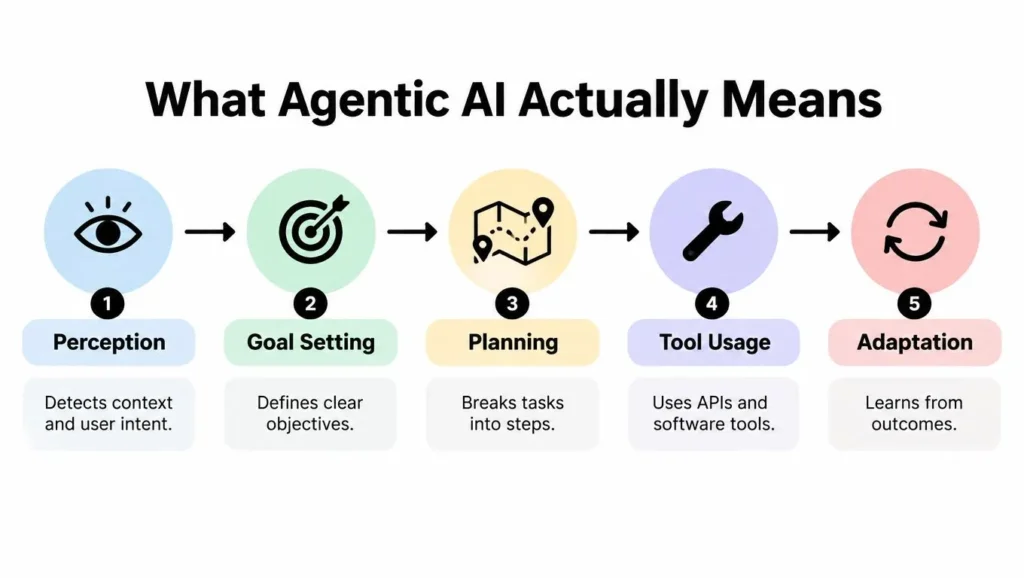
You can think of an agent as a careful digital coordinator. It doesn’t have consciousness, personal intentions, or human judgment. It follows a defined objective through a loop:
- Perception: It gathers context, such as your calendar, an email, a database record, or a search result.
- Goal setting: It identifies the outcome you want, including constraints such as timing, budget, or approval requirements.
- Planning: It breaks the objective into smaller steps and decides what needs to happen first.
- Tool use: It calls approved tools, such as search, business applications, APIs, or databases.
- Adaptation: It examines the result and changes course when information is missing, conditions change, or a step fails.
Suppose you ask an agent to manage a customer inquiry. It might read the message, identify the customer’s request, check the account system, find the relevant policy, draft a response, and route the case if it can’t resolve the issue. Each action depends on information returned by the previous one.
That closed loop makes agentic AI different from a single generated reply. It also explains why machine learning and agentic AI aren’t interchangeable terms. Machine learning describes methods that allow systems to identify patterns or make predictions. Agentic AI describes a broader workflow in which an AI system pursues a goal and takes bounded actions.
A short video can make this relationship between planning, tools, and execution easier to visualize:
The same model can support very different experiences depending on its surrounding software. A language model by itself may produce text. An agentic system adds orchestration, tools, memory, and guardrails, allowing generated reasoning to participate in a decision-and-action loop. For practical examples in customer-facing workflows, resources on AI for lead intake show why collecting information, checking context, and routing the next step can be treated as one connected process.
How Agentic AI Differs From Regular AI
A chatbot usually waits for a prompt and returns an answer. It may be excellent at explaining, drafting, summarizing, or brainstorming, but the user normally remains responsible for turning that answer into action.
An agentic system starts with a broader objective. It can decide which step to take, call a tool, inspect the result, and continue until it reaches the intended outcome or a guardrail tells it to stop.
Consider the travel example in detail. A chatbot might list flights and tell you where to book. An agentic workflow could:
- Read constraints: Check your calendar, travel policy, preferred airport, and stated arrival time.
- Search options: Use an approved travel service to retrieve available routes.
- Compare choices: Evaluate timing, connections, and policy fit.
- Resolve uncertainty: Ask whether a slightly later flight is acceptable if your preference isn’t clear.
- Request approval: Show the selected itinerary before any irreversible purchase.
- Complete the task: Book through an authorized service after approval and save the confirmation.
The output isn’t merely a paragraph about flights. It’s a completed, reviewable travel task.
| Aspect | Chatbot | Agentic AI |
|---|---|---|
| Scope | Responds to a question or instruction | Pursues a broader objective |
| Tool use | May provide guidance about tools | Can call approved tools and services |
| Autonomy | Usually stops after generating a response | Can continue through multiple steps |
| Outcome | Text, suggestions, or a draft | A completed or partially completed workflow |
| Human role | Interprets and executes the next step | Sets boundaries, reviews decisions, and approves sensitive actions |
The architecture behind the agent matters. A U.S. government definition of AI agents describes systems that include at least one generative AI model plus software scaffolding for discretionary actions through tools. That scaffolding can also support several cooperating sub-agents.
In practice, the model is only one component. Orchestration software decides how tasks progress, tool interfaces connect the system to external services, memory preserves relevant context, and guardrails limit what the agent can do. Without those parts, a model may describe an action without being able to perform it.
Practical rule: Ask whether the system can change something outside the chat, not only whether it can produce a convincing answer.
That question quickly separates a conversational feature from an agentic workflow. A system that drafts an email is acting like an assistant. A system that selects recipients, checks policy, sends the message, records the action, and schedules a follow-up is operating agentically.
Where Agentic AI Comes From
Agentic AI didn’t appear from nowhere with modern generative tools. Researchers explored software agents for decades, focusing on systems that could operate in an environment instead of calculating one isolated answer.
The history of AI agents traces the idea through earlier work and explains that researchers in the 1980s and 1990s increasingly used “agent” for systems designed to do things in an environment. In 1995, Stuart Russell and Peter Norvig described agents as systems that operate autonomously, perceive their environment, persist over time, adapt to change, and pursue goals.
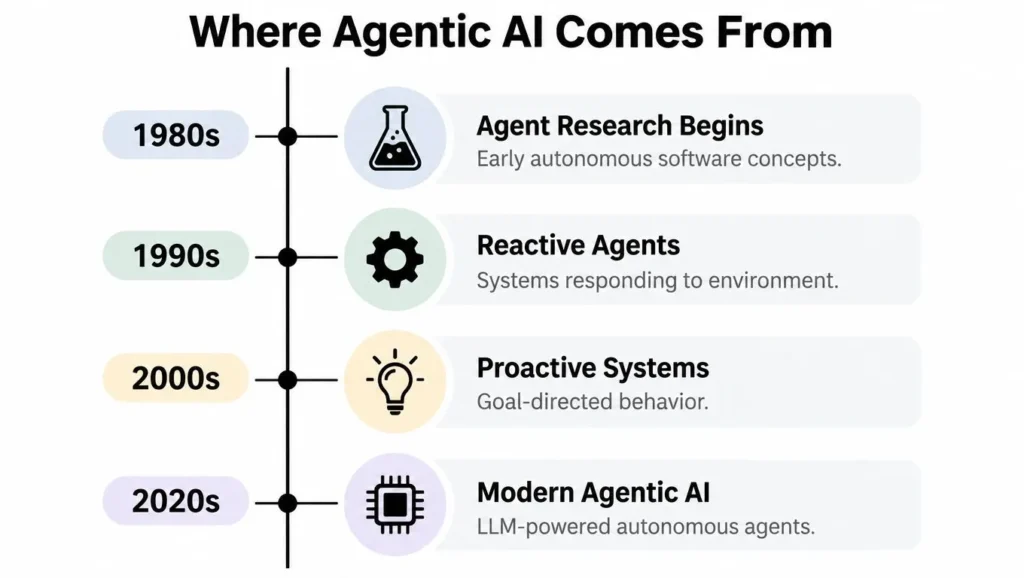
Earlier systems supplied pieces of the same ambition. The General Problem Solver emerged in 1959, A* pathfinding was developed in 1968, and SHRDLU appeared in 1971. Those projects weren’t modern agentic products, but they explored problem solving, navigation, language, and action in constrained environments.
The newer shift comes from accessibility and scale. Large language models can interpret natural-language goals, work with less rigid instructions, and help select among available tools. Cloud services and business applications give those systems places to search, read, update, and report.
That doesn’t erase the older lessons. An agent still needs a clear objective, information about its environment, feedback from its actions, and limits on what it may change. Modern systems make the workflow easier to assemble, but they don’t remove the need for design.
Agentic AI is better understood as an evolution of goal-directed software than as a sudden replacement for ordinary chatbots.
This historical view also reduces hype. The central idea has remained consistent: perceive, decide, act, and respond to feedback. What changed is that natural-language interfaces and powerful language models made those capabilities easier to connect to everyday workflows.
Real Capabilities and Useful Examples
Agentic AI is most practical when a task has a recognizable objective, several connected steps, and approved systems the software can access. It doesn’t need to control everything. A narrow workflow can still be useful if it removes repeated handoffs while keeping a person responsible for important decisions.
Email management offers a clear example. An agent could read incoming messages, classify them by topic, identify requests that need a reply, retrieve relevant account information, draft responses, and create follow-up tasks. You might allow it to label and organize messages automatically while requiring approval before it sends anything externally.

Other useful scenarios include:
- Research assistance: Gather information from approved sources, compare findings, identify gaps, and produce a documented brief.
- Customer support: Read an inquiry, check the customer record, apply the relevant policy, draft an answer, and escalate cases that require judgment.
- Scheduling: Compare calendars, account for constraints, propose a suitable time, and send an invitation after confirmation.
- Operational reporting: Collect data from connected systems, check for missing values, prepare a recurring report, and flag unusual results for review.
- Sales administration: Update records after a call, identify the next action, prepare a follow-up, and leave sensitive changes for a sales representative.
Teams evaluating customer workflows may also find it helpful to examine an AI-driven CRM for sales teams, especially when they’re deciding which actions belong in an automated sequence and which should remain with a person.
The strongest use cases have clear inputs, repeatable steps, visible evidence, and reversible actions. An agent can help prepare a document, but a person may still need to verify the facts. It can suggest a support route, but a manager may need to handle an unusual complaint.
A workflow doesn’t become safe merely because it saves time. The more systems an agent can access, the more carefully its permissions and decision points need to be designed.
Trust, Risk, and Human Oversight
The difficult question isn’t only “Can the agent complete the task?” It’s “Who is accountable when it completes the wrong task successfully?”
A chatbot can make one incorrect statement. An agent can treat that statement as a premise, use it in a plan, call several tools, update records, and continue before anyone notices. In a multi-agent setup, one incorrect command can cascade through the wider workflow.
A 2026 study on controllability and AI incidents reviewed documented incidents and reported that approximately 78% were associated with insufficient human oversight. The same study found that 62% of surveyed respondents distrusted highly autonomous systems. These figures concern reported incidents and governance stakeholders, not every AI deployment, so they should be interpreted cautiously.
The practical lesson is not to reject autonomy. It’s to make autonomy bounded and observable.
Controls that make action safer
- Limit permissions: Give the agent access only to the data and tools needed for its assigned task.
- Use checkpoints: Require confirmation before purchases, external messages, deletions, or other difficult-to-reverse actions.
- Keep activity logs: Record the plan, tool calls, results, and changes so a reviewer can reconstruct what happened.
- Prefer reversibility: Start with drafts, proposed updates, labels, and queued actions rather than immediate destructive changes.
- Define stop conditions: Make the agent pause when information conflicts, confidence is low, or a request falls outside policy.
- Test realistic failures: Check what happens when a search returns incomplete data, a calendar changes, or a tool becomes unavailable.
Accountability belongs to the people and organizations that deploy the system, not to the software alone.
Human oversight doesn’t mean approving every trivial action forever. It means deciding which actions can run automatically, which require review, and how someone can stop or reverse the workflow. A well-designed agent should make those boundaries visible instead of hiding them behind a polished chat interface.
For a broader view of responsible implementation, this guide to AI ethics and governance provides useful context around accountability, transparency, and organizational controls.
Key Takeaways and What to Expect Next
The simplest definition is also the most useful: agentic AI is goal-directed software that can plan and act. A regular chatbot primarily responds to a prompt. An agentic system can use that response as part of a longer process involving context, tools, decisions, feedback, and an eventual outcome.
Travel booking makes the distinction visible. Asking for flight suggestions is conversational. Searching available options, checking your constraints, requesting approval, completing the reservation, and returning the confirmation is agentic. Email management follows the same pattern when the system moves beyond drafting and begins classifying, retrieving information, creating tasks, and executing approved follow-ups.
Keep these principles in mind when judging an agentic product:
- Look for the action loop: Can it observe results and decide what to do next?
- Inspect the tools: Which applications, databases, or services can it access?
- Ask about boundaries: Can you restrict permissions and require approvals?
- Demand visibility: Does it show plans, tool calls, decisions, and errors?
- Start with a narrow workflow: Choose a task with clear inputs and a measurable human review process.
- Keep ownership human: Let the system handle bounded execution, while people remain responsible for policy, judgment, and consequences.
The technology is useful precisely because it isn’t magic. It combines a model with software that coordinates steps, connects tools, stores relevant context, and enforces limits. Those surrounding controls often matter as much as the model’s ability to write fluent text.
Adoption should therefore be practical rather than theatrical. Begin with a workflow such as inbox triage, research preparation, scheduling, or report assembly. Let the system propose actions first, review its logs, tighten its permissions, and expand its role only after the process behaves reliably.
Agentic AI won’t remove the need for clear goals or careful decisions. It makes those requirements more important because the system can carry decisions into the outside world.
Maxijournal.com publishes approachable writing about science, technology, business, education, travel, and many other subjects for readers who want useful ideas without unnecessary jargon. Visit maxijournal.com to discover fresh articles and practical explanations that help you make sense of changing technology.
Discover more from Maxi Journal
Subscribe to get the latest posts sent to your email.