You’ve got an album queued, a release date that’s already passed, and a draft that keeps sliding into a track-by-track summary. The sentences you’ve written so far mention warm production and honest vocals, and you can hear the press release talking.
The test I apply to every draft is a reader who has never learned a musical term. If that reader finishes the piece and can tell a friend what you heard and why it mattered, the review works. If the only thing they can repeat back is that the production is warm, it doesn’t.
Learning how to write music reviews is mostly learning to make that case in public without hiding behind vocabulary. That means a fixed structure, two deliberate listens, adjectives backed by moments, a plain-English layer for the jargon you can’t avoid, and a rating that arrives last, after the reasoning is already on the page. None of it is complicated. All of it has to be done in order.
The Four-Part Structure Every Music Review Needs
| Part | What It Covers | Typical Words | Example Focus |
|---|---|---|---|
| Lead | Verdict and thesis in one or two sentences | 40-60 | The album’s main strength and its main weakness |
| Context | Artist, release, format and listening conditions | 60-100 | Debut LP heard on headphones and then on speakers |
| Analysis | Two to four concrete musical features with evidence | 120-160 | Vocal phrasing, arrangement density, drum pattern |
| Evaluation | Overall verdict, limits and the intended listener | 40-60 | Recommended for slowcore fans, skip if you want upbeat pop |
Four parts, one order, every time. The lead earns the read. Two sentences on what the record is and whether it works, so a reader who stops there still knows your verdict and has a reason to continue.
The context paragraph lets the reader judge your listening. Name the artist, the release, the format (stream, vinyl, download) and the conditions (headphones on a commute, monitors in a treated room, laptop speakers). That paragraph is also where you say whether you knew the artist before, because familiarity changes what you hear.
Analysis is the part lazy drafts skip and the only part that makes a verdict credible. Two to four features, each with a moment attached. The evaluation answers the question the reader has: who should buy it, who should skip it. Keep it to one or two sentences and resist hedging.
Length should serve the argument, not the other way round. Archival research into British music criticism found that in the week beginning 6 June 1946, The Times published seven live reviews of roughly 300 words each, and that individual reviews across the period ran from approximately 230 words to nearly 650. Those numbers still split cleanly: 50 words of lead, 80 of context, 120 of analysis, 50 of evaluation. The study of press coverage and music criticism makes the useful point that space limits forced critics to pick evidence over inventory.
A lead you can defend: “Recorded on a laptop and tested on headphones, this debut is a slow, patient record whose best moment is a drum fill that arrives one bar late.”
Notice what that lead does. It names the conditions, sets a tempo of its own, and points at a specific event. The analysis then has somewhere to go: “The vocal enters a half beat behind the guitar in every verse, which makes the chorus feel like a release rather than a repeat.”
The same discipline holds when the subject is one night instead of one record. Live writing lives or dies on specific moments rather than atmosphere, which is what makes showbiz commentary on Montreux performances worth studying as a model: it stays anchored to what happened on the stage rather than to reputation. If you want to see the structure outside music altogether, the independent film reviews on Maxi Journal open with a verdict and build the case afterward.
Write the lead first. A verdict you can say in one sentence keeps every later paragraph pointed at the same target.
How to Listen Twice and Take Notes
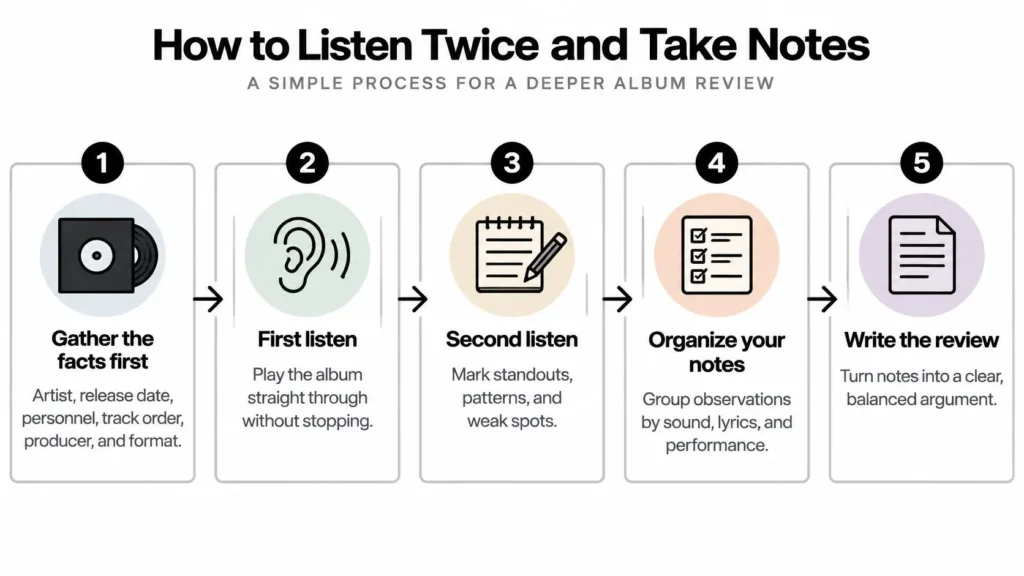
This is the routine, in order, and each step exists to stop a specific failure.
- Gather the facts before you press play. Artist, release date, personnel, track order, producer, and the format you’re hearing. Two minutes of prep stops you writing a paragraph about a bassist who isn’t on the record.
- First listen, descriptions only. Timestamped and physical: “0:47 vocal enters a bar late,” “2:10 drums drop out,” “3:02 second guitar double-tracks.” No adjectives yet, because the first pass is for collecting evidence, not for delivering judgement.
- Let the first reaction cool. A verdict formed thirty seconds after the final chord is a mood. An hour, or a day, is usually enough to tell the difference between a record that moved you and one that ended loudly.
- Second listen, shuffled. Random order breaks the sequence effect, where a strong opener flatters everything behind it. This is the pass where each evaluative claim gets tested against a moment you can point to.
- Revisit what you disliked. The track you skipped is often where the record’s real argument sits, and it’s the first place a review written from memory goes wrong. Skipping a song because it’s quiet, then calling the album slight, is a common and embarrassing error.
- Label each note. Mark every statement as preference or evidence-based judgement before drafting. Both belong in a review, but only one can carry the verdict.
Your own familiarity is a variable, not a neutral backdrop. A cross-genre listening study that used 356 excerpts with 701 participants in the United Kingdom and United States collected ratings for familiarity, enjoyment, emotional valence, arousal and perceived contrast after randomized listening. Randomize, then record what you already knew.
Readiness test: If you can’t point to two timestamps behind a claim, that claim isn’t ready to publish.
Turning Adjectives Into Evidence
“Beautiful” tells a reader nothing. “Energetic” tells them less. Both become criticism only when a following clause names something the reader could hear too, such as harmonic pacing, vocal phrasing, stereo placement, rhythmic articulation, dynamic range or arrangement density.
A systematic study of professional Beethoven-recording criticism identified the activities that recur in serious reviews, including evaluation, descriptive judgement and factual information, along with seven evaluation criteria worth borrowing. The Frontiers in Psychology analysis of recording criticism is a useful checklist because it names what critics weigh, rather than what they say they weigh.
| Criterion | Question to Ask | Evidence to Cite |
|---|---|---|
| Interpretation | Does the performance match the material? | Tempo choices and phrasing decisions |
| Technical execution | Are the parts played and sung cleanly? | Pitch control and rhythm section tightness |
| Coherence | Do the tracks belong together? | Sequencing and recurring motifs |
| Originality | What does it add to its genre? | Unusual instrumentation or structure |
| Communication | Is the message clear to the listener? | Lyric delivery and mix clarity |
| Expressive effect | What does it make a listener feel? | Dynamic shifts and moments of silence |
| Overall achievement | Does it succeed on its own terms? | Verdict tied to two named features |
You don’t run all seven on every release. Pick the two or three that decide this record and say why the others don’t matter here. A 40-minute album of two-chord songs probably stands or falls on interpretation and expressive effect, not on technical execution.
Here’s how the conversion works in practice. The weak version says the record is beautiful and energetic. The revised version says the singer holds back on the chorus, staying close to the melody while the drums push forward, so the lift arrives only when the strings come in. One sentence describes; the other criticizes, and the reader can hear the difference.
The editing rule that follows from this is mechanical. Every major verdict should trace to more than one specific observation, and the writer should keep what the recording does separate from whether they personally like it.
Read each sentence that contains an adjective and ask which sound, moment or arrangement decision proves it. If there’s no answer, cut the adjective.
Writing for Readers Who Don’t Know the Jargon
A listener can hear that a chorus feels bigger without knowing the word “arrangement.” Write for that listener first. Explain what changed in the sound, then use the musical term if it helps name the choice.
Choose the reader you have in mind: a longtime fan familiar with the artist’s previous album, a casual listener following a playlist, or someone hearing the artist for the first time. The Duke University guide to writing about music advises against blow-by-blow analysis in favor of a focused argument built from selected details. Keep that focus, and explain any term a newcomer may not know.
Use a plain-English translation alongside the jargon:
- Production: how the recording sounds, including the space around instruments, their relative volume, and the effects on them.
- Arrangement: which musical parts play and when they enter.
- Vocal delivery: how the singer uses their voice, including phrasing and intensity.
- Rhythm: how the beat moves and where the words sit against it.
- Lyrics: what the words say and how they fit the melody.
For example, “the arrangement builds” names a technique, but “the strings join the chorus for the first time, making it feel fuller” lets any reader hear the change. Use the technical term when it adds precision. Translate it immediately when it could leave a reader guessing.
The same plain language helps when describing how independent artists present their work online. A discussion of an artist’s release and public identity can point readers to sharpening your SoundCloud channel identity, without assuming they know the platform’s jargon.
Read each paragraph as someone unfamiliar with music terminology. Can that reader tell what happened in the song and why it matters? If not, replace the label with a description of the sound.
Rating Systems and Disclosing Context
A reader sees a four-star rating before the argument beneath it. Choose a format that suits the outlet, then make the prose explain the judgment.
| System | How It Works | Best Use | Main Limit |
|---|---|---|---|
| Five stars | Whole stars from one to five | Quick reader scanning | Hides the reasons behind the score |
| Ten-point score | Decimal score out of ten | Comparing many releases in one list | Implies precision the criteria cannot support |
| Letter grade | A to F with optional plus or minus | Ranking albums in a year-end list | Feels like school grading and flattens nuance |
| Recommend or skip | Yes or no with a one-line reason | Helping a reader decide quickly | Gives no sense of degree |
Ratings compress a judgment; the trade-off is speed for detail. A historical account of music criticism’s first two and a half centuries notes that The Gramophone used star ratings for jazz and swing from 1936. Stars are quick to scan, but the prose must show what they leave out.
Give readers the context they need to interpret your verdict: your familiarity with the artist and genre, the listening conditions, and the criteria behind the score. Say whether you heard the full album or only a promotional excerpt. Headphones, a car stereo and a laptop speaker can reveal different qualities, so describe what shaped your judgment.
Streaming also affects how listeners encounter an album. In 2023, 73% of surveyed people said they listened to music through licensed audio-streaming services, according to IFPI’s Engaging with Music report, which surveyed more than 43,000 people across 26 countries. Tell readers whether you assessed the album as a sequence or heard tracks in a shuffled or playlist context.
Put disclosure near the top, in one clear sentence. Sponsored content, affiliate links and conflicts of interest must be clearly disclosed on Maxi Journal.
Write the argument first, then assign the number. If the score and the evidence disagree, change the score.
Editing and Formatting Checklist
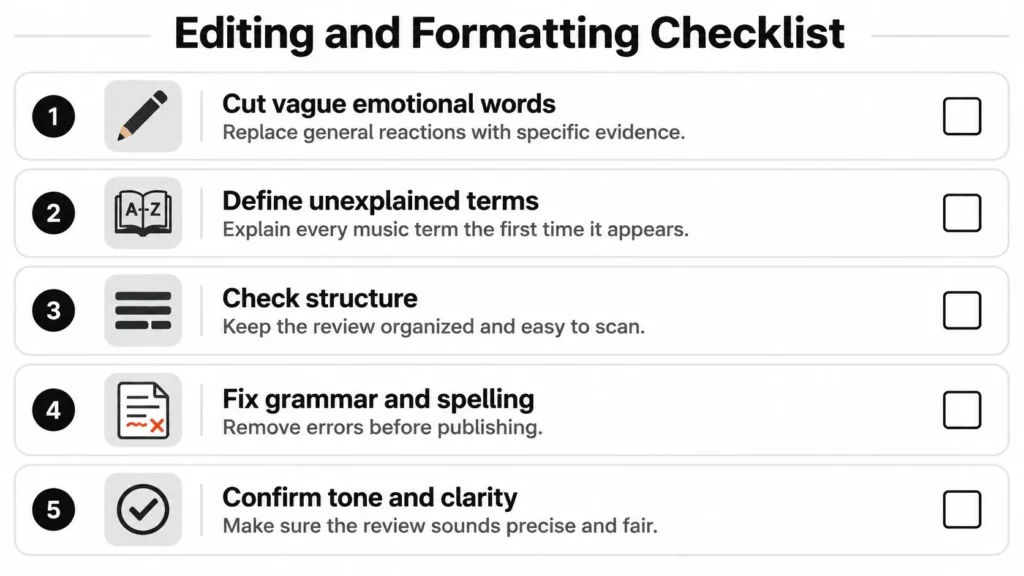
Use this checklist after the review’s structure and listening notes are in place. Check each item once, then read the draft straight through.
Language
- Replace vague emotional words with evidence. If you call a song restless, point to the clipped rhythm or abrupt changes that create that feeling.
- Translate technical terms on first use. Explain what the term sounds like in plain English without flattening the criticism.
- Cut repeated setup. If a paragraph restates the lead without adding evidence, remove it.
- Match the verdict to the argument. The score should reflect the strengths and limits described in the review.
Quotation and attribution
- Quote briefly and identify the source. Use lyrics or other passages only when they support your point, and name the artist and track.
- Use quoted material fairly. Maxi Journal uses quotes, excerpts and clips for criticism, commentary or news reporting when they are attributed to the original source, limited in quantity, and used for criticism, commentary or news reporting.
- Credit reused Maxi Journal content. Include the bylined author’s name, a link to the original article when published online, and the publication date.
Formatting and search
- Name the artist and release in the headline. A clever headline still needs to tell readers what the review covers.
- Give readers the album name and verdict early. Put both in the first 150 words so someone arriving from a feed can quickly grasp the subject and argument.
- Use subheads to mark changes in the review. Keep paragraphs to two or four sentences so the draft stays easy to scan on screens and in feeds. For more practical guidance on shaping a readable draft, see Maxi Journal’s blog writing tips.
- Write a specific meta description. Name the album and state the verdict rather than promising a vague look at a new record.
Final pass
Read the draft aloud to catch repetition and clumsy phrasing. Then check whether a reader unfamiliar with the artist or genre can follow the argument, including any music terms, without having heard the album.
Pitch Your First Review to a Music Blog
A useful pitch lets an editor understand the review before opening a draft. Put the artist and release first, then give the release date, the format you reviewed, your one-sentence verdict, the target word count, and the angle. An angle aimed at readers new to an independent music scene gives the pitch a clear audience and purpose.
Subject: Review pitch, [artist], [album], out [date]
I’d like to review [album] at 600 words. I listened to the full record on headphones and then on speakers. My verdict is that it’s a patient, quiet debut whose best songs are the two that never resolve. My angle is a guide for readers who’ve never listened to this scene before, with production terms explained as they come up. I can send the full draft within a week.
Send the pitch to the right place. Check the publication’s contributor or submissions page first; if there isn’t one, use its contact form. Maxi Journal welcomes anyone with something to say who wants a chance to be published. Creators and authors can also publish unique articles there or promote an upcoming book or music album.
Be ready to provide credit details and a writing sample. Maxi Journal credits original authors with a byline at the top of the article, an author bio if provided, links to author profiles or websites, and their name in social media shares. Keep a finished review ready to send. If you are promoting your own work, an electronic press kit can gather a bio, press photo, and links in one place.
To find other potential outlets, browse this list of independent music blogs and shortlist publications that cover the artist or genre.
Set a deadline and send the pitch. Choose an album released this month, finish the review, and submit your proposal within 48 hours.
Maxi Journal is an independent magazine that publishes writing across arts, science, technology, tourism, and other subjects. Its contributors can pitch an album review or a broader piece about an artist. Visit maxijournal.com to see what it publishes and find a way to get your work considered.
Discover more from Maxi Journal
Subscribe to get the latest posts sent to your email.