Deep inside every single atom, you’ll find its command center: the nucleus. It’s an incredibly tiny, unbelievably dense core that contains almost all the atom’s mass and its entire positive charge.
Think of an atom as a massive sports stadium. If that’s the case, the nucleus would be nothing more than a single marble sitting right on the 50-yard line. Yet, that tiny marble accounts for over 99.94% of the stadium’s total mass. It’s the definition of small but mighty.
Inside the Atom’s Tiny Heavy Core
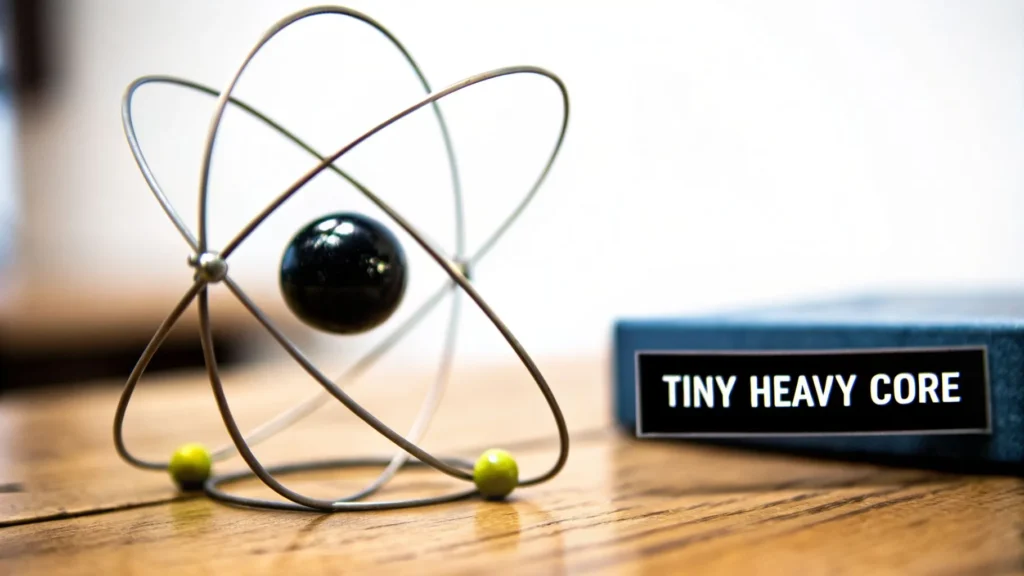
So, what’s packed into this minuscule space? The nucleus is made of two main particles, which scientists lump together and call nucleons.
- Protons: These are the particles with a positive charge. The number of protons is what gives an element its identity. For instance, an atom with six protons is always carbon. No exceptions.
- Neutrons: As their name suggests, these particles are neutral—they have no charge. They add mass and, crucially, act like a sort of nuclear glue, helping to hold the positively charged protons together, which would otherwise fly apart.
The mind-boggling forces holding this core together dictate an element’s stability and its potential to be radioactive. These fundamental rules of the subatomic world are the bedrock for incredible technologies, from nuclear energy to the strange and fascinating principles of quantum physics. If you’re curious how we’re tapping into these properties, check out our guide on quantum computing explained simply.
The sheer density of the nucleus is almost impossible to wrap your head around. If you could somehow isolate the material that makes up a nucleus, a piece the size of a sugar cube would weigh more than all of humanity combined.
To get a clearer picture, it helps to see how the main atomic players stack up against each other.
Subatomic Particle Quick Comparison
Here’s a quick rundown of the three fundamental particles that make up a standard atom.
| Particle | Relative Mass | Electric Charge | Location in Atom |
|---|---|---|---|
| Proton | ~1 | +1 | Nucleus |
| Neutron | ~1 | 0 | Nucleus |
| Electron | ~1/1836 | -1 | Orbiting Nucleus |
As you can see, protons and neutrons are the heavyweights, while the electrons orbiting the nucleus are incredibly light in comparison.
The Discovery That Redefined Reality
Before 1911, scientists had a pretty comfortable idea of the atom. They pictured it as a “plum pudding,” a model put forward by J.J. Thomson. The idea was simple: the atom was a soft, positively charged sphere with negatively charged electrons dotted throughout, sort of like plums in a pudding. It was a tidy theory that explained why atoms were electrically neutral.
But that cozy picture was about to be completely demolished. An experiment was underway that would deliver results so bizarre, so utterly unexpected, that it forced a complete rewrite of our understanding of matter itself.
A Cannonball Bounces Off Tissue Paper
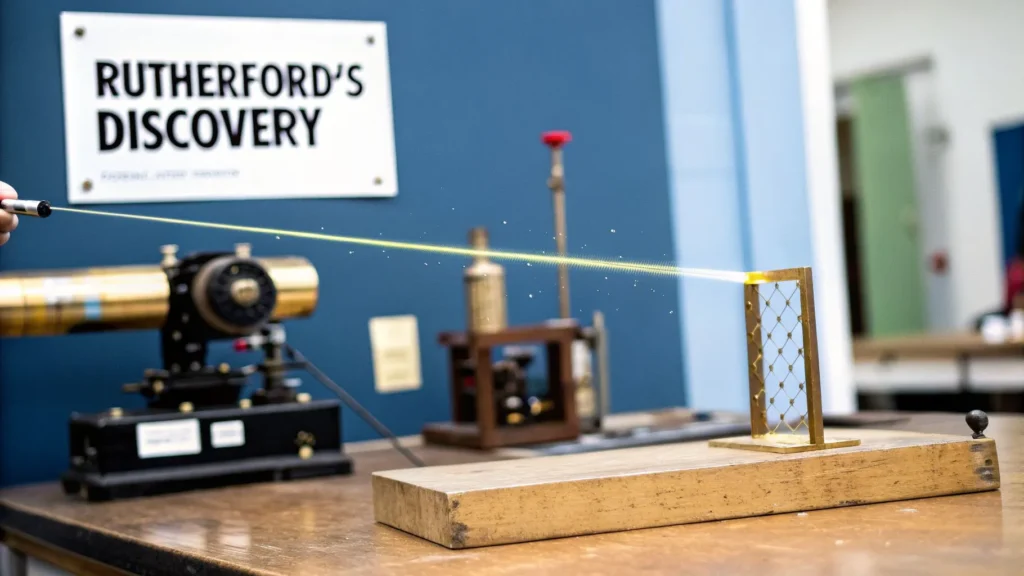
Physicist Ernest Rutherford, along with his colleagues Hans Geiger and Ernest Marsden, decided to put the plum pudding model to the test. Their plan was to fire a beam of tiny, positively charged alpha particles at a sheet of gold foil that was mind-bogglingly thin. If the plum pudding model was right, these particles should have sailed straight through.
And most of them did, just as expected. But then came the shock. A small number of particles were deflected at wild angles. Even more strangely, about 1 in 8,000 particles bounced almost straight back.
Rutherford was floored. He later famously said it was “almost as incredible as if you fired a 15-inch shell at a piece of tissue paper and it came back and hit you.” You can dig deeper into this landmark event by exploring this history of nuclear science.
That single observation made the plum pudding theory obsolete overnight. For a tiny alpha particle to be thrown backward so violently, it must have slammed into something incredibly small, incredibly dense, and also positively charged. The fluffy “pudding” just couldn’t do that.
Rutherford’s experiment proved the atom wasn’t a uniform ball of fluff. It was mostly empty space, with almost all its mass and positive charge crushed into a tiny point at the center. This was the first real evidence of the nucleus of an atom.
A New Model of the Atom Emerges
The gold foil experiment gave Rutherford the evidence he needed to propose a radical new structure for the atom. He concluded there must be a central core—the nucleus—that contained all the positive charge and nearly all the mass. The electrons, he figured, must be orbiting this nucleus from a great distance, like planets circling a sun.
This new “planetary” model explained everything perfectly:
- Most particles passed through: Since the atom is mostly empty space, the vast majority of alpha particles simply missed the tiny nucleus.
- Some particles were deflected: Particles that passed close to the positive nucleus were repelled by its charge and pushed off course.
- A few bounced back: The very few particles that were on a direct collision course with the dense, massive nucleus were repelled with enormous force, sending them flying backward.
This was a monumental leap forward. Rutherford established that over 99.9% of an atom’s mass is concentrated in an impossibly small core, forever changing our view of the universe’s most basic building blocks.
Inside the Nucleus: Meet the Protons and Neutrons
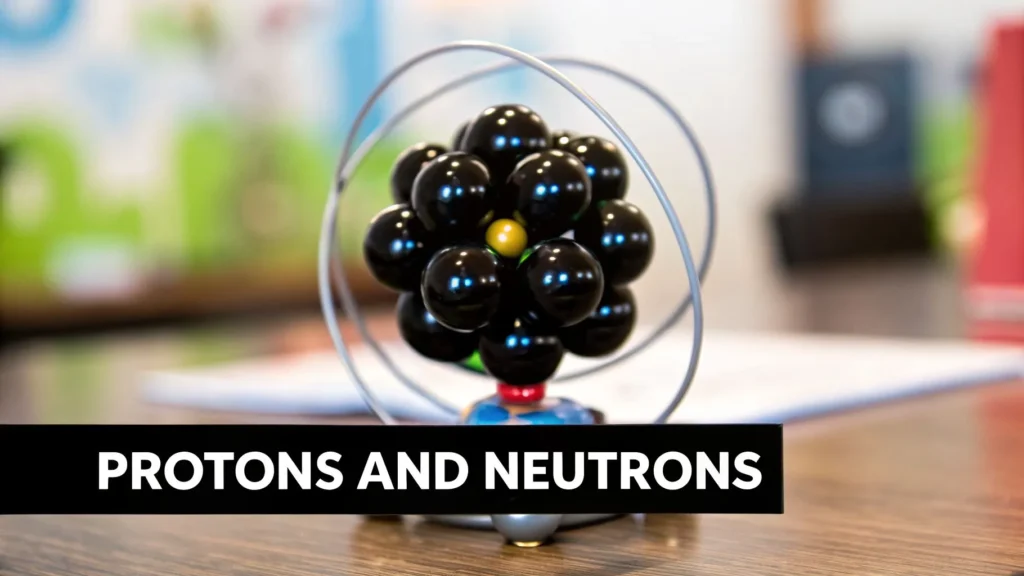
Once scientists confirmed the atom had a tiny, dense core, the next question was obvious: what’s actually in there? The nucleus of an atom isn’t just one solid thing. It’s packed with two types of particles, known together as nucleons.
These residents are the protons and neutrons, and they’re responsible for nearly everything that makes an atom what it is—from its identity to its stability.
Protons: The Atomic Fingerprint
You can think of protons as an atom’s unchangeable ID card. Each proton carries a single positive electric charge, and the number of them in a nucleus—its atomic number—is what defines an element. It’s a simple, unbreakable rule.
One proton always means you have hydrogen. Six protons, and you’re looking at carbon. This positive charge from the protons is also what keeps the negatively charged electrons locked in orbit around the nucleus. But this brings up a huge problem. If the nucleus is full of positive protons, they should be repelling each other with incredible force. Why doesn’t it just blow itself apart?
That’s where the other resident, the neutron, comes in to play the role of peacemaker.
The discovery of the neutron in 1932 by James Chadwick completely changed our understanding of the atom. It solved the long-standing mystery of why atoms of the same element could have different masses and, more importantly, how the nucleus managed to stay in one piece.
Neutrons: The Nuclear Peacemakers
Neutrons are electrically neutral, just like their name suggests. Since they have no charge, they don’t feel the repulsive force from the protons. Instead, they add mass to the nucleus and contribute to the powerful binding force that glues everything together, overpowering the protons’ urge to fly apart. Think of them as the essential buffer keeping the peace in a very crowded neighborhood.
Chadwick’s brilliant discovery was the result of bombarding a thin sheet of beryllium with alpha particles. This process kicked out a mysterious form of radiation that had no charge. He correctly deduced that this radiation was made of particles with almost the same mass as a proton, but with zero charge. He had found the neutron. You can read more about this key moment on the Department of Energy’s historical archive.
This breakthrough also provided the final piece of the puzzle to explain isotopes—versions of the same element with different numbers of neutrons.
A perfect example is carbon:
- Carbon-12: The most common form of carbon, it has 6 protons and 6 neutrons. It’s perfectly stable.
- Carbon-14: This version has 6 protons but 8 neutrons. The two extra neutrons make it unstable and radioactive.
That tiny difference—just two extra neutrons—is what makes Carbon-14 so useful for radioactive dating, helping scientists figure out the age of everything from ancient bones to historical artifacts. This constant interplay between protons and neutrons is the secret to the diversity and stability we see in the universe.
The Cosmic Glue Holding It All Together
So, we have this tiny, impossibly dense nucleus packed full of positively charged protons. Basic physics tells us that like charges repel. So what’s stopping every atom in the universe from instantly blowing itself apart?
The secret is a force that acts like the universe’s most powerful superglue: the strong nuclear force. It’s incredibly powerful, but there’s a catch—its grip only works over ridiculously short distances, about the width of a single proton.
An Epic Tug of War
Think of it as a constant battle raging inside the nucleus. The electromagnetic force is always trying to shove the protons apart. At the same time, the strong nuclear force is pulling both protons and neutrons together, easily winning the fight as long as everyone stays close.
This is where neutrons become absolutely crucial. They add to the “glue” of the strong force without adding any of the repulsive electromagnetic force, acting as essential stabilizers.
This cosmic tug-of-war between the strong nuclear force and electromagnetism is what determines the fate of every atomic nucleus. A stable nucleus has found a perfect balance, while an unstable one is destined for radioactive decay.
The sheer amount of energy involved in holding a nucleus together is staggering. We call it nuclear binding energy, and it’s the energy you would need to expend to rip a nucleus apart into its separate protons and neutrons.
The Energy Locked Inside the Nucleus
So where does all this binding energy come from? It’s a real-world application of Albert Einstein’s famous equation, E=mc². When protons and neutrons bind together to form a nucleus, a tiny amount of their combined mass vanishes, converted directly into energy. This “missing” mass is known as the mass defect.
Believe it or not, a complete nucleus is actually lighter than the sum of its individual parts. That lost mass has become the very energy that now holds it together. This single principle is the key to the immense power unleashed in nuclear reactions.
- Fission: When you split a heavy, somewhat unstable nucleus like uranium, the smaller pieces that result are more tightly bound. This means their total mass is less than the original atom, and that mass difference is released as a tremendous burst of energy.
- Fusion: This is the reverse process. When you force light nuclei like hydrogen to fuse together, the new, heavier nucleus is also more tightly bound. Once again, the mass difference is converted into an even more colossal release of energy—it’s the very process that powers our sun.
Why Some Atoms Are Stable and Others Decay
That constant push-and-pull between the strong nuclear force and electromagnetism brings up a great question: Why can a carbon atom’s nucleus stick together for billions of years, but a uranium nucleus is basically guaranteed to fall apart? It all comes down to the delicate balance between its protons and neutrons.
Think of it like a recipe. For a stable nucleus, especially in lighter elements, you need the right ingredients in the right amounts. The perfect ratio is about one neutron for every proton. A carbon-12 nucleus, with its 6 protons and 6 neutrons, is the gold standard for this kind of stability. It’s a combination that just works, lasting for ages without changing.
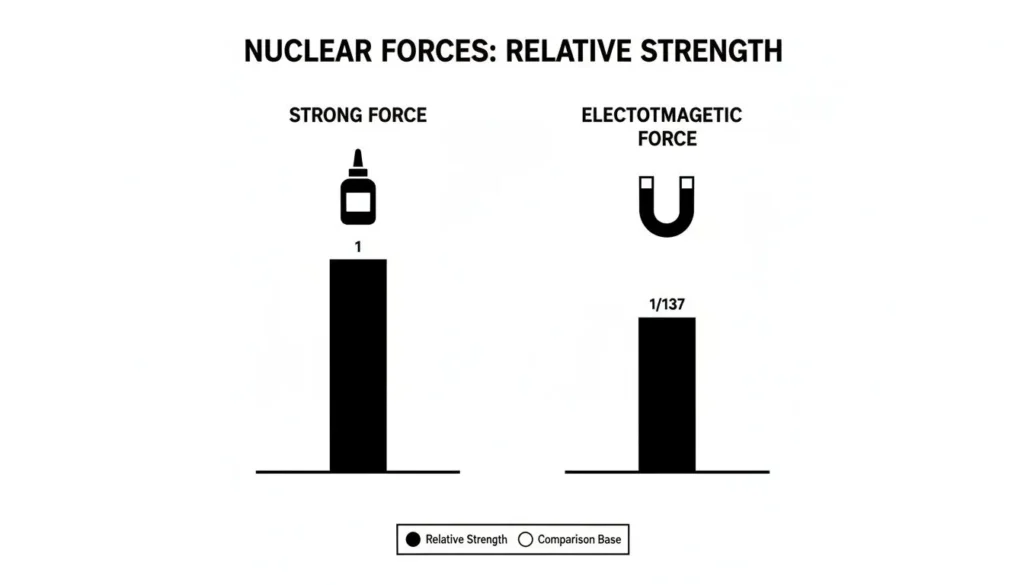
As you can see, the strong force is a powerhouse compared to the electromagnetic force. But its incredibly short range is the kicker—it’s what makes that proton-to-neutron balance so critical. Get the numbers wrong, and the whole thing becomes unstable.
The Band of Stability
As atoms get bigger and pack in more protons, things get crowded. The electromagnetic repulsion builds up, so you need more and more neutrons to act as a buffer and add to the “glue” of the strong force. If you plot all the known stable isotopes on a chart, you’ll see they fall within a specific curve known as the band of stability.
When the nucleus of an atom has a proton-neutron mix that falls outside this band, it’s out of balance. It becomes unstable and radioactive. It has either too many neutrons for its protons, or too few, and it will eventually change itself to get to a more stable state.
This transformation is called radioactive decay. The unstable nucleus will literally spit out particles or energy to fix its neutron-to-proton ratio and get closer to that coveted band of stability. It usually happens in one of three ways:
- Alpha Decay: The nucleus kicks out a particle containing two protons and two neutrons (basically a helium nucleus).
- Beta Decay: A neutron turns into a proton (or vice-versa) and releases an electron in the process.
- Gamma Decay: The nucleus gets rid of excess energy by shooting out a high-energy photon, or gamma ray.
Every radioactive isotope has a half-life—the set amount of time it takes for half of the atoms in a sample to decay. This predictability is what allows scientists to perform radioactive dating, and it’s a direct result of an atom’s built-in instability.
Let’s use hydrogen’s isotopes to see how this works. Regular hydrogen has one proton and zero neutrons; it’s stable. Deuterium, with one proton and one neutron, is also perfectly stable. But tritium has one proton and two neutrons, throwing the ratio off. This makes it radioactive. It undergoes beta decay, turning one of its neutrons into a proton, and ends up as a stable helium-3 atom.
Harnessing the Power of the Atomic Nucleus
Getting to grips with the nucleus of an atom reveals the unbelievable forces packed inside. But just understanding these forces is one thing; figuring out how to control them has completely changed our world. This is where we get to see the immense energy locked inside the nucleus put to work.
At the end of the day, there are really two main ways we can tap into this atomic power: fission and fusion. While they both unleash staggering amounts of energy by changing an atom’s core, they are basically opposite processes.
Unleashing Energy with Nuclear Fission
Nuclear fission is all about splitting a single, heavy atomic nucleus into smaller pieces. Imagine splitting a big log with an axe—the break itself releases the energy that was stored inside the wood. In a nuclear reactor, scientists use a neutron as the “axe” to split an unstable nucleus, like that of uranium-235.
When the uranium nucleus finally splits, it lets out a huge burst of energy and, just as importantly, more neutrons. These new neutrons fly off and slam into other uranium nuclei nearby, causing them to split, too. This kicks off a self-sustaining chain reaction that generates a constant, powerful flow of heat.
The game changed in 1938 when Otto Hahn and Fritz Strassmann first pulled off nuclear fission. By firing neutrons at uranium, they were shocked to find barium—an element about half the mass of uranium. This proved the atomic nucleus could be split, kicking off a new era of both incredible power and devastating warfare.
This discovery has a complicated legacy. It gave us some of the most destructive weapons ever created, but it also opened the door to a potent source of clean energy. As of 2026, 413 nuclear reactors are running worldwide, producing about 10% of global electricity. This helps avoid roughly 2.5 billion tons of CO2 emissions every single year. You can dig into more of these global energy numbers on the World Nuclear Association’s website.
The Future Promise of Nuclear Fusion
While fission is about breaking atoms apart, nuclear fusion does the exact opposite: it smashes two light atomic nuclei together to create a single, heavier one. This is the very same process that has been powering our sun for billions of years, and it releases even more energy than fission.
The main fuel for fusion is hydrogen, which is incredibly abundant and easy to find. The catch is that recreating the mind-boggling heat and pressure found in the sun’s core is an enormous engineering challenge. Still, the potential reward is a source of clean, safe, and practically limitless energy.
- Abundant Fuel: The specific hydrogen isotopes needed for fusion can be pulled right out of seawater.
- Enhanced Safety: Fusion reactions aren’t chain reactions, so they can be stopped instantly. This means there’s no risk of a meltdown.
- Minimal Waste: Fusion doesn’t produce the long-lived radioactive waste that’s a major downside of fission.
Understanding the rules that run our universe, from the tiniest nucleus to the biggest cosmic structures, is an incredible journey. If you’re curious about the bigger picture, you might enjoy our related article: Is There an End to the Universe? As research pushes forward, fusion looks to be the next great leap in our ongoing quest to power civilization.
Common Questions About the Atomic Nucleus
Even after diving into the details, a few questions always seem to come up. This is where we’ll tackle those common points of confusion head-on with some clear, straightforward answers.
Think of this as a quick debrief to lock in your understanding.
What Is the Difference Between Nuclear Fission and Fusion
At first glance, they sound similar, but fission and fusion are total opposites.
Fission is all about splitting things apart. It takes one big, heavy nucleus (like uranium) and breaks it into smaller pieces. This split releases a huge amount of energy, and it’s the process that powers the nuclear reactors we use today.
Fusion, on the other hand, is about joining things together. It takes two very light nuclei (like isotopes of hydrogen) and smashes them into a single, heavier one. This process unleashes even more energy than fission—it’s the same reaction that powers our sun and the holy grail for future clean energy.
Why Is the Nucleus So Much Smaller Than the Atom
The simple answer? An atom is almost entirely empty space.
Here’s a great way to picture it: imagine a professional football stadium. If the nucleus were a single marble placed on the 50-yard line, the electrons would be like tiny grains of sand zipping around in the stadium’s highest seats. Everything in between is just empty volume.
The strong nuclear force that binds protons and neutrons is incredibly powerful, but it only works over minuscule distances. That’s why it packs all the heavy stuff into that impossibly dense core, leaving the rest of the atom feeling vast and vacant.
How Is the Nucleus Used in Modern Medicine
The physics of the atomic nucleus isn’t just for power plants or bombs; it’s a cornerstone of modern medicine. You’ve almost certainly encountered these technologies.
- MRI Scans: A Magnetic Resonance Imaging (MRI) machine is a master of manipulating nuclei. It uses powerful magnets to interact with the hydrogen nuclei (protons) in your body’s water, using their response to build incredibly detailed images of your organs and tissues.
- PET Scans: Positron Emission Tomography (PET) relies on radioactive tracers. Doctors introduce a substance with an unstable nucleus into the body, and as it decays, it emits particles that a scanner can detect. This allows them to see metabolic processes in real-time, helping to spot issues like cancer.
- Radiotherapy: This is a direct approach to fighting cancer. Beams of radiation, often from the decay of nuclei like Cobalt-60, are precisely aimed to damage and destroy cancerous cells while minimizing harm to healthy tissue.
These applications show just how practical our understanding of the nucleus has become. This kind of foundational science also opens doors in other advanced fields, like you can see in our article exploring how CRISPR technology works to edit genes.
At maxijournal.com, we publish clear and engaging articles daily at the intersection of science, technology, and more. Dive deeper into the topics that shape your world by exploring our curated content at https://maxijournal.com.
Discover more from Maxi Journal
Subscribe to get the latest posts sent to your email.