Preparing for a marathon isn’t just about running; it’s a journey that demands a smart mix of consistent training, fueling your body correctly, and getting enough recovery. Most runners follow a 12 to 20-week training cycle. The idea is to slowly build your mileage to sidestep injuries while ramping up your endurance. It’s all about finding that sweet spot between long runs, quicker workouts, and those all-important rest days.
Your Marathon Journey Begins Here
The thought of crossing a 26.2-mile finish line is incredible, but getting there doesn’t have to feel overwhelming. This guide is here to break down how to prepare for a marathon with a plan that’s both realistic and achievable. Let’s bust the myth that you need to be a super-athlete. Real success comes from smart planning, showing up consistently, and actually listening to what your body is telling you.
This isn’t about running yourself into the ground. It’s about building a solid foundation, making gradual progress, and showing up to the start line feeling ready for one of the most rewarding challenges you’ll ever take on.
The Growing Appeal of Marathon Running
If you’re thinking about running a marathon, you’re in good company. The race has become a popular goal for runners of every skill level. Between 2008 and 2018, the number of people running marathons worldwide jumped by a massive 49.43%, with almost 1.3 million people finishing in 2018.
The boom among female runners was even more impressive, growing 56.83% faster than among male runners. It just goes to show that with the right approach, that finish line is closer than you think. You can dive deeper into these numbers with this detailed study on marathon performance across nations.
So, what does a successful plan look like? It boils down to a few key things:
- A Sustainable Training Schedule: This has to be built around your current fitness level, not just some generic plan you found online.
- Smart Fueling and Hydration: You’ll need to learn what to eat and drink before, during, and after your runs to perform your best.
- Injury Prevention: This means adding strength work and getting the right gear to keep you healthy and on the road.
- Mental and Pacing Strategy: The marathon is as much a mental game as a physical one. Mastering your headspace is crucial for race day.
The goal isn’t just to finish; it’s to arrive at the starting line healthy, strong, and confident. Your training is the process of building that physical and mental resilience, one mile at a time.
Quick Start Marathon Preparation Checklist
To give you a bird’s-eye view of what’s ahead, here’s a quick rundown of the essential phases of marathon training. Each stage sets you up for the next, ensuring you build the strength and stamina you’ll need to conquer 26.2 miles.
| Phase | Duration | Key Focus | Actionable Tip |
|---|---|---|---|
| Foundation Building | 4-8 Weeks | Establishing a consistent running base (3-4 runs/week). | Focus on “easy” conversational-pace runs to build aerobic fitness without over-stressing your body. |
| Peak Building | 8-12 Weeks | Gradually increasing long run distance and adding intensity. | Introduce one “quality” workout per week, such as tempo runs or intervals, to improve speed and efficiency. |
| Tapering & Race Prep | 2-3 Weeks | Reducing mileage to allow for full recovery and peak performance. | Cut your weekly mileage by 40-60% but maintain some light intensity to stay sharp. Focus on sleep and nutrition. |
| Race Day & Recovery | 1-2 Weeks | Executing your race plan and prioritizing post-race recovery. | Stick to your practiced nutrition and pacing strategy. Post-race, prioritize rest and light movement. |
This checklist simplifies the journey, but remember that each phase is a critical building block toward your race day success.
Building a Training Plan That Actually Works
Your marathon training plan is your personal roadmap to that 26.2-mile finish line. A generic, one-size-fits-all map won’t work because it doesn’t know where you’re starting from or what your daily life looks like. Let’s bust the biggest myth right now: you do not need to run punishingly high mileage to succeed.
Building a plan that gets you to the starting line healthy and prepared is all about smart personalization and, most importantly, consistency.
The idea that more miles automatically leads to a better race day is a trap. In my experience, relentless volume is the fastest path to burnout and injury. It’s the quality and consistency of your running that matters, not just logging junk miles. If you’re just starting out, check out these fitness tips for beginners to help build a solid foundation.
This isn’t just an opinion; it’s backed by data from thousands of real runners. A deep dive into Strava data reveals that runners logging 30-45 miles per week—totaling somewhere between 412 to 715 miles over their training—often post fantastic finish times. In many cases, they perform just as well as those running much higher volumes. As this data-driven look at marathon training shows, consistency beats peak mileage almost every time.
Choosing Your Training Plan Duration
First things first, you need to pick your timeline. Marathon plans usually fall between 12 and 20 weeks. The right choice for you comes down to one thing: your current running fitness.
20-Week Plan (Best for Beginners): If you’re new to distance running or your weekly mileage is under 10-15 miles, go with a longer plan. This gives your body plenty of time to adapt slowly and safely, which is key for avoiding injuries.
16-Week Plan (The Sweet Spot): This is the go-to for a reason. It’s a great fit for runners who already have a consistent base of 15-20 miles per week. You’ll have enough time to build serious endurance without getting completely fried.
12-Week Plan (For Experienced Runners): This is an accelerated timeline. Only consider this if you have a strong, established running base and are already comfortable with longer runs and higher weekly mileage.
This timeline gives you a bird’s-eye view of the major phases of marathon prep, from building your base to sharpening up for race day.
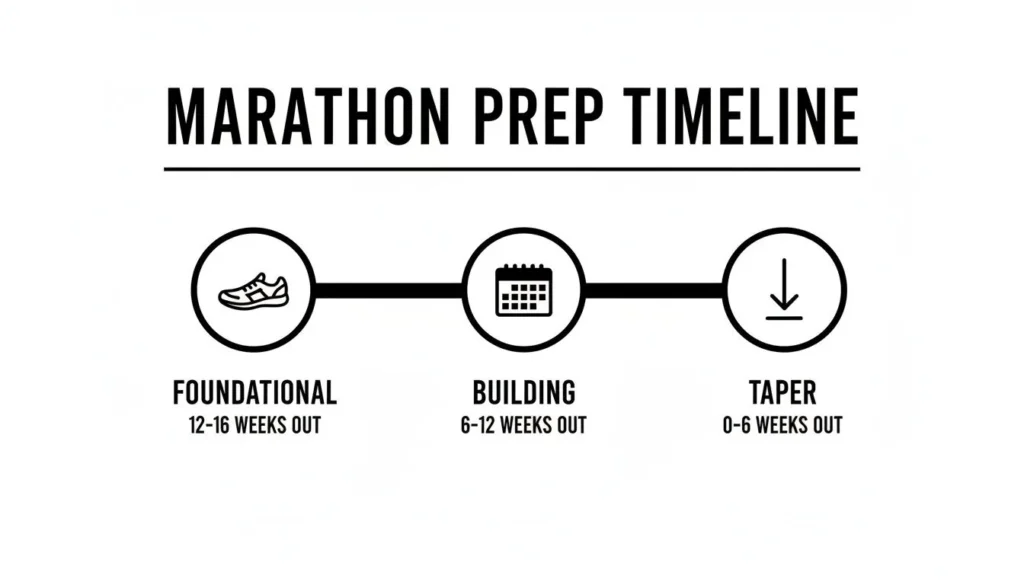
As you can see, each phase—Foundational, Building, and Taper—has a specific job to do in getting your body ready for the big day.
The 80/20 Rule of Running
One of the cornerstones of smart endurance training is the 80/20 rule, also known as polarized training. It’s a simple but powerful principle: 80% of your weekly runs should be at a low intensity (think an “easy” or conversational pace), and only 20% should be at a moderate-to-high intensity.
Running easy is a skill. It builds your aerobic engine, strengthens connective tissues, and allows you to recover, making you stronger for the hard workouts that truly move the needle on your fitness.
So many runners make the classic mistake of running their easy days too hard. This just leaves you with tired legs, meaning you can’t give your all on the key workout days that actually build speed and strength. Your easy runs are for endurance; your hard runs are for getting faster.
Structuring Your Training Week
A solid marathon training week is built around a few key workouts. You can and should move the days around to fit your life, but the core components should always be there.
A Sample Mid-Training Week:
- Monday: Rest or Active Recovery (walking, gentle stretching)
- Tuesday: Quality Workout (Tempo Run, Intervals)
- Wednesday: Easy Run (3-5 miles at a conversational pace)
- Thursday: Easy or Medium-Long Run (5-8 miles)
- Friday: Rest or Cross-Training (swimming, cycling)
- Saturday: Long Run (This is the most important run of the week, building distance gradually)
- Sunday: Easy Recovery Run (2-4 miles, very slow)
That “quality workout” is your chance to really push yourself. One of the most famous marathon-specific workouts is the Yasso 800. The concept is simple: you run 800-meter repeats on a track. The goal is to run each 800m interval in the same minutes and seconds as your goal marathon time in hours and minutes.
For example, if you’re aiming for a 4-hour marathon, you’d try to run your 800s in 4 minutes.
These workouts aren’t a magic bullet, but they’re incredibly effective for improving your VO2 max (how efficiently your body uses oxygen) and getting a feel for your goal race pace. When you understand the “why” behind every run, your training becomes smarter and far more effective.
Fueling Your Body for Endurance

Let’s get one thing straight: a marathon is just as much an eating and drinking contest as it is a running race. Your training builds the engine, but the fuel you put in the tank determines whether you cruise to the finish or sputter out and hit the dreaded “wall.”
Too many runners obsess over their mileage charts but give their nutrition a passing glance. That’s a huge mistake. This is your no-nonsense guide to dialing in your fuel strategy, learning what your body needs, and practicing it until it’s second nature on race day.
Everyday Nutrition for Marathon Training
What you eat every single day is the foundation for your performance. Think of it this way: marathon training puts your body under constant, managed stress. You’re continually breaking down muscle fibers so they can rebuild stronger. To do that, you need the right building blocks.
A solid diet for any endurance athlete comes down to a few key principles:
- Complex Carbohydrates: This is your primary energy source. You should be loading up on whole grains, brown rice, quinoa, potatoes, and plenty of vegetables. Aim to make carbs about 50-65% of your daily calories.
- Lean Protein: Absolutely crucial for muscle repair. Think chicken, fish, beans, lentils, tofu, and Greek yogurt.
- Healthy Fats: These are vital for hormone function and keeping inflammation in check. Good sources include avocados, nuts, seeds, and olive oil.
If you’re looking to make meal prep less of a chore, brushing up on some cooking tips for beginners can make a world of difference.
Mastering Your Long Run Fueling
Your weekly long run is a full dress rehearsal for the marathon, especially when it comes to your fueling plan. This is your lab. It’s where you experiment with what you eat, when you eat it, and how much you drink. The cardinal rule of marathon running is nothing new on race day, and this is where you live that rule.
For any run lasting longer than 75-90 minutes, you need to start practicing your fueling strategy. The goal is to take in 30-60 grams of carbohydrates per hour. Some highly trained runners might even push that up toward 90 grams.
You can get these carbs from a lot of different places:
- Energy gels
- Chews or gummies
- Sports drinks
- Real food like bananas, dates, or even pretzels
What works perfectly for your running buddy might send you running for a porta-potty. Use your long runs to figure out what your stomach can handle. A common and effective approach is to take your first fuel source around the 45-minute mark, and then continue every 45-60 minutes after that. This keeps your energy stores topped off and prevents you from bonking.
The single biggest fueling mistake I see is waiting until you feel an energy dip to eat or drink. By that point, you’re already behind. Start early and fuel consistently—it’s the key to finishing strong.
Race Week Carb-Loading and Hydration
Carb-loading isn’t about stuffing yourself with a mountain of pasta the night before the race. That’s a recipe for feeling bloated and sluggish on the start line. Proper carb-loading is a more methodical approach that starts two to three days before your marathon.
The idea is to pack your muscles with glycogen, which is the body’s most accessible form of stored energy for running. During these few days, you’ll want to ramp up your carbohydrate intake to about 70-85% of your total daily calories. Just as importantly, you need to cut back on fat and fiber to avoid any digestive surprises on race morning.
Stick with simple, easy-to-digest carbs:
- White rice
- Pasta
- Potatoes (peeled)
- White bread and bagels
Hydration is the other half of this equation. Start consciously sipping more water and electrolyte drinks in the days leading up to the race. Don’t chug, just sip consistently. The goal is to see light, straw-colored urine. Showing up to the start line fully hydrated is one of the easiest performance boosts you can give yourself.
Staying Healthy With the Right Gear and Injury Prevention

Let’s be clear: the number one goal of any marathon plan is to get you to the starting line healthy. All the perfect long runs and speed workouts mean nothing if you’re nursing an injury right before race day.
Your success will come down to two things: picking the right gear and making injury prevention a non-negotiable part of your routine. These aren’t just afterthoughts; they’re as critical as your weekly mileage. The right equipment prevents the blisters and chafing that can ruin a key workout, while a smart strength routine is your best defense against common running injuries.
Your Most Important Piece of Gear: The Right Shoes
Forget what your favorite elite runner wears or which brand looks coolest. Think of your running shoes as a piece of personalized medical equipment. Getting the right pair is your first and best defense against injury.
The best place to start is a specialty running store. They’ll do a gait analysis, which is just a fancy way of saying they’ll watch you run—usually on a treadmill or a patch of pavement—to see how your foot lands. They’re looking at your foot strike and how much your foot rolls inward, a movement called pronation.
This information helps them point you to the right shoe category for your body:
- Neutral: For runners whose feet don’t roll too far inward or outward.
- Stability: For runners who overpronate (roll inward too much) and need a little extra support to guide their foot.
- Motion Control: For runners with more significant overpronation who need maximum support.
Buying a shoe just because it looks good or a friend loves it is one of the fastest tickets to injury. Get a proper fitting. It’s a small investment that pays off over hundreds of miles.
Once you’ve found your perfect pair, keep an eye on their mileage. Most running shoes are built to last between 300–500 miles. Pushing them past their limit means the cushioning and support are shot, which is a classic recipe for shin splints and knee pain.
Apparel That Prevents Discomfort
After shoes, your clothes are the next biggest factor in staying comfortable. The golden rule here is simple: no cotton. Ever. Cotton is like a sponge; it soaks up sweat and holds it right against your skin. This leads to painful chafing, blisters, and can make you feel freezing in cool weather or sweltering in the heat.
Stick to technical, moisture-wicking fabrics. Synthetics like polyester or natural fibers like merino wool are designed to pull sweat away from your skin so it can evaporate. Also, get yourself some anti-chafing balm and use it generously on problem spots like inner thighs, underarms, and along your sports bra line before every long run.
The Foundation of Injury Prevention: Strength Training
Good gear helps, but a strong body is your ultimate weapon against injury. Running puts a massive amount of stress on your muscles and joints, step after step, month after month. If your key supporting muscles are weak, that force goes to all the wrong places, and that’s when things start to hurt.
Most common running injuries—runner’s knee, IT band syndrome, you name it—often trace back to the same culprits: weak glutes, unstable hips, and an inactive core. These are your power muscles, meant to keep your pelvis and legs stable with every stride. When they don’t do their job, smaller muscles try to pick up the slack, get overloaded, and become injured.
The good news is you don’t have to live in the gym to fix this. Just two 20–30 minute sessions per week can make a world of difference. For a deeper dive, our guide on how to prevent sports injuries is packed with valuable insights.
Your routine should focus on these core areas:
- Glutes: Glute bridges, clamshells, and squats are your friends.
- Hips: Work in moves like lateral leg raises and fire hydrants.
- Core: Planks, bird-dogs, and dead bugs build serious stability.
Think of this strength work as building a durable chassis for your running engine. It prepares your body to handle the miles, absorb impact more effectively, and hold your form together when you start to get tired. This is how you build a body that’s resilient enough to cross that finish line feeling strong.
Mastering the Taper and Your Race Day Strategy
After months of grinding out miles, you’ve reached the final—and arguably most important—part of your marathon prep. This isn’t about getting fitter; it’s about getting fresher. Welcome to the taper.
The taper is a deliberate, strategic reduction in your running volume to let your body finally absorb all that hard work. You’ll be resting more, repairing muscle, and showing up to the start line ready to unleash your full potential.
For many runners, this is the hardest part of training. Your body is used to high mileage, and cutting back can feel completely wrong. This restlessness and anxiety even has a name: the “taper tantrums.” Trust the process. This rest isn’t a weakness; it’s your secret weapon.
Why the Taper Works
The goal here is simple: shed all the built-up fatigue without losing any of the fitness you’ve worked so hard for. Think of it like this: you’ve spent months building a powerful engine. The taper is when you let it cool down, top off the fuel, and tune it for race day.
A proper taper usually lasts two to three weeks. During this time, you’ll slash your total weekly mileage by 40-60%. This lets your muscles fully restock their glycogen stores and repair all the micro-damage from training.
This isn’t just some old running wisdom; the science backs it up. Studies of sub-elite training plans, like those analyzed in this deep dive of global marathon performance data, show that a well-executed taper can boost performance by 2-3%. That might not sound like a lot, but for a 4-hour marathoner, that’s almost seven minutes off your time.
The biggest mistake I see runners make is being too scared to taper properly. They worry they’re losing fitness and keep pushing, only to arrive at the start line with heavy, tired legs. Your fitness is already baked in; the taper is what lets it shine.
Now, reducing volume doesn’t mean stopping altogether. The trick is to cut the mileage while keeping a little bit of intensity. A few short, race-pace efforts will keep your neuromuscular system sharp and your legs feeling snappy, not sluggish.
Below is a sample plan that shows how you might structure your mileage reduction over the final three weeks.
3-Week Taper Mileage Reduction Plan
| Week Before Race | Total Weekly Mileage | Long Run Distance | Key Intensity Workout |
|---|---|---|---|
| Week 3 | 80% of peak mileage | 10–12 miles | 4 miles at marathon pace |
| Week 2 | 60% of peak mileage | 6–8 miles | 2 miles at marathon pace + 4x400m at 10k pace |
| Week 1 | 40% of peak mileage | 2–3 easy miles | 2-3 short “strides” after an easy run to stay sharp |
This table provides a framework, not a rigid rule. The key is the progressive drop in volume while maintaining just enough intensity to keep your body primed.
Dialing in Your Race Day Blueprint
While your body is tapering, your mind should be sharpening. Now is the time to build a rock-solid plan for race day, covering every detail to eliminate stress and surprises.
Think through the entire morning, from the moment you wake up to the starting gun.
- The Morning Of: Stick to what you know. Eat the exact same breakfast you’ve practiced with before your long runs. A simple bagel with peanut butter or a bowl of oatmeal are classic go-tos because they’re high in carbs but low in fat and fiber.
- Gear Check Bag: Pack this the night before. You’ll want a warm change of clothes, comfortable shoes (sandals are amazing for swollen feet), a recovery snack or drink, and any other personal items you’ll need at the finish line.
- Arrival and Warm-Up: Know exactly how you’re getting to the start line and leave way more time than you think you need. About 20-30 minutes before your corral is set to go, do a very light jog and some dynamic stretches to get the blood flowing.
Having this blueprint memorized will help you navigate the pre-race chaos with calm and confidence.
Get Your Head in the Game
The marathon is just as much a mental beast as it is a physical one. Use the extra downtime during the taper to build your mental fortress. One of the best tools for this is visualization.
Every day, take a few quiet minutes to close your eyes and see yourself on the course. Picture yourself running with a strong, fluid stride. Imagine conquering that one big hill everyone talks about or powering through the final, punishing miles. See yourself crossing the finish line, exhausted but completely euphoric. This mental rehearsal builds an incredible amount of confidence.
You also need to prepare for the inevitable tough moments. Acknowledge that at some point, you will want to stop. Come up with a few simple, powerful mantras to repeat when things get dark. Phrases like “strong and steady” or “I trained for this” can be the lifeline that pulls you through a rough patch.
When you step up to that start line, you won’t just be physically prepared for the 26.2-mile journey—you’ll be mentally ready for anything it throws at you.
Your Top Marathon Training Questions Answered
Even with a perfect training plan on paper, the reality of preparing for a marathon is messy. Life happens, motivation dips, and questions pop up constantly. Think of this section as your personal FAQ, tackling the most common hurdles runners face on their way to 26.2 miles.
We’re moving beyond the training plan to address the real-world challenges that can make or break your marathon journey. From mental slumps to race-day jitters, here’s how to handle the curveballs with confidence.
How Do I Stay Motivated When Training Gets Tough?
Let’s be clear: at some point, marathon training will feel like a grind. The initial excitement fades, your legs feel heavy, and a cold, dark morning run feels like the last thing you want to do. This is completely normal.
The key isn’t to avoid these slumps but to have a strategy for pushing through them. Motivation isn’t a magical resource; it’s a skill you build.
One of the best ways to do this is to break down your massive goal of running 26.2 miles into smaller, more manageable pieces. Instead of focusing on the finish line months away, set small, weekly goals.
- Focus on the Process: Your goal this week might be to hit all your planned runs or to finally do that 20-minute strength session you keep skipping.
- Celebrate Small Wins: Did you nail your tempo run? Acknowledge it. Did you get out the door when you wanted to stay in bed? That’s a huge victory.
- Find Your Community: You are not alone. Joining a local running group or an online forum can be a game-changer. Sharing struggles and successes with others who get it provides powerful accountability and camaraderie.
Remember your ‘why.’ Why did you sign up for this in the first place? Write it down and put it somewhere you’ll see it every day. On tough days, that ‘why’ will be the fuel that gets you out the door.
What Should I Do If I Miss a Training Run?
Panic is the first reaction for many runners when they miss a scheduled run. Did I just derail my entire marathon? The short answer is a resounding no.
A single missed run, or even a few, will not ruin your months of hard work. Consistency over time is what matters, not perfection.
The goal is to handle a missed run without adding stress or injury risk. Don’t try to cram two runs into one day or do an extra-long run to “make up for it.” This is a classic recipe for overtraining and getting hurt.
Here’s a simple framework for deciding what to do:
- If you missed an easy or recovery run: Just forget about it. Let it go. An extra rest day is often just as beneficial.
- If you missed a quality workout (tempo, intervals): You can swap it with an easy run later in the week if it doesn’t disrupt your long run. If not, just let it go and focus on your next key session.
- If you missed your long run: This is the one you might reschedule if possible. See if you can shift it to the next day. But if that means doing it the day before another hard workout, it’s better to just skip it.
The most important thing is to listen to your body. If you missed a run because you felt sick or exhausted, your body sent you a clear signal that it needed rest. Honoring that is always the right call.
How Do I Pace Myself to Avoid Hitting the Wall?
Starting a marathon too fast is the single most common and devastating race-day mistake. Adrenaline is pumping, the crowd is electric, and it’s incredibly easy to run the first few miles much faster than you planned.
This early energy expenditure is a debt you will inevitably pay in the final, painful miles.
The infamous “wall” isn’t a myth; it’s a physiological reality. It happens when your body depletes its stored glycogen. The key to avoiding it is a smart, disciplined pacing strategy that you’ve practiced throughout your training.
First, run by feel, also known as Rate of Perceived Exertion (RPE). Your marathon pace should feel comfortably hard, but not breathless, for the first two-thirds of the race. If your breathing is ragged in the first 10k, you are going too fast.
Next, consider using a tool. A pace band on your wrist can be a simple, effective reminder of the split times you need to hit for each mile. This keeps you honest when adrenaline is telling you to fly.
Finally, break the race down mentally. Don’t think about running 26.2 miles.
- Run the first 10 miles conservatively, almost like an extended warm-up.
- Focus on maintaining your goal pace from miles 10 to 20.
- From mile 20 on, if you feel good, you can start to gradually increase the effort.
This mental strategy transforms an intimidating distance into manageable chunks. Mastering your pace is the final piece of the puzzle, turning your hard-earned fitness into a strong finish.
At maxijournal.com, we’re dedicated to bringing you approachable and insightful content on health, sports, and much more. To continue your journey with us, explore our daily articles at https://maxijournal.com.
Discover more from Maxi Journal
Subscribe to get the latest posts sent to your email.