Ask ten different people what adventure travel means, and you’ll likely get ten different answers. At its heart, it’s any journey that nudges you right out of your comfort zone. It’s less about where you go and more about how you experience a place.
We’re talking about an active, hands-on style of travel defined by three key ingredients: physical activity, cultural engagement, and a real connection with nature.
What Is Adventure Travel Really About
First, let’s ditch the old-school image of just adrenaline junkies and extreme athletes. While that’s certainly one slice of the pie, the true meaning of adventure travel is so much bigger and far more personal.
Think of it this way: traditional tourism is like watching a great documentary about a destination. You see the sights and learn the facts, but you’re still an observer.
Adventure travel is about stepping through the screen and becoming a character in that documentary. You’re no longer just watching from a bus window; you’re an active participant, shaping your own story and interacting directly with the world around you.
To help you get a quick handle on what makes up this travel style, here’s a simple breakdown.
Adventure Travel At A Glance
This table shows the core elements that turn a regular vacation into a genuine adventure.
| Core Component | Description | Example Activity |
|---|---|---|
| Physical Activity | Getting your body moving, from light walks to intense climbs. | Kayaking through sea caves in Thailand. |
| Cultural Exchange | Meaningful interaction with local people and their traditions. | Taking a pasta-making class on a farm in Italy. |
| Connection with Nature | Immersing yourself in the natural world, big or small. | Stargazing in the Atacama Desert in Chile. |
A trip doesn’t have to be extreme in all three areas, but the most unforgettable adventures usually blend them together beautifully.
The Three Pillars of Adventure
So what are the building blocks that make a trip an adventure? It almost always comes down to a mix of these three elements.
- Physical Activity: This is the “get up and go” part. It can be as demanding as summiting a peak in the Alps or as gentle as a long bike ride through the French countryside.
- Cultural Exchange: This is about genuine, authentic connection. You’re not just observing a culture; you’re learning from it. Think less “tourist show” and more sharing a meal with a local family in Vietnam or learning a traditional craft.
- Connection with Nature: This component gets you out into the wild. It could be trekking through a Costa Rican jungle, diving on a coral reef in Belize, or even just camping out under a sky full of stars.
This dynamic combination is exactly why the industry has exploded. What was once a small niche has become a massive force in travel, valued at USD 896.06 billion in 2023. It’s projected to more than double, hitting an incredible USD 1,931.26 billion by 2034. That growth is a clear signal that people are craving more meaningful ways to see the world. You can dig deeper into these adventure tourism market trends if you’re curious.
Adventure is not about the absence of fear, but the decision that something else is more important. It’s a mindset of curiosity and a willingness to step into the unknown, even just a little.
A Spectrum of Experience
One of the biggest myths is that you have to be a hardcore athlete to go on an adventure. That’s just not true. Adventure travel exists on a massive spectrum, which makes it accessible to almost anyone, regardless of age or fitness level.
The key is that it’s all about personal challenge.
For one person, adventure is a multi-day trek through the Himalayas. For someone else, it might be navigating a foreign city’s subway for the first time or trying a bizarre-looking street food. If it pushes your boundaries and gives you a new perspective, it absolutely counts.
Soft vs. Hard: The Two Sides Of Adventure
When you hear ‘adventure travel,’ your mind might jump straight to scaling Everest or hacking through a dense jungle with a machete. But that’s only one side of the coin. Adventure travel is a huge spectrum, and figuring out where you fit is the first step to planning a trip you’ll actually love.
Think of it this way: are you looking to dip your toes in, or dive headfirst into the deep end? Neither is better than the other. It all comes down to your comfort level, current skills, and what you’re hoping to get out of the experience.
Defining Soft Adventure Travel
This is your on-ramp to adventure. Soft adventure is the most popular and accessible way to add a dose of excitement to your travels. It’s all about low perceived risk, requiring little to no prior experience, and usually comes with the safety net of professional guides and comfortable lodging.
You get the thrill without needing months of training or a backpack full of specialized gear.
- Guided Kayaking: Paddling across a serene lake or exploring a calm coastline with a guide.
- Scenic Hiking: Sticking to well-marked trails, like the ones you’d find in most national parks.
- Cultural Walking Tours: Getting to know a historic city on foot with a local showing you the way.
- Wildlife Safaris: Spotting incredible animals from the safety of a 4×4, led by an expert driver who knows where to look.
Soft adventures are perfect if you’re new to this, traveling with family, or simply want to spice up a vacation without pushing your limits too far. The focus is on the experience itself, not on conquering an extreme challenge.
Understanding Hard Adventure Travel
Now we get to the other end of the spectrum. Hard adventure is where the stakes get higher. We’re talking about trips that involve significant perceived risk, demand specialized skills you’ve honed over time, and require a serious level of physical and mental toughness.
Hard adventure is about pushing past your known boundaries. It’s a commitment. You need training, the right skills, and a healthy respect for the environment you’re stepping into. The payoff is a feeling of accomplishment that’s hard to describe and a viewpoint few ever get to see.
These aren’t activities you just sign up for on a whim. They are serious undertakings.
- Mountaineering: Technical climbs on high-altitude peaks, like those in the Himalayas or the Andes.
- Whitewater Rafting: Navigating powerful, high-class rapids (think Class IV or V).
- Ice Climbing: Using crampons and ice axes to ascend frozen waterfalls or glaciers.
- Multi-Day Solo Trekking: Navigating remote wilderness for days on end with only the gear on your back.
These journeys are for seasoned travelers who have put in the work. You need to be in top physical shape, have specific training under your belt, and be ready to handle whatever Mother Nature throws at you. It’s less about being a participant and more about total immersion and self-reliance.
Soft Adventure vs. Hard Adventure: A Comparison
To help you see the difference clearly, we’ve put together this simple comparison. Take a moment to honestly assess where you are right now and what kind of trip you’re truly ready for.
| Feature | Soft Adventure | Hard Adventure |
|---|---|---|
| Perceived Risk | Low to moderate. Safety nets are in place. | High. Involves real and significant dangers. |
| Skill Level | Minimal to none. Basic instruction is usually sufficient. | High. Requires advanced training and experience. |
| Physical Fitness | Basic level of health and mobility. | Excellent physical conditioning is essential. |
| Gear & Equipment | Often provided or easily rented. | Highly specialized and personal gear is required. |
| Guidance | Almost always professionally guided. | Can be guided, but may also be self-led. |
Use this table as your guide. Knowing which category speaks to you is the key to finding an adventure that excites, challenges, and rewards you in just the right way.
Inspiring Adventure Travel Activities And Destinations
Okay, so we’ve covered the difference between ‘soft’ and ‘hard’ adventure. But what does that actually look like out in the real world? The truth is, the planet is one giant playground, and there’s no shortage of ways to get your pulse pounding.
To get the ideas flowing, let’s break down some incredible adventure activities by the environments where you’ll find them.
Think of it as a spectrum. There’s a whole range of experiences, from easily accessible trips to seriously demanding expeditions.
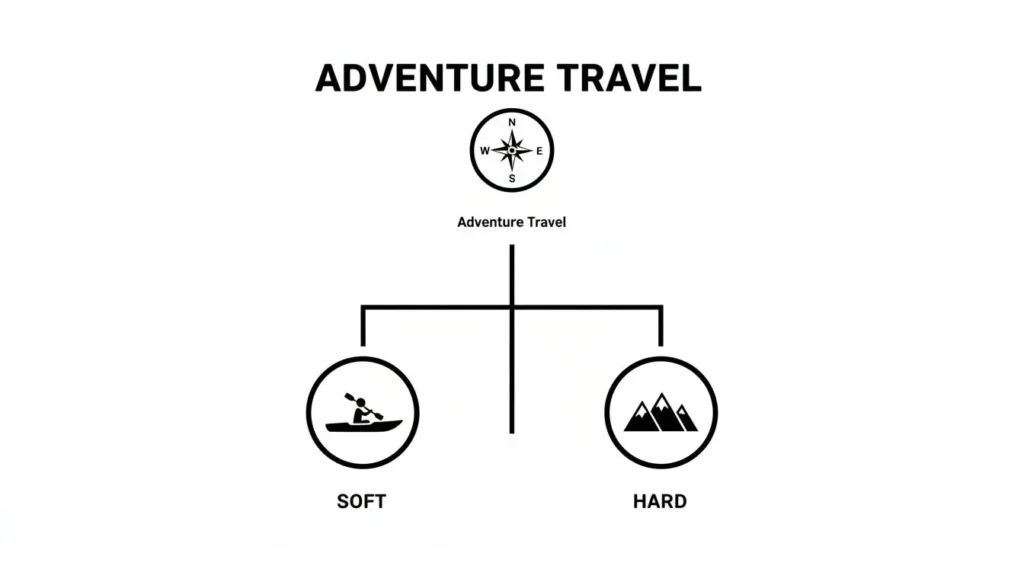
This just helps visualize that ‘adventure’ isn’t one-size-fits-all. It’s all about finding the right level of challenge for you.
Adventures On Land
For a lot of us, real adventure starts the moment the pavement disappears. Getting out on land, whether it’s a dense jungle or a wide-open desert, is an amazing way to connect with the ground beneath your feet.
Trekking in Nepal is the classic example for a reason. Tackling the world-renowned Everest Base Camp trek or finding a quieter path in the Annapurna region puts you right among the planet’s highest peaks. It’s as much a cultural journey into the Sherpa way of life as it is a physical one.
Or, for a different kind of thrill, picture a 4×4 safari across Tanzania’s Serengeti. This is a perfect soft adventure—you’re right there, face-to-face with Africa’s “Big Five,” but with the safety and knowledge of an expert guide.
Adventures On The Water
If you feel the pull of the world’s oceans, rivers, and lakes, water-based trips offer a totally unique viewpoint. These adventures can be incredibly peaceful or intensely powerful. It all depends on what you’re after.
Take scuba diving in Australia’s Great Barrier Reef. It’s a soft adventure that requires just a basic certification to unlock a mind-blowing underwater world of vibrant coral and marine creatures. You get to witness one of nature’s greatest masterpieces up close.
On the other end of the scale, you have whitewater kayaking on the Futaleufú River in Chile. This is a hard adventure, plain and simple. It’s a test of skill and nerve against world-class rapids, with the stunning backdrop of Patagonia as your reward. For more ideas, check out our guide to the most beautiful places to travel in the world.
Adventures In The Air
There’s nothing quite like the perspective you get from the sky. Taking to the air delivers a feeling of freedom and scale that’s tough to find anywhere else, usually with a healthy dose of adrenaline.
Paragliding over the Swiss Alps near Interlaken is the perfect example. You get to soar like a bird over jagged peaks and impossibly blue lakes. It’s a pure thrill, but as a tandem flight with a pro pilot, it’s a soft adventure that requires zero experience.
It’s interesting to see how the market for these trips has evolved. After the post-pandemic “revenge travel” boom, things are leveling out. While operator-led trips saw a 37% dip from 2023 to 2024, the numbers have stabilized just above 2019 levels. This points to a healthy, more normal demand for adventure. You can dig into more of this data in the full 2025 Adventure Travel Trends & Insights report.
Who Is Adventure Travel Actually For
Let’s get one thing straight right away. The idea that adventure travel is only for fearless twenty-somethings with deep pockets is a complete myth. The reality is so much more interesting. This kind of travel is for anyone with a curious spirit who wants to do more than just see the world—they want to feel it.
It’s really a mindset, not a demographic.
Think about the rise of solo travel. It’s a powerful movement of people pushing their own boundaries to build confidence and independence. This isn’t just a niche trend, either. The market for solo extreme adventures was valued at USD 79.9 million in 2024 and is expected to climb to USD 188.8 million by 2030. You can dig into more of the data in this adventure tourism market analysis.
Of course, when you’re heading out alone, being prepared is key. For some extra peace of mind on your next trip, check out our guide to solo travel safety tips.
Adventure Is For Everyone
Adventure isn’t about your age or marital status. It’s about your willingness to step just a little bit outside of what’s comfortable. And that looks different for everyone.
- Couples are swapping the typical beach holiday for shared challenges that strengthen their bond. They’re learning to scuba dive in Belize or tackling a multi-day trek, forging memories that a poolside lounge just can’t match.
- Families are creating the most incredible learning experiences for their kids. A guided safari in Kenya or a trip through the Costa Rican rainforest becomes a real-life classroom, teaching resilience and a love for conservation better than any textbook ever could.
The beautiful truth about adventure travel is that it meets you where you are. Whether you’re 25, 45, or 75, there is an experience waiting that will challenge and inspire you in just the right way.
Even active seniors are a huge part of this scene. They’re embracing “soft” adventures like guided cycling tours through Vietnam’s countryside or bird-watching expeditions in the Galápagos Islands. It just proves that the thirst for discovery never gets old.
At the end of the day, it’s simple. If you’d rather be the one paddling the kayak than the one watching it from the shore, adventure travel is for you. It doesn’t matter who you are.
How To Plan Your First Adventure Trip
Alright, so you’re ready to get out there. Planning that first big adventure can feel like a mountain to climb before you even see the real one, but it doesn’t have to be. We’ll break it down into simple, actionable steps that turn the anxiety into pure excitement.
Before you even think about booking a flight or buying gear, the most critical step is an honest self-check. Think about your current fitness level and, just as important, your comfort zone. Are you truly ready for a week-long, unsupported trek, or would a series of guided day hikes be a better fit right now?
Match The Destination To Your Goals
Once you have a clear picture of your capabilities, the fun part begins: choosing where to go. Instead of just throwing a dart at a map, find a destination that lines up with what you want to get out of the trip. Are you looking for a solo challenge to push your limits, or a family trip full of new discoveries?
Your answer will point you in very different directions.
- For solo growth: A well-established route like Spain’s Camino de Santiago is a great option. It offers plenty of space for self-reflection but also has a built-in community of fellow travelers.
- For family bonding: A place like Costa Rica is hard to beat. It’s famous for accessible rainforest lodges and guided nature tours that are perfect for all ages.
From here, you’ll face a fundamental choice: hire a guide or go it alone.
Guided Tour Or DIY Adventure
There’s no right answer here, just what’s right for you and your trip. For a first-timer, a guided tour is often the best choice. They handle the logistics—permits, transport, accommodation—so you can focus on the experience itself without the stress.
Going the DIY route gives you total freedom, but it demands a lot more time for research and planning. It’s incredibly rewarding but is usually better suited for seasoned travelers who are confident navigating new environments. If you’re leaning toward DIY, our guide on how to plan a trip abroad is a fantastic place to start.
Choosing a guided tour isn’t “cheating.” It’s a smart move that gives you access to local expertise and proven safety measures, which is exactly what you want when you’re in a new and challenging place.
The good news is that the adventure travel industry is booming. A recent report found that 73% of operators saw revenue growth from 2023, and they’re expanding their trips to include everything from eco-safaris to deep cultural immersions. This growth means you have more high-quality, professional options than ever. You can read the full state of the adventure travel industry report for a deeper dive.
Finally, don’t forget the two non-negotiables: gear and insurance. Pack light, but pack smart. Focus on quality essentials, especially good boots and proper layering. Most importantly, get travel insurance that specifically covers the activities you plan to do. A standard policy probably won’t cover whitewater rafting or rock climbing, so you have to read the fine print.
Frequently Asked Questions About Adventure Travel
It’s natural to have a few questions, even after you’ve done some research. Let’s clear up some of the most common ones so you can feel confident about taking that next step.
Do I Need To Be Super Fit For Adventure Travel?
Absolutely not. This is probably the single biggest myth about adventure travel. While it’s true that “hard” adventures like climbing a Himalayan peak require you to be in elite physical shape, the world of “soft” adventure is wide open.
Countless amazing experiences are accessible to anyone with a basic level of fitness. Think guided hikes on beautiful, well-kept trails, snorkeling in calm tropical waters, or even an immersive cultural walking tour.
The key is simply being honest about where you’re at, fitness-wise. Choose a trip that matches your current ability, and you’re guaranteed to have an incredible time without feeling overwhelmed.
Is Adventure Travel Safe?
Safety is the absolute cornerstone of any good adventure travel company. While any travel has some risk, professional operators work tirelessly to keep you safe.
They do this by focusing on a few key areas:
- Expert Guides: They hire pros who are not only certified in first aid but also have an intimate knowledge of the local terrain and the activity itself.
- Quality Equipment: All gear, from kayaks to climbing harnesses, is high-quality, regularly maintained, and meets strict safety standards.
- Established Protocols: They follow proven safety procedures for every single activity, leaving nothing to chance.
Your best bet for staying safe is to book with a certified, well-reviewed tour operator and get comprehensive travel insurance. And here’s a pro tip: double-check that your insurance policy specifically covers every activity you plan on doing.
How Much Does Adventure Travel Cost?
The price range for adventure travel is massive, which is great because it means there’s something for almost every budget. There’s no single answer here.
A weekend camping and hiking trip you plan yourself could cost next to nothing. On the other end of the spectrum, a fully-guided, two-week expedition to Antarctica will be a major investment.
The final cost comes down to a few things:
- Destination: A trip through Southeast Asia will usually cost less than a similar trip to Scandinavia.
- Duration: How long you’re gone is one of the biggest factors.
- Activity: A city bike tour is going to be a lot cheaper than a guided heli-skiing package.
- Travel Style: Are you backpacking and staying in hostels, or are you on an all-inclusive tour with comfortable hotels?
By playing with these variables, you can design an adventure that fits what you’re willing to spend.
The heart of adventure travel isn’t about how much money you spend. It’s about the richness of the experience. A simple, thoughtfully planned trip can be just as meaningful as a five-star expedition.
Whether you’re just starting to look or you’re ready to book, the secret is matching your dreams with your budget and fitness. Get that right, and your next adventure will be a perfect fit.
At maxijournal.com, we’re passionate about sharing stories that inspire curiosity and action. Explore our extensive collection of articles on travel, culture, and the great outdoors by visiting us at https://maxijournal.com.
Discover more from Maxi Journal
Subscribe to get the latest posts sent to your email.