Forget the familiar blue marble you see in pictures from space. To understand earth in the beginning, you have to picture a world born from cosmic violence 4.5 billion years ago. It was a roiling, red-hot ball of molten rock, constantly battered by asteroids and comets.
A Planet Forged in Fire and Chaos
Our planet’s story kicks off around 4.54 billion years ago, a date scientists have pinpointed through decades of painstaking geological and astronomical research. The early Earth was nothing like our world today. It began as a mostly molten sphere, heated by a trifecta of forces: gravitational compression, the decay of radioactive elements, and a relentless barrage of asteroid impacts.
This violent, primordial period is known as the Hadean Eon, a name taken from Hades, the Greek god of the underworld. It’s a fitting description. For its first 500 million years, Earth was utterly inhospitable, a glowing orb with no oceans, no continents, and no breathable air. You can explore a more detailed breakdown of this timeline on Wikipedia’s page about the history of Earth.
The Building Blocks of a World
That intense, planet-wide heat wasn’t just destructive; it was also the engine of creation. By keeping the entire planet in a liquid state, it triggered a critical process called planetary differentiation.
This was essentially a “great sinking” event where heavier, denser materials like iron and nickel were pulled by gravity toward the planet’s center. This process had two world-changing outcomes:
- Forged the Core: The sinking iron and nickel formed Earth’s incredibly dense, metallic core. This was the first step toward creating the powerful magnetic field that now shields us from dangerous solar radiation.
- Layered the Planet: As the heavy metals sank, lighter silicate materials floated toward the surface. These eventually cooled to form the planet’s mantle and the very first, fragile crust.
The idea of a dense central core is a cornerstone of planetary science. If you’re curious about the fundamental building blocks of all matter, our guide on the nucleus of an atom is a great place to start.
This infographic provides a clear visual of the chaotic sequence of events that defined our planet’s fiery birth.
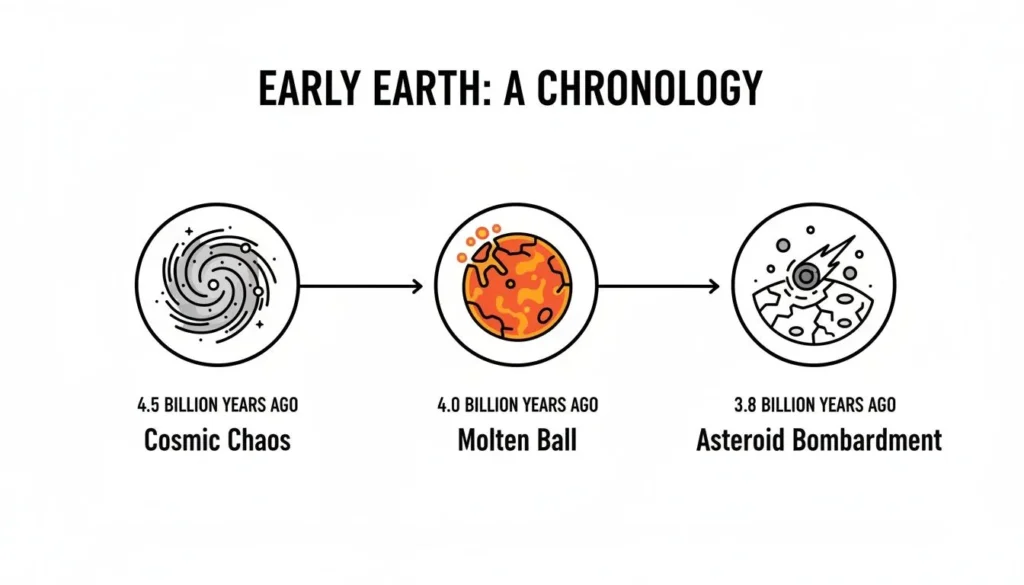
As you can see, our home went from a diffuse cloud of cosmic dust to a molten sphere under constant attack from space debris.
A Timeline of Creation
To fully appreciate the immense timescales involved, it’s helpful to summarize the initial formation stages.
The table below outlines the key phases, from the first clumping of cosmic dust to the end of the violent Hadean Eon.
Key Stages of Early Earth’s Formation
| Stage | Approximate Timeline | Key Events and Characteristics |
|---|---|---|
| Solar Nebula & Accretion | 4.6 to 4.5 Billion Years Ago | Dust and gas in a cosmic cloud clumped together due to gravity, forming planetesimals that collided and grew into a protoplanet. |
| Hadean Eon Begins | 4.5 Billion Years Ago | Earth is a molten magma ocean. Heavy elements like iron sink to form the core, and lighter elements form the mantle and early crust. |
| Late Heavy Bombardment | 4.1 to 3.8 Billion Years Ago | An intense period of frequent and massive asteroid and comet impacts that reshaped the surface and delivered key ingredients like water. |
This sequence of events laid the foundation for everything that followed, transforming a hostile ball of magma into a planet with the potential to one day harbor life.
Building a Planet from Cosmic Dust
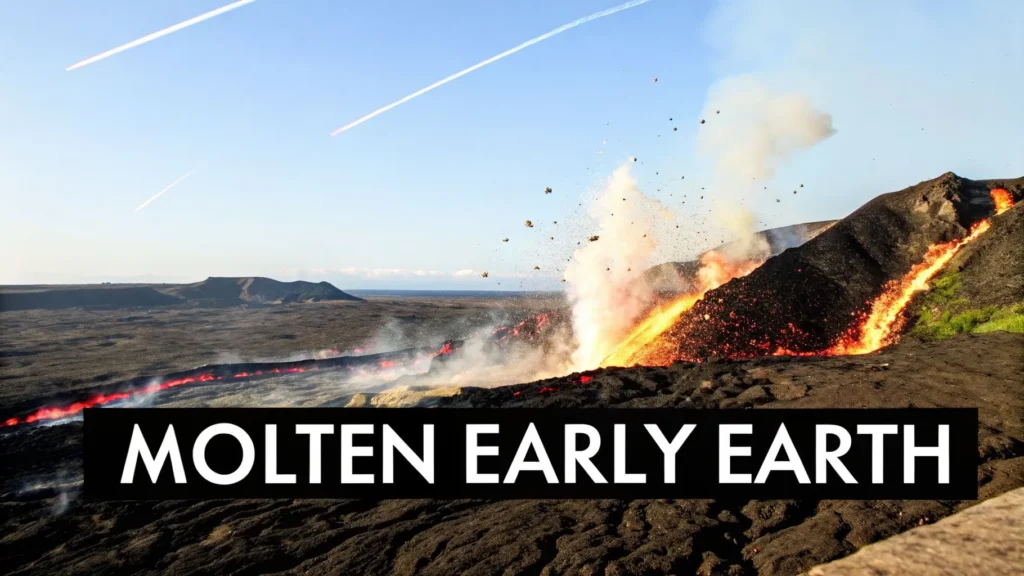
The story of the Earth in the beginning wasn’t a quiet one. It was a cosmic free-for-all, a violent and chaotic process driven by gravity. It all boils down to a process called accretion, the fundamental recipe for building a planet.
Imagine a tiny speck of dust in the vast, swirling cloud that surrounded our young Sun. Static electricity makes it cling to another speck. Soon, you have a dust bunny. As it grows, so does its gravitational pull, and the process accelerates.
These clumps snowballed from pebbles into boulders and eventually into massive bodies stretching for miles, known as planetesimals. Our solar system was once teeming with billions of them, all bumping and grinding against each other in a cosmic mosh pit.
The Great Cosmic Collision
For millions of years, these planetesimals smashed into each other. Most impacts were just destructive crashes, but every now and then, two would merge into a larger body. It was a slow, brutal process of consolidation.
This is where gravity really took over. The bigger a planetesimal got, the more gravitational muscle it had to pull in its smaller neighbors, effectively clearing its path around the Sun. Think of it as a gravitational “rich-get-richer” scheme.
The sheer energy of these constant, high-speed collisions was mind-boggling. This, combined with heat from decaying radioactive elements inside, was enough to melt the entire baby Earth into a glowing ball of molten rock.
This molten state wasn’t just a fiery side effect; it was absolutely essential. It set the stage for our world to organize itself into the planet we recognize today.
Forging the Layers of a Planet
With Earth now a giant sphere of liquid rock and metal, a crucial sorting process called planetary differentiation began. It was surprisingly simple: heavy stuff sinks, and light stuff floats.
The heaviest elements, mostly iron and nickel, were pulled by gravity straight to the center. This great metallic migration formed Earth’s incredibly dense core. At the same time, the lighter, rocky silicate materials floated toward the top, eventually cooling to form the mantle and the thin, fragile crust we live on.
This separation wasn’t just about making layers. It had world-changing consequences:
- A Layered World: The sinking of iron created the solid inner core and the churning liquid outer core. The lighter silicates formed the mantle and crust.
- A Magnetic Shield: The motion of the liquid outer core is what generates Earth’s magnetic field. Without this shield, we’d be defenseless against harmful solar winds, and life might never have gotten a foothold.
The energy that drove this entire assembly, from accretion to core formation, was immense. The forces at play rivaled those that power the stars themselves. If you’re curious about how stars generate their energy, our article on the basics of fusion reactions is a great place to start. This planetary-scale furnace transformed a uniform clump of space debris into the complex, living world we call home.
Surviving Earth’s Hellish Infancy
After its chaotic birth, our young planet wasn’t out of the woods. It entered an era so violent it’s named for the underworld: the Hadean Eon. For its first 500 million years, Earth was under constant assault from the debris left over from the solar system’s formation.
Picture a sky lit not by stars, but by the fiery trails of incoming meteors. This wasn’t a rare meteor shower; it was a non-stop, planet-wide bombardment. This intense period, lasting from about 4.1 to 3.8 billion years ago, is known as the Late Heavy Bombardment.
The inner solar system was a cosmic shooting gallery, and Earth was right in the middle of it. It was pummeled by a storm of asteroids and comets, some as large as small moons. While billions of years of geological activity have erased these craters from Earth’s surface, you can still see the scars on the face of our Moon, which serves as a frozen record of this ancient violence.
A Destructive Yet Creative Force
These impacts were unimaginably destructive. Each collision unleashed enough energy to re-melt huge swathes of Earth’s fragile new crust, keeping the surface a hellscape of magma oceans and churning volcanoes. Any time the planet started to cool, another massive impact would hit the reset button.
It’s hard to grasp the sheer scale of this bombardment. The energy from a single large impact could have flash-boiled any early oceans, sterilizing the entire globe over and over. For a world trying to become habitable, this was a constant, devastating setback.
But here’s the paradox: this cosmic beating wasn’t just an act of destruction. The very objects that terrorized the young Earth were also delivering the key ingredients for life. The bombardment was, in effect, a delivery service on a planetary scale.
The Cosmic Delivery of Life’s Ingredients
These asteroids and comets weren’t just giant, inert rocks. They were time capsules from the outer solar system, packed with materials from where they first formed. When they slammed into Earth, they delivered their precious cargo.
This cosmic delivery system brought two things absolutely critical for a living world:
- Water: Comets are essentially massive, dirty snowballs of frozen gas, dust, and water ice. Many scientists believe the relentless rain of these comets over hundreds of millions of years delivered a huge portion of the water that fills our oceans today.
- Organic Molecules: Besides water, these impactors were rich in carbon-based compounds. They carried the fundamental building blocks of life itself, like amino acids, which are the components of proteins.
In other words, the very cataclysms that threatened to shatter the nascent Earth were also seeding it with the raw materials needed for biology to get started.
The Late Heavy Bombardment represents a crucial turning point. It was the chaotic final act of planetary formation that, through its violence, provided the water for our oceans and the essential organic compounds for the eventual emergence of life.
Paving the Way for a Habitable World
By about 3.8 billion years ago, the storm finally started to calm down. The rate of impacts dropped off as the inner solar system was swept clean of most of its large debris. This newfound quiet was exactly what the planet needed.
With the constant, crust-shattering collisions finally easing, Earth’s surface at last had a chance to cool and solidify without being immediately re-melted. This allowed the vast amounts of water vapor—delivered by comets and released by volcanoes—to condense and fall as rain. A global deluge that may have lasted for millions of years began to fill the planet’s basins, giving birth to the first oceans and setting the stage for the story of earth in the beginning.
How Earth Forged Its Atmosphere and Oceans
The journey of the early Earth from a molten ball of rock to the blue planet we know today is one of the most formative periods in its history. This process involved losing its first atmosphere entirely, building a new one from intense volcanic activity, and then experiencing a rainstorm that lasted for millions of years.
Earth’s very first atmosphere was nothing like what we breathe now. It was a thin layer of hydrogen and helium, gases pulled directly from the swirling solar nebula as the planet formed.
This initial atmosphere was short-lived. A young, chaotic Sun bombarded the inner planets with powerful solar winds, which easily blew these light gases into space. The infant Earth was left bare.
This was only a temporary state, however. The key to Earth’s second, more durable atmosphere was locked away in its own molten core. As the planet-wide magma ocean churned, a process called outgassing began.
The Great Volcanic Exhale
Think of outgassing as the planet releasing trapped gases on a massive scale. For millions of years, countless volcanoes erupted, venting a dense mixture of gases from deep within the Earth’s mantle. This wasn’t just lava; it was a huge release of volatiles.
This second atmosphere was completely different from the first. It was a thick, heavy blanket made of:
- Water Vapor (H₂O): The most abundant gas by far.
- Carbon Dioxide (CO₂): This created a strong greenhouse effect, trapping heat and keeping the planet warm.
- Nitrogen (N₂): A very stable gas that would eventually become the main component of our modern atmosphere.
- Other Gases: Smaller amounts of methane (CH₄) and ammonia (NH₃) were also part of the mix.
Crucially, this new atmosphere had almost no free oxygen. It would have been instantly toxic to most modern life. But this toxic shroud contained the single most important ingredient for what came next: an incredible amount of water vapor.
A Rainstorm for the Ages
As the chaos of the Late Heavy Bombardment started to die down, the planet’s surface finally got a chance to cool. Once the crust solidified and surface temperatures fell below the boiling point of water, a monumental event was set in motion. The massive amount of water vapor in the atmosphere started to condense.
What came next was a global deluge of unimaginable scale—a continuous, planet-wide rainstorm that likely lasted for millions of years. This was a torrential downpour that filled the lowest points on the planet’s scarred crust.
This epic rain, fed by the steam from Earth’s own interior, was the primary source of our planet’s water. The basins, craters, and vast depressions slowly filled, drop by drop, over millennia, giving birth to the first global oceans.
These early oceans weren’t the blue, salty waters we recognize today. They were likely acidic and full of dissolved minerals, especially iron, which probably gave them a murky, greenish color. Still, these were the waters where life would first begin.
Cosmic Water Delivery
While volcanic outgassing provided most of the water, it wasn’t the only source. The comets and asteroids that bombarded the early Earth also made a significant contribution. Comets, often called “dirty snowballs,” are packed with water ice.
Every time one of these icy bodies struck Earth, it delivered its water directly to the surface. This cosmic delivery service acted as a supplement to the water being released from the planet’s interior, helping to fill the oceans.
The combination of internal outgassing and external delivery ensured that the early Earth wouldn’t remain a dry, dead rock. It was destined to become a water world, setting the stage for life to emerge.
Reading the Geological Story of Early Earth
The story of the earth in the beginning feels impossibly remote. No one was there to see it, so how can we possibly know what happened? The answer is that scientists have become geological detectives, piecing together the story from clues locked deep inside our planet’s oldest rocks.
Their most important tool is radiometric dating. You can think of it as a perfect natural clock built right into certain minerals. Unstable radioactive elements, like uranium, decay into stable elements, like lead, at a constant, predictable rate.
By measuring the ratio of the original “parent” element to the stable “daughter” element, geologists can calculate exactly how long that clock has been ticking. It’s an incredibly precise method for figuring out the age of rocks and, by extension, our world.
The Geological Timekeepers
But to get the true age of our planet, scientists had to look beyond Earth. They turned to meteorites—leftover building blocks from the solar system’s formation, perfectly preserved in the vacuum of space.
By applying radiometric dating to these pristine space rocks, researchers pinned down the age of our solar system, and our planet, at approximately 4.54 billion years old. This number, first calculated back in the 1950s, is still the foundation of modern planetary science.
While meteorites give us Earth’s birthday, our own rocks tell us what happened next. The catch is that our planet’s geology is constantly in motion, recycling the crust and making truly ancient rocks incredibly hard to find. This is where one special mineral changes everything.
Zircon crystals are geological superheroes. These tiny, unbelievably tough minerals can survive the intense heat and pressure that obliterate other rocks, holding a chemical snapshot of the environment where they formed billions of years ago.
Zircon Crystals: Tiny Time Capsules
Zircon crystals are the closest thing we have to a message in a bottle from the hellish Hadean Eon. Often found embedded in younger rocks, these microscopic time capsules are some of the oldest materials ever found on Earth.
The oldest known zircon, discovered in the Jack Hills of Western Australia, was dated to an astonishing 4.4 billion years old. This tiny crystal, barely the width of a human hair, has completely rewritten our understanding of the earth in the beginning.
When scientists analyzed its chemistry, they found something mind-blowing: the zircon had formed in the presence of liquid water. This was a massive discovery for a few key reasons:
- Evidence for Early Oceans: It means liquid water oceans likely existed on Earth far earlier than we thought, maybe just 100 to 200 million years after the planet first formed.
- A Cooler Early Earth: This directly challenges the old view of a completely molten Hadean world, suggesting parts of the crust cooled down and solidified much faster.
- The Stage for Life: With liquid water present so early, the conditions needed for life to emerge may have been in place much sooner than we ever imagined.
These tiny, tough crystals prove that even the most chaotic chapters of Earth’s history left clues behind. By learning to read them, we’ve uncovered the story of a planet that was perhaps less of a fiery hellscape and more of a water world, right from the start.
Once the cosmic beatdown of planetary bombardment slowed and the first oceans began to swell, the stage was set for life’s grand entrance. The shift from a world of just rocks and water to one teeming with biology is the most fascinating part of the story of earth in the beginning. For ages, we’ve wondered how living things could possibly spring from non-living chemistry.
Two main ideas give us a pretty good guess at how it happened. The first is the classic “primordial soup” theory. Just imagine the early oceans as a warm, shallow broth filled with simple organic molecules. These basic building blocks, like amino acids, hitched rides to Earth on comets and asteroids, while others were forged right here by lightning and volcanoes. The idea is that over millions of years, these simple molecules linked up into more complex chains, eventually leading to the first cells that could copy themselves.
Natural Laboratories on the Seafloor
But there’s another incredible possibility, hidden deep beneath the waves in some of the most hostile environments imaginable. Down on the ocean floor, you’ll find hydrothermal vents—huge, chimney-like structures blasting out superheated, mineral-packed water from inside the planet.
You can think of these vents as nature’s own high-pressure chemistry labs. They offer a constant flow of energy and a rich stew of chemical ingredients, all perfectly concentrated in one spot. This provides a compelling alternative to the sun-drenched primordial soup on the surface.
- Energy Source: Instead of sunlight, life here could run on pure chemical reactions, a process called chemosynthesis.
- Protection: The deep ocean would have been a perfect shield, protecting fragile new life from the intense ultraviolet radiation that blasted Earth before an ozone layer existed.
- Chemical Gradients: The wild differences in temperature and chemistry between the vent’s hot fluid and the cold seawater create the ideal conditions for complex organic molecules to form.
The origin of life probably wasn’t a single “lightning strike” moment. It was almost certainly a gradual process—a slow, steady buildup of complexity that took advantage of the wild chemical and energetic conditions of a young Earth.
From Chemistry to Biology
Whether it happened in a warm little pond or a deep-sea vent, the basic problem was the same: how do you get simple, random molecules to organize into something that acts alive? The latest research points to mineral surfaces, like tiny clay particles or the porous rocks of hydrothermal vents, as a key player. These surfaces could have acted like a scaffolding, helping to gather and arrange molecules into the orderly structures needed to form proteins and RNA, a close relative of DNA. If you want to dive deeper into this, our guide on the primordial soup theory offers a more detailed look.
This is the all-important leap—the move from random chemistry to organized, self-replicating biology. It’s what connects us, today, directly back to our planet’s violent, fiery birth. The very same geological forces that built the Earth also cooked up the perfect chemical cradles for the first sparks of life to ignite.
Answering Your Questions About Early Earth
When you start digging into the story of our planet’s birth, you run into some big questions. The scales of time and geology are just staggering. It’s only natural to wonder how we know what we know, and what it was really like back then.
Here, we’ll tackle some of the most common questions that pop up when we stare back across 4.5 billion years of history. Let’s clear up the picture of Earth’s wild, fiery infancy.
How Do We Know How Old the Earth Is?
We can figure out the Earth’s age using a method called radiometric dating. You can think of it as a fantastically slow, perfectly reliable atomic clock built into the rocks themselves. It works by measuring how radioactive elements decay into other elements at a fixed rate.
The trick is, Earth’s surface is constantly being melted, crushed, and recycled, which resets those clocks. So, the most accurate date doesn’t come from Earth rocks, but from meteorites—pristine leftovers from the formation of our solar system. A geochemist named Clair Patterson was the first to analyze these space rocks in the 1950s, calculating Earth’s age at 4.54 billion years. It’s a number that has held up remarkably well ever since.
Was There Any Land on the Very First Earth?
No, not at first. During its most extreme phase in the Hadean Eon, the entire planet was a roiling ocean of magma. There was simply no solid ground to be found anywhere—just a glowing, molten sea.
It was only as the planet gradually cooled that a primitive crust could begin to form. This first crust was thin, fragile, and constantly being shattered by colossal asteroid impacts or swallowed back into the mantle. The first tiny, stable chunks of continent, which we call cratons, didn’t start to emerge until the Hadean was giving way to the Archean Eon.
In short, “land” as we think of it wasn’t a feature of Earth’s earliest, hottest phase. The planet had to cool down considerably before any crust could survive the chaos and stick around.
Could a Human Survive on Early Earth?
Not for a single second. The environment of early Earth was a hellscape that would have been instantly fatal in a half-dozen different ways.
- Poisonous Air: The atmosphere had no oxygen. It was a dense, suffocating soup of carbon dioxide, methane, and ammonia.
- No Sunscreen: Without an ozone layer, the surface was blasted with a lethal dose of UV radiation from the Sun.
- Scorching Heat: The ground was either molten or incredibly hot, punctuated by constant, massive volcanic eruptions.
- Constant Bombardment: A steady rain of asteroids and comets slammed into the planet, with impacts large enough to vaporize any oceans that tried to form.
It was a world totally alien and hostile to life as we understand it today.
Where Did All of Earth’s Water Come From?
Our planet’s water seems to have come from two main sources. A good portion was actually locked inside the minerals of the planet as it formed. Later, through millions of years of intense volcanic activity, this water was cooked out of the rock and released into the atmosphere as steam in a process called volcanic outgassing.
The rest was an extraterrestrial delivery service. For hundreds of millions of years, the young Earth was pummeled by water-rich comets and asteroids. These icy travelers, relics from the outer solar system, brought staggering amounts of water with them. As the planet finally cooled enough for that steam to condense, this one-two punch of internal and external water filled the first ocean basins.
At maxijournal.com, we explore the fascinating stories behind our world, from its fiery birth to the latest in science and technology. Discover more thought-provoking articles and broaden your horizons with us.
Discover more from Maxi Journal
Subscribe to get the latest posts sent to your email.