You’re seeing a 5G icon on your phone right now and wondering what it means. Is it a slightly quicker way to load videos, or is there something more going on behind that tiny symbol?
There is. And the useful answer isn’t “5G is faster.” That’s true, but it’s incomplete.
A better answer is this: 5G changes how wireless networks move data, how many devices they can support at once, and how quickly they can respond. That matters for everyday things like smoother streaming and less lag, but also for less obvious jobs like connecting sensors, cars, factory equipment, and city systems.
If 4G was mainly built for the smartphone era, 5G is built for a world where your phone is the most visible device among many. Think laptops, watches, cars, cameras, game streaming, smart home gear, industrial robots, and connected infrastructure all trying to talk at once.
That’s why people keep asking: how does 5g technology work? The short version is that it uses new spectrum, smarter radio techniques, more advanced antennas, and software-driven network design. The longer version is where it gets interesting.
Beyond a Faster Smartphone What Is 5G Really
Many individuals encounter 5G in a very ordinary moment. You’re in a cafe, on a train platform, or waiting for a friend, and your phone switches from LTE to 5G. You tap a video, a map, or a game and expect it to feel quicker.
Sometimes it does. Sometimes it doesn’t. That’s where the confusion starts.
5G isn’t a speed boost pasted on top of 4G. It’s a broader redesign of mobile networking. The focus is on capacity, responsiveness, and the ability to support many different kinds of devices at the same time.
What 5G changes in practical terms
Think of a mobile network like a city’s transportation system.
With older networks, the main goal was getting more cars from one place to another. With 5G, the city also has to handle buses, delivery vans, emergency vehicles, bikes, and trains, all with different priorities. A text message doesn’t need the same treatment as a cloud gaming session. A smart meter doesn’t need the same treatment as a self-driving system.
That’s why 5G was designed to do several things well at once:
- Move more data quickly: Helpful for streaming, downloads, video calls, and fixed wireless internet.
- Respond faster: Helpful when delay matters, like gaming, interactive apps, and certain industrial tasks.
- Handle far more devices: Helpful for the growing number of connected sensors and smart systems.
Why “faster” is only half the story
If you only think of 5G as “better phone internet,” you miss what makes it important.
A crowded stadium is a good example. The challenge isn’t one person getting a fast connection. The challenge is thousands of people all trying to upload clips, check scores, message friends, and use apps at the same time. 5G was built with that kind of density in mind.
Big idea: 5G isn’t one single trick. It’s a collection of radio and software upgrades that make wireless networks more flexible, more targeted, and better at sharing resources.
That’s also why your experience depends on where you are, what spectrum your carrier uses, and how modern the local network is. The icon doesn’t tell the whole story.
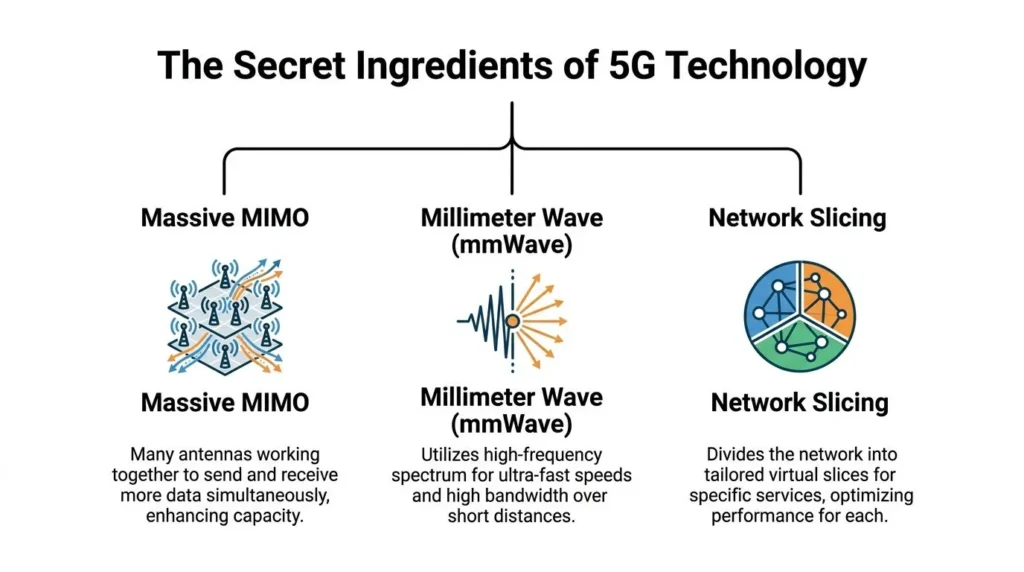
The Secret Ingredients of 5G Technology
To understand how does 5g technology work, it helps to break it into a few core ingredients. Not all explanations do this clearly, so let’s translate the jargon into something you can picture.
Spectrum is the road system
Wireless data travels over radio spectrum. You can think of spectrum as invisible roads in the air.
Some roads are long and wide-reaching. They travel far and pass through walls better, but they may not carry as much data. Other roads are shorter and more specialized. They can move a lot of data quickly, but they don’t travel as far.
5G works across a broader set of these roads than earlier mobile generations. According to AWS’s overview of 5G, 5G can use bandwidths up to 100 MHz in sub-6 GHz and 400 MHz in mmWave bands, which is one reason it can reach theoretical download peaks of 10 to 20 Gbps and latency as low as 1 millisecond. The same source notes that 3GPP Release 15, defined in June 2018, established the 5G NR air interface and that commercial rollout began in 2019.
That sounds abstract, so here’s the plain-English version. If 4G worked with narrower roads, 5G can use wider ones. Wider roads let more traffic flow at once.
OFDM is the packing system
One of the quiet heroes inside 5G is OFDM, short for Orthogonal Frequency Division Multiplexing.
You don’t need to memorize the phrase. What matters is the idea. OFDM splits data into many smaller pieces and sends them across many subcarriers instead of trying to cram everything into one stream. It’s like packing a lot of fragile items into many small boxes rather than one oversized box that’s harder to handle.
That makes transmission more efficient and helps the network deal with interference and changing radio conditions more gracefully.
Massive MIMO adds many more working antennas
Now for the part many people hear about but don’t fully visualize.
Massive MIMO stands for Multiple Input Multiple Output. Older networks used multiple antennas, but 5G scales that idea up dramatically. As described in this explanation of 5G and Massive MIMO, 5G macro cells often use 64 to 256 or more antenna elements, allowing many data streams to be sent and received at the same time. The same source states that this setup can support up to 20 to 30 times higher throughput per cell and up to 1 million devices per square kilometer, which is 10 times more connected devices than 4G LTE can handle.
A simple analogy helps here. Picture a small grocery store checkout line versus a large airport security area with many open lanes. More lanes mean more people can move through at once. Massive MIMO does something similar for wireless traffic.
Beamforming aims the signal instead of spraying it everywhere
If Massive MIMO gives the network more “hands,” beamforming helps it use those hands intelligently.
Older-style transmission is like a floodlight. It spreads energy broadly. Beamforming is more like a smart spotlight. The network directs the signal toward the device that needs it instead of broadcasting the same way in every direction.
That improves efficiency and can help the network serve many users without causing as much interference between them.
Practical rule: Massive MIMO increases how much traffic the network can carry. Beamforming improves how precisely that traffic is delivered.
Why these ingredients matter in daily life
All of this engineering exists for a reason. It changes what wireless feels like when lots of people or devices are competing for service.
Here’s the practical translation:
| 5G feature | Plain-language meaning | Everyday effect |
|---|---|---|
| Wider spectrum use | More room for traffic | Faster downloads and smoother streaming |
| OFDM | Smarter data packing | Better performance in messy real-world conditions |
| Massive MIMO | More simultaneous lanes | Less slowdown in crowded places |
| Beamforming | Targeted signal delivery | More efficient connections to devices |
If you’ve ever wondered why one network seems fine in a quiet suburb but struggles at a packed concert, these ingredients are part of the answer. 5G isn’t magic. It’s a smarter way of organizing wireless traffic.
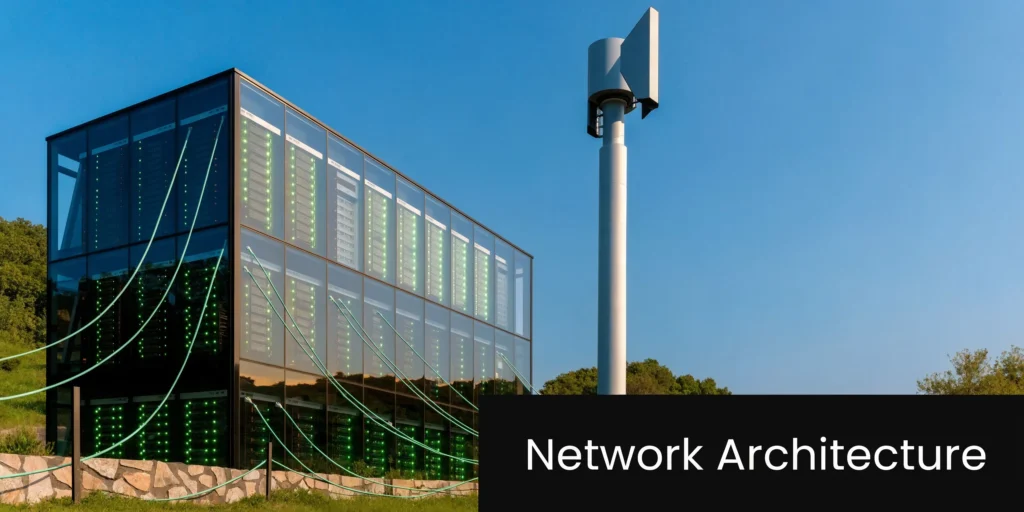
Assembling the 5G Network Architecture
The radio part gets most of the attention, but a 5G network also needs solid plumbing behind the scenes. Otherwise it’s like building a sleek airport terminal with no runways, baggage system, or control tower.
The RAN is the local access layer
The Radio Access Network, shortened to RAN, is the part that connects your device to the carrier through nearby antennas and base stations.
If you want a city analogy, the RAN is the set of neighborhood roads, intersections, and on-ramps that first carry you away from your block. It handles the immediate wireless handshake between your device and the network.
When your phone uploads a photo or starts a video call, the RAN is where that traffic first enters the system.
The core network is the traffic control center
Once data gets off the local roads, it needs routing, prioritization, security checks, and service coordination. That’s the job of the core network.
Think of the core as a combination of highway system and control room. It decides where traffic goes, how resources get assigned, and which services get priority.
In this way, 5G becomes more software-driven than older generations. Instead of treating everything in the same way, modern cores can shape traffic based on the job that traffic needs to do.
Edge computing moves computing closer to you
One reason people expect 5G to feel quicker is that distance matters. Even if a radio link is fast, sending data to a faraway data center and back still takes time.
That’s why edge computing matters. It puts processing closer to users, closer to cell sites, or closer to local network hubs. In plain terms, it’s like moving the kitchen closer to the dining room so orders don’t spend as long in transit.
That’s especially useful for applications that can’t tolerate much delay, such as responsive gaming, industrial control systems, or systems that use AI close to the data source. If you want a simpler primer on how software systems learn from data, this introduction to what machine learning is gives helpful background.
Network slicing is the “different lanes for different jobs” idea
One of the most distinctive parts of 5G architecture is network slicing.
According to Wikipedia’s 5G entry, 5G’s software-defined architecture can create application-specific subnetworks, or slices, on shared physical infrastructure. The same overview describes URLLC with less than 1 millisecond response and 99.99999% availability, while also noting that slices can be designed for uses such as eMBB for high-speed broadband and mMTC for massive IoT deployments.
That sounds technical, but the basic concept is simple. One physical network can behave like several virtual networks, each tuned for a different need.
For example:
- A broadband slice: Good for video, downloads, and home internet.
- A low-latency slice: Better for time-sensitive control or interactive experiences.
- A massive-IoT slice: Built for lots of sensors sending small bits of data.
A 5G network isn’t one giant pipe. It’s closer to a programmable system that can shape itself around different tasks.
How the pieces work together
A useful way to picture the full architecture is this:
- Your device connects through the RAN
- Traffic is routed and managed by the core
- Nearby edge resources handle urgent processing when needed
- Software policies decide how that traffic should be treated
That combination is why 5G is often described as a platform, not just a radio upgrade. The antennas matter, but so does the software intelligence behind them.
Understanding Real-World 5G Performance
This is the part that clears up most everyday confusion. Two people can both say “I have 5G” and still have very different experiences.
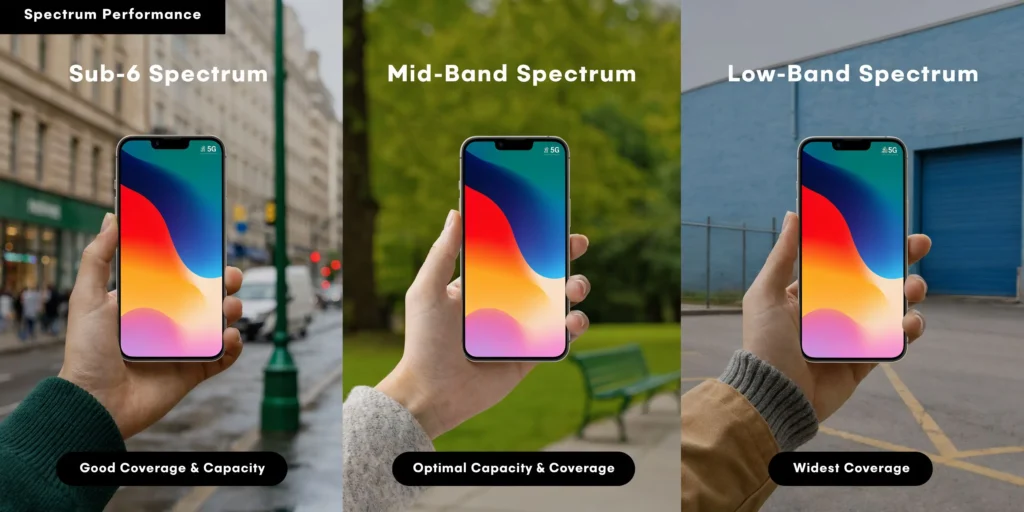
That’s because 5G comes in different spectrum bands, and each one has trade-offs. Some go farther. Some go faster. Some are the best compromise.
Low-band 5G is the reliable workhorse
Low-band 5G covers large areas and tends to travel well through obstacles. If you live outside a dense downtown core, this is the flavor of 5G you’re likely to encounter.
The trade-off is straightforward. It won’t deliver the headline-grabbing performance people associate with top-tier 5G marketing.
That doesn’t make it useless. Far from it. Low-band matters because coverage is the foundation of any network. A decent connection over a broad area is more valuable than a spectacular one that only works on one street corner.
Mid-band 5G is the sweet spot
Mid-band is the most balanced version of 5G. It offers a better mix of speed and reach, which is why many carriers focus heavily on it.
If low-band is the dependable family car, mid-band is the well-rounded daily driver that’s quick enough to be fun but practical enough to use everywhere.
Here, many people experience the “now this feels meaningfully better” version of 5G.
High-band mmWave is the speed specialist
Then there’s mmWave, the eye-catching version of 5G.
It can deliver extremely high speeds, but it has a short range and struggles more with obstacles. In the verified data, mmWave is described as operating in the 24 to 100 GHz range and needing dense small-cell deployment because range can be under 500 meters in those bands, especially in crowded urban environments, as explained in the Massive MIMO overview.
That makes mmWave excellent for places like stadiums, busy urban zones, transport hubs, and dense event spaces. It’s less suited to broad, blanket coverage across huge areas.
A quick comparison
| 5G band type | Best trait | Main trade-off | Best fit |
|---|---|---|---|
| Low-band | Broad coverage | Lower peak performance | Rural areas, suburbs, dependable mobility |
| Mid-band | Balance of speed and reach | Not as far-reaching as low-band, not as extreme as mmWave | Most everyday mobile use |
| High-band mmWave | Very high speed and capacity | Short range, more sensitive to obstacles | Dense city blocks, venues, fixed hotspots |
Why your speed test may differ from someone else’s
A 5G logo doesn’t tell you:
- Which band you’re on
- How busy the cell is
- How close you are to the site
- Whether your carrier uses modern backhaul and core infrastructure there
- Whether your phone supports the band in use
That’s why one person sees a dramatic jump and another shrugs.
If you want to judge 5G, don’t ask only “Do I have 5G?” Ask “What kind of 5G is this, and what conditions is it working under?”
What to expect as a consumer
If you’re reading carrier maps or shopping for service, keep these practical expectations in mind:
- Coverage maps simplify reality: A map may show 5G availability, but indoor conditions and local congestion still matter.
- Mid-band delivers the most satisfying everyday experience: It tends to be the version that feels both quick and usable in normal life.
- mmWave is impressive but situational: It shines where carriers have invested heavily in dense deployment.
- Backhaul matters: Fast radio access doesn’t help much if the rest of the network is a bottleneck.
That last point is easy to miss. People blame the radio layer when the primary issue sits deeper in the network.
How 5G Will Reshape Our Daily Lives
The easiest way to understand 5G’s future impact is to stop treating it like only about phones. A phone is the most visible screen in a much larger connected system.

A city with more devices than people can see
Start with a normal morning. Traffic lights adjust to flow. Buses report location in real time. Parking systems track open spaces. Utility sensors monitor infrastructure. Delivery vehicles update routes on the move.
That works well when a network can handle huge numbers of connected devices without falling apart under the load.
According to this 5G technology overview focused on Massive MIMO, 5G can support up to 1 million connected devices per square kilometer, which is 10 times more than 4G LTE. The same source ties that device density to applications such as AR, VR, and autonomous vehicles, alongside peak speeds of 20 Gbps and latency under 1 millisecond in ideal conditions.
The practical meaning is simple. A city doesn’t need every device to send huge files. It needs lots of devices to stay connected reliably, while sending small updates continuously.
Cloud gaming that feels less “remote”
Now shift to a commuter playing a fast-paced game on a train.
Cloud gaming works by rendering the game elsewhere and streaming the result to your screen. That means delay matters as much as raw speed. If the network is slow to respond, controls feel mushy and the whole experience breaks.
5G doesn’t guarantee perfect gaming everywhere, but it makes wireless play more plausible because it was designed to reduce response time and improve capacity in busy environments.
If you’re curious about where that blends into virtual worlds and persistent digital spaces, this explainer on what the metaverse is adds useful context.
Factories and hospitals care about consistency, not hype
A factory manager doesn’t care whether a speed test looks flashy. They care whether sensors, machines, cameras, and control systems can exchange data with predictable timing.
A doctor using connected equipment cares about reliability, timing, and local processing more than headline download speed. The same is true for logistics teams, warehouse operators, and transport systems.
That’s why 5G’s importance is bigger in professional environments than in consumer marketing. Businesses can use one network platform for very different jobs if the network can separate and prioritize them correctly.
Here’s a short visual overview of where those capabilities are heading:
Three everyday stories that make it concrete
The gamer
A player starts a session on a phone during lunch, then continues on a tablet at home. The game world itself runs in the cloud. What matters most is whether the network responds quickly enough that movement, aiming, and timing still feel natural.
The delivery fleet operator
Vans stream location, diagnostics, and route changes throughout the day. The business gains more than convenience. It can coordinate routes, react to traffic, and monitor vehicle health without relying on a patchwork of separate systems.
The city engineer
Sensors on roads, lights, and public infrastructure send small updates constantly. None of those updates is glamorous on its own. Together, they create a more observable city, where maintenance teams can respond earlier and traffic systems can adapt more intelligently.
5G’s biggest long-term effect may be invisible. Many of its wins happen in the background, where devices, systems, and services coordinate more smoothly than they used to.
That’s the practical translation guide in one sentence. 5G matters not because every person needs extreme speed every second, but because modern life increasingly depends on many connected systems working at once.
Addressing 5G Health and Safety Questions
Questions about 5G and health come up for a good reason. Wireless signals are invisible, technical language is confusing, and misinformation spreads quickly online.
The most useful starting point is basic physics. Mobile networks use radio waves, which are part of the electromagnetic spectrum. The key distinction is between non-ionizing radiation and ionizing radiation.
The important difference people often miss
Ionizing radiation has enough energy to damage atoms directly. X-rays are the common example people know.
5G uses radio frequencies, which are non-ionizing. That puts it in the same broad category as other wireless communication technologies, not in the category people usually mean when they think of dangerous medical imaging or nuclear exposure.
Common concerns, answered plainly
“Does 5G use a completely new kind of harmful radiation?”
No. It uses radio spectrum for communication, including higher-frequency ranges than many earlier mobile networks, but it is still radiofrequency energy.“Does beamforming make it dangerous because the signal is more targeted?”
Beamforming makes wireless transmission more efficient by directing signal energy toward devices instead of spreading it broadly. That’s a networking technique, not a separate health category.“Does more antenna equipment automatically mean more risk?”
More antennas reflect how networks improve coverage and capacity. Network design choices don’t change the fact that mobile communication remains based on radio transmission.
Why health conversations become muddy
People combine several different fears into one.
They hear “higher frequency,” “more antennas,” and “new infrastructure,” then assume all three mean a different biological risk. But those are engineering details about how a network is built and how efficiently it communicates.
The safest way to think about 5G health claims is to separate physics from rumors. Ask what kind of energy is involved, what the equipment is doing, and whether the claim matches established radio science.
If you want to evaluate scary headlines, look for precise language. “Radiation” by itself is too vague to be useful. The category matters.
Answering Your Top 5G Questions
A lot of the confusion around 5G comes from small, practical questions that never get answered clearly. Let’s tackle the ones people ask most.
Do I need a new phone to use 5G
Usually, yes. Your device needs a 5G-compatible modem and antenna system, and it also needs support for the specific bands your carrier uses.
That’s why two “5G phones” may not behave identically on different networks or in different countries. Device support matters almost as much as network support.
Is 5G the same as 5 GHz Wi-Fi
No. They sound similar, but they’re different things.
5G refers to the fifth generation of cellular networking. 5 GHz Wi-Fi refers to a Wi-Fi frequency band used by local wireless routers. One is a mobile network standard. The other is a local networking band inside homes, offices, and public hotspots.
Why does my 5G sometimes feel like 4G
Because not all 5G uses the same spectrum or network setup.
Your phone may be connected to low-band 5G, or you may be in a congested area, indoors, or on a part of the network where backhaul is the primary constraint. The icon tells you less than people assume.
Is remote surgery really possible over 5G
In theory, some of the underlying capabilities line up with that vision. In practice, deployment is harder.
As summarized in IBM’s discussion of 5G slicing and edge computing, real-world 5G latency averaged 15 to 30 milliseconds in a cited 2025 Cisco report, which is above the under 10 milliseconds needed for surgery-level responsiveness. The same source states that by Q1 2026, only about 20% of global operators had deployed slicing, partly because of high core network upgrade costs.
So the honest answer is this: the architecture points in that direction, but the broad real-world network environment isn’t there yet.
What is network slicing in simple language
Think of one building with several dedicated rooms instead of one giant open hall.
Everyone uses the same building, but each room is organized for a different job. One room is quiet and stable. One handles heavy traffic. One is optimized for fast response.
That’s what slicing tries to do for a 5G network. It creates virtual environments with different performance characteristics on shared physical infrastructure.
Can 5G replace home internet
Sometimes. It depends on local coverage, congestion, and what kind of 5G service is available.
For some households, fixed wireless 5G can be a convenient alternative, especially where cable or fiber options are limited. For others, wired broadband will be more predictable. The right answer depends less on the label “5G” and more on how good the network is where you live.
What’s the best way to think about 5G overall
Use this checklist:
- Ask what band is being used
- Check whether the experience is mobile or fixed wireless
- Remember that latency and consistency matter, not just speed
- Separate long-term potential from current deployment reality
That last point keeps expectations grounded. 5G is a major technical shift, but it still depends on how carriers build it.
The Future Is Connected A Conclusion
5G makes more sense once you stop treating it like a mysterious badge on your phone and start seeing it as a system.
It uses wider and more flexible spectrum, smarter signal handling, advanced antennas, and software-based network control. Those pieces work together to increase capacity, improve responsiveness, and support a much larger connected world.
That world includes phones, of course. It also includes vehicles, sensors, hospitals, factories, games, home internet services, and infrastructure typically unseen.
The big takeaway is simple. When people asking how does 5g technology work, they’re asking how modern connectivity is being rebuilt to serve more tasks at once, with more precision than older networks could manage.
And 5G isn’t the final stop. It’s a platform that keeps evolving as carriers improve core networks, add edge computing, and refine how wireless resources are shared. If you enjoy following that bigger picture, these best tech news websites can help you keep up with changes.
If you like clear, approachable explainers on technology, science, health, business, entertainment, and more, visit maxijournal.com. It’s a great place to discover fresh articles, practical commentary, and smart writing for curious readers.
Discover more from Maxi Journal
Subscribe to get the latest posts sent to your email.