Beyond the score, what are you trying to learn before you press play? Most moviegoers treat review sites as interchangeable. They check one number, maybe skim a blurb, and decide. That shortcut is convenient, but it confuses very different tools.
A critic aggregator tells you whether professional reviewers broadly agree. A publication tells you why a film works or fails. A social platform shows how real viewers, fans, and niche communities are reacting. Those are not the same job, and using them as if they are leads to bad choices.
That’s why the best movie review websites aren’t merely the biggest names. They’re the sites that fit a specific part of your decision process. If you want speed, one platform works better. If you want nuance, another does. If you care about indie cinema, festival buzz, or international recommendations, the best option changes again.
This guide approaches the category like an analyst, not a fan ranking sites by habit. The point isn’t to crown one winner. It’s to show how each platform gathers opinions, what signal it produces, where that signal breaks down, and how to combine several sites into a review toolkit you can trust. Used together, these seven sites give you something a single score never can: consensus, context, and perspective.
1. Rotten Tomatoes
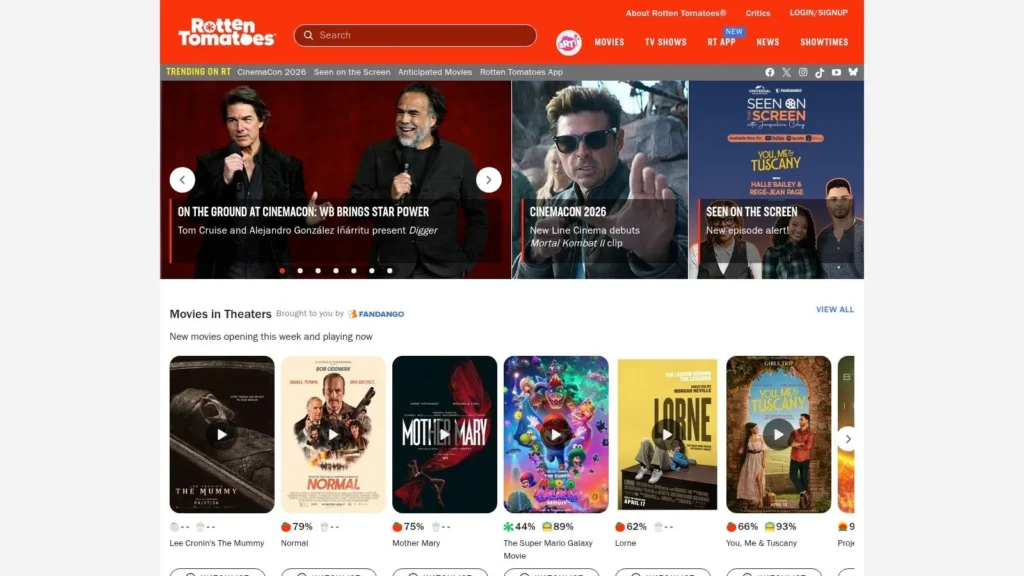
What should your first review source do: measure enthusiasm, explain craft, or tell you whether critics broadly approved? Rotten Tomatoes is strongest at the third job.
Rotten Tomatoes converts a large set of published reviews into a simple approval signal. Its Tomatometer tracks the share of critics who gave a film a positive review, which makes it useful for one fast decision: is the critical response generally favorable? The site also applies a separate “Certified Fresh” label with stricter review-volume and approval requirements, as noted earlier.
That method gives Rotten Tomatoes a specific place in a personal review toolkit. It is the screening layer. If a wide critic pool lands in clear agreement, you get a quick read on consensus before spending time with full reviews elsewhere.
Why its method works
The Tomatometer is effective because it measures breadth of approval, not intensity. That sounds like a small distinction. It changes how you should read the score.
A film with many mildly positive reviews can post a strong Tomatometer even if few critics consider it exceptional. That makes Rotten Tomatoes less useful for ranking two well-reviewed films against each other. It is more useful for filtering obvious misses, spotting broad critical support, and identifying titles where consensus forms early across many outlets.
The audience panel adds a second signal. Comparing critic and audience reaction can reveal predictable fault lines: horror films, franchise entries, broad comedies, and awards contenders often play differently with reviewers and ticket buyers. That split does not prove one side is right. It shows that the movie may depend heavily on taste, expectations, or fandom.
Practical rule: Use Rotten Tomatoes at the start of the process, as a consensus check rather than a final verdict.
Best use case
Rotten Tomatoes works best as the first stop for mainstream releases and heavily marketed new films, where review volume is high and the consensus signal stabilizes quickly.
Use it with a little discipline:
- Check the review count: A score based on many reviews is more stable than an early number built from a thin sample.
- Compare All Critics and Top Critics: A gap between the two can show whether support is broad or concentrated among certain outlets.
- Open several full reviews: The written excerpts often show whether “Fresh” means “excellent,” “solid,” or “better than bad.”
- Pair it with a deeper critical source: Aggregation helps with triage. Interpretation still comes from critics with a clear point of view.
That last step matters across cultural criticism. The same habit of starting with consensus, then moving to more detailed commentary, also applies when reading independent music reviews.
2. Metacritic
What if you care less about whether critics approved a movie and more about how strongly they valued it? That is the problem Metacritic is built to solve.
Metacritic’s movie section translates published reviews into a weighted 0 to 100 Metascore, which makes it useful for readers who want finer ranking, not just broad approval. In the BacanaPlay comparison summarized by Media Play News, Metacritic is described as a critic-focused platform founded in 2001 that usually pulls from a narrower pool of established outlets than larger audience-driven databases.
That narrower pool shapes the signal. Metacritic is often more useful once a film has already cleared the basic question of competence and you are trying to sort degrees of praise. A movie with a respectable consensus elsewhere may still land in a noticeably lower range here if reviews trend toward qualified approval rather than real enthusiasm.
Its weighting system matters too. Metacritic does not treat every published review as equal, so certain outlets can influence the final score more than others. For readers building a personal review toolkit, that makes Metacritic a strong second stop after an aggregator that measures breadth. It helps answer a different question: not whether support exists, but how concentrated and how intense that support is.
Metacritic is most helpful when the choice is between several promising films and you need a sharper way to separate “good,” “very good,” and “widely admired.”
Best use case
Metacritic fits readers who want more precision in the critic layer of their toolkit. It is especially useful for awards contenders, festival releases, literary adaptations, and director-driven projects where the difference between mild respect and strong acclaim changes your expectation.
Use it deliberately:
- Compare films in the same tier: Metacritic is better at sorting a crowded field of well-reviewed titles than making a simple watch-or-skip call.
- Read beyond the number: The weighted score is helpful, but the publication mix explains why the number landed where it did.
- Check for concentration: A high score based on a smaller, selective critic pool can mean elite critical support, not broad agreement across every corner of the press.
- Pair it with an audience platform: Metacritic gives you intensity from critics. A site like IMDb is better for testing whether that response carries over to general viewers.
Its main limitation is transparency. The weighting model affects the final score, but the exact formula remains proprietary, so part of the judgment still depends on how much you trust Metacritic’s editorial selection process.
3. IMDb
What should you use when critic consensus is clear, but you still need to know how ordinary viewers responded?
IMDb fills that role better than almost any other platform because it combines audience ratings with a large film database. Reviews sit alongside cast lists, release details, trivia, franchise links, and credits. That structure makes IMDb less useful as a pure verdict engine and more useful as an audience-context tool.
Its scale matters here. As noted earlier, Market Report Analytics identifies IMDb as the largest player in the movie rating site market. That position helps explain why its audience signal is often strongest on mainstream releases, long-running franchises, and older catalog titles that have accumulated years of user activity.
What IMDb is really good at
IMDb is strongest when your question is diagnostic rather than binary. A score on its own tells you whether viewers leaned positive or negative. The surrounding data helps explain why.
That difference is more important than it sounds. If a sequel drops below earlier entries, you can check whether cast changes, release timing, or franchise fatigue may be shaping the response. If a horror film earns mixed ratings but unusually passionate user reviews, that often points to a title with strong appeal inside a niche and weaker crossover appeal outside it.
IMDb also adds a part of the toolkit that aggregators usually miss. Rotten Tomatoes and Metacritic summarize critical reception. IMDb shows how broad audiences react once a film leaves the critic bubble. For readers building a review toolkit, that makes it a useful counterweight rather than a substitute for critic-led sites.
Its weakness is the same feature that makes it valuable. The open review system creates volume, but volume includes noise. Individual posts vary widely in quality, so the best approach is to look for recurring themes across multiple reviews instead of trusting one extreme reaction.
Best use case
IMDb works best in the audience layer of your toolkit, after you have checked critic opinion elsewhere and want to test audience follow-through.
Use it with a clear method:
- Compare audience reception against critic reception: A gap between the two can reveal crowd-pleasers, critic favorites, or divisive releases.
- Read patterns, not isolated reviews: Repeated complaints about pacing, tone, or adaptation choices usually matter more than one highly emotional post.
- Use the surrounding database as evidence: Cast history, release order, genre tags, and franchise pages often explain why viewers responded the way they did.
- Check under-covered titles: IMDb is often more informative than traditional outlets for older films, genre releases, and direct-to-streaming projects.
The practical takeaway is simple. IMDb should not be your only review source. It should be your audience-checking instrument inside a broader toolkit that combines critic aggregation, full-length criticism, and viewer response.
4. RogerEbert.com
If aggregators tell you the temperature, RogerEbert.com tells you the weather.
RogerEbert.com is one of the strongest arguments for keeping individual criticism in your toolkit. The site extends Roger Ebert’s legacy while publishing reviews from an established roster of critics and contributors. Its value isn’t volume. It’s interpretation.
Why depth still matters
A strong review from RogerEbert.com can rescue you from the biggest weakness of score-driven browsing: false clarity. A number can tell you that critics leaned positive. It usually can’t tell you whether the film is emotionally rich, formally daring, ethically muddled, or interesting in failure.
That’s where edited criticism earns its place. In the verified market overview, RogerEbert.com is described as offering in-depth critiques and covering thousands of films dating back to Roger Ebert’s work since the 1960s, in contrast to aggregation models that flatten different critical voices into a single metric.
This difference matters most for films that divide audiences for good reasons. Challenging dramas, documentaries, formally experimental films, and director-driven work often need a critic who can explain intention, not just verdict.
When a film seems polarizing, read one full critic review before trusting any aggregate score.
Best use case
RogerEbert.com is a second-step site. You don’t open it to skim a leaderboard. You open it when you want a reasoned judgment from a critic who has to defend an opinion in full sentences.
That makes it especially good for:
- Prestige releases: You get cultural context, not just summary.
- Documentaries and indies: These films often disappear inside broad aggregates.
- Disagreement checks: If the crowd loves a film you suspect is hollow, or critics reject one you found intriguing, this site helps you parse why.
Its main limitation is breadth. It won’t mirror the sheer catalog depth of IMDb or the rapid tallying of Rotten Tomatoes. That’s fine. In a personal review toolkit, RogerEbert.com should supply depth, not scale.
5. IndieWire
IndieWire is where criticism and industry reading intersect. That makes it especially valuable if your taste runs toward festival premieres, independent film, international cinema, or awards conversation.
IndieWire doesn’t function like a pure review database. It functions like an informed editorial environment where reviews sit alongside reporting, interviews, and awards analysis. That combination changes how you read a movie before wide release.
Why IndieWire is more than a review outlet
Many of the best movie review websites tell you how a film landed after consensus formed. IndieWire often becomes useful earlier, when a title first appears at Sundance, Cannes, Toronto, or Venice and the public still has very little context.
That early positioning matters because festival reviews often shape the first serious narrative around a film. Is it an awards player, a distributor pickup with breakout potential, or an admired but difficult niche title? IndieWire is strong at framing those questions.
The site is also a smart complement to broad lists about movie review resources because it fills a gap that general rankings often miss: specialty taste. The verified content gap on niche film interests specifically points to the need for guidance that distinguishes between mainstream consensus tools and outlets better suited to arthouse or international discovery. That’s where IndieWire earns a place beside broader platforms and also where readers may want more focused commentary such as Maxi Journal’s independent film reviews.
Best use case
IndieWire belongs in your toolkit if you care about what’s emerging, not just what has already stabilized into public opinion.
A practical approach:
- Use it for festival season: It’s especially helpful when trailers and wide audience ratings don’t exist yet.
- Pair it with Metacritic later: Early critical framing from IndieWire becomes more useful once aggregate scores arrive.
- Lean on it for independent and international titles: These films often need more context than general-audience platforms provide.
Its tradeoff is obvious. If you mostly watch broad studio releases and want one quick verdict, this isn’t the most efficient first stop. It’s a specialist tool, and that’s exactly why it belongs on the list.
6. The New York Times Movies
Some review sites help you decide what to watch tonight. The New York Times helps you place a film in a larger cultural conversation.
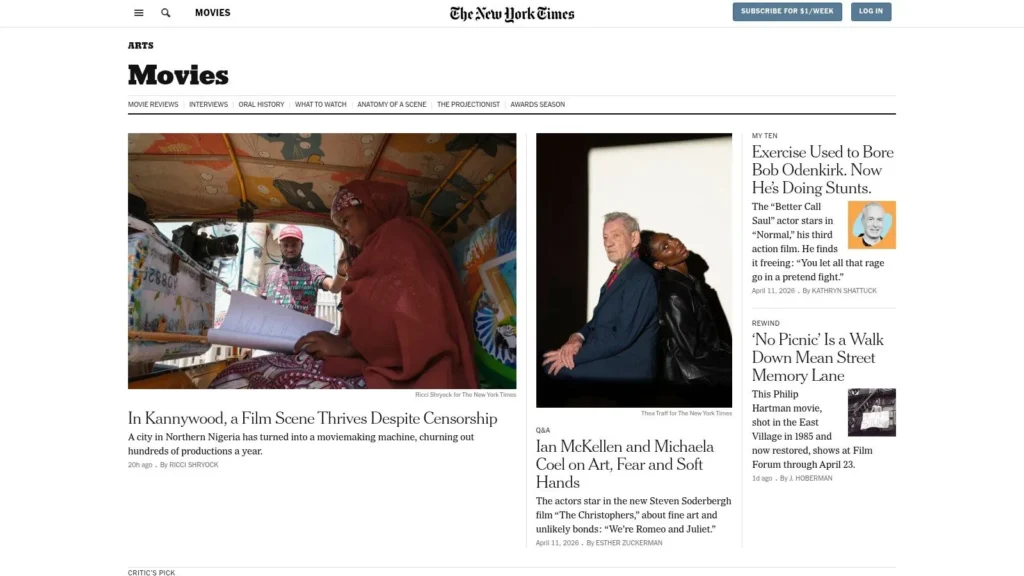
The New York Times Movies section is less about velocity than authority. When a major release, prestige drama, documentary, or international title lands, Times criticism often becomes one of the most cited reference points in the broader media ecosystem.
Why it still matters
The verified data notes that New York Times archives stretch back to the 1920s and cover all Best Picture winners. That archive gives the site something few platforms can match: continuity. You’re not only reading isolated reviews. You’re reading criticism within a publication that has tracked cinema across eras, movements, and industry shifts.
That historical depth improves present-day reading. A New York Times review is often most useful when the movie in question is trying to say something larger about politics, class, identity, celebrity, technology, or memory. In those cases, plot summary and star ratings aren’t enough.
The site also works well as an anchor source when too much online reaction feels interchangeable. A well-edited review from an established critic can reset the conversation.
A serious newspaper review is most valuable when you want language for what you sensed but couldn’t yet articulate.
Best use case
Use the Times when the film matters culturally, not only commercially.
It’s especially strong for:
- Prestige and awards releases: The framing is usually broader than “thumbs up or down.”
- Documentaries and international films: The criticism often connects the film to real-world context.
- Canon building: Lists, retrospectives, and archive browsing help serious viewers deepen taste over time.
The main drawback is access. Frequent reading usually requires a subscription, so it’s less convenient as an everyday utility than the free aggregators. But as a high-trust voice in a mixed review toolkit, it earns its place.
7. Letterboxd
Letterboxd is the best audience platform for people who don’t just watch movies. They track them, rank them, joke about them, argue over them, and build identities around them.
That social layer is why Letterboxd fills a role no traditional review publication can. It turns movie taste into an active community practice through diaries, ratings, reviews, custom lists, and follows.
Why cinephiles use it differently
The verified data identifies Letterboxd as a social platform for personal film tracking and community discovery, which is the right lens for understanding it. This isn’t a replacement for professional criticism. It’s a discovery engine built from user behavior and taste clustering.
That makes it unusually effective for niche audiences. If you love horror, Hong Kong action, slow cinema, anime, repertory screenings, or microbudget indies, Letterboxd often surfaces enthusiasm long before larger outlets catch up. It also helps you find individual users whose taste aligns with yours, which is often more predictive than any single aggregate score.
The platform’s niche strength also appears in market-level data. A projected market report describes Letterboxd as appealing to more than 5 million film buffs through community-driven logging and lists, while a separate projection highlights strong user satisfaction among niche users because of social features like custom lists and watchlogging, according to Data Insights Market’s movie rating sites report.
Best use case
Letterboxd is where you go after the formal reviews, when you want to know whether a film has heat within actual moviegoing communities.
Use it for:
- Trend spotting: Lists and diary activity reveal what cinephiles are rallying around.
- Taste matching: Follow users and critics whose logs consistently overlap with yours.
- List-driven discovery: This is one of the platform’s strongest strengths.
If you already use social discovery in other arts categories, the habit transfers cleanly. Maxi Journal’s piece on the best ways to discover new music reflects a similar idea: curation works better when you combine expert guidance with community behavior.
Its weakness is the same thing that makes it lively. The writing quality varies widely, and the tone can swing from insightful to performative in seconds. Treat it as a smart community layer, not a substitute for edited criticism.
Top 7 Movie Review Sites Comparison
| Source | Implementation complexity | Resource requirements | Expected outcomes | Ideal use cases | Key advantages |
|---|---|---|---|---|---|
| Rotten Tomatoes | Low, easy web/app access | Minimal for users; API/use for scraping limited | Quick critic + audience consensus signal | Casual lookup, editorial quick-takes, discovery | Fast high-level consensus, large critic pool, free app |
| Metacritic (Movies) | Low, straightforward site integration | Minimal for users; proprietary weighting behind score | Granular numeric Metascore for comparisons | Ranking, year-end lists, editorial packaging | More granular scoring than binary systems, useful for ranking |
| IMDb (Reviews section) | Low, public site with integrated data | Minimal; vast user-generated content to filter | Large-volume audience sentiment and long-form reviews | Gauging fan reaction, research on cast/credits, niche titles | Massive audience signal, exhaustive credits, featured reviews |
| RogerEbert.com | Low, standard website reading | Minimal (ad-supported); professionally edited content | In-depth, authoritative criticism and archival context | Deep analysis, quotable reviews, festival/feature coverage | High editorial standards, trusted critic roster, extensive archive |
| IndieWire (Film Reviews) | Low, accessible online coverage | Minimal; festival reporting requires staff presence | Early festival reviews and industry-focused criticism | Cinephile discovery, awards tracking, indie/international film | Timely festival-first coverage, industry perspective, critic insights |
| The New York Times – Movies | Low–Medium, site available but metered | Subscription needed for frequent access | Authoritative, culturally framed reviews | Prestige/mainstream coverage, quotable criticism, long reads | High editorial reputation, wide newsroom resources, international coverage |
| Letterboxd | Low, social platform, easy to use | Minimal for basic use; optional paid Pro/Patron tiers | Cinephile buzz, curated lists, trend signals | Discovery, trend spotting, list curation, community engagement | Social features, user lists/tags, many professional voices present |
Build Your Perfect Movie Review Toolkit
There isn’t one best movie review website for every viewer because movie decisions aren’t one problem. Sometimes you need speed. Sometimes you need nuance. Sometimes you need to know whether a polarizing film is dividing critics, audiences, or both. The smartest approach is to build a stack of sources that answer different questions.
Start with an aggregator. Rotten Tomatoes is the cleanest first-pass filter when you want broad critical direction quickly. Metacritic is better when you need sharper differentiation between decent, strong, and exceptional critical reception. Those two together already fix a common mistake: assuming all positive consensus means the same thing.
Then add one or two editorial voices. RogerEbert.com gives you depth and argument. The New York Times gives you cultural framing and historical seriousness. IndieWire adds industry context and early intelligence on festival titles, indie releases, and international films. These sites are where you learn why a film is landing the way it is.
Finally, add an audience layer. IMDb is the mass signal. Letterboxd is the taste-community signal. That distinction matters. IMDb tells you how broad audiences are reacting across a huge database. Letterboxd tells you what active film culture is excited about, defending, or rediscovering.
A simple toolkit looks like this:
- For casual viewing: Rotten Tomatoes, then IMDb.
- For prestige films: Metacritic, then The New York Times or RogerEbert.com.
- For indie and festival films: IndieWire, then Letterboxd.
- For niche taste building: Letterboxd plus one trusted critic publication.
The larger lesson is simple. Don’t outsource judgment to a single score. A percentage, a Metascore, a newspaper review, and a community thread each measure different things. Once you understand the method behind each platform, you stop treating movie reviews as noise and start reading them as signals.
That’s also why a broader publication ecosystem still matters. A site like maxijournal.com can fit into that mix when you want approachable entertainment commentary alongside coverage from other cultural categories. The goal isn’t to replace the major review platforms. It’s to widen the set of voices you use.
Use the big aggregators for consensus. Use critics for reasoning. Use audience platforms for texture. That combination gives you a much better chance of finding films you’ll love.
If you want more arts and entertainment commentary beyond the major review platforms, visit maxijournal.com. It publishes independent writing across movies, music, culture, technology, science, travel, and other categories, and it may be useful if you like mixing broad discovery with opinion-driven commentary.
Discover more from Maxi Journal
Subscribe to get the latest posts sent to your email.