A child can stand in sunlight, feel warmth on their face, and have no idea they’re being touched by energy born in atomic collisions deep inside the Sun. That’s the strange beauty of fusion. The same process that lights the morning sky is what scientists are trying to recreate here on Earth.
The Ultimate Power Source Lighting Up Our Universe
Every star you can see works because light atomic nuclei fuse together. Our Sun does it continuously, turning hydrogen into helium and releasing the energy that warms oceans, drives weather, and makes photosynthesis possible. According to the U.S. Department of Energy, the Sun fuses about 620 million metric tons of hydrogen into helium every second, while converting 4 million tons of mass into energy through fusion’s mass defect process (DOE explanation of fusion energy).
That can feel abstract until you connect it to ordinary life. The warmth on a sidewalk, the growth of crops, and the daylight powering solar panels all begin with fusion in the Sun’s core. Fusion isn’t a speculative idea. Nature has been running the experiment successfully for billions of years.
Why people care so much about copying it
Scientists want to use fusion on Earth for a simple reason. If we can control it, fusion could provide carbon-free electricity from fuels that are widely available. Deuterium can be extracted from water, and tritium can be bred from lithium, making fusion attractive as a long-term energy source for human civilization.
The scale is what grabs people. A pickup truck loaded with fusion fuel holds energy equivalent to 2 million metric tons of coal or 10 million barrels of oil, according to the DOE’s fusion overview (DOE explanation of fusion energy). That comparison turns fusion from “advanced physics” into something tangible. You don’t need a mountain of fuel. You need a tiny amount used with extraordinary care.
Fusion matters because it turns a small amount of matter into a very large amount of usable energy.
From stars to laboratories
Bringing fusion down from the sky into a machine is brutally hard. On Earth, researchers have to heat fuel into an ultra-hot plasma and keep it stable long enough for atomic nuclei to collide and fuse.
That quest has been going on for decades. Early efforts such as the UK’s ZETA device in the 1950s showed how difficult the challenge was. More recent machines have made real progress, and the field has moved from “can this happen at all?” to “how do we make it practical as a power plant?”
The Physics of Creating Energy from Mass
A fusion reaction begins with a tiny disappearance.
Not the fuel. Not the atoms themselves. A small fraction of their mass. Einstein’s E=mc² says mass can be converted into energy, and fusion is one of the clearest examples of that idea in nature. A little mass goes in. Less mass comes out. The difference becomes usable energy.
That can feel strange because everyday reactions do not work this way. If you burn wood or boil water, the atoms are rearranged but their nuclei stay the same. Fusion changes the nucleus itself, which is why the energy scale jumps so dramatically.
The key idea is mass defect
Take the deuterium-tritium reaction, the one engineers care about most for early fusion power plants. A deuterium nucleus joins with a tritium nucleus and produces a helium nucleus plus a neutron. The total mass of those products is slightly lower than the total mass you started with. Physicists call that difference the mass defect.
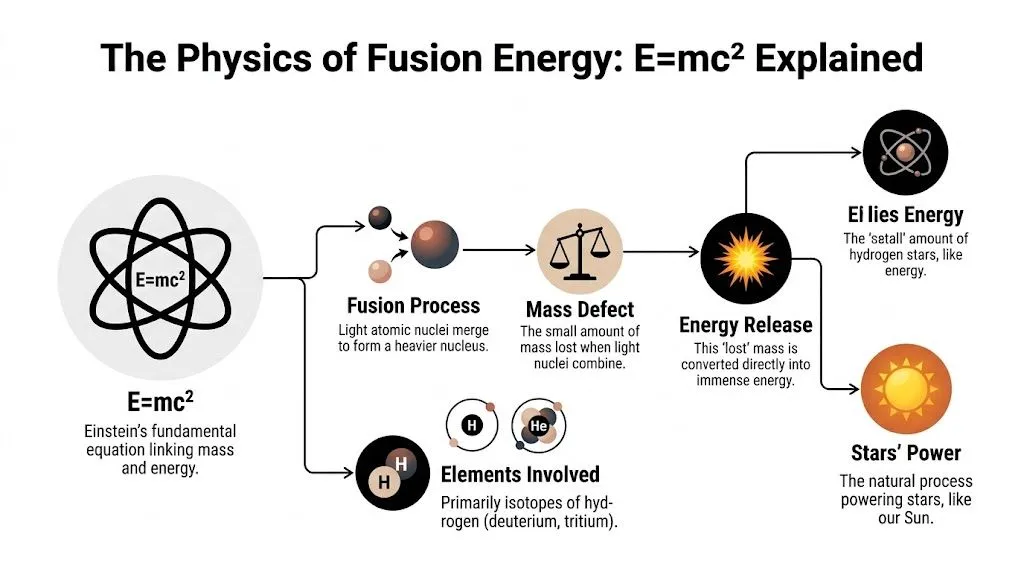
The bookkeeping is real, but the result is physical. That missing mass leaves as energy carried by the reaction products. Each deuterium-tritium fusion event releases 17.6 MeV of energy. The International Atomic Energy Agency notes that fusion fuel is about four million times more energy dense than coal in principle, which helps explain why a very small amount of fuel could do work on the scale of powering a city (IAEA overview of fusion energy). If you want a refresher on the part of the atom being changed during this process, this guide to the nucleus of an atom is a useful companion.
That is the part many readers miss. Fusion is not impressive because it uses a lot of fuel. It is impressive because a tiny amount of fuel carries an outsized amount of energy.
Why fusing light elements releases energy
The next question is natural. Why does combining two nuclei give off energy at all? Building larger things usually seems like it should cost energy.
The answer is binding energy, which is a measure of how tightly a nucleus is held together. Some nuclei are more stable than others. Very light nuclei such as hydrogen isotopes can move into a more tightly bound state by fusing. When that happens, the final nucleus sits at a lower energy state, and the energy difference is released.
You can feel the basic logic with two strong magnets. When their like poles face each other, your hands feel the pushback. Bring them close enough in the right orientation and they snap together. Fusion follows a similar sequence, though the force involved is different. Atomic nuclei strongly repel each other at first because both are positively charged. If they get close enough, the strong nuclear force takes over, pulls them into a tighter arrangement, and energy is released as the system settles into a more stable state.
Practical rule: In fusion, “missing mass” has been converted into particle motion and heat.
Where that energy goes
The energy from fusion does not appear as a mysterious glow. In a deuterium-tritium reaction, most of it comes out as fast-moving particles, especially the neutron. Those particles slam into surrounding material and lose their energy there as heat.
That heat can then boil water, make steam, and spin a turbine. So the back end of a fusion power plant would look familiar. The extraordinary part is the front end. Instead of burning a pile of fuel, the plant would get its heat from tiny nuclei joining together and giving up a little of their mass in the process.
Common Fusion Reactions Explained
Not all fusion reactions are equally useful. Some happen naturally in stars but are too slow or difficult to make practical in a reactor. Others are much better suited to machines built by engineers.
The reaction scientists care about most for near-term power plants is deuterium-tritium fusion, often shortened to D-T fusion. The reaction that powers the Sun is mainly the proton-proton chain, usually called the P-P chain.
Why D-T is the favorite on Earth
D-T fusion is the leading option because it happens at comparatively lower temperatures than many alternatives. EUROfusion notes that the deuterium-tritium reaction is prioritized for terrestrial reactors because it occurs at relatively lower temperatures, around 100 million °C, due to quantum effects involving pion exchange that help the strong nuclear force act more efficiently for these isotopes (EUROfusion explanation of fission and fusion).
That doesn’t mean “easy.” It just means easier than other fusion recipes.
The Sun gets away with the proton-proton chain because it has enormous gravity squeezing matter inward over immense timescales. Engineers on Earth don’t have a star’s gravity, a star’s size, or a star’s patience. So they choose a reaction that’s more willing to happen in a laboratory.
For a broader primer on reaction basics, this overview of what is a fusion reaction helps connect the terminology to the physics.
Key fusion reactions compared
| Feature | Deuterium-Tritium (D-T) Fusion | Proton-Proton (P-P) Chain |
|---|---|---|
| Main setting | Experimental and proposed terrestrial reactors | The Sun and other stars |
| Fuel | Isotopes of hydrogen called deuterium and tritium | Ordinary hydrogen nuclei, which are protons |
| Why scientists use it | It occurs at relatively lower temperatures for reactor design | It naturally powers stars under crushing gravity |
| Products | Helium nucleus and a neutron | Multiple steps eventually leading to helium |
| Energy character | Strong, reactor-friendly energy release per reaction | Effective in stars, but too slow for practical Earth reactors |
| Engineering trade-off | Good for ignition attempts, but neutron handling is difficult | Natural in stars, impractical for human-built power systems |
One reaction powers stars, one may power cities
The Sun’s fusion process is majestic but not a blueprint you can shrink into a building. D-T fusion is more like a specialized industrial recipe. It isn’t the most poetic option, but it’s the one engineers can work with.
That distinction clears up a common misunderstanding. People often say fusion reactors are “little suns.” That’s useful as shorthand, but it’s not precisely true. A reactor borrows the core idea of fusion, then uses a different fuel strategy to make the process achievable on Earth.
The Sun shows fusion is possible. Reactor physics asks which version of fusion humans can actually control.
How Reactors Control the Power of a Star
Before fusion can generate electricity, scientists have to solve a basic problem. Atomic nuclei are positively charged, so they repel each other. It’s like trying to force together the same poles of two magnets. They push apart before they can touch.
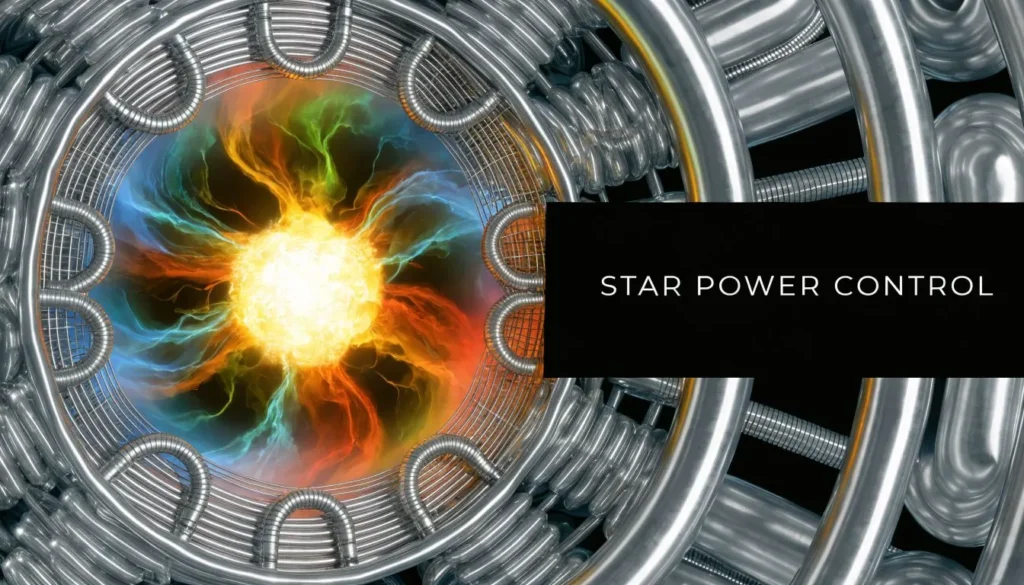
To get fusion, researchers must heat fuel until it becomes plasma, a hot soup of charged particles where electrons are stripped from atoms. At that point, nuclei move fast enough that some can get close enough for the strong nuclear force to pull them together.
The temperature problem
The conditions for fusion are far from modest. To overcome electrostatic repulsion, fusion reactors must heat fuel to over 100 to 150 million °C, and the plasma must also satisfy the Lawson criterion for density, temperature, and confinement time: nτT > 5×10^21 m^-3·s·keV (fusion power overview).
Those numbers can blur together, so here’s the simple version. Fusion doesn’t happen just because plasma is hot. It also has to stay hot, stay dense enough, and remain confined long enough for a meaningful number of nuclei to collide.
Scientists usually pursue that with two very different strategies.
Magnetic confinement
In magnetic confinement, machines use powerful magnetic fields to hold plasma away from solid walls. This is necessary because no material can sit there and “contain” something that hot by physical contact.
The best-known machine is the tokamak, which has a doughnut-shaped chamber. Magnets guide the plasma in loops, creating a kind of magnetic bottle. Another design, the stellarator, twists the magnetic path in a more complex geometry to improve stability.
This approach is like trying to hold jelly with invisible rubber bands. The plasma wriggles, swirls, and tries to leak away. Engineers respond with stronger magnets, smarter control systems, and chamber designs that reduce instabilities.
Inertial confinement
In inertial confinement, scientists take a tiny pellet of fusion fuel and blast it with synchronized lasers. The outer layer explodes outward, and that reaction drives the rest inward, compressing the fuel so rapidly that fusion can happen before the pellet flies apart.
That method doesn’t confine plasma for long. It relies on the fuel’s own inertia to keep it together for a brief instant. Think of squeezing a droplet so fast that fusion happens before the droplet has time to disperse.
This visual gives a good sense of how extreme that engineering looks in practice.
Two paths, same goal
Here’s the side-by-side logic:
- Magnetic confinement: Better suited to sustained plasma control, but it demands exceptional stability over time.
- Inertial confinement: Produces intense short bursts, but repeating those bursts often enough for a practical power plant remains difficult.
- Shared challenge: Both systems must deliver enough fusion events that the energy out becomes useful at scale.
A fusion reactor doesn’t “hold fire.” It manages a charged fluid that would fall apart instantly without constant control.
That’s why fusion research is as much an engineering discipline as a physics one. The reaction itself is known. The challenge is creating the conditions where it happens reliably, safely, and often enough to power the grid.
Current Fusion Projects and Recent Breakthroughs
A good way to judge fusion progress is to ask a simple question: are scientists still proving the basic physics, or are they building machines big enough to matter for the grid?
Today, the answer is increasingly the second one.
ITER and the big-machine strategy
The clearest example is ITER, a massive international tokamak built to test fusion at power-plant scale. ITER is not being built to sell electricity. It is being built to answer a tougher question. Can a reactor-sized machine keep a fusion plasma hot and stable enough to produce much more fusion power than the heating power fed into it?
According to the World Nuclear Association, ITER’s target is 500 MW of fusion power from 50 MW of input heating power, or Q=10. The same source also highlights an earlier milestone from the JET tokamak, which produced 16 MW of fusion power in 1997. Taken together, those two facts show how the field has progressed from proving large-scale fusion is possible to testing whether it can be pushed toward reactor-level performance (World Nuclear Association overview of fusion power).
That scale matters because megawatts are not abstract lab numbers. They are the language of power stations, city grids, and industrial plants.

Why each machine matters
Fusion progress can feel slow if you look only at calendar years. It makes more sense if you look at what each machine teaches.
One reactor might show how to keep a plasma from wobbling out of control. Another tests how walls survive intense neutron bombardment. Another improves the magnets, the heating systems, or the software that has to react in fractions of a second. Fusion engineering works a bit like learning to fly by building better aircraft one generation at a time. You do not jump from the Wright brothers to a transatlantic jet in one leap.
That is why projects like JET and ITER matter even before they generate commercial electricity. They reduce uncertainty, one hard lesson at a time.
The NIF ignition breakthrough
A very different milestone came from the National Ignition Facility, which uses lasers instead of magnetic confinement. In December 2022, researchers there announced a result the field had chased for decades: the fusion reaction released more energy than the laser energy delivered to the fuel target. Lawrence Livermore National Laboratory describes the shot as 2.05 megajoules in and 3.15 megajoules out, the first controlled fusion experiment to clear that threshold (Lawrence Livermore National Laboratory announcement).
That number is easier to understand with a physical picture. A megajoule is a unit of energy, not power. It tells you how much energy came out of one burst, not how long a machine can keep producing it. NIF’s result was like proving you can get a campfire to catch from a difficult spark. A power plant would need to light that fire again and again, cheaply, reliably, and many times per second.
So the breakthrough was real, and the remaining engineering challenge is also real.
Reality check: Crossing a scientific threshold proves the door can open. Building a useful power plant means designing the whole building around that door.
Why the field feels more concrete now
Fusion now has public megaprojects, national-lab breakthroughs, and private companies testing different reactor ideas in parallel. Some groups are improving tokamaks. Others are trying stellarators, compact magnetic systems, or pulsed approaches.
That variety is healthy. Fusion is not one machine. It is a family of attempts to make light atomic nuclei snap together under controlled conditions and release usable energy at a scale large enough to power neighborhoods, factories, and eventually whole cities.
The field still has serious obstacles. But the center of gravity has shifted. The biggest questions are now about cost, materials, repetition rate, durability, and grid-ready design. Those are difficult questions, but they are engineering questions, which is a much more tangible place for fusion to be.
Future Applications Risks and Misconceptions
A practical fusion plant would feel less like a science-fiction prop and more like a giant industrial boiler room that happens to use star physics instead of burning fuel. Its first job would be simple to describe and hard to achieve: send steady electricity to the grid for homes, trains, data centers, hospitals, and factories around the clock.
The reason people get excited goes beyond “clean energy.” Fusion packs a striking amount of energy into a small amount of fuel. The abstract physics matters because it could translate into very tangible outcomes, like replacing mountains of mined and burned fuel with a far smaller stream of reactor fuel and supplying enough continuous power to keep a city running. That is why fusion keeps showing up in conversations about desalination, hydrogen production, and other energy-hungry systems. If you like that kind of long-range thinking, this article on how long it would take to terraform Mars explores another problem where huge energy demands shape what is possible.
Misconception one, fusion is just fission with a different label
Fusion and fission both come from the atomic nucleus, but they work in opposite ways. Fission breaks apart heavy atoms such as uranium. Fusion joins light nuclei such as hydrogen isotopes.
That difference changes the behavior of the reactor itself. A fission reactor is built around a chain reaction. A fusion reactor is built around maintaining a very hot, very unstable plasma. If that plasma slips out of its narrow operating window, the reaction fades. The process works more like keeping a ball balanced on a cushion of air than lighting a fuse.
Misconception two, a fusion reactor can melt down like a fission plant
The common fear is understandable. “Nuclear” often gets mentally sorted into one box.
Fusion does not run with the same kind of self-feeding reaction that creates meltdown scenarios in fission plants. The plasma has to stay hot enough, dense enough, and confined well enough for nuclei to overcome their electrical repulsion, like pushing two strong magnets together until they finally snap into a new arrangement. Remove that control, and the snap stops happening.
A fusion plant would still be a serious industrial facility. It would handle extreme heat, strong magnetic fields in many designs, high-energy systems, and fast neutrons that batter nearby materials. So the honest safety picture is not “nothing can go wrong.” It is that the failure modes are different, and the classic runaway reactor image does not map cleanly onto fusion.
Misconception three, fusion produces no radioactive issues at all
Fusion is cleaner on the waste question than many people assume, but “radioactive-free” is too simple. The main concern is not spent fuel rods like those from fission plants. The bigger issue is that neutrons from fusion can strike the reactor’s inner walls and structural parts, making some of those materials radioactive for a period of time.
Researchers at ITER explain that fusion facilities are designed with low-activation materials so much of this material can decay to lower radioactivity levels over time and be managed more easily than long-lived high-level fission waste. You can read their overview in ITER’s page on waste management in fusion.
That distinction matters. Fusion still brings radiation handling, shielding, remote maintenance, and disposal questions. But it does not produce the same volume or type of long-lived waste that people usually picture from fission debates.
What success would look like
Success would not mean a magical machine with no tradeoffs. It would mean a reactor that can run repeatedly, survive neutron damage, stay affordable to maintain, and deliver electricity at a price power systems can use.
If engineers get there, the payoff is easy to picture. Fewer smokestacks. More stable clean power for heavy industry. Large-scale electricity that does not depend on weather alone. In practical terms, fusion would matter because it could turn a tiny fuel stream into enough dependable energy to support real places, not just laboratory milestones.
Frequently Asked Questions About Fusion Energy
Is fusion the same as fission
No. Fusion joins light nuclei together. Fission splits heavy nuclei apart. Both release nuclear energy, but they do it by opposite processes.
Why does fusion need such extreme heat
The nuclei involved are positively charged, so they repel one another. The fuel must be heated into plasma so particles move fast enough to get close enough for the strong nuclear force to bind them.
Does fusion create radioactive waste
Some reactor materials can become activated, so fusion is not completely free of radioactive handling issues. But it does not produce the same kind of long-lived high-level waste associated with fission fuel cycles.
Can fusion reactors explode like bombs
No reactor is risk-free, but fusion power systems are not nuclear bombs. Fusion in a reactor depends on tightly controlled conditions. If those conditions fail, the reaction stops rather than running away.
When will fusion power reach the grid
There isn’t a guaranteed date. Large projects and private companies are working toward that goal, but engineering, cost, and repeatability still need to be solved before fusion becomes an everyday part of the power system.
If you enjoy clear science writing that turns difficult ideas into readable explanations, visit maxijournal.com. It’s an independent online magazine publishing approachable articles across science, technology, health, business, arts, travel, entertainment, education, and more.
Discover more from Maxi Journal
Subscribe to get the latest posts sent to your email.