You probably know the routine. You install a new Call of Duty, skip past the menu, and head straight for multiplayer. Team Deathmatch, Domination, maybe Warzone if you want a larger sandbox. For a lot of players, that’s the whole identity of the series.
But that misses half the picture. The call of duty campaign isn’t a side dish. It’s the franchise’s scripted, story-driven core. Since the original game launched in 2003, Call of Duty has sold over 500 million lifetime units worldwide, and total franchise revenue has surpassed $30 billion, with single-player campaigns playing an integral role in building that success, according to this Call of Duty sales overview.
If multiplayer feels like a competitive sport, the campaign feels like starring in a blockbuster war film that responds to your input. You don’t just watch the breach, the escape, or the desperate last stand. You perform it.
For players who’ve only treated Call of Duty as an online shooter, that’s the key shift to understand. The campaign is where the series slows down enough to build tension, establish characters, and deliver missions that stick in your memory long after the final scoreboard disappears.
More Than A Match What is the Call of Duty Campaign?
At its simplest, a call of duty campaign is the single-player story mode. But that dry definition doesn’t tell you why people care about it.
The better way to think about it is this. Multiplayer asks, “How well can you outplay other people?” The campaign asks, “What does it feel like to survive a global crisis from the front line?” That difference changes everything, from pacing to mission design to tone.
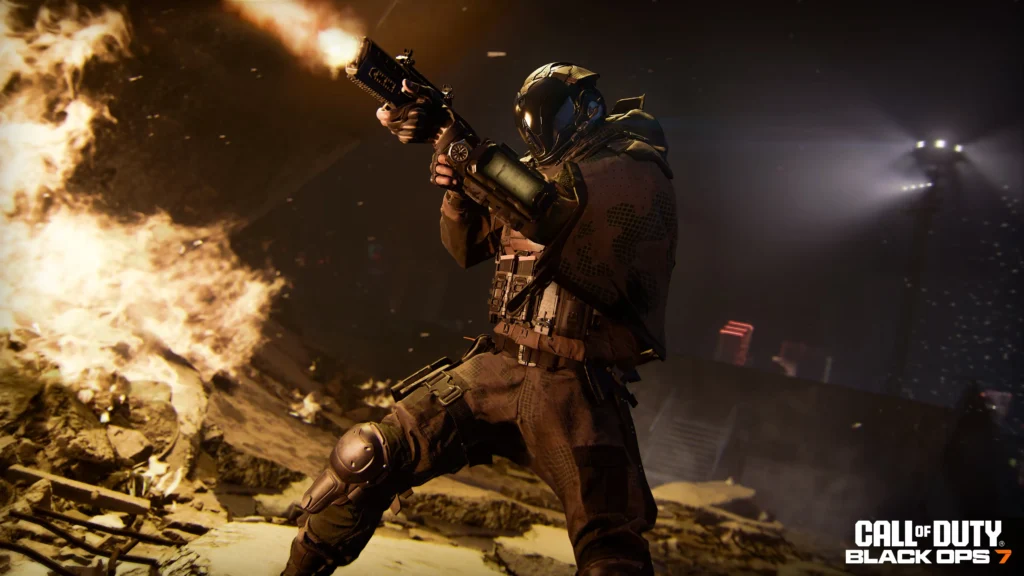
What you actually do in a campaign
You move through a curated sequence of missions with a clear dramatic arc. One mission might put you in a crumbling city under fire. The next might shift to a stealth infiltration at night. Another might throw you into a vehicle chase or a desperate defense against overwhelming odds.
That structure matters because it lets the developers control rhythm in a way multiplayer never can. They can build suspense, release it in a huge firefight, then pull back for a quiet debrief or a story twist.
Why campaigns matter to the franchise
Some players still talk about campaigns as if they were a bonus mode. The sales history says otherwise. The brand’s huge commercial reach didn’t happen by accident, and it didn’t come from free-to-play modes alone. The premium games, with campaign included, built the identity that made Call of Duty a global giant in the first place.
Practical way to frame it: If multiplayer is the mode you master, the campaign is the mode you remember.
For new players, that makes the campaign a strong entry point. You don’t need twitch-level reflexes or map knowledge. You need curiosity, a few spare evenings, and a taste for tightly staged action.
Defining the Cinematic Shooter Experience
Call of Duty didn’t invent the idea of a military shooter. What it sharpened was the cinematic shooter. That means a game designed less like an open playground and more like a carefully edited action film.
Three pillars of the format
The first pillar is forward momentum. Campaigns usually push you from scene to scene with little downtime. You’re rarely wandering aimlessly. The game wants you moving, reacting, advancing.
The second is spectacle. A Call of Duty mission often revolves around a set-piece. That could be a building collapse, an ambush in a crowded street, a helicopter assault, or a covert breach where everything goes wrong at the worst possible second. These moments are scripted, but the scripting is the point. It’s how the game delivers impact.
The third is clarity. Even when the plot gets dense, the immediate objective is usually readable. Follow the squad. Secure the room. Escape the area. Protect the target. That simplicity keeps the action legible.
Why linear design works here
Some players hear “linear” and assume “limited.” In a Call of Duty campaign, linearity is what makes the pacing so sharp. The developers know where you’ll stand, what you’ll see, and when key events will hit. That control lets them stage action with the same precision a filmmaker uses to frame a scene.
If you’re interested in how visual storytelling shapes emotion, many of the same principles appear in documentary filmmaking techniques, even though the genre is completely different. Framing, timing, viewpoint, and contrast all shape how a scene lands.
How it differs from multiplayer and Warzone
Multiplayer creates stories after the fact. You remember the comeback, the lucky headshot, the awful spawn trap. The campaign creates stories on purpose. It introduces named allies and enemies, builds a chain of missions around them, and guides you through a beginning, middle, and end.
A strong campaign doesn’t ask you to invent the drama. It delivers the drama, then lets you play through it.
That’s why the mode appeals even to people who don’t normally stick with competitive games. It offers direction. It offers closure. Most of all, it offers authored moments with a clear emotional target.
From Normandy to Nukes The Campaign’s Evolution
The history of the call of duty campaign is really the history of a series learning how flexible its own formula could be. The early games stayed close to the ground. Later ones reached for espionage thrillers, conspiracy drama, futuristic combat, and emotional character work.
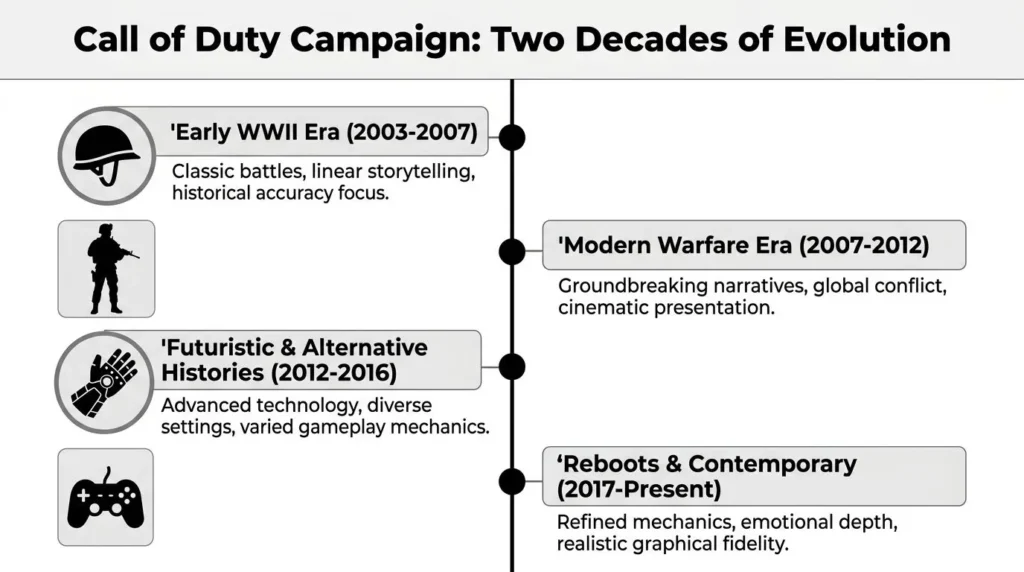
The first era felt historical and direct
The original games were rooted in World War II. Their appeal came from scale and immediacy. You weren’t a lone superhero. You were one soldier moving through battles that felt larger than any one character.
Those campaigns were more straightforward than what came later. They emphasized battlefield immersion, allied squads, and familiar wartime imagery. The storytelling worked, but it was less interested in psychological twists or franchise mythology.
Modern Warfare changed the tone
Then the series pivoted. The jump to a modern setting turned the campaign into something tenser and more contemporary. Missions began to feel like headlines rewritten as action fiction. The pace got snappier. The framing got more theatrical. The stakes became global in a way that felt immediate rather than historical.
That shift also changed the player fantasy. Instead of reliving major wars from the past, you were now operating inside intelligence conflicts, urban raids, covert operations, and geopolitical crises.
Black Ops and the future widened the lens
Black Ops took the campaign in another direction. It leaned harder into mystery, memory, and conspiracy. Later entries pushed further into speculative warfare, advanced gadgets, and future battlefields.
Here, the series stopped being one thing. A call of duty campaign could now be historical, contemporary, or near-future science fiction. That variety is one reason the brand stayed culturally visible for so long. Players with different tastes could still find an entry that suited their preferences.
Reboots made the timeline more complicated
The long-running challenge is continuity. Call of Duty doesn’t have one neat chronology. It has reboots, parallel strands, revived characters, and alternate tonal identities. That’s exciting when you’re already invested. It can also confuse newcomers.
A useful point of analysis is the franchise’s struggle to maintain coherence across its own lore. The issue isn’t just “What happened first?” It’s also whether newer games expect you to carry emotional attachment from older versions of the same characters. That tension is noted in this discussion of Call of Duty’s complex campaign continuity.
A simple way to read the franchise timeline
- Early WWII games: best seen as classic war stories with simple continuity expectations.
- Modern Warfare original arc: a more connected run with a stronger sense of recurring conflict and escalation.
- Black Ops branch: more interested in secret history, fractured memory, and generational fallout.
- Reboot era: familiar names return, but often in revised forms that don’t always map cleanly onto earlier games.
For many players, that’s the evolution. The campaign didn’t just improve visually. It became a series of different storytelling flavors under one brand.
Landmark Campaigns That Defined the Genre
A great Call of Duty campaign does more than give you a string of missions. It gives the series a new storytelling model that later games either copy, refine, or argue with. If multiplayer is the sport, these campaigns are the blockbuster films that taught players what a Call of Duty story could feel like.
Call of Duty 4 Modern Warfare
Call of Duty 4: Modern Warfare is the hinge point. Earlier entries had scale and intensity, but this was the game that reframed the campaign as a tightly edited military thriller, with missions built like scenes from a film and controls that still felt immediate in your hands.
The easiest way to understand its importance is to look at specific missions. “All Ghillied Up” slows everything down and turns patience into tension. “Charlie Don’t Surf” throws you into a chaotic urban assault with noise, smoke, and confusion coming from every angle. That range showed other shooters that a campaign could switch tone from stealth to spectacle without feeling inconsistent.
It also helped move the series from historical war drama into modern geopolitics, which changed the identity of Call of Duty for years afterward. As noted earlier, its commercial success helped spread that design template across the broader shooter field.
Modern Warfare 2 from 2009
Modern Warfare 2 took that template and pushed it toward pure blockbuster escalation. If Call of Duty 4 felt like a sharp military thriller, Modern Warfare 2 often felt like a summer action film that keeps finding ways to top its last set piece.
The campaign is remembered not just for scale, but for how confidently it jumps between tones. One mission gives you a snowbound infiltration with careful movement and gadget use. Another drops you into collapsing chaos in Washington, D.C. The result is a campaign that treats variety as part of the spectacle.
That ambition made its story beats travel far beyond the usual single-player audience. Even players who skipped the campaign often know its shocks, betrayals, and iconic lines because the game turned them into shared reference points across gaming culture.
Black Ops
Black Ops mattered for a different reason. It proved a Call of Duty campaign could be disorienting on purpose.
Instead of building everything around military escalation, Treyarch built its story around paranoia, fractured memory, and Cold War mythmaking. Numbers, flashbacks, interrogation rooms, and unreliable recollection give the campaign a different texture from Modern Warfare. It is less interested in clean military momentum and more interested in the feeling that something is wrong, even when the gunplay remains familiar.
That shift is a big part of why Black Ops still stands out. Players did not just remember missions. They remembered the mood, the voice performances, and the mystery pulling the whole thing forward. You see the same appeal in other story-driven games where framing and character detail matter as much as moment-to-moment mechanics, which is part of why readers look up choices and character context in guides like this Persona 5 classroom answers and social link guide.
Modern Warfare from 2019
The 2019 reboot asked a different question. What does a Call of Duty campaign look like when it stops trying to top the old games in sheer excess and instead tries to feel immediate, intimate, and uncomfortable?
Its answer was a more grounded style of presentation. Interior spaces feel cramped. Lighting is harsher. Civilian spaces matter more. Missions like “Clean House” became the talking point because they strip away the heroic distance that older entries often used. You move slowly, identify threats in tight rooms, and feel the pressure of making split-second judgments.
That made the reboot important as a statement of intent. The series could return to familiar names and still change its dramatic method.
A short look at the series in motion helps explain why these campaigns still pull so much attention:
Modern Warfare 2 from 2022
Modern Warfare 2 from 2022 is less important as a groundbreaking text than as proof of endurance. In an era shaped by seasonal updates, battle passes, and multiplayer retention, Activision’s financial reporting on Modern Warfare II’s launch performance showed that a new Call of Duty release could still hit massive commercial highs right out of the gate.
For campaign fans, that matters because it confirms something easy to miss. The single-player mode is not just a bonus attached to the competitive suite. It is still part of the series’ identity as a premium, cinematic package.
Taken together, these games show the campaign’s evolution more clearly than any simple ranking can. Modern Warfare defined the modern thriller template. Modern Warfare 2 turned it into maximalist spectacle. Black Ops proved the format could carry psychological intrigue. The 2019 reboot brought the camera closer to the human cost. That variety is why choosing a Call of Duty campaign is really about choosing a flavor of action storytelling, not just picking the “best” one.
Deconstructing the Mission Gameplay and Pacing
A good call of duty campaign works because it understands rhythm. It doesn’t ask you to do the same thing for hours. It alternates pressure, speed, and tone so each mission has its own personality.
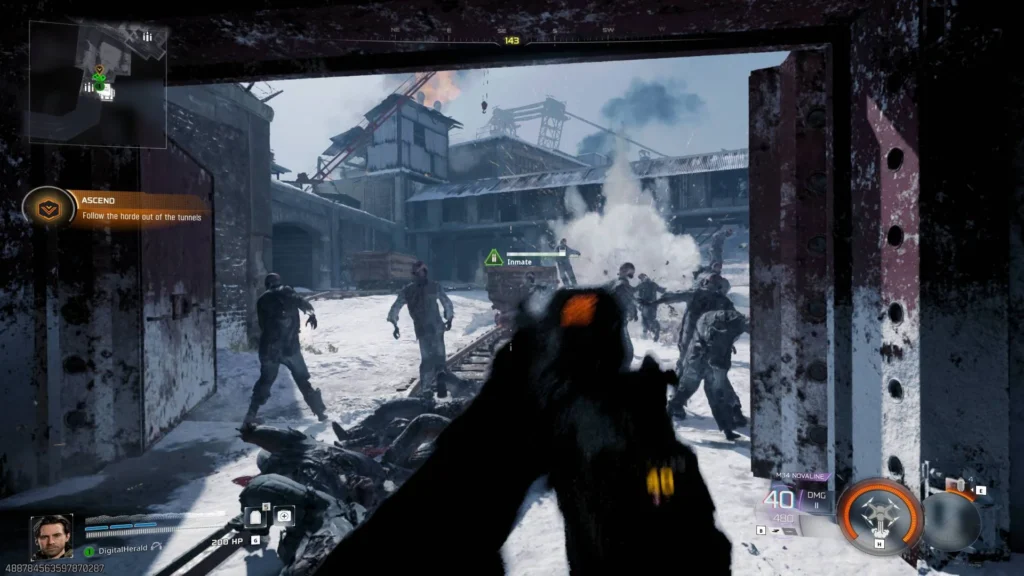
The usual mission loop
Most campaigns mix a few familiar ingredients.
- Opening movement: You start with a briefing, insertion, or short walk-and-talk sequence that establishes mood.
- Combat encounter: The mission introduces a firefight built around cover use, flanking, and target prioritization.
- Twist in tempo: Things often slow down for stealth, reconnaissance, or a sudden relocation.
- Final surge: The mission ends with a dramatic escape, boss-like stand, or large scripted push.
This repetition isn’t a flaw. It’s a skeleton the designers can dress in different settings. A dusty village assault feels different from a dark house raid, even if both use the same broad dramatic shape.
Quiet missions matter as much as loud ones
Players who know Call of Duty only through multiplayer often expect nonstop shooting. Campaigns are smarter than that. Some of the best missions rely on restraint. A room clear at walking speed can feel more stressful than a huge battlefield because the game strips away noise and makes every movement count.
The campaign is often at its best when it’s confident enough to slow down.
That slower pacing also helps the story breathe. Characters can argue, debrief, hesitate, and react. Without those quieter passages, the explosive scenes would blur together.
Difficulty changes the feeling, not just the damage
One of the least discussed parts of the call of duty campaign is how difficulty shapes story absorption. Most online chatter centers on Veteran runs, but that’s not how many people should start.
As noted in this discussion of campaign difficulty and accessibility, modern campaigns are tuned across settings so easier modes preserve narrative pacing while harder modes test skill more aggressively. That’s a useful lens because it reframes difficulty as a taste choice, not a badge of honor.
A simple guide to choosing your setting
| Play style | Best fit | Why |
|---|---|---|
| You mainly want the story | Recruit or a lower setting | You’ll move through missions with fewer frustrating stalls |
| You like balanced tension | A middle setting | Combat still bites, but the pacing stays smooth |
| You want pressure and repetition | Veteran or equivalent | Encounters demand careful positioning and patience |
The blockbuster look has technical costs
That cinematic polish asks a lot from hardware. The same source notes that Modern Warfare (2019) required up to 246 GB of storage because of its high-fidelity assets. That’s a reminder that the campaign’s visual ambition isn’t abstract. It lives in huge installs, dense environments, heavy lighting, and detailed animation work.
If you’re playing on PC, this matters. A campaign can be narratively linear but technically demanding. Stutters, long loads, or storage pressure can blunt the intended effect.
What that means in practical terms
- Install space matters: These games can occupy a major chunk of a drive.
- Presentation is part of the design: Lighting, texture quality, and sound sell the tension.
- Smooth performance helps storytelling: A set-piece loses force if the machine struggles to present it cleanly.
Your Perfect Starting Point Campaign Recommendations
The best first call of duty campaign depends less on “Which one is greatest?” and more on “What kind of story do you want?” If you choose by taste, you’re much more likely to finish it and want another.
Which Call of Duty Campaign Should You Play First?
| If You Like… | Recommended Campaign | Why It’s a Great Start | Tone |
|---|---|---|---|
| Historical war dramas | Call of Duty 2 | It reflects the series’ roots clearly and keeps the storytelling direct | Grounded and traditional |
| Modern military thrillers | Call of Duty 4 Modern Warfare | It remains one of the cleanest examples of the franchise’s cinematic formula | Urgent and iconic |
| Big, controversial action spectacles | Modern Warfare 2 (2009) | It pushes the blockbuster side of the series to its loudest form | Intense and provocative |
| Cold War conspiracies | Black Ops | It adds mystery and psychological tension without losing action | Paranoid and stylish |
| Contemporary realism | Modern Warfare (2019) | It shows how the reboot era modernized visuals and tone | Gritty and severe |
| Futuristic combat ideas | Black Ops 3 | It represents the series at its most experimental in campaign structure and setting | High-tech and unusual |
If you want the safest first pick
Start with Call of Duty 4 Modern Warfare. It explains the appeal of the franchise better than almost any other entry. You get the modern setting, the memorable mission design, and the polished sense of escalation without too much lore baggage.
For many players, it’s the most useful “translation” game. It helps you understand why the series became a cultural force.
If you’re here for story mood
Choose Black Ops. It has a stronger sense of mystery than many other entries and feels more character-driven in its own strange way. If you like spy fiction, hidden agendas, and a campaign that wants you to question what you’re seeing, this is usually the better fit.
If you want the current visual standard
Pick Modern Warfare (2019). It best represents the reboot era’s heavier presentation. The animation, lighting, and room-clearing tension make it a good showcase for what a contemporary Call of Duty campaign can feel like.
Quick rule: Don’t start with a game just because someone called it the “best.” Start with the one whose setting and tone sound most like your kind of story.
If you’re mainly a PC player
Your starting point might also depend on what else you play. If you want more current recommendations across genres and hardware styles, a broader list like best games to play on PC right now can help you decide whether you’re in the mood for a tightly scripted shooter or something slower and more open-ended.
A final tip. If franchise continuity intimidates you, don’t let it stop you. Many Call of Duty campaigns work perfectly well as self-contained rides. You may miss a callback or a familiar face, but you’ll still get the core thrill.
The Enduring Appeal of a Good War Story
The call of duty campaign lasts because it offers something multiplayer can’t. It gives action a shape. It gives gunfights a context. It turns a string of mechanics into a memory with characters, places, and a finish line.
That’s more valuable than it sometimes gets credit for. In an era crowded with giant open worlds and endless live-service grinds, a focused campaign still feels refreshing. You sit down, commit to a story, and reach an ending that was built to land with force.
The series has changed settings, timelines, and tones many times. It has gone from historical battlefields to modern covert operations to stranger, more futuristic conflicts. Through all of that, the single-player campaign has remained one of its clearest artistic signatures.
If you’ve only ever known Call of Duty as a place to chase kills online, the campaign is worth your time. Not because it replaces multiplayer, but because it reveals what the franchise sounds like when it stops shouting and starts telling a story.
If you enjoy clear, approachable explainers on games, entertainment, technology, and culture, visit maxijournal.com for more fresh writing. If you’re a reader with a niche obsession or a writer with something useful to say, it’s also a great place to discover new voices and thoughtful guest contributions.
Discover more from Maxi Journal
Subscribe to get the latest posts sent to your email.