We learn about five senses in school, but scientists now count at least 21, and some receptor-based estimates reach 32. The reason this number is so debated is simple: the answer depends on what, exactly, you count as a separate sense.
That familiar “you have five senses” advice is tidy, memorable, and incomplete. Human perception works less like a checklist and more like an orchestra, with many systems playing at once, blending into the single experience you call reality.
The Enduring Myth of the Five Senses
Most of us met the senses as a short school list: sight, hearing, touch, taste, and smell. It feels so basic that it can seem almost timeless, as if nature itself handed us that number.
But the five-sense model has a history. The traditional belief that humans possess exactly five senses comes from Aristotle’s De Anima (On the Soul), written around 350 BCE, and that framework shaped Western philosophy and education for over two millennia, as described by USC Dornsife’s account of the history of the five senses.

Why the old model stuck
Aristotle’s list survived because it works well as a first map of the world. You can point to an eye and say “seeing,” point to an ear and say “hearing,” and so on. For teaching children, that simplicity is useful.
It also matches everyday language. People talk naturally about what they saw, heard, smelled, tasted, or touched. We don’t usually say, “My vestibular system informed me that I was tipping to the left.”
The five senses are best understood as a powerful historical starting point, not the final word on human perception.
The five are real, but not complete
Modern neuroscience doesn’t say Aristotle was foolish. It says his list was partial.
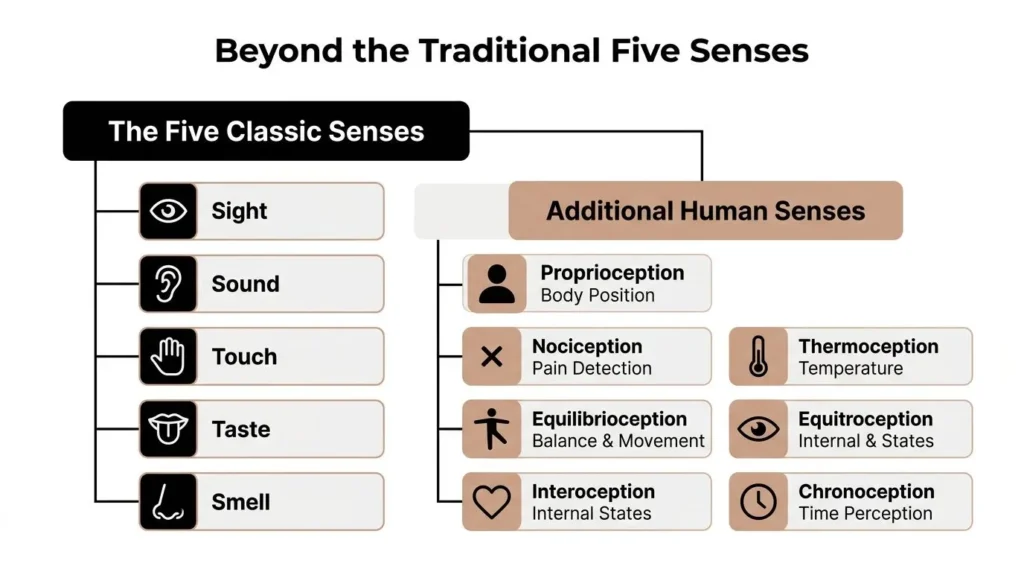
The classic five still matter:
- Sight helps you detect light, color, shape, and movement.
- Hearing lets you pick up vibrations carried through air.
- Touch gives you contact with texture, pressure, and movement across the skin.
- Taste helps you evaluate what’s in your mouth.
- Smell detects airborne chemicals and strongly shapes flavor.
The confusion starts with touch. In ordinary speech, touch sounds like one thing. In biology, it can include several different kinds of detection. Pressure doesn’t feel like temperature. Itch doesn’t feel like pain. Vibration doesn’t feel like a pinprick.
Once scientists started asking whether these should count separately, the neat list of five stopped looking so neat.
Expanding Your Sensory Toolkit Beyond Five
If you want the short museum-floor answer to how many senses do humans have, here it is: most neuroscientists agree there are more than five, and many agree on at least nine. Some classifications identify 21, while modern receptor-based counts reach 32, according to Vital Choice’s summary of modern sensory counts.
The extra senses you use all day
A few of these “hidden” senses deserve plain-English names.
- Proprioception is your body’s internal position tracker. I often call it your invisible GPS. It tells you where your arms and legs are without needing to look.
- Equilibrioception is your sense of balance and movement. It helps you stay upright when you turn, lean, or step onto uneven ground.
- Thermoception is your sense of temperature. It lets you feel warmth from a mug or cool air on your face.
- Nociception is your system for detecting pain-related signals.
- Interoception is your sense of your body’s internal condition, including states like hunger, thirst, or fullness.
- Chronoception refers to your sense of time passing.
If you enjoy seeing how biology turns body signals into useful tools, this broader view of sensing fits nicely with the way people talk about what biotechnology is and how it connects biology with practical systems.
Classical vs. Modern Senses A Quick Comparison
| Classical Sense (The Original 5) | Modern Sense (A Partial List) | What It Does |
|---|---|---|
| Sight | Proprioception | Tracks body position |
| Hearing | Equilibrioception | Supports balance and movement awareness |
| Touch | Thermoception | Detects temperature |
| Taste | Nociception | Detects harmful or pain-related stimuli |
| Smell | Interoception | Monitors internal bodily states |
| Touch | Chronoception | Contributes to time perception |
This table isn’t saying the modern senses replace the old ones. It shows that the old list leaves out systems you rely on constantly.
A better mental model
Think of the classical five as the front row of a museum exhibit. They’re visible, easy to name, and familiar. The rest of your senses are in the larger gallery behind them, still doing just as much work.
Practical rule: If your body can detect a specific kind of change and send that information along a distinct pathway for the brain to interpret, scientists may count that as a separate sense.
That’s why the number grows when researchers look more closely.
Why Scientists Cannot Agree on a Single Number
The core reason scientists debate the number of senses is simple: there is no single definition of what counts as a distinct sense.

That may sound like a technical quibble, but it changes the answer immediately. If you define a sense by conscious experience, the list stays fairly short. If you define it by receptor type, nerve pathway, or brain processing system, the list expands fast.
The disagreement starts with the rules
A simple test shows why the count shifts.
Is temperature one sense, or should warmth and cold be counted separately because different receptors respond to them?
Is touch a single sense, or a bundle that includes pressure, vibration, stretch, and itch?
Should hunger and thirst stand alone, or sit inside the broader category of interoception, your brain’s running readout of the body’s internal condition?
Each choice changes the total. Scientists are often arguing about categories, not discovering that yesterday’s biology has vanished.
Are we counting feelings, sensors, or systems?
One camp counts by experience. Balance feels different from vision. Pain feels different from temperature. On that basis, it makes sense to list them separately.
Another camp counts by the underlying hardware. If the body uses different receptors and sends signals along different pathways, that can justify splitting what seems like one sense into several. A close look at sensory biology from the Encyclopaedia Britannica overview of human sensory reception shows why this approach appeals to neuroscientists. The body is full of specialized detectors, and they do not line up neatly with the tidy classroom list of five.
That is why the final number can feel slippery. You are not choosing from a fixed menu. You are deciding what kind of thing a “sense” is.
Real perception works more like an orchestra than a headcount
The harder scientists look, the more the boundaries blur.
Flavor is a good example. What you call taste depends heavily on smell, but also on texture, temperature, and even pain signals if food is spicy. Balance also refuses to stay in its lane. Your inner ear helps, but so do your eyes, muscles, joints, and skin. The brain combines all of that in real time to produce one stable experience: “I am upright.”
This blending matters outside the lab too. Research on attention and concentration in daily tasks makes more sense once you realize the brain is constantly merging signals, filtering some, amplifying others, and building a usable model of the moment.
This short video gives a useful visual overview of why the list keeps changing.
A single number hides the interesting part
The old five-sense model survives because it is neat, memorable, and easy to teach. Human perception is neither neat nor isolated.
Your senses overlap, cooperate, and sometimes correct one another. Vision can steady balance. Smell can reshape flavor. Proprioception can help you move a hand to the right place before you have consciously thought about it. The scientific disagreement over the number is really a clue. Perception is less like five separate windows and more like a symphony, with different instruments entering, blending, and trading the melody from one second to the next.
Your Hidden Senses in Everyday Action
Hidden senses are easiest to understand when you catch them in the middle of ordinary life, doing their work so well that you barely notice them.

When you move without looking
Reaching for a light switch in the dark feels simple. Under the surface, it is a fast coordination job. Your brain is combining signals from muscles, joints, and skin to keep track of where your shoulder, elbow, wrist, and fingers are before your eyes contribute anything.
That sense is proprioception. It works like an internal position map that updates as you move. You are not calculating each angle on purpose. Your nervous system keeps a live record running in the background, which is why you can scratch your nose, climb stairs, or pull on a sweater without watching every step of the motion.
The interesting part is the blending. Proprioception rarely works alone. In everyday movement, it joins forces with touch, vision, and balance so your actions feel smooth instead of pieced together.
When your body reports from the inside
Some senses point outward. Others keep watch inside.
Interoception is the stream of signals that lets you notice hunger, thirst, a racing heart, a full bladder, or the heavy warmth of a stuffy room. While proprioception tracks where your body is in space, interoception tracks how that body is doing from the inside. One helps you place your hand on the doorknob. The other helps you realize you need water, rest, food, or a cooler place to stand.
You can spot interoception in small moments all day:
- Hungry before lunch: your digestive system is sending status updates.
- Thirsty after exercise: fluid balance has shifted, and your brain gets the message.
- Too warm in a crowded room: temperature regulation is pushing into awareness.
- Butterflies before a speech: body state and emotion are arriving as one combined experience.
That overlap matters for attention too. People trying to build better body awareness often notice that focus improves when they catch those internal signals earlier. This practical guide on how to improve concentration connects well with that idea.
When balance corrects you before you think
You step onto a curb that is lower than expected. Your body wobbles, then recovers almost instantly. That correction depends on equilibrioception, the sensory system for balance, working together with vision, proprioception, and touch.
This is the part list-style articles often miss. In real life, your senses do not wait in separate boxes for their turn. They behave more like sections of an orchestra, each joining at the right moment. Balance adjusts posture. Proprioception updates limb position. Interoception tells you whether exertion is building. Touch confirms contact with the ground. What you experience is one event: staying upright.
A simple test shows the teamwork. Close your eyes and touch your nose. That single motion depends on several senses arriving at the brain in time and being woven into one usable picture of your body.
How Sensory Science Is Shaping Our Future
A richer understanding of the senses doesn’t stay in textbooks. It changes medicine, design, and computing.
When engineers build virtual environments, they can’t rely on sight alone. A convincing system has to respect timing, body position, movement, and balance. According to Learn Genetics at the University of Utah, practical applications now include vestibular implants that deliver 250-500 biphasic pulses/s to ampullary nerves and reduce fall risk by 40% in bilateral vestibulopathy patients, while VR interfaces aim for less than 10ms audiovisual asynchrony for immersive training.
Better medicine starts with better sensing models
Pain treatment improves when clinicians think beyond “ouch” as a single event and instead examine the pathways involved in nociception. Balance disorders become more understandable when doctors treat the vestibular system as a distinct sensory system, not just a side note to hearing.
Neuroprosthetics work on the same principle. A cochlear implant, for example, helps by interfacing with a sensory pathway rather than merely amplifying sound in the everyday sense of the word.
Better digital worlds need body awareness
Virtual reality feels convincing when what you see matches what your body expects. If the image says “you’re turning” but your balance system disagrees, the illusion breaks. Sometimes your stomach notices before your conscious mind does.
That’s why work on sensory timing matters so much for simulated training, rehabilitation, and immersive environments. If you’re curious about where these ideas lead in digital culture, what the metaverse means in practice becomes much easier to understand once you see that embodiment is a sensory problem, not just a graphics problem.
The more precisely we understand human sensing, the better we can build tools that support it, restore it, or respectfully imitate it.
Its Not a Number It Is a Symphony
People ask how many senses humans have because numbers feel satisfying. They promise closure.
But the deeper lesson is that counting senses only gets you so far. A February 2026 study emphasized that humans “don’t experience the world through neat, separate senses, everything blends together,” with smell, touch, sound, sight, and balance influencing experiences like food taste or perceived body weight, as reported by ScienceDaily’s coverage of the study.
Why blending matters more than counting
You don’t eat flavor with your tongue alone. Smell joins in. Texture joins in. Temperature joins in. The look of food can change what you expect before the first bite.
The same thing happens in motion. Vision, balance, and proprioception collaborate so tightly that it can be hard to tell where one ends and another begins. Your reality is not delivered in labeled sensory packets. Your brain combines signals into one ongoing scene.
That’s why the best answer to how many senses do humans have is slightly unsatisfying and much more interesting. Humans have more than five. Probably many more, depending on the rules used. But your lived experience isn’t a list of isolated channels.
It’s a symphony. Each sense is an instrument. Perception is the music.
If you enjoy clear science writing that makes complex ideas feel graspable, explore more approachable essays and explainers at maxijournal.com. It’s a good place to keep following topics that sit between science, technology, health, and everyday life.
Discover more from Maxi Journal
Subscribe to get the latest posts sent to your email.