Every extra 1,000 steps per day is linked with a 15% lower all-cause mortality risk, and benefits remain measurable up to nearly 20,000 steps according to a 2023 meta-analysis summarized in this BodySpec guide to the 20,000-step challenge. That stat is exciting, but it also creates a common problem. People hear “more steps are better,” jump straight into a challenge, and then get sidelined by sore feet, angry tendons, or plain burnout.
As a kinesiologist would tell you, 20000 steps a day is not just a fitness goal. It’s a loading program. Your heart, muscles, bones, tendons, schedule, shoes, and recovery habits all have to keep up. If one of those lags behind, the plan starts to wobble.
That’s why the smart question isn’t “Can 20,000 steps help?” It can. The better question is, can you build to it safely enough to sustain it.
Why Everyone Is Talking About 20000 Steps
A step goal that once sounded extreme now shows up everywhere. Fitness apps celebrate streaks, watches vibrate when you sit too long, and social media turns daily totals into public scoreboards. In that setting, 20000 steps a day starts to look like the next badge of discipline.
Part of the appeal is easy to understand. Walking asks for very little upfront. You do not need special skills, a gym membership, or a complicated program. For busy adults who want a clear target, step counts feel concrete in a way that “be more active” never does.
There is also a psychological pull here. A big round number feels meaningful. It gives people a finish line, even though daily movement works more like a budget than a one-time test. You are adding repeated load to your feet, ankles, calves, knees, and hips every day. If your body and schedule can absorb that load, the habit may stick. If they cannot, enthusiasm fades fast.
Why the idea is so appealing
A 20,000-step target attracts attention because it seems to solve several problems at once:
- It is measurable. Your phone or watch gives immediate feedback.
- It feels accessible. Walking is familiar, so the goal looks less intimidating than a complex workout plan.
- It supports daily activity. Higher step counts usually mean less sedentary time.
- It can fit into normal routines. Commutes, errands, breaks, and evening walks all count.
The catch is sustainability.
A short challenge can create momentum, but a lasting routine asks more from you. Your connective tissue has to adapt. Your footwear has to hold up. Your workday has to allow enough movement. Your recovery has to match the volume. That is why some people feel great on higher step counts while others end up with hot spots, shin soreness, irritated tendons, or simple mental fatigue after a week or two.
Big idea: 20000 steps a day is a capacity goal.
That distinction matters. Motivation can get you through a weekend. Capacity is what lets you repeat the workload without your body or calendar pushing back. The fundamental conversation around 20,000 steps should be less about proving grit and more about building enough tolerance to make high-volume walking safe, useful, and realistic over time.
What 20000 Steps a Day Looks Like
Twenty thousand steps is usually closer to a daily endurance session than a casual “stay active” goal. In practical terms, it often adds up to roughly 9 to 10 miles and can take several hours to complete, depending on your stride, pace, terrain, and how often you stop.

That time requirement surprises people.
A desk-based adult may get only a fraction of that through normal life. Even with errands, household chores, and a short workout, 20,000 steps often requires planned walking blocks. One walk before work, another at lunch, and another in the evening is a common pattern. Without that kind of structure, the goal can stay out of reach and start to feel like a daily chase.
A simple snapshot helps:
| Real-world measure | What 20,000 steps usually means |
|---|---|
| Distance | Around 9 to 10 miles |
| Time | Several hours of total walking |
| Effort | More like light endurance training than incidental movement |
| Daily impact | Extra planning for shoes, route, breaks, and recovery |
The easiest comparison is a part-time physical task layered onto your regular day. That does not mean it is a bad goal. It means the goal has consequences. Your feet absorb repeated loading. Your calves and hips do more total work. Your schedule has less margin for skipped walks, bad weather, or fatigue.
Calorie estimates add to the confusion. People want one clean number, but walking energy cost shifts with body size, pace, hills, surface, stride mechanics, and whether the steps come from steady walking or broken-up movement. A long treadmill walk and a day of stop-and-go city walking can produce the same step total while feeling very different in the body.
This is also where risk management starts to matter. If you treat 20,000 steps like a fun number on a watch, you can miss early warning signs such as hot spots, shin soreness, tendon irritation, or unusual fatigue. A better approach is to treat the goal the way you would treat any other high-volume activity. Build up gradually, monitor how you recover, and use basic sports injury prevention strategies before small aches turn into interruptions.
One more point often gets missed. Twenty thousand steps done comfortably is not the same as twenty thousand steps done barely hanging on. The first reflects capacity. The second usually leads to shortcuts in form, inconsistent routines, or burnout. For the average person, that difference matters more than the headline number itself.
The Science of High-Volume Walking Benefits and Risks
Walking volume has a dose-response pattern. Health gains rise quickly when someone goes from very low activity to a moderate daily step count. After that, the curve usually flattens. You can still gain benefits at higher totals, but each extra block of steps tends to buy less than the first big jump out of a sedentary routine.

Where the benefits are strongest
A large PubMed-indexed review found that daily steps were linked with lower risk of early death, with the biggest gains showing up as people moved from very low step counts into a more active range. The same analysis also suggested diminishing returns at higher totals, which is the part many readers miss when they hear bold step-count headlines. More is not automatically better in a straight line. The body responds more like a sponge that soaks up a lot at first, then less with each extra pour of water. You can read that evidence in this step-count meta-analysis on PubMed.
That does not mean 20,000 steps is pointless. It means the reason for aiming that high matters. If your goal is basic health improvement, you may not need such a large target. If your goal is lifestyle, endurance, mood, outdoor time, or replacing sedentary hours with movement you tolerate well, a higher total can still make sense.
Walking works because it improves several systems at once without the barrier of complex equipment or high skill. Your heart and lungs get repeated low-intensity work. Your muscles keep contracting and relaxing for long periods. Blood sugar control often improves when you break up long sitting bouts with regular movement. For many adults, that consistency matters more than heroic single workouts.
Where the risk starts climbing
The risk side is less glamorous, but it is real.
Each step is a small load. Tens of thousands of steps turn that small load into a large daily total for the feet, ankles, shins, knees, hips, and low back. The body can adapt to that stress, but adaptation takes time. Muscles often feel ready first. Tendons, joint surfaces, and bone usually need longer.
A simple way to understand it is to compare your body to a team with different training speeds. Your cardio system is the fast learner. Connective tissue is the slower learner. If the fast learner sets the pace, the slower one gets overwhelmed.
That mismatch explains why someone can feel fitter after two or three weeks, then suddenly develop heel pain, Achilles stiffness, forefoot soreness, or shin irritation. Their engine improved. Their chassis had not caught up yet.
Here is the pattern many active walkers run into:
| What tends to improve first | What often needs more time |
|---|---|
| Breathing comfort | Tendon tolerance |
| Daily routine and mood | Bone stress tolerance |
| General stamina | Foot skin and blister resistance |
| Confidence with longer walks | Recovery habits and load management |
High-volume walking can also create a false sense of safety because it is “just walking.” From a tissue-loading standpoint, a very long daily walk behaves more like repetitive training than casual activity. Surface changes, hills, hard pavement, worn shoes, and a sudden jump in weekend mileage all affect how stressful those steps feel to your body.
Device data can help, but it has limits. Step counts are useful for tracking volume. They are less useful for judging whether your body is recovering well. A watch cannot tell you that your plantar fascia is getting irritated or that your calf is staying tight for three days straight. Your symptoms and recovery pattern matter just as much as the number on the screen.
If you want a practical overview of warning signs and prevention habits, this guide on sports injury prevention strategies for active people is a helpful companion.
The safest takeaway is simple. High-volume walking can be excellent for health, but only if your body can repeat it week after week. A step goal you can recover from will beat a bigger number that leaves you limping, exhausted, or quitting by the end of the month.
Clinical view: The best walking plan is the one your body can repeat next month, not just next Monday.
Is This Ambitious Goal Right for You
A daily target of 20,000 steps can mean very different things depending on who is doing it. For one person, it is a demanding but realistic training goal. For another, it is the walking version of trying to run a half marathon with no build-up.
Your fit for this goal comes down to a few practical factors. Current activity level matters. So do injury history, body size, available time, sleep, eating habits, and the reason you want the goal in the first place. A target only helps if your body can absorb the work and come back ready for more.
Who tends to do well with it
A strong candidate usually has a solid walking base already. They handle long walks without next-day pain, have no active foot, ankle, knee, or hip issue, and can keep their routine steady across the week.
A middle-ground candidate often has the motivation but not the tolerance yet. This includes desk workers who get only a few thousand steps on weekdays, people returning after a long break, and active weekend walkers who are inconsistent during the week. They may still reach 20,000, but they need a ramp-up period, not a sudden jump.
A poor candidate right now is someone dealing with heel pain, repeated shin soreness, tendon irritation, persistent swelling, or the habit of going very hard for a few days and then crashing. In that situation, a lower target done consistently is the better training decision.
Your age, recovery, and muscle mass all matter
Older adults often get substantial health benefits at step counts well below 20,000, as noted earlier in the article. Chasing the biggest number on the screen is rarely the smartest first move.
Body composition changes the equation too. If you carry more body weight, each step places more total load through the feet, knees, and hips because you are repeating the same impact thousands of times. If you are under-muscled, the issue is different. You may have the willpower to finish the steps but not enough tissue capacity to repeat them day after day.
That is why strength work belongs in the conversation. Walking tolerance improves when your calves, hips, and trunk can share the load better. If you are new to that side of training, this guide on how to start strength training safely and simply can help.
Questions to ask before you commit
Use this screen before you set 20,000 as a daily rule:
- What is my current average day? If you are far below that number now, your first goal is adaptation.
- How do my feet and calves respond to longer walks? Normal fatigue is fine. Pain that returns each time is a warning.
- Can I recover between higher-volume days? Sleep, food, and lighter days all count.
- Why do I want this goal? Weight management, endurance, stress relief, and personal challenge can each call for a different plan.
- Am I willing to build slowly? Sustainable progress is usually less exciting than a challenge headline, but it is much more likely to work.
One simple rule helps here. If reaching 20,000 steps would force you to ignore pain, skip recovery, or organize your whole life around getting the number, the goal is too aggressive for your current stage.
For many people, the most honest answer is conditional. You may be a good fit later. You may be a good fit for some days of the week. You may do much better with a range than a fixed daily quota.
If 20,000 motivates you, treat it as a long-term training destination and earn it gradually.
Your Progressive Plan to 20000 Steps
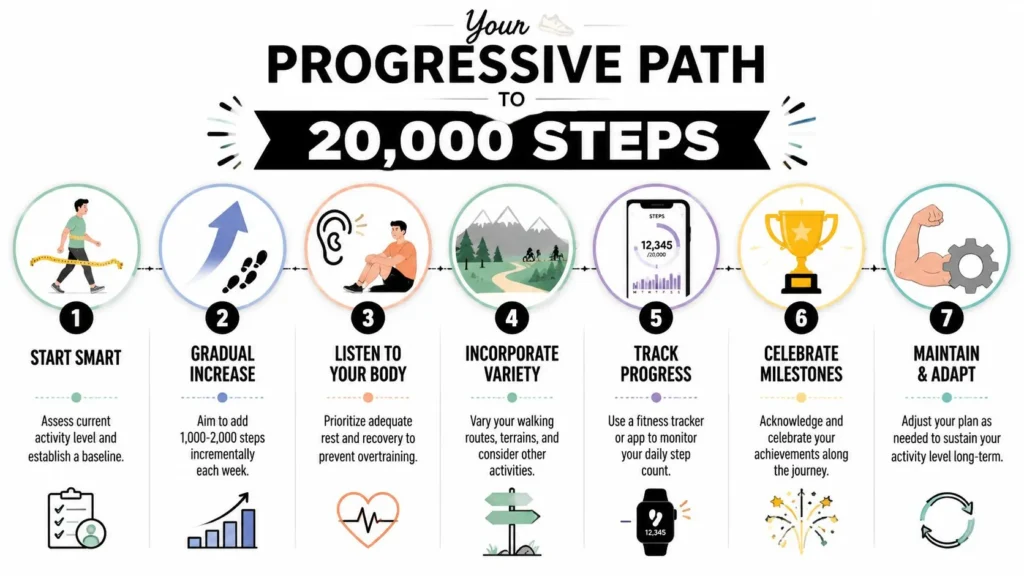
The common mistake is treating 20,000 as a switch. It’s better treated like a training block. You build tolerance first, then volume, then consistency.
Research on recreational walkers shows why that matters. Injury rates can be as high as 42% in people averaging 18,000 or more steps, and adding rest days and cross-training can reduce injury odds by nearly 30% compared with pushing hard every day, according to this Women’s Health discussion of sustainability and walking injuries.
The progression rules that matter most
Start with these essential steps:
- Earn your next increase. Don’t raise volume just because the calendar says so. Raise it because your body handled the last level well.
- Use step loading. Mix harder days with easier days instead of chasing the same high number every day.
- Cross-train on purpose. Cycling, easy rowing, or another low-impact option can preserve activity while unloading your feet.
- Strength train alongside walking. Calves, glutes, hips, and trunk strength improve tolerance. If you’re new to that side of training, this practical guide on how to start strength training can help.
Sample 8-Week Progression Plan to 20,000 Steps
| Week | Daily Average Target | Weekly Structure |
|---|---|---|
| 1 | Baseline plus a modest increase | Keep most days easy. Add one slightly longer walk. |
| 2 | Small increase from week 1 | Repeat the pattern only if feet and calves feel settled. |
| 3 | Build again | Add one longer day, but keep at least one lower-step day. |
| 4 | Hold or nudge upward | If soreness is accumulating, stay here instead of pushing. |
| 5 | Introduce higher-volume days | Try one higher day, followed by a recovery day. |
| 6 | Expand tolerance | Two higher days separated by easier days. |
| 7 | Approach target range | Practice distributing steps across the day. |
| 8 | Test 20,000 strategically | Use it on selected days first, not automatically every day. |
You’ll notice this table avoids rigid daily numbers. That’s intentional. The safest plan depends on your baseline, and people starting from different places shouldn’t force the same weekly jump.
A safer weekly rhythm
For many adults, this structure works better than “20k every day”:
- Higher-volume days: Use these when you’re rested and your schedule allows broken-up walking.
- Moderate days: Keep moving, but avoid chasing the total.
- Recovery days: Walk enough to stay loose, then stop before fatigue changes your gait.
- Cross-training day: Replace some step volume with lower-impact cardio.
A common mistake is treating lower-step days like failure. They’re not. They’re where adaptation happens.
Practical rule: If yesterday’s steps change today’s walking mechanics, you needed more recovery than you took.
Signs your progression is too fast
Pull back if you notice any of these patterns:
- Morning heel pain: A classic early sign that the plantar fascia or Achilles is getting irritated.
- One-sided shin tenderness: Often a warning sign, not just “tight calves.”
- You need to jog to catch up at night: That turns a walking plan into a fatigue plan.
- Your mood worsens around the goal: Burnout counts too.
Progressive loading sounds less exciting than a challenge. It works better.
Practical Tips for Success and Safety
A 20,000-step goal puts the same few body parts on repeat for hours. Your feet, calves, and hips handle that workload one step at a time, like a car tire rolling over the same road all day. If your setup is off, the problem usually shows up first as irritation, then as pain, then as a forced break.

Make your setup work for you
Start with your shoes. Comfort matters more than marketing. A pair that feels stable at minute 90 matters far more than a pair that feels impressive in the box. If you need help sorting through fit, cushioning, and support, this guide on how to choose running shoes for beginners is a useful starting point.
Your walking environment matters too. Sidewalks are predictable and easier to pace. Trails and uneven ground ask more from your feet and ankles, which can be helpful in small doses but risky if your tissues are already tired. If you want variety, add it gradually instead of changing shoes, terrain, and distance all in the same week.
Small changes lower strain:
- Use more than one walking window. A few shorter bouts are often easier on your feet than one long push.
- Choose routes with built-in stopping points. Benches, water fountains, or loops near home make it easier to stop before form slips.
- Carry water on longer walks or know where you can get it. Fatigue climbs faster when you are under-fueled and dehydrated.
- Rotate routes for your mind and your joints. A small hill, a flatter day, or a treadmill session can change the stress enough to improve tolerance.
Track patterns, not just totals
Step counts help, but they do not tell the whole story. Two 20,000-step days can feel very different if one came from easy movement spread across the day and the other came from a forced evening march after too much sitting.
Use your tracker as a logbook, not a scoreboard. A dedicated wearable is usually more consistent than guessing from memory or relying on a phone that is not always on you. More important, pair your step total with notes about how your body felt.
A simple tracking habit works well:
- Record your daily steps
- Note where you felt soreness
- Write down how long stiffness lasted the next morning
- Mark whether the day included hills, treadmill time, or harder surfaces
That gives you something useful to act on. If heel soreness keeps showing up after long pavement walks, you have a clue. If your calves tighten after back-to-back high days, you have another. Patterns are easier to fix than surprises.
Respect early warning signs
Your body rarely jumps from fine to injured without a middle stage. It usually sends smaller signals first.
Pay attention to pain that is specific, repeatable, and getting easier to trigger. General tiredness at the end of a long day is expected. Pinpoint pain in the heel, arch, Achilles, or shin deserves caution, especially if it returns at the same spot or changes how you walk.
Watch for:
- Heel or arch pain with the first few morning steps
- Achilles stiffness that keeps coming back
- A tender spot along the shin
- Swelling, limping, or a shorter stride by evening
If these show up, cut the volume early. That does not mean you failed. It means you caught a small problem before it became a month-long one.
One useful rule is simple. If you have to ignore your form to hit the number, the number is too high for that day.
Frequently Asked Questions
Do I need to walk all 20,000 steps at once
No. The workload is often better tolerated when split across the day. Shorter walks can reduce foot fatigue and make the schedule more realistic.
What’s the difference between a rest day and an active recovery day
A rest day minimizes loading and gives irritated tissues a break. An active recovery day keeps you moving at a clearly easier dose. If your feet or calves feel beat up, choose rest over pride.
Does treadmill walking count the same as outdoor walking
It counts toward your step total. The main difference is how your body experiences the session. Treadmills are more controlled. Outdoor walking adds surface variation, turns, weather, and hills. Neither is automatically better. The better one is the version you can do consistently and comfortably.
What if I miss a day
Don’t try to “make up” a missed day with a heroic spike. That’s one of the easiest ways to irritate the plantar fascia, Achilles, or shins. Return to your usual plan and keep the weekly pattern stable.
Is 20,000 steps a day too much for weight loss
Not automatically, but more is not always better. High-volume walking can burn about 800 to 1200 kcal per day, yet injury risk for problems like plantar fasciitis rises by 2.5 to 3.0 times when people go above 15,000 steps daily, and eccentric strengthening such as heel drops can improve tendon stiffness by 20 to 30% according to this PubMed-indexed review of high-volume walking and injury risk. If your body can’t recover, the plan stops helping.
Should I do any exercises besides walking
Yes. Even a small amount of strength work helps. Calf raises, heel drops, glute work, and basic trunk strength can make a big difference in how well you tolerate volume.
maxijournal.com publishes approachable writing across health, science, sports, technology, travel, arts, and more. If you enjoy clear, evidence-aware articles like this one, visit maxijournal.com to read more or explore contributing your own ideas.
Discover more from Maxi Journal
Subscribe to get the latest posts sent to your email.