You check your phone for a casting update, open another tab for box office news, then switch again to confirm whether a music release rumor is real. By the time you finish, you have more alerts than answers. Entertainment news now arrives through trade outlets, social posts, clips, newsletters, and algorithmic recommendations, so the fastest update is not always the most useful one.
That fragmentation reflects a larger industry shift. One forecast places the global entertainment and media sector at USD 3.351 trillion in 2025 and USD 8.02097 trillion by 2035, projecting a 9.12% CAGR. As distribution expands across more platforms, readers face a practical problem: different outlets specialize in different parts of the market, and mixing them poorly creates noise instead of understanding.
A smart entertainment feed is built by function.
This guide sorts outlets by their primary strength, such as speed on deal news, depth on industry strategy, reach in celebrity coverage, or authority in music reporting. The goal is not to crown a single winner. It is to help you choose the right source for the right task, then combine them into a news mix that fits how you follow entertainment.
1. maxijournal.com
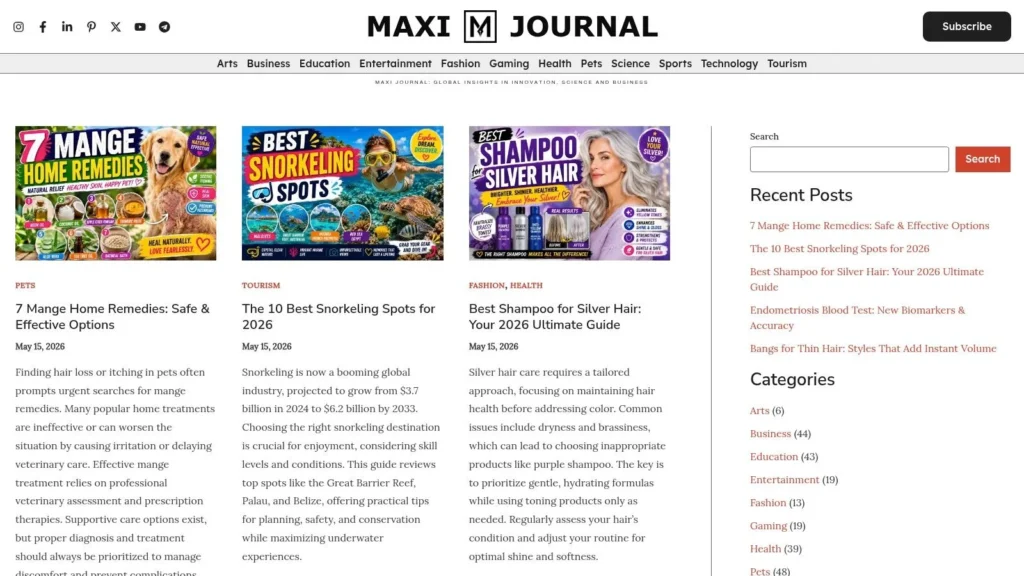
Open three entertainment sites in a row and the difference becomes clear fast. One gives you studio chess moves, another gives you celebrity headlines, and Maxi Journal gives you a broader cultural read. Its value in this guide is not trade authority. It is breadth across the subjects that now shape entertainment consumption, including gaming, tech, fashion, travel, lifestyle, and general internet culture.
That positioning matters because entertainment news rarely stays confined to film and television anymore. Streaming habits overlap with social platforms, gaming communities drive release conversations, and celebrity coverage often spills into fashion, wellness, and creator-economy topics. As noted earlier, the wider media business is expanding across more platforms and formats. A publication with a wider editorial frame can help readers spot those connections faster than a narrowly focused trade outlet.
Best for cross-category readers
Maxi Journal fits readers who want entertainment coverage in plain language and in context with adjacent interests. It works well as a discovery source, especially if your reading habits move between pop culture, digital trends, and lighter analysis rather than staying fixed on Hollywood deal reporting.
Its editorial mix is the clearest differentiator:
- Wide topical spread: Entertainment appears alongside science, technology, health, sports, tourism, fashion, gaming, pets, and arts.
- Accessible framing: Articles are written for general readers and hobby-focused audiences, not only industry professionals.
- Regular publishing cadence: The site updates often enough to support habitual browsing across multiple categories.
- Open contributor model: A visible “Write For Us” path signals a more flexible publishing structure than many legacy entertainment brands.
- Usable site infrastructure: Subscription prompts and policy pages are easy to find, which gives readers a clearer sense of how the publication operates.
The practical advantage is selection efficiency. If you want a single stop for broad-interest reading, Maxi Journal can surface entertainment stories that sit next to the wider trends influencing them. A reader interested in franchise coverage, for example, might move from a culture piece into a ranked feature such as best superhero movies ranked without switching to a different editorial environment.
Where it wins and where it doesn’t
Use Maxi Journal for breadth, readability, and idea generation.
Do not use it as your only source if you need deal-level reporting, executive strategy, awards forecasting from insider circles, or the kind of industry verification associated with long-established trades. Larger outlets such as Variety, The Hollywood Reporter, and Deadline are stronger for those use cases.
That tradeoff is useful, not disqualifying. Maxi Journal works best at the top of a custom news stack. Start here for broad cultural scanning, then add one trade publication for industry mechanics and one specialist outlet for a vertical like music or celebrity TV. That mix gives you range without sacrificing depth.
2. Variety
Variety is the site to open when you want to know what happened in Hollywood and why it matters to studios, talent, distributors, and investors. It balances breaking news with business framing better than most mainstream entertainment outlets, which makes it especially useful during awards season, festival windows, mergers, release-calendar changes, and labor disputes.
Its strongest use case is context. Plenty of sites can tell you a sequel was announced. Variety is more likely to connect that announcement to franchise strategy, distribution priorities, or awards positioning.
Best for business-aware readers
Entertainment coverage often stops at the headline. That’s a problem because major audience questions now revolve around profitability, ad-supported plans, bundles, price increases, and rights reshuffling rather than pure subscriber growth. In the 2024 to 2025 period, Netflix said its ad-supported plan reached 40 million monthly active users in 2024, up from 15 million a year earlier, while Disney and Warner Bros. Discovery pushed harder into bundle strategies and ad inventory.
That shift is exactly where Variety is strongest. It helps readers move from “what was announced” to “who benefits, who pays, and what changes next.”
If you also like entertainment through a fan lens, pair Variety’s industry coverage with lighter reading such as Maxi Journal’s take on the best superhero movies ranked. The combination works well because one source tracks the business mechanics while the other stays closer to audience taste and genre enjoyment.
Use Variety when the story involves deals, awards campaigns, studio strategy, or the economics behind streaming headlines.
Its downside is predictable. Some of its deeper research tools and premium extras are aimed at professionals, so casual readers may hit registration prompts or subscriber-only areas.
3. The Hollywood Reporter
The Hollywood Reporter is where polished storytelling meets industry reporting. If Variety often feels like a trade desk with broad reach, The Hollywood Reporter feels like a magazine operation that happens to know the business inside out.
That difference matters when you want more than a feed of updates. THR often gives readers a stronger sense of personalities, power structures, reputation, and long-running tensions inside film, television, music, and awards culture.
Best for features and industry atmosphere
Choose The Hollywood Reporter when the headline alone isn’t enough. Its long-form profiles, roundtables, and feature packages are useful for understanding how a moment in entertainment fits into a larger narrative about labor, image management, studio politics, or prestige.
It also lands well for awards followers. Instead of only telling you who might win, THR tends to map the campaign environment around the contenders, the mood in the room, and the strategic signaling behind screenings, interviews, and festival premieres.
A few reasons readers keep it in rotation:
- Magazine-quality long reads: Stronger narrative depth than speed-first competitors.
- Signature interviews and roundtables: Useful when you want industry voices in one place.
- Balanced mix: Daily reporting still sits alongside criticism, features, and business coverage.
Its trade-off is speed. If a major casting story breaks at noon, Deadline may surface it first. THR becomes more valuable a bit later, once context, sourcing, and framing catch up to the initial alert.
4. Deadline
Deadline is the fastest tool on this list for many Hollywood developments. When a deal closes, a pilot gets ordered, a star joins a project, or a release calendar shifts, Deadline is often where people in the business check first.
That speed creates a very specific kind of value. Deadline isn’t trying to be leisurely. It’s trying to reduce the lag between industry movement and public awareness.
Best for speed and deal flow
Open Deadline if you’re monitoring the latest entertainment news in real time. Its blog-like format and constant updates make it especially good for live situations such as strikes, festival lineups, awards races, pilot season, and release-date reshuffles.
Here, it excels:
- Real-time updates: Fast on casting, development, deals, and schedule changes.
- High-volume publishing: Useful for readers who want a running pulse, not just polished summaries.
- Free accessibility: Strong for casual readers who don’t want to start with a paywalled trade product.
The best use of Deadline isn’t to read every item. It’s to catch movement early, then decide which stories deserve deeper follow-up elsewhere.
Its weakness follows directly from that model. Stories can arrive in small, iterative bursts, so readers who prefer synthesis over constant motion may find the experience noisy.
5. Entertainment Tonight
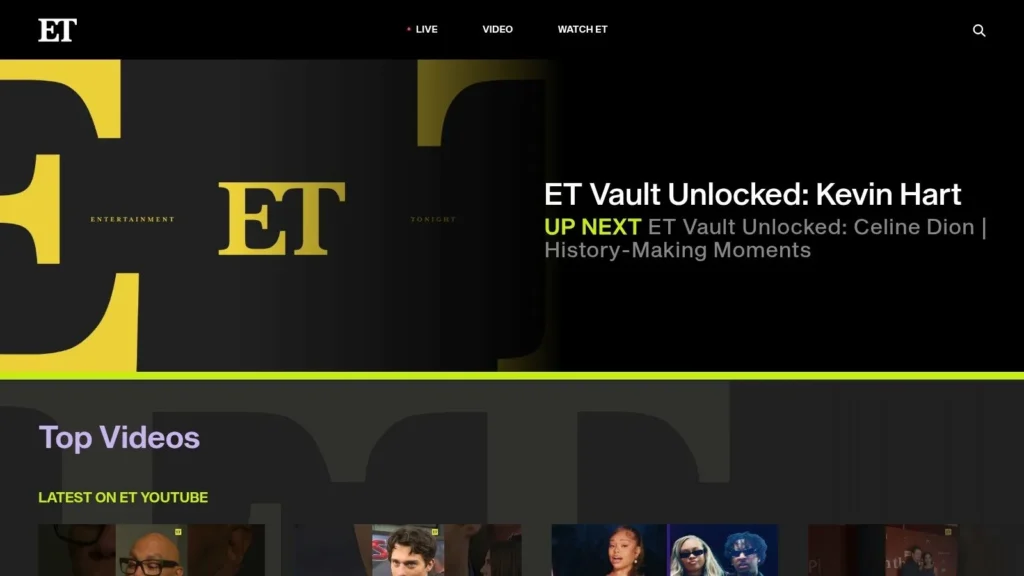
Entertainment Tonight is the easiest source here to consume quickly. It works best when you want mainstream celebrity coverage, video interviews, event clips, and a familiar TV-linked news style that doesn’t ask much from the reader.
Some readers underestimate ET because it sits closer to the celebrity end of the spectrum. That’s a mistake if your goal is broad awareness. ET is often efficient for seeing which moments are breaking into public conversation beyond trade circles.
Best for celebrity access and video-first updates
ET’s real advantage is format. If you don’t want to scroll through dense text after a long day, its short clips, segment tie-ins, and quickly packaged stories are low-friction ways to stay current.
That makes it particularly effective for:
- Mainstream star coverage: Interviews, reactions, red-carpet moments, and official reveals.
- Casual mobile reading: Fast summaries that don’t require insider knowledge.
- Cross-platform consumption: Useful if your entertainment intake starts on social or video before it reaches articles.
A good pairing strategy is to read ET for personality-driven updates, then jump to a fan-facing explainer or franchise piece such as Maxi Journal’s coverage of the new Tomb Raider adaptation. ET captures the public-facing moment. Supplemental reading helps with franchise context.
Its limitation is clear. ET rarely serves readers who want detailed business analysis, rights questions, or the financial logic behind studio decisions.
6. E! News
E! News is built for readers who want entertainment coverage to feel social, visual, and immediate. If ET is video-led mainstream celebrity news, E! is the fast-moving pop-culture stream that keeps red carpets, reality TV, royals, style, and trending celebrity moments in one place.
It doesn’t pretend to be a trade outlet, and that’s why it works. Readers who want approachable entertainment updates usually don’t need deep financing analysis. They need a clean read on what’s hot, who’s in the headline cycle, and which reality or celebrity storyline is dominating attention.
Best for pop culture and red-carpet tracking
E! is useful when the story is less about industry structure and more about public fascination. Its galleries, quick-read format, and celebrity-lifestyle framing make it easier to skim than the Hollywood trades.
That matters because much of today’s entertainment discovery starts in feed culture. Viral moments and social-first attention increasingly shape what breaks through to broader audiences, especially in music and youth-driven fandoms.
Use E! when you want:
- Fast mainstream headlines: Celebrity news without trade jargon.
- Event coverage: Red carpets, outfits, parties, and post-show reactions.
- Reality and lifestyle updates: Areas many business publications barely touch.
E!’s weakness is depth. If you’re trying to understand windowing strategy, ad-supported streaming tiers, or labor implications, you’ll outgrow it quickly.
7. Billboard
A reader trying to make sense of a breakout song often runs into the same problem. General entertainment outlets report the headline, but they rarely explain whether the momentum comes from radio, streaming, touring demand, label support, or a short-lived social spike. Billboard is useful because it organizes music news around those distinctions.
Its advantage is specialization. Billboard covers charts, executive moves, release strategy, touring, and artist performance in the same editorial system, which makes it easier to connect audience attention with commercial results. That focus gives readers a better way to judge whether an artist is building repeatable traction or merely having a viral week.
Best for music charts and music-business intelligence
Billboard works best for readers who want more than celebrity music coverage. It is a strong choice for following chart methodology, label decisions, festival positioning, touring signals, and the business context behind a release. Broader outlets may mention a hit single. Billboard is more likely to show how that single fits into an artist’s larger trajectory.
That matters because music discovery now spreads across streaming services, short-form video, playlists, and live performance. Readers who want to track emerging talent can pair Billboard’s reporting with fan-facing discovery coverage such as Maxi Journal’s list of up-and-coming music artists. For the revenue side of the equation, Mogul’s Spotify royalty insights add useful context on how streaming economics affect artist careers.
One caution. Billboard is a specialist source, not a full entertainment hub. If your priority includes film, TV, celebrity culture, and awards coverage in equal measure, it works better as one part of a custom feed than as your only outlet.
Latest Entertainment News: 7-Outlet Comparison
| Title | Implementation complexity | Resource requirements | Expected outcomes | Ideal use cases | Key advantages |
|---|---|---|---|---|---|
| maxijournal.com | Low, simple web access and contributor workflow | Minimal, free browsing; subscription details unclear | Frequent, accessible cross-topic articles and practical guides | Casual readers, niche hobbyists, independent contributors | Broad interdisciplinary coverage with frequent updates and contributor pathways |
| Variety | Medium, mix of free coverage and premium data tools | Moderate, free news; premium products (Vscore, charts) behind paywall | Industry-grade reporting, data-driven analysis, festival/awards insight | Industry professionals, analysts, box-office and festival tracking | Authoritative industry data and strong festival/market presence |
| The Hollywood Reporter | Medium, combined daily news and magazine production | Moderate, free articles; some magazine/archive content subscription-based | In-depth features, talent access, contextual business reporting | Long-form research, awards coverage, trend analysis | Magazine-quality storytelling and strong access to talent |
| Deadline | Low, real-time blog format optimized for rapid updates | Low, free access and beat-specific newsletters | Immediate scoops and fast-breaking industry updates | PR monitoring, breaking-news alerts, timely industry tracking | Speed-first coverage with wide industry citation |
| Entertainment Tonight (ET) | Low, video-led, multimedia-first platform | Low, free video content and extensive social distribution | Quick multimedia updates, on-camera exclusives, celebrity clips | Celebrity news followers, video consumers, mainstream audiences | Strong video footprint and on-camera exclusives optimized for mobile |
| E! News | Low, social-first, photo and short-form driven | Low, free access, newsletters, mobile app prompts | Fast pop-culture headlines, red-carpet galleries, trending moments | Fashion/celebrity trend followers, reality-TV fans, social sharing | Excellent red-carpet and reality-TV coverage with approachable formats |
| Billboard | Medium, combines editorial with extensive chart systems | Moderate, free chart access; Billboard Pro for deeper data | Authoritative music charts, data-driven music-business reporting | Music industry professionals, chart tracking, artist/release analysis | Unmatched chart authority and specialized music-business insights |
Build Your Perfect Entertainment Feed
A casting announcement breaks before breakfast. Deadline posts the item first. Variety follows with the business implications. The Hollywood Reporter adds executive and talent context. ET and E! turn the same event into interview clips, reaction coverage, and social conversation. Billboard matters only if the story also affects music, touring, or chart momentum. The question is not which outlet won the story. The useful question is which outlet answered the part you care about.
A strong entertainment news routine works best as a set of roles. Use Deadline for early alerts on deals, renewals, production changes, and other fast industry movement. Use Variety when you need reported analysis of strategy, distribution, box office positioning, or awards consequences. Use The Hollywood Reporter when the story requires more context around power structures, talent relationships, or longer-term industry meaning.
Audience-facing coverage fills a different gap. Entertainment Tonight and E! News are better suited to celebrity visibility, red carpets, interviews, fashion moments, and the parts of entertainment news that spread through video and social platforms. Billboard remains the specialist source for chart performance, release cycles, artist traction, and the commercial side of music.
This category-based approach saves time. It also improves source quality because each outlet is judged by what it consistently does well, not by habit or name recognition.
Entertainment coverage now spans streaming, social video, live events, podcasts, creator culture, and music platforms. Readers who want more context on how those parts connect can review this overview of music industry insights.
For readers who want a broader editorial mix, maxijournal.com is a useful general-interest option covering entertainment alongside technology, culture, travel, health, gaming, and related topics. It also includes guest submission information for contributors who want to publish through the site.
Discover more from Maxi Journal
Subscribe to get the latest posts sent to your email.