You’re probably here because a battle just went sideways.
A Flying Pokémon came in, you picked a move that looked right, and the damage didn’t match what you expected. Maybe it was Gyarados and your Rock move felt underwhelming. Maybe it was Charizard and one Rock hit erased it. That confusion is normal, because flying pokemon weakness is easy at the basic level and much trickier once dual typing enters the picture.
A newer player often memorizes one rule. Flying is weak to Electric, Ice, and Rock. That part is true. The problem is that many famous Flying Pokémon aren’t pure Flying types, so the second type can make a weakness harsher, softer, or disappear entirely. If you want to make better decisions in raids, story battles, gym fights, or competitive matches, you need to read both types, not just the wings.
Why Mastering Flying Type Matchups Wins Battles
A common battle problem looks like this. Your opponent sends out Gyarados. You have an Electric move and a Rock move available. Both seem like good anti-Flying choices at first glance, but they are not equal in this matchup.
Gyarados is Water/Flying, and that second type changes everything. Electric attacks punish both Water and Flying, so this is the kind of matchup where type reading decides the turn before you even press the button. If you only remember “Flying dislikes Rock,” you might make a decent play. If you remember how dual typing stacks, you make the best play.
Why newer players get this wrong
Type matchups are typically learned as a checklist. Flying loses to Electric, Ice, and Rock. That’s useful, but it’s only the first layer. The actual battle question is usually more specific.
- Is this a normal weakness or a stacked one
- Did the second type cancel one of Flying’s usual problems
- Can Ground still hit it, or is the immunity active
- Am I targeting the Pokémon’s real weakness, or just its visible type
Those questions matter because Flying types show up everywhere. Early-route birds teach basics. Dragons like Rayquaza and utility pivots like Zapdos punish lazy assumptions. Big threats such as Charizard and Gyarados are famous precisely because their typing creates extreme matchups.
Practical rule: When you see a Flying Pokémon, don’t ask only “What hurts Flying?” Ask “What hurts both of its types?”
That habit wins battles because it turns type knowledge into move selection. You stop guessing and start reading the board the way experienced trainers do. You also become harder to surprise, which matters a lot against opponents who rely on common mistakes.
The difference between knowing and applying
A good trainer knows the chart. A better trainer checks the full typing, predicts the opponent’s likely switch, and chooses coverage accordingly.
That’s why this topic matters. Flying isn’t just one of the most common types. It’s one of the easiest places to see how Pokémon rewards careful reading over raw power.
Decoding Flying Type Weaknesses and Resistances
At the pure type-chart level, Flying is one of the cleaner matchups in Pokémon. A pure Flying-type Pokémon is weak to Electric, Ice, and Rock, resists Bug, Fighting, and Grass, and is immune to Ground under normal conditions. In the mainline games, those interactions are typically 2× for weakness and 0.5× for resistance, as explained in Bulbapedia’s Flying type chart overview).
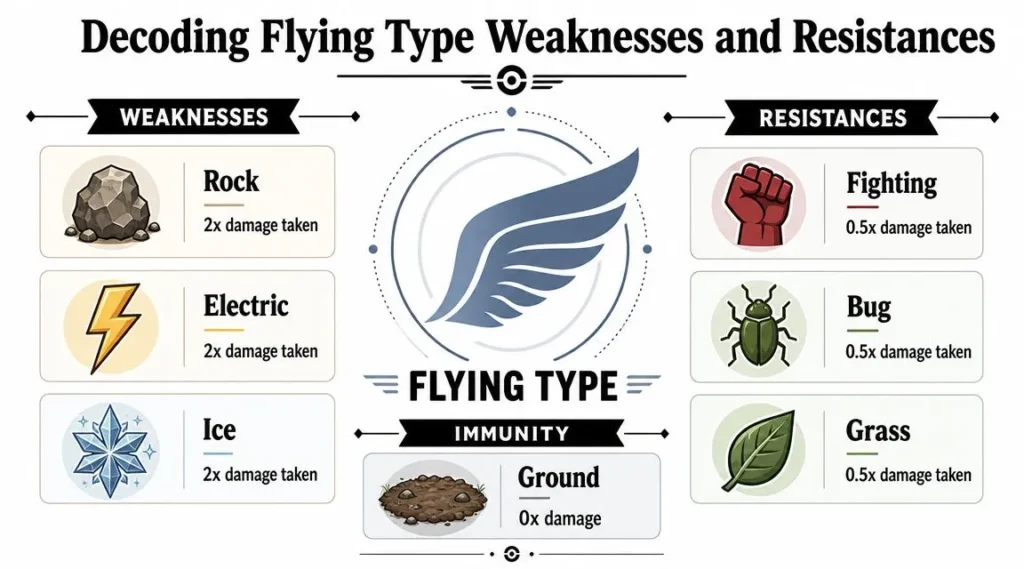
Imagine doors and keys. Some attack types open Flying’s defenses cleanly. Electric, Ice, and Rock are the right keys. Bug, Fighting, and Grass push against a locked door. Ground doesn’t even get through the doorway if Flying’s immunity is active.
The core matchup you should memorize
If you only remember one chart for flying pokemon weakness, make it this one:
- Electric attacks hit Flying for super-effective damage
- Ice attacks do the same
- Rock attacks also hit Flying super effectively
- Bug, Fighting, and Grass attacks are resisted
- Ground attacks fail against Flying under normal conditions
That last point is especially important. A lot of strong physical attackers rely on Ground coverage. Flying can shut that down completely when its airborne status is intact.
Why Ground immunity matters so much
Ground immunity is one of Flying’s best defensive tools. It doesn’t just reduce damage. It negates Ground moves under normal conditions. That means move choice matters more than raw strength.
A strong move with the wrong typing can do nothing. A properly chosen move with the right typing often does much more. That’s one reason serious players care about matchup planning, move coverage, and training details like EV training basics for better battle prep.
A Flying Pokémon doesn’t just resist certain attacks. It changes what moves are safe to click at all.
Don’t mix up offense and defense
Another place players get confused is mixing the two sides of the type chart. Flying-type Pokémon are weak to Electric, Ice, and Rock when they’re defending. Flying-type moves are super effective against Bug, Fighting, and Grass. Those are separate questions.
So if your goal is to survive a Flying opponent, think defense first. Ask what can hit that Pokémon hard. Don’t get distracted by what Flying moves are good against.
Top Pokémon and Moves to Ground Any Flyer
Once you know the chart, the next step is practical counterplay. You don’t win because you memorized “Electric beats Flying.” You win because you brought the right attacker, with the right coverage, into the right matchup.
Your choices become tactical. Some Flying Pokémon fold to one clean hit. Others force you to think about speed, bulk, and whether their second type changes the usual answer.
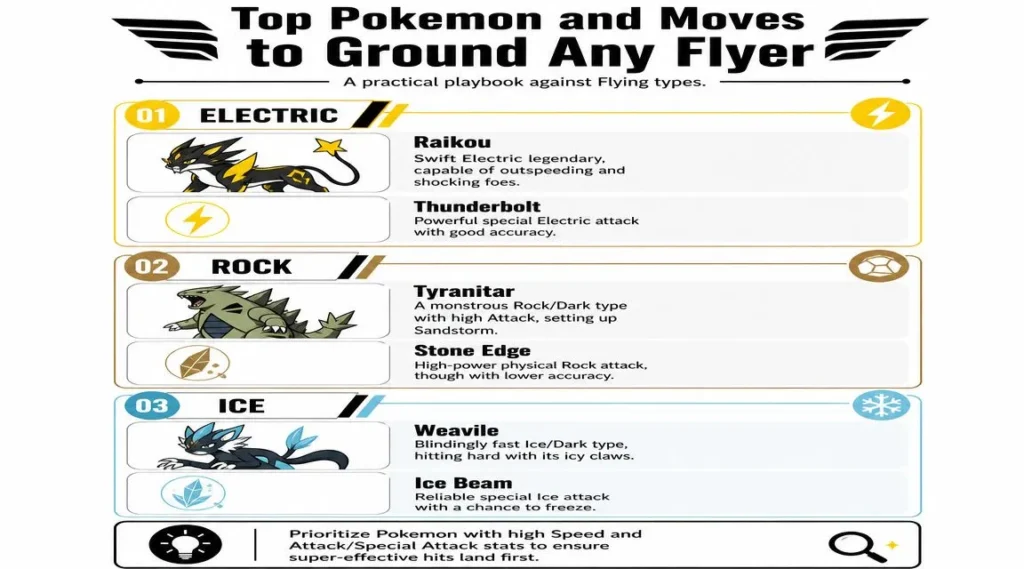
Electric answers
Electric is often the safest anti-Flying option because so many Flying Pokémon don’t want to take that hit at all. It’s especially punishing against targets like Gyarados.
Consider these common examples:
- Raikou works well when you want fast special pressure. It threatens Flying targets without needing setup.
- Jolteon fills a similar role. It’s known for speed and clean Electric offense.
- Zapdos can also pressure opposing flyers, though mirrors get more complex because dual typing changes the usual script.
A move like Thunderbolt is a classic answer because it gives reliable Electric pressure. If you’re facing a Flying/Water target, Electric becomes even more attractive.
Rock answers
Rock coverage punishes many Flying Pokémon, and it becomes devastating against Fire/Flying combinations such as Charizard. Rock also has practical value because many teams can fit Rock coverage more easily than a dedicated Electric or Ice attacker.
Good examples include:
- Tyranitar, which threatens Flying targets and fits naturally on teams that like physical pressure
- Terrakion, a strong offensive option when you want immediate Rock damage
- Other Pokémon carrying Stone Edge or similar Rock coverage
Rock also punishes Flying types on switch-in in formats where entry hazards matter. Even outside serious competitive play, the main lesson holds. If a Flying target also fears Rock because of its second type, Rock moves become much more dangerous than the simple chart suggests.
Ice answers
Ice is the matchup specialist. Against some Flying pairings, it’s merely good. Against others, it’s terrifying.
- Weavile is a classic example of fast Ice pressure
- Mamoswine gives you strong Ice offense with useful offensive presence
- Special attackers using Ice Beam can punish common Flying combinations from the special side
This matters most against Flying/Dragon targets. When both types dislike Ice, your punishment rises sharply.
If a Flying Pokémon is also Dragon, don’t think “Ice is nice.” Think “Ice may be the whole answer.”
How to choose the right counter
Don’t pick your anti-Flying tool by habit. Pick it by matchup.
A quick way to decide:
| Opposing Flying pairing | Strong first idea | Why |
|---|---|---|
| Flying/Water | Electric | Both types fear Electric |
| Fire/Flying | Rock | Rock attacks punish both types |
| Flying/Dragon | Ice | Ice attacks punish both types |
| Flying/Steel | Check full chart carefully | The second type changes several usual expectations |
That last row matters. Some pairings look simple but aren’t. A Flying/Steel Pokémon doesn’t behave like a plain bird with armor added on. It needs a fresh read, not a recycled one.
When Weaknesses Stack The Charizard Problem
This is the part many players miss. A pure Flying-type chart is only the beginning. Once a Pokémon has a second type, the standard flying pokemon weakness rules can stack, shrink, or vanish.
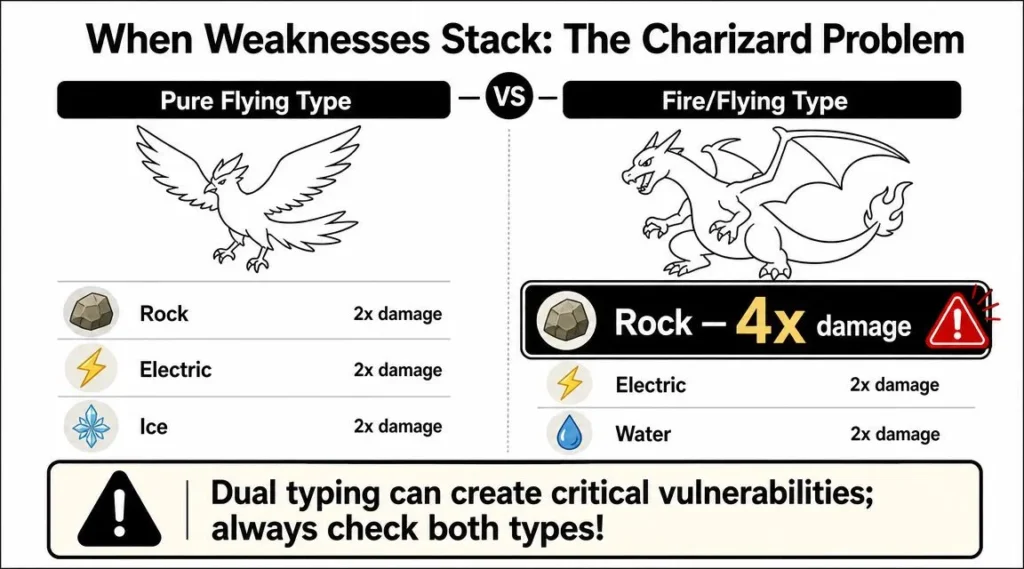
Niantic’s official Pokémon GO help directly notes that dual types can create an “extra weak” result, using Rayquaza as the example because Ice is strong against both Flying and Dragon, as shown in Niantic’s type effectiveness help page. That same dual-typing logic also explains why Fire/Flying Pokémon can take 4x damage from Rock.
Charizard and the classic stacked weakness
Charizard is the easiest example to teach because the punishment is so memorable. As Fire/Flying, it carries a Rock weakness from both sides. Flying dislikes Rock. Fire also dislikes Rock. Put them together and Rock becomes the matchup you’re hunting first.
That’s why players talk about the “Charizard problem.” If you ignore the second type, you only see a normal weakness. If you read both types, you see a major vulnerability and build your turn around it.
Gyarados and the hidden trap
Gyarados teaches a different lesson. It’s Water/Flying, so newer players often look at Rock or Ice first because they remember Flying’s usual weak points. But Electric is the standout answer.
Water fears Electric. Flying fears Electric too. That creates the stacked punishment you want to exploit. At the same time, Water changes how you think about Ice, so blindly following the pure Flying chart can lead you to a weaker choice than necessary.
The best move against a Flying Pokémon often comes from the second type, not the wings.
Zapdos and the erased weakness
Dual typing doesn’t just stack problems. It can remove them. Zapdos is Electric/Flying, so Electric attacks no longer act like the standard anti-Flying answer many players expect.
A common mistake is when people get caught clicking the obvious move into the wrong target. They remember the rule but forget to re-check it after the second type enters the equation.
A fast way to read dual-type flyers
When you see a Flying Pokémon, run through this checklist:
Start with the base Flying chart
Electric, Ice, and Rock are your first suspects.Ask what the second type adds
Does it also fear one of those attack types?Ask what the second type removes
Does it resist or neutralize one of those usual Flying weaknesses?Prioritize the stacked answer
If one move hits both types well, that’s often your strongest line.
This habit helps with famous examples like Charizard and Gyarados, and it helps just as much with less obvious targets. It’s also why broad popularity guides like this look at well-known Pokémon don’t tell the whole battle story. Recognition is useful. Typing interaction wins the turn.
Abilities Items and Game-Specific Tactics
Type charts give you the default rulebook. Battles become much deeper once abilities, items, and field effects start modifying those rules.
A Flying-type Pokémon normally resists Bug, Fighting, and Grass, and it’s immune to Ground-type moves under normal conditions. That Ground immunity can be removed by effects like Gravity, Ingrain, Smack Down, Thousand Arrows, or holding an Iron Ball, as outlined in Pokémon Database’s Flying type reference. This is the part of flying pokemon weakness that separates basic memorization from real battlefield awareness.
Grounding a Flying target
Ground immunity feels absolute until a battle effect changes the state of the field. Once that happens, moves you normally wouldn’t consider can suddenly become valid.
A few common ideas matter here:
- Gravity changes the battlefield and removes the comfort of being airborne
- Smack Down can force a Flying target into a grounded state
- Iron Ball can strip away that normal protection
- Thousand Arrows is notable because it interacts with Flying targets in a special way
- Ingrain also affects grounded status in ways newer players often overlook
That means you shouldn’t assume a Flying Pokémon stays protected forever. Skilled players look for ways to turn off the immunity, then punish with Ground pressure or better board control.
Items and battle context
Items also complicate the picture. A non-Flying Pokémon can temporarily act safer against Ground with the right setup, while a Flying Pokémon can lose some of its normal defensive edge if the wrong item or field effect comes into play.
This is why matchup reading is never just “type chart, done.” You also need to look at the battle state, likely held items, and format-specific habits. Even catching and building teams in games with different battle systems can shape how often you see these interactions, especially for players moving between console battles and mobile formats like Pokémon GO catching and team-building play.
A Flying Pokémon is strongest when the field still respects its immunity. Once that immunity is gone, the matchup can flip quickly.
Different games, same lesson
Mainline singles, doubles, and Pokémon GO don’t all feel the same. But the core lesson carries over. Don’t treat Flying like a fixed label. Treat it like a state plus a typing.
If the state changes, your move choices should change too. That’s how experienced trainers squeeze value from mechanics that newer players barely notice.
Flying Type Weakness Quick Reference Chart
If you want one cheat sheet to remember, use this and then check the second type before attacking. That last step is the one players skip most often.
Flying Type Defensive Matchup Chart
| Attack Type | Damage Multiplier | Notes |
|---|---|---|
| Electric | 2× | Standard weakness for a pure Flying type |
| Ice | 2× | Standard weakness for a pure Flying type |
| Rock | 2× | Standard weakness for a pure Flying type |
| Bug | 0.5× | Flying resists Bug |
| Fighting | 0.5× | Flying resists Fighting |
| Grass | 0.5× | Flying resists Grass |
| Ground | 0x | Immunity under normal conditions |
The mistake to avoid
The biggest mistake is using this chart as if every Flying Pokémon were pure Flying. Many aren’t. That’s why Charizard can be far more afraid of Rock than a plain Flying type, while Zapdos changes what you’d expect from the Electric matchup.
Keep these quick reminders in mind:
- Check both types first
- Look for stacked weaknesses
- Don’t assume Ground immunity is always active
- Use the strongest type-correct option, not just the strongest move on the screen
If you build that habit, flying pokemon weakness stops being a memorization problem and becomes a fast, reliable battle read.
If you enjoy clear gaming guides, approachable explainers, and fresh writing across games, education, tech, health, sports, arts, and more, visit maxijournal.com. It’s a strong place to find new reads and explore independent web publishing with a wide range of topics.
Discover more from Maxi Journal
Subscribe to get the latest posts sent to your email.