So you’ve downloaded Pokémon Go and you’re ready to start your adventure. The very first thing you’ll do, and the thing you’ll do most often, is catch Pokémon. At its core, the mechanic is simple: you see a Pokémon on the map, tap it, and flick a Poké Ball its way.
But there’s a real art to it. Mastering the catch is what separates a good Trainer from a great one. Let’s break down how to get started and a few tricks to make sure fewer Pokémon get away.
Your First Catch: A Quick Start Guide
Alright, you’ve spotted a Pidgey on your map. Your first instinct is the right one—tap on it! This pulls you into the “catch screen,” where it’s just you, the Pokémon, and your supply of Poké Balls.
At the bottom of the screen, you’ll see your Poké Ball. To make a throw, just press and hold it. You’ll notice a circle appear on the Pokémon. Now, swipe your finger straight up toward your target. The speed and direction of your swipe matter, but for now, just focus on a simple, straight flick. Your goal is just to make contact.
Reading the Catch Circle
Once you’re in an encounter, pay close attention to the colored circle that appears and shrinks on the Pokémon. This little ring tells you everything you need to know about your chances.
The color is your difficulty meter:
- Green: This one’s a cakewalk. An easy catch.
- Yellow/Orange: A bit more of a challenge. It might break out.
- Red: Get ready for a fight. This Pokémon is tough to catch.
Landing your Poké Ball inside that colored circle as it gets smaller is key. Not only does it increase your catch odds, but it also gives you extra XP for Nice, Great, or Excellent throws. Don’t stress about hitting perfect “Excellent” throws right away. Just work on consistently hitting the Pokémon inside the larger white circle.
As you get more comfortable, you’ll want to dig into more advanced techniques to boost your catch rate. For more in-depth strategies, be sure to check out our complete gaming guides section.
Mastering Excellent Throws and Curveballs
If you’re looking to catch more than just Pidgeys and Rattatas, you have to get your throwing technique down. Moving past simple straight lobs is where you really start to see a difference, especially with stubborn or rare Pokémon. This is all about mastering the throw bonuses that stack the odds in your favor.
The basic loop is simple: you find a Pokémon, you throw a ball, and you hope for a catch.
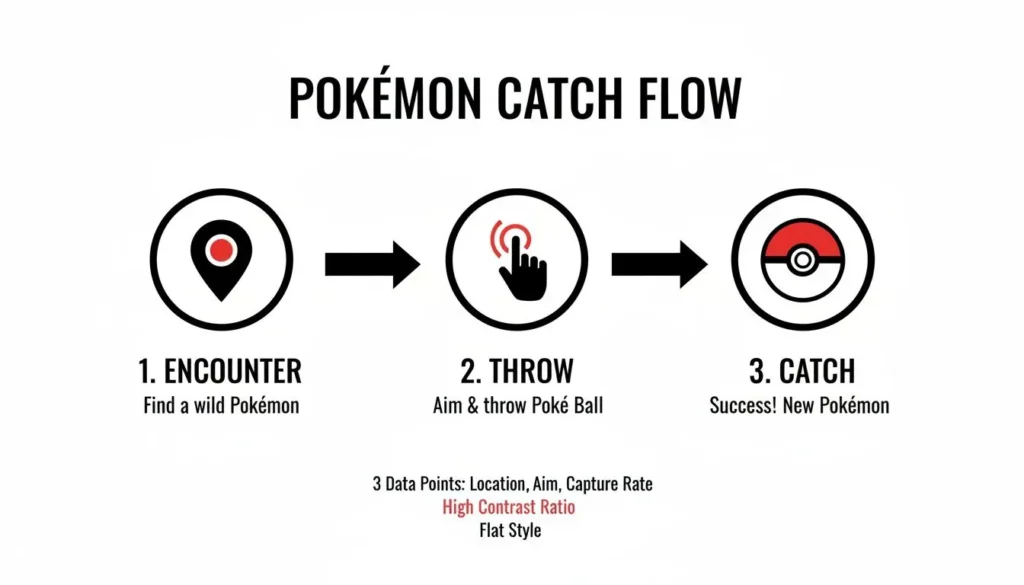
Looks easy on paper, right? But that “Throw” part is where a little skill can dramatically change the outcome.
Landing Nice, Great, and Excellent Throws
The secret to these bonuses is all in the timing. As you press and hold the Poké Ball, you’ll see a colored circle shrink inside the outer white one. Your goal is to hit the Pokémon inside that inner circle.
Landing your throw when the circle is large gets you a Nice throw. Hitting it when it’s about half-size nets you a Great throw. And if you can nail it when the circle is tiny, you’ll score an Excellent throw.
An Excellent throw isn’t just for bragging rights; it provides the single biggest catch rate bonus you can get from a throw. For Legendaries and other rare encounters, landing one can be the difference between a catch and watching it run away.
When the game first launched, players with a roughly 50% catch rate on common Pokémon quickly learned they needed an edge. The ‘Excellent Throw’ technique was born out of necessity, and with practice, it can boost your success by up to 20%. You can dig into the numbers and see how the game’s mechanics have been analyzed over the years by checking out some in-depth Pokémon Go stats.
The Power of the Curveball
The curveball is a game-changer. It’s a straightforward trick that adds a major boost to your catch rate—even more than a standard Great throw—and gives you a little extra XP for every successful catch. It’s a win-win.
Here’s how to do it:
- Spin It Up: Before you throw, hold the Poké Ball and spin it in a small circle at the bottom of your screen. Keep spinning until it starts to sparkle.
- Release at an Angle: Instead of throwing straight, you’ll toss it diagonally. If you spin the ball counter-clockwise, aim for the upper-right. If you spin it clockwise, aim for the upper-left.
It feels weird at first, but the key is practice. Find some big, common Pokémon like Wailmer or even a nearby Snorlax to get a feel for the arc. Once you can consistently land curveballs inside the target circle, you’re on your way.
Combining a curveball with a Nice, Great, or Excellent throw is the most effective catching strategy in the game. It’s a fundamental skill every serious trainer needs to master.
Using Berries and Items for Tough Encounters
So you’ve lined up the perfect curveball Excellent throw, but that stubborn Pokémon just won’t stay in the ball. We’ve all been there. When you’re up against a powerful Pokémon with a fiery red catch circle, it’s time to dig into your item bag.
Knowing when to use the right berry is a huge part of mastering the catch game, especially for those high-stakes encounters like a Legendary Raid boss or a rare wild spawn.
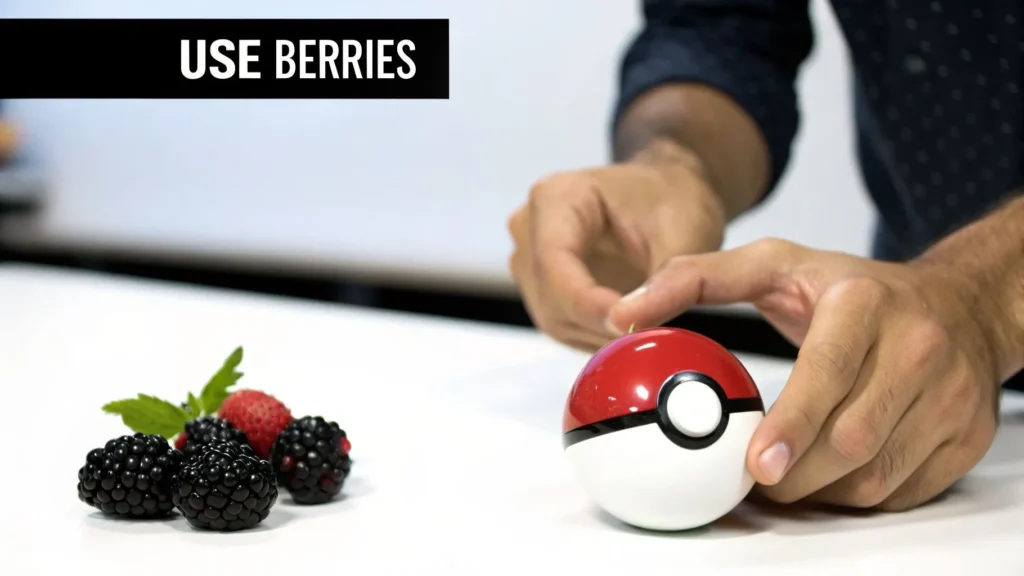
Think of your berries as your ace in the hole. A simple Razz Berry gives your catch odds a nice little bump, making it a go-to for a feisty Snorlax or a final-stage evolution you stumble upon. But for the big leagues—Legendary and Mythical Pokémon—you’ll want to break out the Golden Razz Berry for the biggest possible boost to your catch rate.
Calm Erratic Pokemon and Boost Candy
Not every berry is about making the Pokémon easier to catch, at least not directly. The Nanab Berry, for instance, is your secret weapon against those hyperactive Pokémon that just won’t sit still. Think Zubat, a jumping Lopunny, or anything that loves to attack. A quick Nanab will calm it right down, letting you line up a much more precise throw.
And then we have the Pinap Berry, a must-have for anyone serious about grinding for evolutions. Using one doubles the Candy you get from a successful catch, which is invaluable.
- Silver Pinap Berry: This is the best of both worlds. It gives you a catch rate boost and more candy. I save these for rare Pokémon that I also need a ton of candy for, like a wild Dragonite or a Deino.
These items completely changed how trainers approach tough catches. The Nanab Berry, for example, can reduce shakeouts by 30%, making high-CP raid bosses far more manageable. In fact, some data shows that around 70% of successful raid catches now involve a berry. It’s a strategy that has become second nature to most experienced players, and you can see more fascinating trends in these Pokémon Go player statistics.
Pro Tip: I always try to use a Pinap Berry on my first encounter with any new Pokémon. It gives you a great head start on the candy you’ll need to fill out its Pokédex entry and work toward its evolution.
Finally, don’t forget about items that bring the Pokémon to you. Lure Modules attract Pokémon to a PokéStop for all nearby players, while Incense creates a personal spawn circle that only you can see. Popping one of these is a fantastic way to practice your throws and farm candy, especially during Community Days or other events.
Reading Pokemon Behavior and Catch Circles
We’ve all been there: wasting a dozen Poké Balls on a stubborn Pokémon that just won’t stop jumping and attacking. If you want to stop wasting resources, you have to learn to read the game’s visual cues. It all comes down to the colored circle and the Pokémon’s own actions.
That colored ring you see on the Pokémon is your first clue. It shows you the base catch rate—a fixed difficulty stat for every species—and tells you how tough the encounter will be.
- Green: An easy catch. Go for it.
- Yellow to Orange: A moderate challenge. You might need to be more strategic.
- Red: This is a difficult catch. The Pokémon has a high chance of breaking free, so don’t just throw and pray.
This color should immediately tell you whether to switch to a better Poké Ball or use a Razz Berry.
Timing Your Throws
The most frustrating part of catching isn’t a red circle; it’s a Pokémon swatting your Poké Ball away or jumping right over it. The secret here is simple: patience. Every Pokémon has a predictable attack animation.
Wait for the Pokémon to finish its attack animation. As soon as the animation ends, the catch circle will reappear. Throw your ball immediately after the attack finishes for a clear, unobstructed shot before it can attack again.
Mastering this timing is what separates casual players from the pros. While an average trainer might make 20-30 catches in a session, experienced players using Lure Modules can easily hit 50+. Their efficiency comes from nailing this attack-and-throw rhythm, a critical skill for racking up XP bonuses. You can learn more about how dedicated players engage with the game and see how Pokémon Go maintains its audience.
One last pro-tip: turn off AR mode. This centers the Pokémon on your screen and stops it from moving around, making it way easier to land consistent Curveballs and Excellent throws without having to physically move your phone. It’s a small change that makes a huge difference.
Pro Tips for Faster Catching and Raids
For any serious trainer, especially during a frantic event like Community Day, speed is everything. Getting stuck in long catch animations means you’re missing out on other spawns—and potentially that perfect shiny or hundo. This is where a couple of advanced tricks can completely change your game, letting you catch far more Pokémon in way less time.
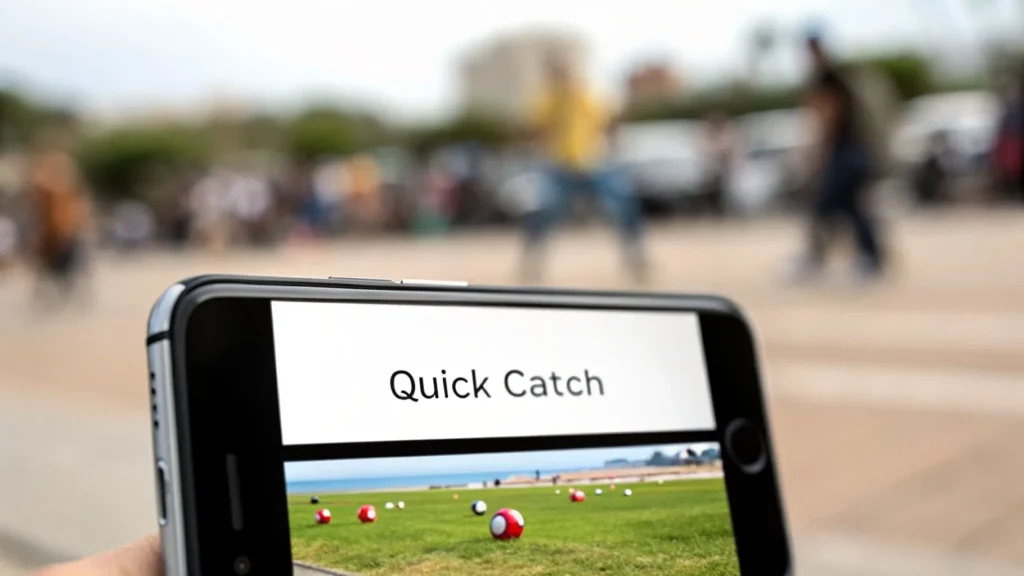
The absolute best way to speed things up is with the Quick Catch trick. It’s a slick, player-discovered technique that lets you skip the entire capture animation, shaving precious seconds off every single encounter. When you’re trying to check hundreds of Pokémon, those seconds make a huge difference. Honestly, it’s a must-learn for anyone looking to make the most of their time.
How to Perform the Quick Catch
This little maneuver works on both iOS and Android, and it just takes a bit of finger gymnastics to get the hang of. Once you’ve got the muscle memory down, you’ll wonder how you ever played without it. It’s a core part of learning how you catch a Pokémon in Go like a pro.
- On the catch screen, take your non-dominant thumb and slide the berry or ball menu icon to the left, holding it in place.
- Now, use your dominant hand to throw a curveball at the Pokémon like you normally would.
- The moment the ball makes contact, lift both thumbs off the screen at the same time.
- Finally, tap the flee icon in the top-left corner.
If you nailed it, you’ll be right back on the overworld map. If the Pokémon is still there, you didn’t catch it—try again! If it vanished, pop into your storage to confirm the successful catch. This kind of optimization reminds me of strategies in other games, like breeding specific traits. If you’re into that sort of thing, you’ll probably love our guide on how to breed flowers in Animal Crossing.
The Circle Lock Trick for Raids
After you’ve taken down a tough Raid Boss, you’re left with a challenging catch. This is where the Circle Lock method is an absolute game-changer.
The entire goal here is to “set” your ideal throw circle before the Raid Boss even starts its attack animation. You then wait for the perfect opening to throw, which almost guarantees your ball lands inside the circle for a catch bonus.
It’s pretty simple in practice. Just press and hold your Poké Ball until the colored circle shrinks to your target Excellent or Great throw size. Then, lift your finger without throwing the ball. Wait for the boss to start its attack animation. As it’s finishing the attack, spin and throw your curveball so it lands right when the animation ends and the circle pops back up.
Common Questions About Catching Pokemon
Even seasoned trainers run into the same frustrating issues now and then. Here are some quick answers to the questions we see pop up all the time, tackling those little problems that can make or break a catch.
Why Do Pokemon Flee After One Throw
It’s one of the most infuriating things in the game, right? You find a Pokémon you want, make one throw, and poof—it’s gone. Every Pokémon has a base flee rate, but sometimes there’s more going on.
If you’re moving too quickly (like riding in a car), the game can issue a “soft ban,” causing every single Pokémon to flee after the first ball. If you’re stationary, it’s just bad luck. To improve your odds, always use a Razz Berry on a Pokémon you really want. For Legendaries or rare spawns, don’t hesitate to use a Golden Razz Berry and an Ultra Ball.
Is Turning Off AR Mode Really Worth It
Absolutely. The single biggest reason is stability. While AR mode is a fun gimmick, turning it off puts the Pokémon on a simple, static background. You no longer have to swing your phone around to keep your target centered.
This makes a huge difference when you’re trying to master curveballs and consistently hit Excellent throws. When you’re facing a high-stakes catch like a raid boss or a shiny, nearly every experienced player will have AR disabled. It’s a simple toggle that gives you a massive advantage.
Are Excellent Throws Actually Worth the Effort
Yes, and it’s not even close. An Excellent throw nets you a nice XP bonus, but the real prize is the catch rate multiplier—it’s the highest you can get from a throw. It’s a skill that pays off immensely, especially when you encounter one of the most popular Pokémon that tend to be a bit stubborn.
For those rare spawns with a tiny, angry red circle, landing an Excellent curveball is often the only thing standing between a successful catch and a major disappointment.
Discover more from Maxi Journal
Subscribe to get the latest posts sent to your email.