You probably know the feeling. You buy groceries with good intentions, download a habit tracker, promise yourself that this week will be different, and then life gets loud. Work spills into the evening, your phone keeps pulling you off course, and the plan that looked clear on Sunday starts feeling unrealistic by Wednesday.
That pattern doesn’t mean you’re lazy or bad at change. It usually means your system is too vague, too big, or fighting your real environment.
If you’re learning how to build healthy habits, the useful question isn’t “How do I become more disciplined?” It’s “How do I make the healthy action easier to repeat?” Lasting habits tend to come from a simple sequence: understand the loop, attach the new behavior to a reliable cue, shape your environment so the right action is obvious, and track enough progress to keep going.
Understanding the Science Behind Your Habits
A habit is a behavior your brain learns to run with less effort. That’s why some actions feel almost automatic. You don’t debate them. You just do them.
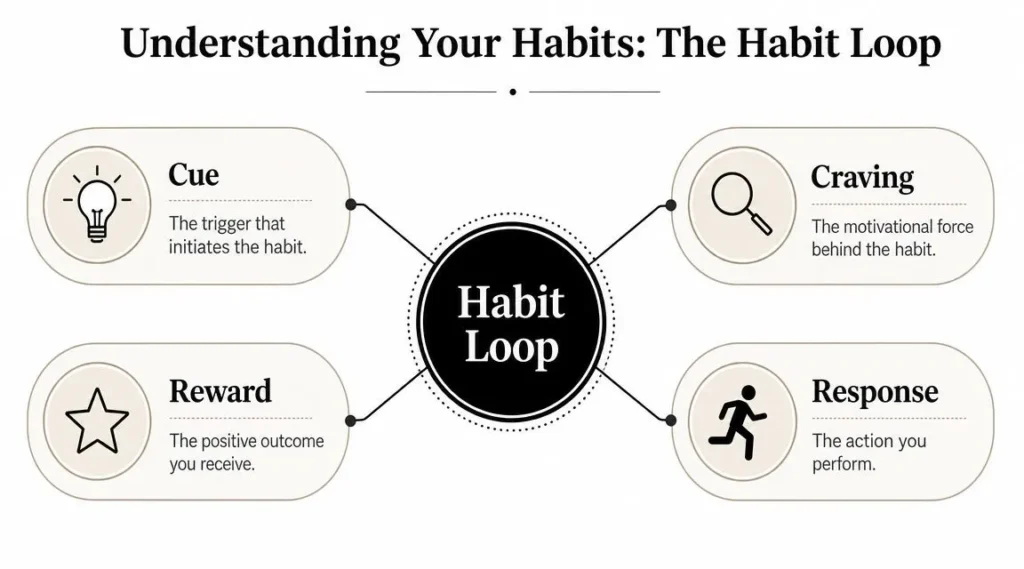
A familiar example is checking your phone. It often starts with a cue, such as a buzz, a moment of boredom, or a pause between tasks. Then comes the craving, which might be relief, stimulation, or the feeling that you won’t miss anything important. The response is the action itself, picking up the phone. The reward is the quick hit of novelty or connection.
The habit loop in plain language
The loop is simple enough to use in daily life:
- Cue. Something happens first. Your alarm rings, you finish lunch, or you sit at your desk.
- Craving. Your brain expects a feeling or benefit. Energy, calm, comfort, progress.
- Response. You act. You stretch, snack, scroll, walk, or pour coffee.
- Reward. You get something back. Less stress, more focus, a sense of completion.
Many people treat habits like moral tests. They assume success depends on wanting it badly enough. In practice, habits are more mechanical than that. If you strengthen the cue and shrink the response, repetition gets easier.
Healthy habits usually stick when the action is small enough to repeat under ordinary conditions, not ideal ones.
Why willpower fades so fast
Willpower helps at the beginning, but it isn’t a stable operating system. If every healthy choice requires a debate, you’ll burn out.
That’s why implementation intentions are so useful. Instead of saying, “I’ll exercise more,” you pre-decide the exact moment and action. A strong version sounds like this: “After I put down my lunch plate, I will walk for 10 minutes.” The cue is clear. The action is specific. The brain has less work to do.
Research summarized in health guidance notes that habit formation can take roughly 18 to 254 days, depending on the person, the behavior, and the context, which is why consistency matters more than intensity at the start, as explained in this summary from IE University on the science behind building habits.
What readers often get wrong
The confusion usually shows up in three places:
| Common mistake | What it sounds like | Better move |
|---|---|---|
| Starting too big | “I’ll work out every day” | Choose a version you can repeat even on busy days |
| Using weak cues | “I’ll do it sometime later” | Tie it to a stable moment in your day |
| Changing the plan constantly | “Maybe mornings, maybe evenings” | Keep the cue and context steady |
If you remember one idea from the science, remember this: your brain loves repetition in a stable context. The more often the same cue leads to the same small action, the more likely the behavior becomes automatic.
Design Your Environment for Automatic Success
Most habit advice overestimates self-control and underestimates surroundings. Your kitchen, desk, phone, and schedule all shape what you do next.
A better environment doesn’t force perfection. It makes the healthy choice easier than the unhealthy one.

Make good habits visible and easy
Look at the moments where you usually drift off plan. Then ask two questions: What cue can I make more obvious? What friction can I remove?
A few examples work well because they’re concrete:
- Morning walking. Put your shoes by the door the night before.
- Better hydration. Fill a water bottle and place it on your desk before work starts.
- Healthier lunches. Prep ingredients where you can see them first, not behind snack foods.
- Less mindless scrolling. Move distracting apps off your home screen and turn off nonessential alerts.
If you’re also trying to create a steadier start to the day, this guide on how to create a morning routine pairs well with environment design.
Fix the room before you fix yourself
People often tell themselves they need more motivation to cook, stretch, journal, or sleep earlier. Sometimes they don’t need more motivation. They need fewer obstacles.
Try a quick before-and-after reset:
| Area | Before | After |
|---|---|---|
| Kitchen | Snacks on the counter | Fruit bowl or prepped ingredients visible |
| Bedroom | Phone charging beside bed | Phone charging across the room |
| Desk | Tabs, alerts, clutter | Water bottle, notebook, one clear next action |
| Entryway | Workout gear hidden away | Shoes and bag ready by the door |
That shift seems small, but it changes what your brain notices first.
Practical rule: If a habit matters, give it a physical home.
Public health guidance also notes that sleep and movement habits are harder to maintain when digital systems make unhealthy choices easiest. Long-term success usually comes from pairing habit work with environmental design, such as nonessential notification limits and device cutoffs, as described by Kaiser Permanente’s guidance on building healthy habits.
A short visual walkthrough can help you spot these friction points in your own space:
Create Your Step-by-Step Habit Plan
Once your environment supports you, you need a plan simple enough to survive real life. The most useful setup combines habit stacking, a tiny starting action, and a clear schedule.
Use habit stacking to remove guesswork
Habit stacking means attaching a new habit to one you already do reliably. The formula is short and effective:
After I [current habit], I will [new habit].
Examples:
- After I brush my teeth, I will drink a glass of water.
- After I make coffee, I will do a short stretch.
- After I sit down at my desk, I will write one line in my journal.
- After I finish dinner, I will walk for a few minutes.
This works because the old habit acts as a cue for the new one. You don’t have to remember from scratch.
Start with the smallest version first
A lot of people sabotage themselves by choosing the final version of the habit instead of the starter version. If your real goal is regular exercise, the opening move might be putting on workout clothes and walking outside. If your goal is eating better, the opening move might be preparing one simple lunch ahead of time.
The pattern supported in public-health guidance is gradual. The World Economic Forum notes that habit laddering works by starting with an easy activity, focusing on frequency for six to eight weeks, and only then increasing intensity. That matches CDC guidance to turn broad goals into small actions, such as walking for 10 minutes, three times a week, as outlined in this World Economic Forum article on healthy habit formation.
That gives you permission to begin below your ambition.
Build your plan in four parts
Use this structure:
Choose one behavior
Pick one habit, not five. “Walk after lunch” is clearer than “get healthier.”Attach it to an existing cue
Use a habit you already perform without much thought.Shrink it
Make the first version easy enough that resistance stays low.Hold the context steady
Same place, same cue, same rough time.
If you like digital support, tools for AI-powered habit creation can help turn broad intentions into repeatable routines and prompts.
Micro-habits you can start in two minutes
| Health Goal | Two-Minute Habit |
|---|---|
| Fitness | Put on walking shoes and step outside |
| Fitness | Do a brief stretch after standing up from your chair |
| Nutrition | Fill a water bottle before opening email |
| Nutrition | Add one ready-to-eat fruit to your bag |
| Mental well-being | Write one sentence about how you feel |
| Mental well-being | Take a few slow breaths after closing your laptop |
| Sleep | Put your phone on charge outside the bed area |
| Focus | Clear one small section of your desk |
The point of these micro-habits isn’t impressive effort. It’s repeatable action.
For another example of cue-based consistency, this article on how to develop a reading habit shows how a tiny routine grows when it has a stable trigger.
How to Track Progress and Stay Motivated
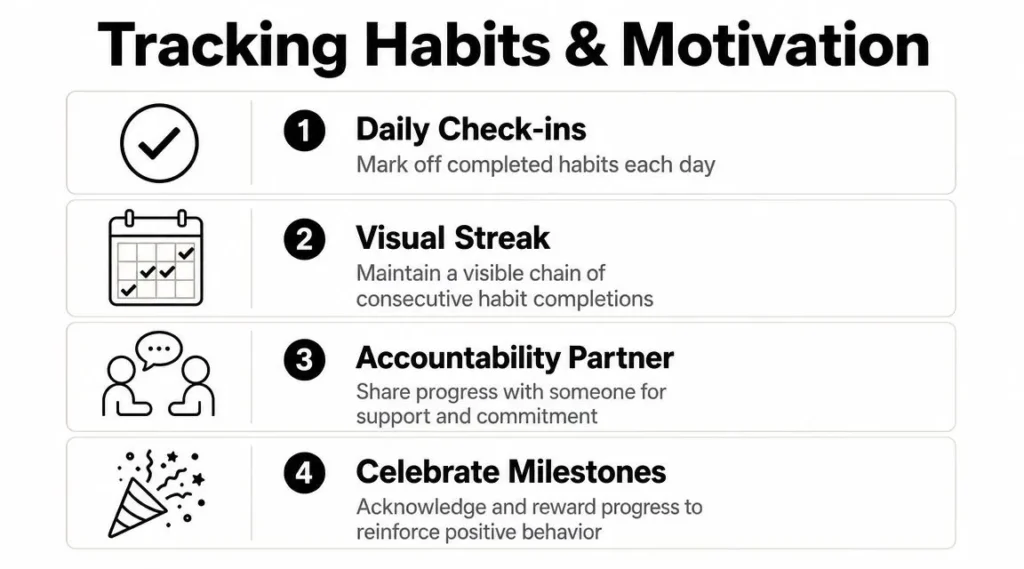
Tracking matters because memory is unreliable. If you only judge yourself by how motivated you feel, you’ll miss the evidence that you’re building consistency.
A visible record does two jobs. It shows whether the habit happened, and it gives your brain a small sense of completion.
Turn vague goals into measurable ones
“Eat healthier” sounds good but doesn’t tell you what to do today. A better plan is specific enough to mark complete or incomplete.
Both the CDC and UCLA Health recommend turning behaviors into a SMART plan and monitoring adherence. A vague goal often falls apart, while a target like 30 minutes of exercise five times per week with a weekly review gives you a concrete benchmark, as described in UCLA Health’s guide to building habits that stick.
That doesn’t mean every habit must be large. It means every habit needs to be clear.
Keep the tracking system simple
The best tracker is the one you’ll keep using. For many people, that’s not a complex app. It’s a paper calendar, a notebook, or a short note on the fridge.
A weekly tracker can be as simple as this:
| Habit | Mon | Tue | Wed | Thu | Fri | Sat | Sun |
|---|---|---|---|---|---|---|---|
| Walk after lunch | □ | □ | □ | □ | □ | □ | □ |
| Water before coffee | □ | □ | □ | □ | □ | □ | □ |
| Phone off at bedtime | □ | □ | □ | □ | □ | □ | □ |
You don’t need to score yourself. Just mark whether it happened.
A visible streak turns an invisible process into something you can protect.
If you enjoy reflective tracking, a dedicated health and wellness journal can also help you spot patterns such as when the habit feels easy, when it slips, and what changed around it.
Use rewards that reinforce the identity
Rewards don’t have to be dramatic. The most useful ones are immediate and aligned with the habit.
Good examples include:
- After a walk. Listen to a favorite podcast while cooling down.
- After meal prep. Enjoy a relaxed evening without deciding dinner at the last minute.
- After journaling. Make tea and treat the checkmark as the finish line.
The deeper motivation comes from evidence. Every time you complete the habit, you’re collecting proof that you’re someone who follows through.
Navigating Common Obstacles and Setbacks
Healthy habits don’t break because you missed one day. They usually break because a missed day turns into a story about who you are. “I blew it” becomes the reason you stop.
That’s the part to challenge.
Missing once is data, not failure
A setback is useful if you read it correctly. It tells you where the system was too fragile.
Maybe the cue wasn’t stable. Maybe the habit was still too big. Maybe your phone pulled you off course before the routine started. None of that says you can’t build healthy habits. It says the setup needs adjustment.
One missed day is an interruption. A repeated missed day is a design problem.
A practical recovery rule is simple: return at the next available opportunity. Don’t wait for Monday, next month, or a cleaner schedule.

What to do when you’re too busy
“I’m too busy” often means the habit only exists in its ideal form. On crowded days, use the minimum version.
Examples help:
- Your full habit is a workout. Your minimum version is changing into workout clothes and walking briefly.
- Your full habit is cooking dinner. Your minimum version is preparing one simple ingredient.
- Your full habit is meditation. Your minimum version is one quiet minute before opening your laptop.
A smaller version keeps the identity alive. You’re still the person who shows up.
The digital environment is a real obstacle
Many people blame themselves for poor consistency when the bigger problem is constant interruption. If your phone is always visible, your attention is always available to something else.
Public-health guidance increasingly notes that habits for sleep and movement are harder to maintain when digital environments make unhealthy choices easiest. Long-term change works better when you pair habit-building with environment design, such as turning off nonessential notifications and setting device cutoffs, as explained in Kaiser Permanente’s article on healthy habits.
Try these adjustments:
- For sleep. Set a charging station outside the bed area.
- For exercise. Start the habit before checking messages.
- For focus. Use app blockers during your cue window.
- For stress. Remove feeds from the first and last part of the day.
When motivation disappears
Motivation comes and goes. Systems stay.
If you don’t feel like doing the habit, don’t negotiate with the full version. Ask a narrower question: “What’s the smallest honest version I can do right now?” That question usually gets you moving again.
Your Journey to Lasting Healthy Habits
Lasting change is easier to understand when you treat it as a loop. Understand the habit mechanism. Design your space so the right action is easier. Act with a tiny, cue-based plan. Track what happens. Troubleshoot instead of judging yourself when life gets messy.
That’s a better answer to how to build healthy habits than chasing motivation. You don’t need a dramatic reset. You need a repeatable system.
Over time, the habit stops feeling like a project and starts feeling like part of your normal life. That’s the real shift. You’re not just doing healthy actions once in a while. You’re becoming a person whose routines support health by default.
If consistency is your sticking point, Strive Workout Log’s consistency guide is a useful companion read because it focuses on the day-to-day mindset that keeps habits going after the initial burst of motivation fades.
Choose one habit. Make it obvious. Make it small. Repeat it until it feels less like effort and more like identity.
If you enjoy practical, evidence-grounded guides like this, Maxi Journal publishes approachable writing across health, science, technology, education, sports, arts, travel, entertainment, and more. It’s a good place to keep reading, discover new perspectives, and find fresh articles that turn complex topics into useful everyday advice.
Discover more from Maxi Journal
Subscribe to get the latest posts sent to your email.