A reading habit rarely fails because someone does not care enough about books. It usually fails because the habit never had a structure strong enough to survive real life.
If you’ve tried to become “a reader” by buying a stack of books, setting an ambitious goal, and then falling off within days, the weak point is usually the system around the behavior. Reading habits stick when the cue is clear, the starting action is small, and the reward is immediate enough to make repetition likely.
That is the practical shift behind learning how to develop a reading habit. Treat reading as a habit loop you can design, not a personality trait you either have or do not have.
Good reading systems are usually simple. Put the book where you’ll see it. Attach reading to a moment that already happens every day. Start with an amount so small you can do it on tired, busy, distracted days. Then make the experience satisfying enough that your brain wants to come back.
This guide focuses on that process: less pressure, more repeatability, and a reading practice that becomes automatic instead of aspirational.
Why Most Reading Habits Fail Before They Start
A reading habit usually breaks long before page 1. It breaks at setup.
Many adults say they want to read more, yet reading for pleasure remains a minority behavior, and plenty of people stop reading regularly once school or structured obligations disappear, as noted earlier. That gap matters because good intentions do not create repetition. Repetition comes from a habit loop that has a clear cue, a manageable routine, and a reward your brain notices soon enough to want again tomorrow.
Willpower is a weak foundation
A plan like “read for an hour every night” sounds serious, but it asks too much from an ordinary day.
Work runs late. A child needs something. Attention is fried. The phone offers an easier hit of stimulation. Then one missed day turns into three, and people often blame themselves instead of examining the design of the habit. In practice, the system asked for focused effort at the exact time energy was lowest.
Small, repeatable behaviors survive real life better than ambitious ones.
You need an entry point that still works on busy, distracted, low-energy days.
That is why habit research matters here. Reading becomes more reliable when the behavior is tied to a stable cue, the first action is easy enough to start without negotiation, and the experience ends with a small sense of completion.
What actually breaks the habit
Three failure points show up often.
- The starting dose is too large. If reading feels like a 45-minute project, the brain delays it.
- There is no reliable cue. Without a trigger such as breakfast, commuting, or getting into bed, reading depends on memory.
- The environment adds friction. A hidden book and a visible phone create the wrong default.
Attention is part of this problem too. Someone who wants to read but checks messages every few minutes does not need more guilt. They need better stimulus control and stronger focus habits. Practical changes like reducing screen proximity and training better concentration during reading sessions make the habit easier to keep.
Reading is built, then it feels natural
Consistent readers rarely depend on inspiration. They set up conditions that make reading the easy next action.
A book stays in sight. The reading moment is attached to something that already happens. The daily target is small enough to clear even on rough days. The reward is immediate and concrete. A checked box, a few calm minutes, a paragraph that sparks curiosity, or the simple satisfaction of keeping a promise.
That is the trade-off many people miss. Big goals feel exciting at the start, but they produce fragile habits. Smaller goals feel modest, yet they create automatic behavior. Once the loop is stable, volume can grow.
Master the Art of Starting with One Page a Day
The fastest way to kill a reading habit is to make the daily requirement emotionally heavy. The fastest way to build one is to make starting almost laughably easy.
James Clear’s advice is simple: commit to one page per day. In his reading habit guidance, he ties that approach to habit formation research suggesting a new action can become automatic in 21 to 66 days. That frame matters because the first job isn’t reading a lot. It’s becoming someone who begins.
Why one page works when bigger plans don’t
One page sounds trivial, and that’s the point.
A tiny commitment lowers resistance. You don’t need perfect focus, a free evening, or a heroic burst of discipline. You just need enough willingness to open the book and read a single page. On many days, you’ll keep going. On bad days, you’ll still preserve the streak and the identity.
People get habit-building wrong in this way: They optimize for outcome before they’ve stabilized behavior. They want a polished reading life before they’ve learned to show up consistently.
Practical rule: Make the habit so small that skipping it feels sillier than doing it.
Use a simple cue routine reward loop
A reading habit sticks faster when it has a visible cue, a repeatable action, and a small reward.
Try this:
- Cue. Put a book on your pillow in the morning after making the bed.
- Routine. At night, read one page before you turn off the light.
- Reward. Mark the session in a notebook, on Goodreads, or in your calendar.
That setup works because it removes decision-making. The book isn’t hidden on a shelf. It interrupts the moment in a good way. You see it, you read a page, and you close the loop with a tiny signal of completion.
If attention is your biggest obstacle, it helps to strengthen your focus outside the reading session too. Practical concentration drills like the ones in this guide to improving concentration can make it easier to settle into a page instead of rereading the same paragraph.
What to do for the first week
Don’t scale too early. Keep the target microscopic for several days, even if you’re capable of more.
Use this checklist:
- Choose one book only. Don’t start with five options on your nightstand.
- Pick one location. Bedside chair, couch corner, kitchen table. Same place helps.
- Set one minimum. One page. Not ten. Not a chapter.
- Track completion visibly. A paper calendar works well because you can see the chain grow.
If you read more, great. If you stop after one page, that’s still success. The habit isn’t measured by intensity yet. It’s measured by repetition.
What not to do
Avoid these common mistakes in the opening phase:
- Don’t attach the habit to mood. “I’ll read when I have time” usually means “I won’t.”
- Don’t start with a difficult book. Dense books create unnecessary drag.
- Don’t negotiate with the minimum. Once you start changing the rules, the habit gets fuzzy.
One page a day isn’t a life sentence. It’s the doorway. Once walking through the doorway feels normal, you can expand the session without rebuilding the whole system.
Build a Reading Ritual That Fits Your Life
A habit becomes stable when it lives inside a routine that already exists. That’s why random reading sessions rarely last. They depend on spare time, and spare time is unreliable.
Behavioral psychology points to habit stacking as a better method. In this Psyche guide on building a daily reading habit, the pattern is straightforward: connect reading to something you already do, such as coffee, lunch, or bedtime. The same source notes that reading 10 minutes a day for a month is 400% more effective for building a lasting habit than reading for 3 hours once a week.

Attach reading to a stable anchor
The formula is simple:
After [current habit], I will read for [small amount of time or pages].
Good anchors include:
- Morning coffee. Read while the mug is still hot.
- Lunch break. Keep a paperback or Kindle nearby.
- After dinner. Replace the automatic scroll with a book.
- Before bed. Put the book where your phone usually goes.
The best anchor is one that already happens almost every day without effort. If your mornings are chaotic, don’t build your reading plan around mornings just because it sounds productive.
For readers who want a stronger start to the day overall, this morning routine guide can help you identify a stable anchor that reading can latch onto.
Build a space that makes reading easier
Environment design sounds fancy. In practice, it means setting the room up so reading is the path of least resistance.
A useful reading setup often includes:
- A dedicated seat. An armchair, one side of the couch, or a quiet desk corner.
- Good light. If reading feels physically tiring, you won’t come back to it.
- A visible current book. Not buried in a bag.
- No nearby phone. Another room is better than face-down on the table.
That last point matters. If your phone stays beside you, the session becomes a negotiation between pages and notifications. Put it away before you sit down.
A ritual works because it reduces choices. Same time, same place, same opening move.
Make the ritual feel personal, not performative
Some people love tea, a lamp, and silence. Others read on a train, in a parked car before pickup, or through an audiobook during a walk. The ritual doesn’t have to look literary. It has to be repeatable.
A few examples:
| Situation | Better ritual |
|---|---|
| Busy parent | Read in the car for a few minutes before going inside |
| Office worker | Read after lunch instead of checking social media |
| Night owl | Read one chapter with a bedside lamp before sleep |
| Commuter | Use audiobook time as the fixed reading window |
A strong ritual feels almost pre-decided. Once the anchor happens, reading follows. That removes the draining question of whether you’re going to read today.
Your Actionable 30-Day Reading Habit Starter Plan
A good reading system needs a runway. Thirty days is long enough to create rhythm and short enough to feel concrete.
Start with the visual checklist below, then use the week-by-week plan that follows.
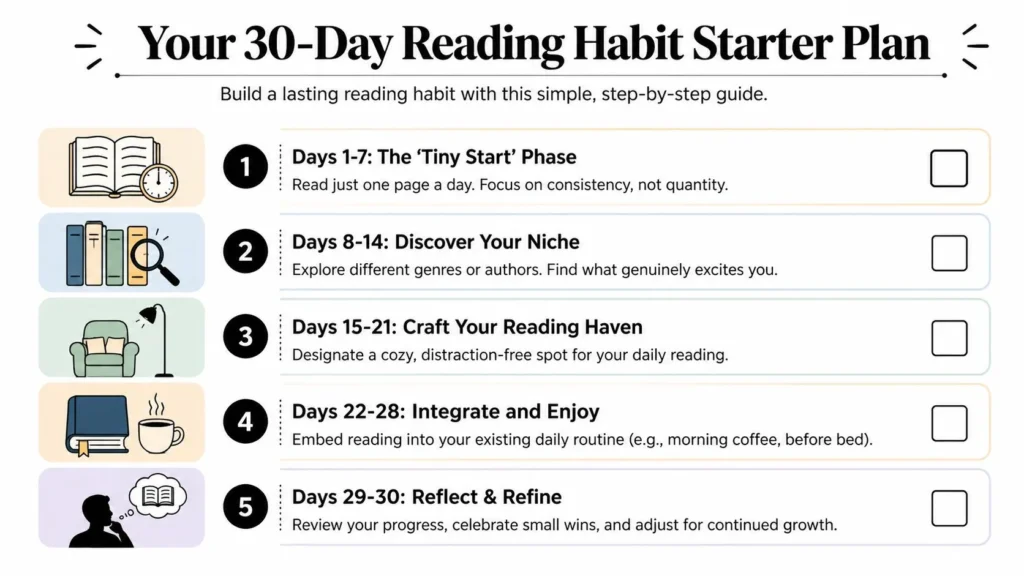
The 30 day starter table
| Week | Daily Goal | Focus |
|---|---|---|
| Week 1 | Read one page a day | Build consistency |
| Week 2 | Read at a scheduled time | Lock in a repeatable slot |
| Week 3 | Improve your reading space | Reduce friction and distraction |
| Week 4 | Extend the session if it feels natural | Grow from habit to practice |
This video can help you see the process in a more visual way.
Days 1 through 7
For the first week, protect one thing only: daily repetition.
Read one page each day. Use the same cue every time. Don’t worry about speed, comprehension depth, or total pages. Your only job is to prove that reading now happens every day in some form.
Use a simple scorecard:
- Done today means you read your minimum.
- Bonus means you went beyond it.
- Missed means no reading happened at all.
Keep the score visible. A notebook on your bedside table works. So does a calendar with an X on each completed day.
Days 8 through 14
Once the habit exists, give it a home in your schedule.
Choose one reading window you can realistically defend. That might be after coffee, after lunch, or before bed. Don’t chase the “ideal” slot if your life doesn’t support it. Reliability beats aesthetics.
At this stage, many readers move from one page to a short timed session or a few pages, but only if the shift feels easy. If increasing the target creates friction, stay small for another week.
Days 15 through 21
Now fix the environment.
Make your reading area more inviting than your default distraction. Put the book where your hand lands first. Charge your phone outside the room. Add a lamp if eye strain makes you quit early. If you read digitally, move the reading app to your home screen and bury the entertainment apps.
If you’re also trying to retain more of what you read, these reading comprehension strategies pair well with a new habit because they help you stay engaged without turning reading into homework.
A habit survives when the room supports it. Friction doesn’t have to be dramatic to break a routine. Small obstacles are enough.
Days 22 through 28
At this point, reading starts to feel less like a task and more like part of the day.
Try pairing reading with enjoyment. Read with tea. Read in a chair you like. Read a book that pulls you forward instead of one you think you should finish. If you’re using an audiobook, make the walk or commute part of the ritual.
You can also broaden your format here. Paperback at night, ebook during the day, audiobook in transit. A reading habit doesn’t become less valid because it uses multiple formats.
Days 29 and 30
Review what worked.
Ask yourself:
- When did reading feel easiest
- Which cue triggered it most reliably
- Which book made the habit easier
- What kept interrupting me
- What will I keep for the next month
Then tighten the system. Keep the parts that made reading automatic. Drop the parts that felt forced.
A useful rule for the next month is simple. Never raise the target so quickly that you stop wanting to begin. The best reading habit is the one you’ll still be doing when life gets messy.
Find Books and Tools You Genuinely Enjoy
A lot of reading habits don’t fail because of poor discipline. They fail because the book is wrong.
Someone decides they should read a classic, a heavy business title, or a worthy book they secretly dread. They push through twenty pages, lose momentum, and assume they’ve lost the habit. In reality, they picked bad fuel.

Stop forcing “important” books
Early in a reading habit, enjoyment matters more than prestige.
If thrillers keep you turning pages, start there. If memoirs are easier than dense nonfiction, use memoirs. If short essays fit your attention span better than long novels, that’s not cheating. It’s intelligent matching.
A simple personal rule helps: if a book feels like a slog for long enough that you dread opening it, set it aside. Reading habits strengthen when the next session feels inviting.
Read books that create momentum, not guilt.
Use a discovery method instead of guessing
Many don’t have a reading problem. They have a selection problem.
Try a simple filter:
- Pick by mood. Fast-paced, reflective, funny, practical, comforting.
- Pick by format. Print, ebook, audiobook.
- Pick by season of life. Commute reading is different from weekend reading.
- Pick by recent wins. If you finished a narrative nonfiction book, find another with a similar feel before jumping into something denser.
This keeps your next choice connected to what already worked, instead of restarting from scratch every time.
Let tools carry some of the load
A few tools make reading easier without turning it into a project:
- Goodreads helps with tracking, shelves, and seeing what friends are reading.
- Libby lets you borrow ebooks and audiobooks through your library, which reduces the cost and effort of finding your next book.
- StoryGraph is useful if you like recommendations based on mood, pace, and reading preferences rather than popularity alone.
- Kindle makes it easy to keep a current book with you and read in small pockets of time.
- A notes app or paper reading journal works if you like recording a line, idea, or page count after each session.
A practical setup is to use one discovery tool, one access tool, and one tracking tool. For example: StoryGraph to choose, Libby to borrow, and a paper calendar to mark daily reading. That’s enough structure to keep momentum without creating admin work.
Match the tool to the friction
Different obstacles need different fixes.
| Friction | Better tool |
|---|---|
| You forget to bring a book | Kindle app or a small paperback in your bag |
| You can’t choose what to read next | StoryGraph or Goodreads shelves |
| You don’t want to spend much | Libby |
| You lose momentum between sessions | Simple tracking in a notebook or app |
The right book plus the right tool often makes reading feel lighter immediately. That’s not a shortcut. It’s what smart habit design looks like.
Overcome Roadblocks and Keep Your Habit for Life
Reading habits usually break at the point of interruption, not at the point of intention. The readers who keep going for years build a system for recovery before they need it.
A missed day is ordinary. A missed week can also be ordinary, if you have a clear way back. What turns a short lapse into a habit collapse is friction, self-judgment, and the loss of a stable cue. Keep the cue. Shrink the routine. Protect the reward.
That is the whole recovery loop.
Handle common setbacks without turning them into identity problems
Busy days rarely kill a reading habit on their own. The usual problem is that the habit depends on one format, one location, or one ideal block of time. A more durable setup gives you options. Keep a physical book where you usually sit, an ebook on your phone for waiting time, and an audiobook for walks, chores, or commuting.
Low motivation needs a different response. Reduce the target until starting feels easy again. One page counts. Five minutes counts. The goal during a rough patch is to keep the cue-routine-reward loop alive so reading still feels like something you do automatically.
Use these resets:
- Missed a day. Read one page the same day you notice the lapse.
- Lost interest in the book. Drop it and pick up one that gives you more energy.
- Can’t focus. Cut the session to five minutes and remove one distraction.
- Life is chaotic. Attach reading to a stable cue such as morning coffee, lunch, or getting into bed.
Use AI as support, not as a substitute
Difficult books often fail because the entry cost is too high. Dense nonfiction, classics, and books with unfamiliar context can create enough friction that readers stop before the habit has a chance to hold.
Used carefully, AI can lower that friction. It helps with comprehension, context, and momentum. It should not replace the book.
A few practical uses:
- Ask for a plain-language explanation of a chapter after you read it.
- Get brief historical or conceptual context before starting a demanding book.
- Clarify unfamiliar terms without breaking concentration for ten separate searches.
- Compare two possible next books if you’re stuck choosing and want one that fits your current energy.
That approach keeps the reading experience intact while removing avoidable obstacles. The book stays at the center. The tool makes re-entry easier when attention is low or the material is hard.
Build for resilience, not streaks
Long-term readers expect uneven seasons. Work gets busy. Children get sick. Travel disrupts routines. Attention changes.
A habit that survives real life has a floor. Decide in advance what your minimum version is. For many people, that is one page, five minutes, or one audiobook track. Habits, which thrive on repetition even in small doses, are sustained by this approach. Miss less by making the default easier to return to.
I have found that readers keep the habit longer when they stop measuring themselves by perfect runs. Measure recovery speed instead. How fast did you return after the interruption? That number tells you more about habit strength than any streak ever will.
A lifelong reading practice looks boring in the best way. It has cues, fallback versions, and enough flexibility to survive a messy week. That is what keeps it going for years.
If you enjoy practical guides like this, visit maxijournal.com for more approachable writing on learning, habits, health, technology, and everyday self-improvement.
Discover more from Maxi Journal
Subscribe to get the latest posts sent to your email.