You probably have the same mix of excitement and confusion most first-time publishers have. You know the kind of magazine you want to build. You can already picture the sections, the voice, maybe even the first few features. Then reality shows up: platform choices, contributor management, editorial planning, audience growth, subscriptions, legal pages, launch timing.
That’s where most good ideas get stuck. Not because the idea is weak, but because an online magazine is not just content. It’s an editorial system, a publishing workflow, a website, a business model, and a retention engine for both readers and writers.
The good news is that the opportunity is real. The global magazine publishing market is projected to grow from US$82.98 billion in 2024 to US$140.07 billion by 2034 at a 5.4% CAGR, while U.S. print magazine ad spending fell from $0.25 billion in 2022 to $0.21 billion in 2023, according to Fact.MR’s magazine publishing market outlook. That tells you two things. Digital demand is still there, and the web-based model is where independent publishers have room to operate.
A lot of people still approach this like a print project with a website attached. That’s a mistake. If you want to learn how to start an online magazine in 2026, think web-first, membership-ready, contributor-friendly, and operationally lean.
From Idea to In-Demand Publication
Most new publishers begin with a theme. Tech and culture. Wellness and travel. Music and independent film. Science and society. That’s a fine starting point, but it’s not yet a publication. A publication has a repeatable editorial promise and a structure readers can return to.

The web model makes that far more achievable than old app-only or PDF-heavy approaches. You don’t need to fund print runs, physical distribution, or a custom app before you know what readers want. You need a clear editorial engine, a site that works on every device, and a plan for turning attention into repeat visits and memberships.
A multi-topic magazine can work well if you treat it like a network of strong verticals rather than a pile of unrelated categories. Readers will tolerate breadth. They won’t tolerate randomness. If your science coverage, entertainment commentary, travel pieces, and gaming articles all feel like they come from the same editorial brain, the publication feels coherent.
Working rule: Build a magazine readers can describe in one sentence. If they can’t explain it clearly, they won’t remember it.
The publishers that last don’t chase volume first. They build consistency first. They know who the reader is, what the publication covers, what it won’t cover, how often it publishes, and which metrics matter in the first year.
That’s the shift you need to make early. Stop asking whether you should launch. Start deciding what kind of magazine you’re building, who will help make it, and how it will support itself once the initial enthusiasm wears off.
Define Your Editorial Vision and Niche
A weak niche creates weak commissioning. Weak commissioning leads to generic articles. Generic articles give you a forgettable publication.
The fix isn’t always to go narrower. For a web magazine, the better move is often to define a tight editorial lens across several related subjects. “Business, technology, and culture for working creatives” is stronger than “a magazine about everything interesting.” “Health, sport, and performance for everyday people” is stronger than “lifestyle.”
Start with editorial pillars, not article ideas
Article ideas are easy. Sustainable editorial pillars are harder, and they matter more.
If you’re building a multi-topic publication, choose three to five recurring pillars that can support fresh commissions for a long time. Good pillars are broad enough to stay alive, but specific enough to create a recognizable identity.
A practical set might look like this:
- Core reporting: News analysis, explainers, and commentary tied to your main subject areas.
- Service journalism: Guides, recommendations, and practical how-tos readers can use.
- Profiles and interviews: Creators, founders, researchers, athletes, or artists with a clear editorial fit.
- Cultural interpretation: Reviews, opinion, and trend pieces that show your point of view.
- Evergreen resource content: Reference articles that can keep earning search traffic over time.
That mix helps you avoid the trap many new magazines fall into. They launch with a burst of enthusiasm, publish whatever feels interesting, and then discover they have no repeatable content system.
That problem is common. Mequoda’s guidance on planning content for an online magazine notes that 70% of new digital publications fail within the first year due to unsustainable content. The same guidance recommends budgeting 40-60% of pre-launch funds for content creation and building a two-year table of contents to protect long-term consistency.
Build a two-year plan before you publish issue one
A two-year plan doesn’t mean every headline must be locked. It means your publication has enough depth to survive past launch month.
Use a simple planning grid:
| Planning layer | What to decide |
|---|---|
| Publication promise | What readers will reliably get from you |
| Pillars | The recurring subject areas you’ll cover |
| Formats | Features, explainers, reviews, interviews, roundups |
| Cadence | How often each section publishes |
| Ownership | Who edits, assigns, writes, and publishes |
Then create a rolling editorial map for future issues or monthly themes. You’re looking for warning signs:
- Repetition risk: Too many similar feature ideas too early
- Expertise gaps: Nobody on the team can reliably edit a subject area
- Production strain: Your publishing cadence assumes more capacity than you have
- Topical imbalance: One category carries the whole publication while others feel empty
If your editorial calendar only looks strong for six weeks, you don’t have a magazine yet. You have a launch package.
Validate the niche before you overbuild it
This part is less glamorous than branding, but it saves time. Before you invest heavily in design and commissions, test your editorial idea in live environments where your readers already gather.
Use places like Reddit, specialist forums, newsletters, YouTube comment communities, and niche social channels to answer basic questions:
- Which topics trigger discussion, not just clicks?
- What reader questions keep repeating?
- Where are mainstream outlets too shallow, too technical, or too boring?
- Which stories could your publication own with a distinct voice?
Validation isn’t about asking strangers if your idea is good. Initial positive feedback often proves superficial, lacking genuine commitment. Validation means identifying repeat interest, recurring problems, and under-served angles.
Budget for content like an operator
Many founders underbudget content because software feels more tangible. They’ll spend too long choosing logos, themes, and plugins, then try to fill the magazine with rushed or inconsistent writing.
That’s backwards.
Commissioning, editing, copy polishing, visuals, and back-catalog depth should absorb a large share of early spending. The archive matters because readers judge a magazine fast. If they arrive and find four posts and one category with life in it, they don’t see potential. They see an unfinished project.
A strong editorial vision isn’t abstract. It shows up in your commissioning brief, your kill criteria, your archive depth, and your ability to keep publishing when the obvious launch ideas are gone.
Build Your Digital Publishing Platform
Your platform decision should reduce friction, not create it. Independent publishers don’t need a complicated stack to start. They need a system they can update quickly, expand later, and trust every day.

A common setup includes WordPress, a reliable managed host such as SiteGround, and a magazine-style theme that supports category-led navigation, strong typography, newsletter capture, and flexible homepage layouts. You don’t need a custom build at the start unless your workflow is highly unusual or your team already has development capacity.
Pick the stack that preserves editorial speed
The right setup lets an editor do routine work without opening a support ticket.
A practical baseline stack for a new web magazine looks like this:
- CMS: WordPress, because it’s flexible, familiar, and easy to extend
- Hosting: A scalable host with strong support and sensible backups
- Theme: A publication-focused theme with homepage modules and ad or promo placements
- Email platform: Mailchimp or another provider that supports signups, automations, and audience segmentation
- Analytics: Standard web analytics plus event tracking for subscriptions, scroll depth, and outbound clicks
- Forms and workflow tools: Simple editorial forms, shared docs, and status tracking in Notion, Trello, or Airtable
If you want design inspiration before choosing a theme, review examples of online journal websites with strong web-first structure. Study how they organize categories, member prompts, and article hierarchy. Don’t copy the look. Copy the clarity.
Design for the smallest screen first
A lot of founders still review their site on a laptop, decide it looks fine, and launch. Readers don’t give you that luxury. If the mobile layout is clumsy, they leave.
That’s not a small usability issue. MagLoft’s guidance on online magazine setup states that 65% of readers will abandon a website that is not optimized for their device. It also notes that locking design for both vertical and horizontal tablet orientations can produce a 30% uplift in reader engagement.
That changes how you should design:
- Navigation must be obvious: Categories, search, and featured stories should be visible without hunting.
- Typography must hold up on mobile: Fancy fonts fail fast on smaller screens.
- Image handling must stay clean: Oversized visuals slow pages and break layouts.
- Prompts must be restrained: Too many popups and banners make the site feel cheap.
Practical rule: If a first-time visitor can’t understand your homepage in a few seconds, the design is serving the founder, not the reader.
Here’s a useful walkthrough before you get too deep into setup:
Structure the homepage like an editor, not a developer
A magazine homepage shouldn’t feel like an endless blog feed. It should act like a front page.
Use distinct content zones. Lead feature. Secondary stories. Topic blocks. Editor’s picks. Newsletter capture. Premium prompts if you plan memberships. Readers should understand the publication’s breadth and hierarchy without scrolling forever.
A simple comparison helps:
| Approach | What happens |
|---|---|
| Blog-style homepage | New posts push everything else down, strong pieces disappear quickly |
| Magazine-style homepage | Editors can surface priority stories, sections, and conversion paths |
Avoid the common platform mistakes
Most technical mistakes are really decision mistakes made too early.
- Over-customizing at launch: Custom builds create maintenance costs before revenue exists.
- Publishing as PDFs: They’re awkward on mobile, weak for search, and hard to update.
- Ignoring templates: If every article layout is different, production slows and the site feels inconsistent.
- Forgetting membership paths: Even if paid access comes later, your design should leave room for it.
The best platform is the one your team can run. Fast publishing, stable templates, good mobile performance, and clean category architecture beat flashy complexity every time.
Develop a Sustainable Contributor Workflow
Most advice on launching a magazine focuses on finding writers. That’s too shallow for a multi-topic publication. Finding writers is easy compared with keeping good ones.
A broad web magazine lives or dies by contributor continuity. If every writer disappears after one or two assignments, your voice fragments, editorial standards drift, and the assigning load gets heavier every month. You spend your time re-explaining the brief instead of improving the publication.
That churn is not rare. This discussion of online publishing contributor retention points to a pattern where 70-80% of freelance writers stop working with a publication after only one or two assignments, often because payments are inconsistent or feedback is weak.
Stop treating contributors as disposable supply
The transactional model looks efficient at first. Post a call for pitches. Accept a few. Pay per piece. Repeat.
It usually breaks down fast for a multi-topic site because each new writer adds onboarding work. They need tone guidance, formatting rules, deadlines, editing expectations, image standards, links policy, and audience context. If they leave immediately after one piece, the publication absorbs all that cost and keeps none of the long-term upside.
A better system is a tiered contributor program with expectations and benefits that increase over time.
For example:
- Trial contributors: One or two assignments, close editing, clear briefing
- Regular contributors: Predictable beats, recurring slots, faster approvals
- Section contributors: Trusted writers attached to a topic area
- Lead contributors or columnists: Distinct voice, stronger visibility, occasional planning input
That doesn’t need to be formal or corporate. It needs to be clear.
Build retention into the workflow
Good contributors stay when the publication feels organized, fair, and responsive.
Use this operating checklist:
Pay on time
Late payment poisons trust faster than almost anything else.Give real editorial feedback
“Looks good” is not editing. Writers improve when editors tell them what worked, what dragged, and what should change next time.Assign beats, not random topics
A writer who owns a lane becomes more useful over time.Create a style guide
Tone, sourcing rules, formatting, headline style, affiliate disclosure language, and image handling should all be documented.Show contributors how to publish well online
Point them to practical references such as this guide on how to publish articles online so they understand web formatting, readability, and digital presentation.
Editors keep contributors by reducing friction. Writers stay where the brief is clear, the response is timely, and the process feels professional.
Give contributors a reason to care about outcomes
Not every magazine can offer big fees early. Many can still offer a better relationship.
That can include bylines with stronger profile pages, recurring columns, early access to editorial themes, structured feedback, or modest performance-linked upside where appropriate. The point isn’t to gamify everything. The point is to move from one-off transactions toward shared investment in the publication.
A multi-topic magazine especially benefits from contributor memory. The writer who has already learned your voice in health, games, travel, or culture will usually deliver better work on the third assignment than on the first. Retention isn’t just a staffing issue. It’s a quality strategy.
Design Your Multi-Stream Monetization Strategy
If your plan is “we’ll launch, grow traffic, and then figure out money,” you don’t have a business model. You have a hope model.
That used to be common when ad targeting was easier and publishers could tolerate weak reader economics for longer. That window is narrower now. FlippingBook’s guide to starting an online magazine notes that industry-wide ad revenue fell 35% in recent years due to cookie deprecation, and it makes the basic point many founders learn too late: single-model reliance is risky. The same source notes that digital products can generate 15% of total revenue and that affiliate links in niches like fashion and pets can yield 20-30% margins.
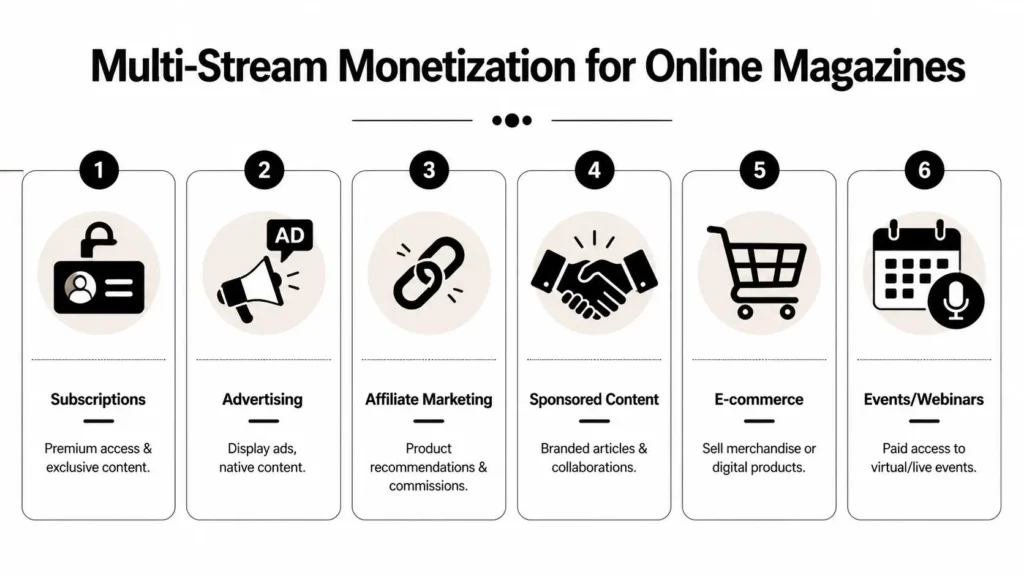
The right way to think about monetization is as a portfolio. Different revenue streams do different jobs. Some pay quickly. Some build slowly. Some work only when trust is already strong.
The four streams that matter most early
For an independent web magazine, these are usually the most practical options.
| Revenue stream | Best use | Main risk |
|---|---|---|
| Subscriptions or memberships | Reader revenue and recurring income | Hard to sell before trust exists |
| Advertising or sponsorship | Monetizing broader reach | Too volatile on its own |
| Affiliate commerce | Useful for recommendation-heavy content | Weak fit if editorial integrity slips |
| Digital products | High-margin assets built from editorial expertise | Requires packaging and promotion |
Subscriptions work best when they’re not your only answer
Reader revenue matters because it aligns your incentives with audience loyalty. But many founders overestimate how fast subscriptions will carry the business.
A new publication usually needs a ladder. Free articles bring discovery. Email capture builds repeat access. Premium content or member benefits create the paid step. If you put a hard wall around everything too early, you cut off your own growth.
For a multi-topic publication, premium offers can be organized around depth rather than category exclusivity. Think member-only explainers, curated briefings, archive access, special interviews, or bundled topic packages for readers who want more than the public site provides.
Advertising still has a place, but not in the driver’s seat
Display ads can help, especially when traffic grows. Sponsorships and native placements can work even earlier if the magazine has a clear audience and strong editorial standards.
What doesn’t work is building the whole business around pageview volume. That pushes you toward weaker headlines, thinner articles, and categories you don’t want to own.
A better use of advertising is selective and controlled. Make room for it without letting it dictate the publication.
Affiliate content should feel like service journalism
Affiliate works best when it helps the reader make a decision. That means buyer’s guides, tested recommendations, comparative explainers, and curated resource lists.
It fits naturally in some sections more than others. Fashion, pets, travel gear, gaming accessories, and practical education tools can all support this model if the recommendations are editorially honest. If every review reads like a sales page, readers will notice and trust drops.
Strong affiliate publishing doesn’t begin with commission rates. It begins with useful recommendations readers would value even if no link paid you.
Digital products are often the cleanest third stream
Many publishers leave money on the table because they think only in articles and subscriptions. But a magazine archive can produce compact products readers will buy.
Examples include:
- Themed guides
- Resource packs
- Research roundups
- Downloadable reading lists
- Editorial collections
- Workshops or webinars tied to a subject area
This works especially well for a publication with several verticals. One audience may never subscribe, but they might buy a focused guide built around a topic they already care about.
Build the model in layers
Start simple. Don’t launch six revenue streams at once.
A sensible order is:
- Build audience and email capture
- Add a light membership or premium layer
- Introduce affiliate content where editorial fit is obvious
- Package digital products from your best-performing topics
- Add sponsorships when the brand is stable enough to protect standards
This is how to start an online magazine without locking yourself into one fragile revenue source. A resilient publication earns money from several places, with each stream reinforcing the others.
Execute a Powerful Launch and Growth Plan
Launch week matters. It just doesn’t matter in the way most founders think.
A launch is not a one-day reveal. It’s a coordinated test of your editorial quality, site reliability, signup flow, and conversion path. If any of those are shaky, promotion only exposes the weakness faster.

Pre-launch preparation
Before the public sees the site, build enough depth that the publication feels alive.
Your checklist should include:
- A credible archive: Not just one feature and a promise of more
- A clear homepage path: New visitor, returning reader, and prospective member should each know where to go
- Working email capture: Test forms, welcome emails, and list segmentation
- Basic analytics: Measure article performance, signups, and subscription starts
- Editorial continuity: Schedule upcoming pieces before launch day arrives
Launch day discipline
Don’t flood every channel with the same message. Match the promotion to the audience.
Use your own email list first. Then distribute selected stories through social channels, contributor networks, and communities where the topic already has traction. Push your strongest pages, not the entire site.
Watch operations closely:
- Broken layouts
- Slow pages
- Signup failures
- Poor mobile behavior
- Reader confusion about free versus paid access
A smooth launch is less about noise and more about removing friction quickly.
The first 90 days are about trendlines
At this stage, new publishers either become disciplined or drift.
According to Mequoda’s digital magazine metrics benchmark, a key long-term benchmark is reaching 20,000 premium members within three to five years. The same source says average session duration is one of the most useful engagement signals, with targets of at least 3.5 minutes on desktop or 2 minutes 20 seconds on mobile indicating strong content resonance.
Those aren’t day-one targets. They are directional benchmarks that tell you what kind of publication you’re trying to build.
In the first months, focus on the metrics that create that future:
| Early metric | Why it matters |
|---|---|
| New free members per month | Shows whether your discovery and signup flow work |
| Session duration | Tells you whether readers actually engage |
| Free member retention rate | Shows whether people see enough value to stay connected |
| Orders per free-member base | Helps you forecast premium conversion over time |
Launches don’t fail because the first week is quiet. They fail because the team never settles on the small set of metrics that actually predicts long-term health.
What usually works and what usually doesn’t
What works
- Publishing consistently on a realistic cadence
- Using email as a primary return channel
- Tightening category pages and internal linking
- Improving top-performing topics instead of chasing every trend
- Watching member behavior, not just traffic spikes
What doesn’t
- Constant homepage redesigns
- Hard paywalling too early
- Publishing too many categories at once without enough depth
- Recruiting contributors faster than you can edit them
- Confusing launch attention with durable audience growth
The first quarter is when habits form. If you track the right signals and keep the operation clean, growth compounds. If you improvise every week, the magazine starts to feel unstable to both readers and contributors.
Frequently Asked Questions About Legal Basics
Should I start as a sole proprietor or form an LLC
If you’re starting alone and validating the concept, a sole proprietorship is often the simplest path. It’s easy to begin, but it usually offers less separation between you and the business.
An LLC can provide clearer liability separation and can make contracts, banking, and contributor payments feel more professional. The right choice depends on your jurisdiction, your risk tolerance, and whether you expect to bring on partners or formal sponsors early. This is one place where a local accountant or lawyer is worth asking before revenue arrives.
Who owns contributor work
Don’t leave this vague.
Use a written contributor agreement that states:
- whether the arrangement is exclusive or non-exclusive
- who owns copyright
- whether the magazine gets first publication rights, ongoing web rights, or full rights
- whether the writer can republish later
- how edits, headlines, and images are handled
Many publication disputes come from assumptions made too early. Writers assume they retain broad rights. Publishers assume payment gives them broad control. Put it in writing before the first assignment is filed.
Which website policies are essential
At minimum, most online magazines need a Privacy Policy, Terms of Service, and any disclosures relevant to how the site earns money. If you use analytics, email capture, affiliate links, sponsored content, comments, or membership accounts, your policies should reflect that clearly.
Don’t copy random policy text from another site and hope it fits. Start with examples to understand the structure, then adapt them to your actual setup. Reviewing website privacy policy examples is a practical first step before you draft your own documents or have them reviewed professionally.
A magazine can look polished and still be legally loose underneath. Clean agreements and clear policies won’t make the publication grow, but they do protect the thing you’re building.
If you’re building an independent web publication and want practical examples, contributor guidance, and reader-focused publishing ideas, visit maxijournal.com. It’s a useful reference point for how a modern multi-topic online magazine can organize content, support contributors, and serve a broad readership without losing editorial clarity.
Discover more from Maxi Journal
Subscribe to get the latest posts sent to your email.