Fortnite players are used to logging in and finding something different, but Ballistic feels different in a more structural way. If you opened the Discover tab, saw a tactical first-person mode, and wondered whether this is just another novelty or something Epic intends players to invest in, that’s the right question.
The new Fortnite game mode isn’t just another remix of Battle Royale. Ballistic is a sign that Fortnite now works less like one game with side activities and more like a platform that can host very different genres under the same account, art style, and ecosystem.
Fortnite Evolves Again Introducing Ballistic
Fortnite stopped being just a battle royale a while ago. That shift accelerated in late 2023, when Epic added LEGO Fortnite, Fortnite Festival, and Rocket Racing, extending Fortnite beyond its older pillars and helping push the ecosystem to approximately 650 million registered players in 2023, according to Business of Apps’ Fortnite statistics. That scale matters because when Epic launches a new mode, it isn’t fighting for awareness the way a brand-new standalone game would.
Ballistic fits that strategy cleanly. It gives Fortnite something it didn’t fully own before: a dedicated tactical shooter lane.
For players, that changes how you should read the launch. Ballistic is not best understood as “Fortnite but with a twist.” It makes more sense to treat it as Fortnite’s answer to a different genre entirely. That’s why the first thing many players want to know isn’t just how to play it. They want to know whether it’s worth learning.
Ballistic matters because Epic no longer needs every Fortnite player to want the same thing from Fortnite.
That’s also why the new Fortnite game mode has broader relevance than a normal patch note item. A player who likes survival crafting can stay in LEGO Fortnite. A player who wants music and social play can stay in Festival. A player who wants vehicle-focused competition can jump into Rocket Racing. Ballistic is aimed at the group that wants slower, tighter, round-based pressure.
If you follow multiplayer trends across platforms, that broader shift is part of why Fortnite keeps showing up in conversations about the best games to play on PC right now. It serves multiple tastes without asking players to leave the ecosystem.
What Is the New Fortnite Ballistic Mode
Ballistic is a 5v5, round-based, first-person shooter that’s widely understood as Fortnite’s take on the Counter-Strike and Valorant style of play. Its identity is less about chaotic improvisation and more about planning, angle control, coordinated pushes, and surviving long enough for your decisions to matter. The key design shift is that Ballistic uses an economy-based structure, where rounds are shaped by what players choose to buy and how teams use utility together, as summarized in Fortnite’s mode overview on Wikipedia.
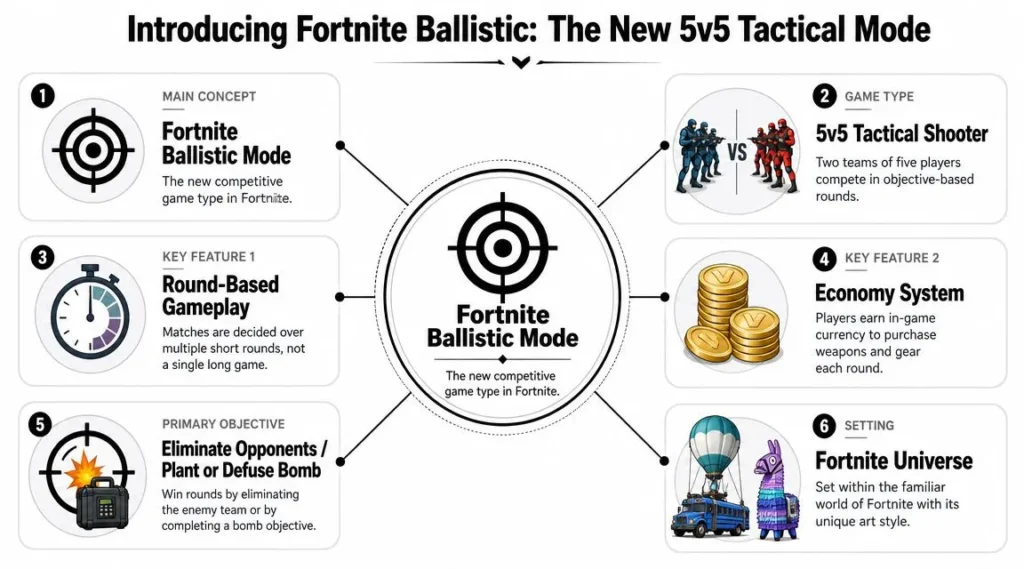
The clearest way to think about it
If you mostly play Battle Royale or Zero Build, Ballistic asks you to stop thinking about looting, rotating through a giant island, and recovering from mid-match chaos. Instead, each round starts with intention. You buy gear. You choose a route. You hold an angle or execute onto a site. One bad peek can decide the round.
That creates a very different emotional rhythm:
- Early decisions matter more: your opening route and buy choice shape the round immediately.
- Information matters more than movement flair: hearing footsteps, spotting utility, and reading rotations become central.
- Team play matters more than solo heroics: a good trade is often stronger than an ambitious solo push.
Why Epic made this an official mode
Ballistic also tells you something about Fortnite’s infrastructure. Fortnite now supports multiple official experiences, and Epic has the tools to publish and manage distinct rulesets inside the same ecosystem. That’s a major reason a mode like this can exist as its own ongoing experience rather than as a throwaway event.
Practical rule: Don’t queue Ballistic expecting Battle Royale instincts to carry you. Treat your first matches like learning a new shooter that happens to live inside Fortnite.
The mode’s appeal is obvious if you’ve ever wanted Fortnite gunplay in a format that rewards patience and structure more than survival chaos. It’s still Fortnite in presentation, but the competitive logic is different from the second the round begins.
Core Mechanics and Round-Based Rules
The fastest way to get comfortable in Ballistic is to understand the loop. Every round follows a repeatable sequence, and once you see that pattern, the mode starts making sense much faster than if you approach it like a standard Fortnite match.
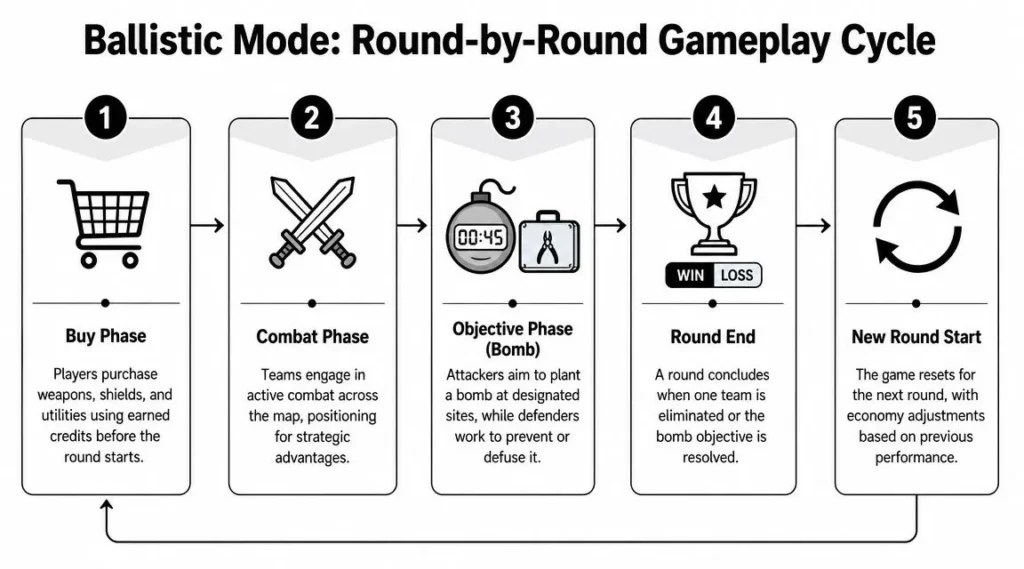
The buy phase changes everything
Before the action starts, you enter a buy phase. That alone separates Ballistic from the normal Fortnite habit of landing and scavenging. You’re not hoping RNG gives you a workable loadout. You’re making a deliberate purchase decision based on what happened in the previous round and what your team plans to do next.
A smart buy phase usually revolves around three questions:
- What can the team afford: if half the squad buys aggressively and the other half can’t support, the round often falls apart.
- What does the map route require: tighter lanes may favor close-range confidence, while longer sightlines punish weak buys.
- What’s the team’s objective: fast pressure, slow defaulting, and site retakes don’t ask for the same tools.
The economy element makes losing and winning feel connected. A round doesn’t end when the scoreboard updates. It carries consequences into the next one.
How rounds are won
Once the round starts, Ballistic becomes a contest of positioning, elimination pressure, and objective timing. The basic tactical-shooter logic applies: one team pushes toward the objective while the other tries to stop the plant, control space, or retake after contact.
This visual helps if you’re trying to internalize the sequence before queueing:
A practical way to read each round is:
- Set your economy plan before the timer ends.
- Take early map space without overcommitting.
- Force reactions with presence, utility, or pressure.
- Commit together once the defense is stretched or exposed.
- Play the numbers after the objective turns live.
A lot of early losses come from players treating the middle of the round like open-world combat. Ballistic punishes wandering.
What works and what fails early
Players who adapt fastest usually do a few simple things well:
| Habit | Why it works |
|---|---|
| Buying with the team | It keeps the squad on the same power curve |
| Holding a defined angle | It reduces unnecessary first deaths |
| Rotating on real information | It prevents panic movement |
| Trading teammates | It turns close fights into recoverable rounds |
What usually doesn’t work:
- Solo flanks with no comms: they’re high risk and often mistimed.
- Panic buying every round: it wrecks your future options.
- Overpeeking after a pick: one advantage can disappear instantly.
- Ignoring the objective: tactical modes punish kill chasing.
Ballistic feels strict at first, but that structure is the point. Once you respect the loop, the mode gets much more satisfying.
How Ballistic Differs from Battle Royale and Zero Build
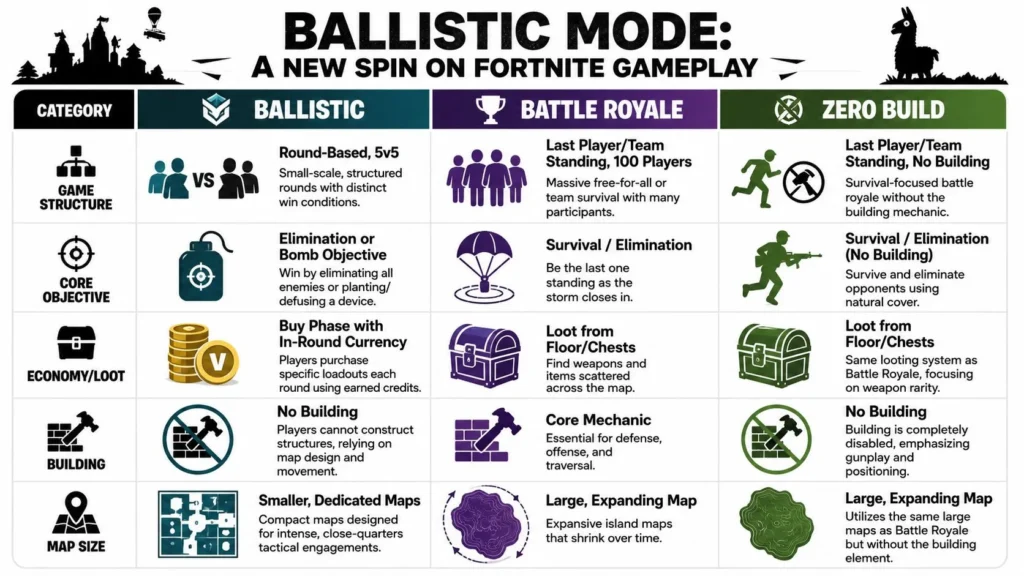
The easiest mistake is assuming Ballistic is just Zero Build condensed into smaller maps. It isn’t. Zero Build removes construction from battle royale logic. Ballistic replaces battle royale logic with tactical-shooter logic.
That’s why some Fortnite habits transfer well, while others become liabilities.
The biggest gameplay split
Battle Royale and Zero Build ask you to survive a large match. Ballistic asks you to win a sequence of small, tense rounds with a fixed team. That sounds obvious, but it changes nearly every decision you make.
Here’s the cleanest comparison:
| Mode | What you focus on most |
|---|---|
| Ballistic | angle control, trading, economy, objective timing |
| Battle Royale | loot pathing, storm movement, building, survival pacing |
| Zero Build | cover usage, mobility, third-party awareness, survival pacing |
In Ballistic, getting one elimination can crack open a site. In Battle Royale, one elimination may barely affect the wider match. In Zero Build, your positioning has to account for multiple unseen threats across a huge space. Ballistic compresses that uncertainty into much tighter reads.
Which skills transfer and which don’t
Some Fortnite skills still help:
- Aim discipline: strong crosshair placement still matters.
- Movement confidence: clean repositioning is useful, even in smaller spaces.
- Sound awareness: experienced players already know how much audio cues matter.
Other instincts need adjustment:
- Over-aggression hurts more: there’s no big island to disappear into after a bad push.
- Loot greed disappears: there’s no scavenging loop to bail out shaky planning.
- Hero plays are less reliable: coordinated teams punish isolated entries fast.
This is part of why new modes in Fortnite can become real population centers instead of side attractions. In one player-count snapshot cited by Fortnite Tracker’s mode comparison, Battle Royale had 368,420 players and Zero Build had 273,570, which shows how a distinct ruleset can sustain its own large audience instead of borrowing interest from the main mode.
That broader pattern matters when judging Ballistic. If the format clicks, it doesn’t need to replace Battle Royale. It just needs to satisfy a different player appetite. If you’ve seen other multiplayer games split audiences across very different experiences, the same logic applies here, just as players compare mode identity in broader platform discussions like Fallout 76 cross-platform support.
Ballistic is for players who want each duel to feel deliberate. Battle Royale is for players who want each match to feel expansive.
New Weapons Map Details and UI Changes
Ballistic works because Epic didn’t just drop first-person camera into Fortnite and call it done. The mode needs its own feel, and that comes from curation. Weapons, maps, and interface all have to support a tighter competitive loop.
The weapon pool feels selected, not scattered
In Battle Royale, the loot pool is part of the drama. In Ballistic, randomness would get in the way. The mode works better when players can make targeted buy decisions and understand what opponents are likely holding.
That has a few practical effects in match play:
- Weapons need readable roles: players should know which buys support close holds, fast entries, or safer ranged duels.
- Repetition matters: seeing the same gun classes regularly helps players learn timing, recoil feel, and common power spikes.
- Utility matters as much as firepower: gear that blocks vision, delays pushes, or forces movement often decides rounds before raw aim does.
The result is a cleaner competitive environment. You lose some of Fortnite’s sandbox unpredictability, but you gain a ruleset where decisions feel more teachable and less arbitrary.
The maps are built for information battles
Ballistic maps don’t need the huge traversal fantasy of the main island. They need strong sightlines, chokepoints, defensible sites, and rotation paths that create meaningful risk. Good tactical maps teach players where fights happen, where fakes are believable, and where defenders can overrotate.
When learning a Ballistic map, focus on these first:
- First-contact lanes where opening peeks usually happen.
- Objective entrances that attackers must clear cleanly.
- Retake routes that defenders use when a site is lost.
- Audio-heavy zones where footsteps reveal too much.
A lot of players get stuck because they learn the map visually but not functionally. Knowing where a corridor is isn’t the same as knowing whether it’s safe to cross once the other team has control.
The UI teaches a different pace
The user interface also has to carry more competitive information than standard Fortnite modes. The in-round HUD needs to support quick reads on team state, objective pressure, and buy decisions without clutter. The buy screen itself becomes part of the skill ceiling. Efficient teams don’t waste that phase.
Learn the UI fast. In tactical modes, hesitation in menus can be as costly as hesitation in fights.
If you’ve only played traditional Fortnite playlists, Ballistic’s interface can feel less playful at first. That’s intentional. It pushes your attention toward planning, not discovery.
Winning Strategies for Your First Matches
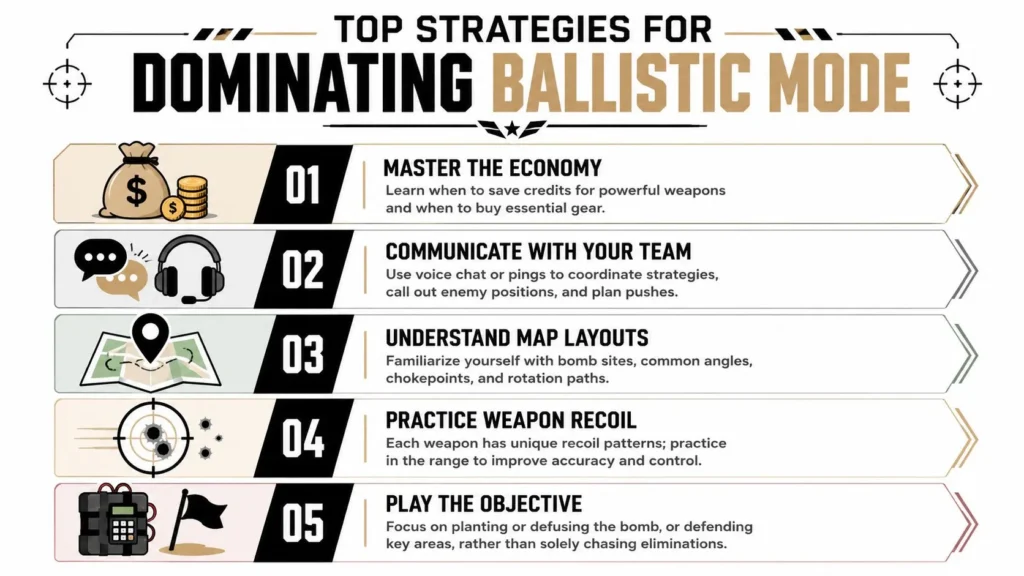
Most early Ballistic losses come from one issue: players keep trying to solve a tactical mode with battle royale habits. If you want to improve fast, strip the mode down to a few repeatable disciplines and get those right first.
Start with economy discipline
You don’t need a perfect theory of every round. You do need to avoid sabotaging your team’s buying curve.
A simple approach works well for new players:
- Buy together when the team can contest the round.
- Save when your squad would enter under-equipped and fragmented.
- Avoid vanity purchases that leave you weak in the next round.
Players coming from Fortnite often underestimate how much the economy decides momentum. In Ballistic, weak purchases don’t just reduce your damage output. They shrink your tactical options.
Play for trades before highlights
A flashy first pick feels great. A clean trade wins more rounds.
Try this in your first sessions:
- Move in pairs when entering contested space.
- Don’t swing a corner just because a teammate did.
- If your team gets the opening elimination, don’t hand it back with an unnecessary repeek.
This is also where hardware consistency starts to matter more than in casual modes. Small aim corrections and stable tracking count for more in Ballistic’s tighter duels, so if you’re trying to dial in settings, Budget Loadout’s Fortnite mouse guide is a useful reference for understanding what kind of mouse shape, weight, and sensor behavior tends to suit Fortnite players.
Learn one part of each map first
New players often overload themselves trying to memorize everything at once. A better method is to own one area.
Pick one role and repeat it:
| Focus area | What to learn |
|---|---|
| Entry path | common defender angle, safest first peek |
| Site hold | fallback position, crossfire options |
| Rotation lane | when it’s safe to leave, when it’s too late |
Once one area feels natural, expand.
Field note: In Ballistic, average decisions made quickly beat ambitious decisions made late.
Use comms that help
Good communication isn’t constant talking. It’s short, useful information.
The most valuable comms are usually:
- Enemy location
- Damage or pressure called clearly
- Objective state
- Rotation timing
If Ballistic is your first real tactical mode and you want to get more competitive in a structured way, broader guides on how to get into esports can help you build habits around review, communication, and consistency, not just raw mechanics.
Frequently Asked Questions About Fortnite Ballistic
Is Ballistic a permanent mode or just an LTM
This is the most important practical question. Players don’t want to sink time into a mode that disappears before they learn it.
The useful framework is Fortnite’s own mode taxonomy. Epic separates Core Gamemodes from temporary experiences. Core modes are intended for ongoing availability and regular updates, which is why that label matters so much when judging whether a new Fortnite game mode is worth learning, as outlined in the Fortnite Core Gamemodes reference.
If you’re evaluating Ballistic seriously, don’t just ask whether it’s fun today. Ask whether Epic is positioning it as a lasting part of the platform. That’s the signal that affects how much time players should invest.
Who is Ballistic really for
Ballistic is best suited to players who enjoy structured team shooters. That includes Fortnite players who prefer pure gunfights, Zero Build players who want more discipline and less third-party chaos, and tactical-shooter fans who may not care much about traditional battle royale pacing.
It won’t suit everyone. Players who love Fortnite for free-form movement, scavenging, big-map unpredictability, or building expression may find Ballistic more rigid than fun. That isn’t a flaw. It’s audience targeting.
Does Ballistic replace Battle Royale or Zero Build
No. The better way to read Ballistic is as another lane inside Fortnite’s broader ecosystem. Epic has been moving toward differentiated experiences rather than one dominant mode for every player type. Ballistic extends that approach into tactical FPS territory.
Will progression and support matter
Yes, and that’s why permanence matters more than announcement hype. Players care about whether support continues, whether balancing arrives consistently, and whether the mode earns enough long-term attention to stay healthy.
For anyone planning to stream or grind ranked-style sessions in a mode like this, connection stability matters more than people think because one bad spike can ruin a round-based shooter. If you’re sorting out your setup, this guide on how to ensure lag-free streaming and gaming is a practical place to start.
What’s the best mindset for your first week
Treat Ballistic like a fresh competitive game, not a novelty side mode. Learn the buy logic. Learn one map area at a time. Value comms over hero plays. Don’t judge the mode after two chaotic solo queues.
The players who’ll enjoy Ballistic most are the ones willing to slow down, pay attention, and let the format teach them what it wants.
If you want more clear, approachable gaming explainers and commentary beyond this Ballistic guide, visit maxijournal.com. It’s a solid place to find fresh writing across games, entertainment, tech, and culture without the usual clutter.
Discover more from Maxi Journal
Subscribe to get the latest posts sent to your email.