Gaia BH1 is the nearest confirmed black hole to Earth, at about 1,500 light-years away. That answer may sound simple, but the discovery changed how astronomers think about our local cosmic neighborhood because this black hole wasn’t found by seeing it directly at all.
A few years ago, if you’d asked visitors at a planetarium where the nearest black hole might be, many would have pictured a bright X-ray source blazing like a cosmic warning beacon. Gaia BH1 turned out to be more interesting. It’s quiet, dark, and hidden in plain sight, which makes its true nature less about a monster in space and more about the detective work astronomers use to catch an invisible object tugging on a visible star.
Our Nearest Cosmic Mystery
“Nearest” is a funny word in astronomy. On Earth, it suggests a short drive. In the galaxy, it can still mean a distance so vast that light itself needs ages to cross it.
That’s why Gaia BH1 matters so much. NASA identifies it as the nearest known black hole system to Earth, at about 1,500 light-years away, a result that turned an abstract idea into a nearby research target in galactic terms. You can read more broad, approachable space context in these fun facts about space exploration, but Gaia BH1 gives that sense of wonder a sharp scientific focus.
Why this discovery feels different
Astronomers have long known black holes should be common, yet nearby dormant ones are hard to catch. They don’t shine on command. They don’t come with labels. If they aren’t pulling in gas and lighting up in X-rays, they can blend into the darkness.
Gaia BH1 brought a different kind of drama. Researchers found it by watching what it did to a companion star. The black hole itself stayed hidden, but its gravity left fingerprints.
Practical rule: In astronomy, you often discover the invisible by measuring how it moves something visible.
That’s the thread running through this whole topic. The nearest black hole isn’t just a record-holder. It’s a lesson in how science works when the thing you want to study refuses to glow, reflect, or announce itself.
Defining Nearness in the Cosmos
If Gaia BH1 is about 1,500 light-years away, what does that mean in everyday language?
A light-year is a unit of distance, not time. It means the distance light travels in one year. Since light is the fastest thing we know, a light-year is enormous. So when astronomers call Gaia BH1 “near,” they mean near compared with the rest of the galaxy, not near in any travel sense a human would recognize.
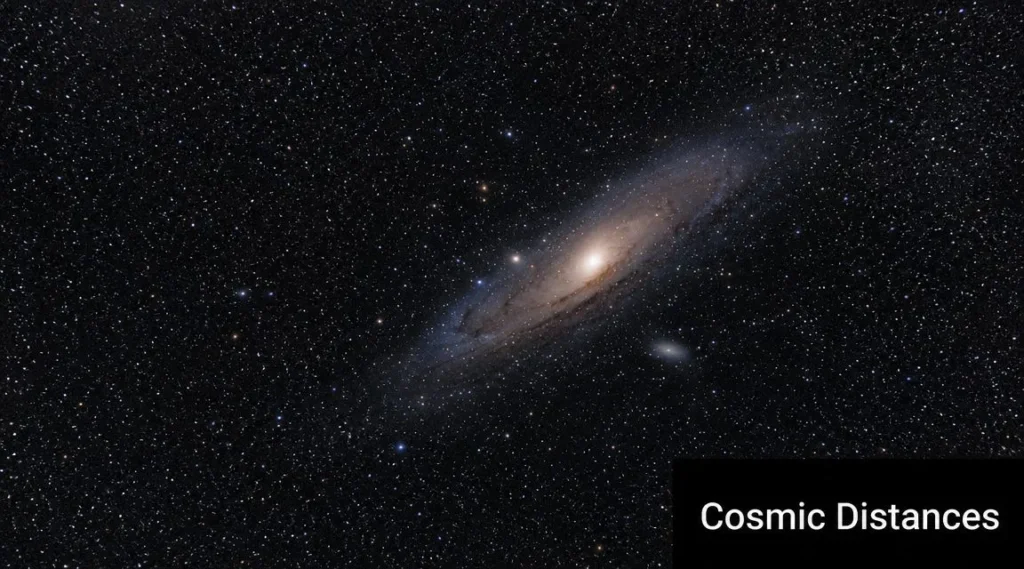
Near for astronomers, far for us
Think of the Milky Way as a vast city at night. Our solar system occupies one tiny neighborhood. Gaia BH1 is not on our street, or even in our district. But compared with objects on the far side of the galaxy, it’s in the same broad metropolitan area.
That shift in scale trips people up. A black hole can be the nearest one we know and still be unimaginably distant from Earth.
Here’s another confusion point. People often hear “black hole” and picture the giant one at the center of a galaxy. But Gaia BH1 is not that kind. It belongs to the stellar-mass category, meaning it formed from the collapse of a massive star rather than sitting in a galactic core as a supermassive black hole does.
Small in size, huge in effect
The most surprising thing about black holes is that mass and size don’t behave the way our intuition expects. Space.com notes that a typical stellar black hole has a mass of about 3 times the Sun, and for a nonspinning black hole the Schwarzschild radius is about 2.95 km per solar mass, so a 10-solar-mass black hole would have an event-horizon radius of only about 30 km in size terms, even while packing tremendous mass into that tiny region, as described in these black hole facts from Space.com.
That mismatch is part of why dormant black holes are so hard to find. They’re compact, dark, and often reveal themselves only through gravity.
The word “near” in astronomy usually tells you more about our map of the galaxy than about any practical closeness to Earth.
Meet Gaia BH1 Our Closest Known Neighbor
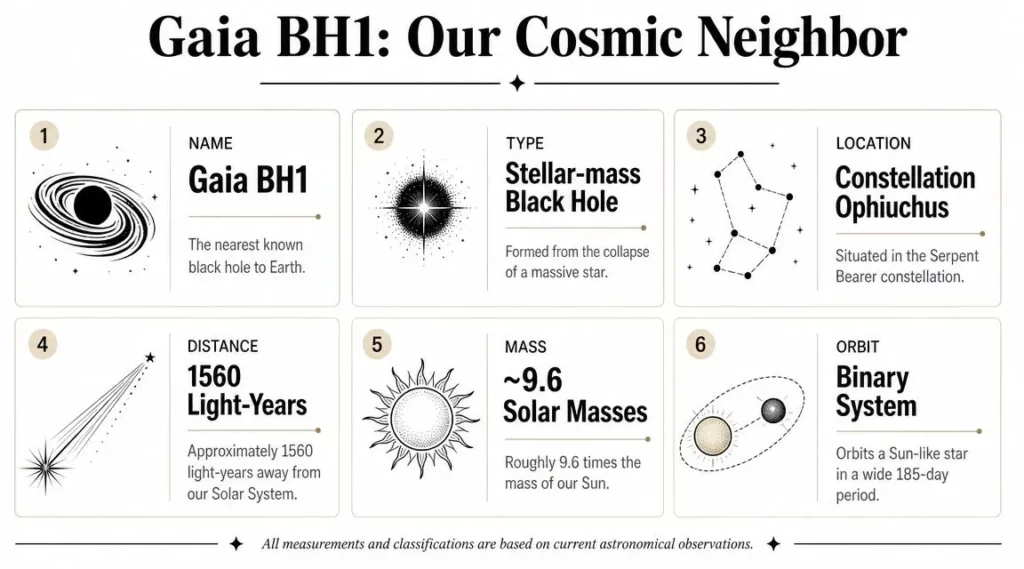
Gaia BH1 is the current champion in the search for the nearest black hole. Harvard astronomers described it in 2022 as a dormant black hole of about 10 solar masses in the constellation Ophiuchus, while NASA places it at about 1,500 light-years away and Space.com gives a very similar estimate of 1,560 light-years in this overview of NASA black hole basics.
What “dormant” really means
A dormant black hole isn’t switched off in some mechanical sense. Its gravity is still there. Its mass is still there. What’s missing is a bright feeding show.
When gas falls toward an actively feeding black hole, that material can heat up and emit energetic radiation. That makes some black holes easier to spot. Gaia BH1 is notable because it doesn’t advertise itself that way. It’s far quieter.
For readers who enjoy visual comparisons of these strange objects, a gallery of images of black holes can help separate artist concepts from actual detection methods.
Gaia BH1 at a glance
| Object | Distance | Mass (Solar Masses) | Type |
|---|---|---|---|
| Gaia BH1 | 1,500 to 1,560 light-years | about 10 | Dormant stellar-mass black hole |
That simple row hides a lot of subtle science. “Dormant” means astronomers had to rely on indirect evidence. “Stellar-mass” tells us this object belongs to the family formed by dead massive stars. And “about 10” solar masses places it comfortably above ordinary stars and compact enough to fit the black hole interpretation.
Why astronomers got excited
Gaia BH1 matters because it gives researchers a nearby lab for studying black-hole formation and binary-star evolution. It also shows that some black holes can sit in binary systems without producing the dramatic X-ray signature that many people associate with them.
That point is easy to miss. The nearest black hole wasn’t found because it blazed. It was found because it pulled.
How Astronomers Find Invisible Giants
The key puzzle is simple to ask and hard to solve. If black holes don’t emit light, how do astronomers find them?
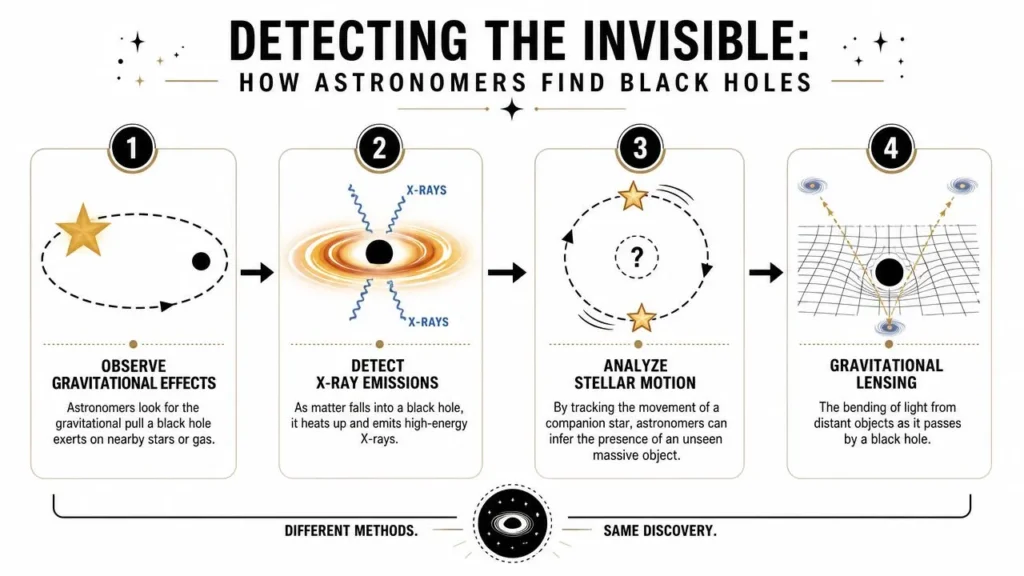
For Gaia BH1, the answer was astrometry. Researchers used ESA Gaia astrometry to track the motion of a Sun-like companion star. They didn’t see the black hole itself. They measured the star’s motion carefully enough to infer that an unseen object with about 10 solar masses had to be there, as explained by the Max Planck Institute in its report on Gaia BH1 and astrometric detection.
The wobble clue
A good analogy is a dog on a leash at night. If you can’t see the dog but you can see the person being tugged in circles, you know something unseen is attached and pulling. Astronomers use a similar logic with stars.
A star in a binary system doesn’t sit still. It responds to the gravity of its companion. If the visible star moves in a way that points to a massive partner, but no ordinary star is visible there, astronomers start testing whether the missing partner could be a black hole.
Why Gaia mattered so much
Gaia, the European Space Agency mission, specializes in measuring stellar positions and motions with remarkable precision. That makes it ideal for finding what astronomers call an astrometric binary, a system where the visible evidence comes from motion rather than from seeing both objects directly.
This is why Gaia BH1 feels like a detective story rather than a simple photograph. The evidence came from reconstruction.
Here are the main ways astronomers find black holes in general:
- By tracking stars: A visible star can betray an unseen companion through orbital motion.
- By catching bright infall: Gas spiraling inward can heat up and glow, especially in high-energy light.
- By watching gravity bend light: A massive dark object can distort the light from something behind it.
- By measuring ripples in spacetime: Merging black holes can reveal themselves through gravitational waves.
If you’re curious about how modern observatories collect this kind of evidence, this explainer on how the James Webb Telescope works is a useful companion read.
Astronomers don’t need to see a black hole directly to weigh its influence. Gravity does the announcing.
Should We Worry About the Nearest Black Hole
No. Gaia BH1 is not a threat to Earth.
That answer is less dramatic than movie science, but the actual physics is more satisfying. Black holes are not cosmic vacuum cleaners that sweep up everything around them from arbitrary distances. Their gravity matters enormously nearby, but from far away they follow the same basic gravitational rules as any object with the same mass.
The myth of the giant cosmic drain
People often imagine a black hole as a kind of bottomless space vacuum. That picture is misleading. If you replaced an ordinary object with a black hole of the same mass, distant objects would respond to the mass, not to some magical suction effect.
That’s why the nearest black hole being in our galactic neighborhood doesn’t mean danger. What matters is whether it is close enough to disturb our solar system. Gaia BH1 is not.
Why size can be deceptive
Space.com notes that astronomers estimate the Milky Way contains anywhere from 10 million to 1 billion stellar black holes, and that even a 10-solar-mass nonspinning black hole would have an event-horizon radius of only about 30 km, despite holding enormous mass in that tiny region. That contrast is part of why black holes are both dramatic in theory and hard to detect in practice.
The number that matters emotionally is often distance. The number that matters physically is closeness of interaction. You only get extreme black-hole effects if you get extremely close.
A short visual break helps here:
What would make a black hole dangerous
Three things would have to line up:
- It would need to be much closer to us than Gaia BH1 is.
- Its path would need to bring it into a region where it could strongly perturb the solar system.
- We would need to miss all the gravitational evidence of that approach.
That combination doesn’t match what astronomers see.
A black hole is dangerous the way a deep whirlpool is dangerous. Not because it affects the whole ocean equally, but because the region near it is extreme.
So, should you worry about the nearest black hole? No. You should be curious about it, because it teaches a cleaner lesson: gravity is powerful, but it isn’t magic.
The Ongoing Search for Cosmic Neighbors
Gaia BH1 is the current record-holder, not the final word. That distinction matters. “Nearest known black hole” leaves room for future discoveries.
Astronomers keep searching because dormant black holes are scientifically valuable. They help researchers test ideas about how massive stars die, how binary systems survive violent stellar evolution, and how many dark compact objects may be drifting through the Milky Way without bright signatures.
Why the search keeps widening
The search has changed character over time. Earlier work often depended on black holes that announced themselves through energetic feeding. Newer searches are better at finding the quiet ones.
That shift matters because the galaxy likely contains far more black holes than the easy-to-spot examples suggest. Once you start looking for gravitational clues instead of light alone, the map gets richer.
What future observatories may add
Upcoming surveys and observatories are expected to expand this census. Wider sky coverage, better motion measurements, and repeated observations should help astronomers find more systems where a visible star is orbiting something unseen and massive.
That’s one reason Gaia BH1 feels less like the end of a search and more like the opening chapter of a stronger one. The local galaxy probably contains more hidden neighbors. Science is getting better at hearing their footsteps.
A nice irony sits at the heart of this field. The better we get at measuring ordinary stars, the better we become at discovering extraordinary dark objects.
Frequently Asked Questions About Nearby Black Holes
Could a closer black hole still be out there?
Yes, that’s possible in principle. “Nearest known” means nearest confirmed with the evidence currently in hand. A closer black hole could remain undetected if it’s especially quiet and doesn’t produce an obvious signal. That’s why ongoing surveys matter so much.
Can amateur astronomers see Gaia BH1 directly?
Not as a black hole itself. Black holes don’t reflect or emit visible light in the usual sense. In systems like this, the science comes from careful measurements of the companion star’s motion, which is the kind of precision work professional surveys excel at.
What happens if something gets too close to a black hole?
The answer depends on how close and on the black hole’s mass. Tidal forces can become extreme, stretching and compressing matter. If you want a beginner-friendly companion explainer on understanding cosmic gravity wells, that resource gives a helpful mental picture for why falling toward a black hole is so different from ordinary gravity near planets or stars.
Why don’t black holes just swallow everything nearby?
Because gravity weakens with distance. Far enough away, a black hole’s pull acts like the pull of any other object with the same mass. It doesn’t have a special long-range suction power.
Why was Gaia BH1 harder to find than bright black holes?
Because it’s dormant. Bright systems can advertise themselves through hot infalling gas. Gaia BH1 had to be uncovered through orbital evidence instead, which takes patient measurement and careful modeling.
Is Gaia BH1 the only nearby black hole candidate worth watching?
No. Astronomers continue to examine candidate systems and refine old claims. That’s normal science. Some candidates strengthen under scrutiny, and some don’t. The important point is that the methods keep improving, especially for hidden systems that don’t glow.
What’s the biggest lesson from the nearest black hole?
That astronomy often works like forensic science. You don’t always catch the object in the act. Sometimes you reconstruct the scene from what gravity left behind.
If you enjoy clear science writing without the jargon overload, maxijournal.com publishes approachable articles across astronomy, technology, education, health, arts, and more. It’s also a good place to explore fresh commentary and discover new voices if you’re a reader, subscriber, or prospective contributor.
Discover more from Maxi Journal
Subscribe to get the latest posts sent to your email.