The United States and Russia come closest at the Diomede Islands, where Little Diomede and Big Diomede are about 2.4 miles (3.8 kilometers) apart. Russia is also roughly 21 hours ahead of Alaska there, but that physical closeness does not mean you can casually cross between them.
That contrast is what makes Alaska to Russia so fascinating. On a map, the gap looks tiny. In real life, it sits inside one of the world’s harshest marine environments, across a tightly controlled international border, with history, law, and logistics all layered on top of the geography.
Many encounter this topic through a gimmick question. Can you walk from Alaska to Russia? The better question is this: what does that narrow stretch of water mean for travelers, historians, and anyone curious about the edge of North America?
The Border You Can Almost Touch
At first glance, Alaska to Russia sounds like a giant transoceanic leap. It isn’t. In the right place, it’s a near-neighbor story.
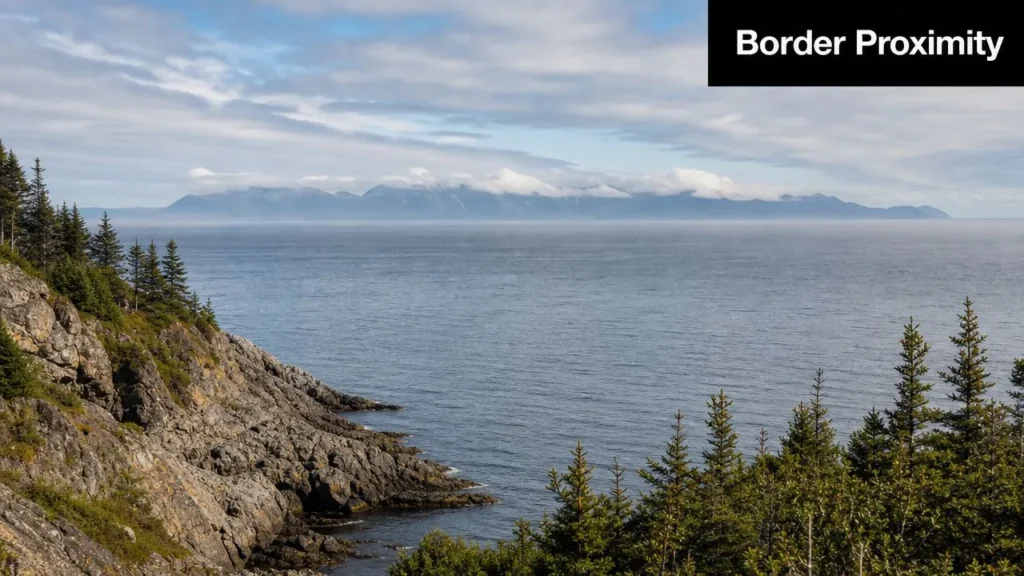
The place that matters most is the Bering Strait, and the detail that resets your mental map is simple: the two countries come astonishingly close near the Diomede Islands. That’s why this border fascinates travelers. It feels less like two distant superpowers and more like two rocky doorsteps facing each other across cold water.
Why people get confused
Most readers stumble in the same place. They hear that Alaska and Russia are close, then assume that “close” must mean “easy to visit across the border.”
It doesn’t.
A useful way to think about it is this: two houses can sit on opposite sides of a fence and still require very different keys, permissions, and routes to enter. The Alaska-Russia border works like that, except the fence is made of sea ice, frigid water, border law, and national security.
The surprise isn’t just that Alaska and Russia are near each other. It’s that one of the shortest distances between them is paired with some of the hardest practical barriers a traveler can face.
What makes this border worth understanding
This isn’t only a trivia fact. It’s also a window into Arctic geography, Russian colonial history in North America, Indigenous connections across the region, and the limits of adventure travel.
If you want a complete picture, you have to hold two truths at once:
- Geographically close: the border narrows dramatically in the Bering Strait.
- Practically difficult: access is restricted and casual crossing isn’t a realistic travel plan.
- Historically deep: Alaska and Russia were once linked by empire, trade, and long human movement across the broader region.
That mix of intimacy and separation is what gives Alaska to Russia its pull.
Where Two Continents Greet Tomorrow
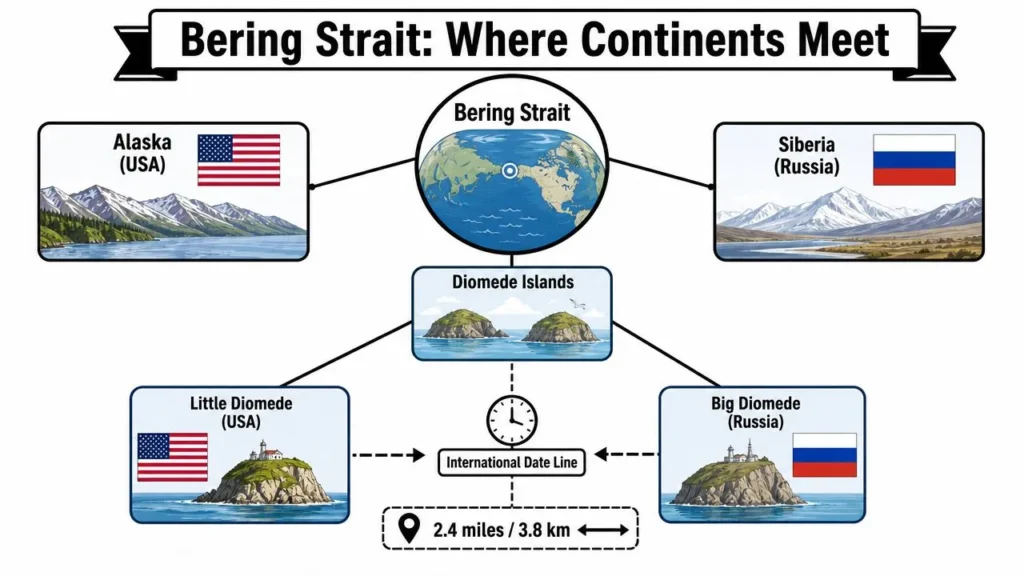
The most famous point in the Alaska to Russia story is the pair of Diomede Islands in the Bering Strait. One is Little Diomede, which belongs to the United States. The other is Big Diomede, which belongs to Russia.
According to Geography Realm’s explanation of the Diomede Islands and the International Date Line, the narrowest separation between the United States and Russia is approximately 3.8 kilometers, or 2.4 miles, between these two islands. The same source notes that because this area lies near the International Date Line, Russia is roughly 21 hours ahead of Alaska.
Two islands, two countries, two different days
If you want the clearest mental image, think of the Diomedes as neighbors living on different calendar pages. They are physically near, but the date line turns that short gap into a strange kind of time border.
That’s why the Alaska to Russia question grabs people so quickly. It combines map-scale closeness with almost science-fiction timing. You can look across a narrow Arctic channel and be staring toward “tomorrow.”
For readers curious about bigger infrastructure ideas in the region, the old dream of a fixed crossing still pops up from time to time in discussions about an imagined Bering Strait tunnel concept. The geography sparks that kind of speculation because the map looks deceptively simple.
A short visual helps bring that geography into focus:
Why the ice leads people astray
The strait isn’t open, gentle water year-round. The same Geography Realm summary notes that this is a seasonally ice-constrained waterway, and public technical summaries describe winter sea ice that can reach 2 to 3 meters in thickness in parts of the region. That fact fuels the familiar question about walking across.
But ice on a map, or even ice in a photograph, doesn’t equal safe passage.
A few practical realities matter:
- Sea ice changes: wind, temperature, and seasonal conditions affect stability.
- The setting is severe: this is high-Arctic water, not a frozen city pond.
- Distance can mislead: 2.4 miles sounds manageable until you add cold exposure, current, visibility, and border enforcement.
Geography lesson: short distance tells you how near two places are. It doesn’t tell you whether the route between them is safe, open, or legal.
The broader landscape
The Diomedes sit inside a larger border zone between Alaska and Siberia. Once you zoom out, the region feels less like a neat line and more like a rugged frontier of water, weather, and isolated communities.
That’s why Alaska to Russia isn’t best understood as a stunt crossing. It’s better understood as an Arctic threshold, one where the continents almost touch, while politics and environment keep them sharply apart.
A Shared History Across the Strait
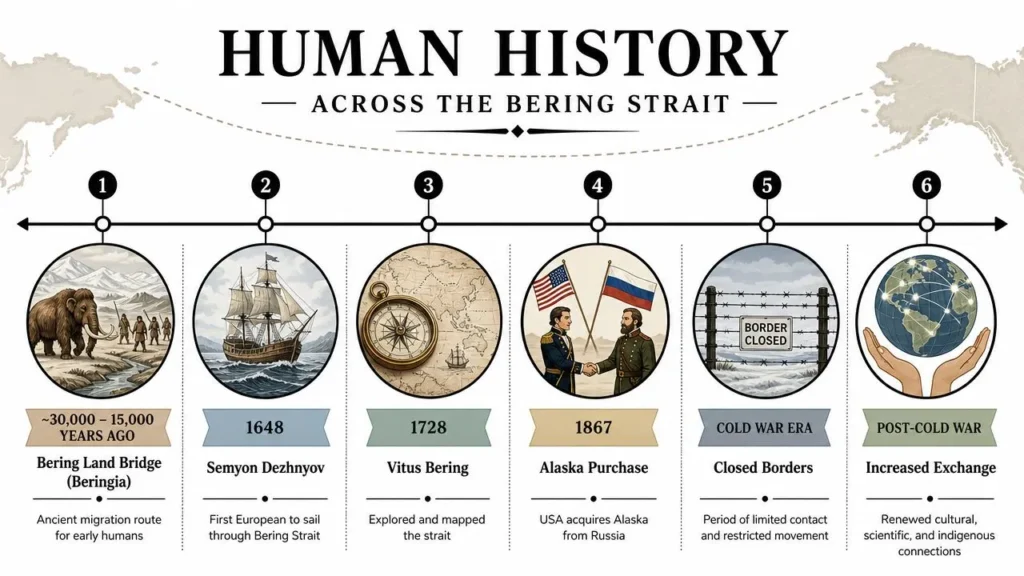
Long before passports and coast guards, the Bering region connected people instead of separating them. The broader area is tied to the story of ancient human movement across Beringia, the land bridge that once linked Asia and North America. Even without turning that into a neat travel narrative, it helps explain why this region carries such deep historical weight.
The more recent chapter is easier to pin to dates. For a long stretch, Alaska was not American at all. It was part of Russia’s imperial world.
When Alaska was Russian America
According to Wikipedia’s overview of Russian colonization in North America, the Russian Empire claimed and administered roughly the territory of present-day Alaska from 1732 to 1867. That region covered about 586,412 square miles (1,518,800 km²), and Russia also maintained a small settlement at Fort Ross in Northern California.
The colonial possession was formally organized as Russian America under the Russian-American Company from 1799 until 1867. For modern readers, that can feel surprising because Alaska is so firmly lodged in the American imagination. Yet for well over a century, this far northern territory was managed as a Russian imperial holding.
Why Russia sold Alaska
Russia didn’t sell Alaska because the land was worthless. It sold Alaska because holding it had become increasingly difficult to justify.
The same historical overview explains that the sale followed decades of declining profitability in the fur trade, especially sea otter pelts, while geopolitical pressure after the Crimean War made Russia reluctant to defend distant Pacific territory. By the 1850s, Russian officials had concluded that keeping Alaska was economically unsustainable and militarily risky.
That logic led to one of the most famous land deals in history. In 1867, Russia sold the territory to the United States for $7.2 million, which the same source says is roughly $166 million in 2025 U.S. dollars. At the time, that worked out to about 2 cents per acre, a price mocked by some American critics as “Seward’s Folly.”
One reason the story lasts is that it mixes ridicule and hindsight. Critics laughed at the purchase price, but Alaska later proved valuable for its oil, gold, fisheries, and strategic location.
The handover and what changed
The formal transfer took place on October 18, 1867, in Sitka, ending 126 years of Russian presence in North America, according to the same historical source. That date matters because it marks more than a flag change. It redirected Alaska’s legal, political, and economic future toward the United States.
Here’s the simplest way to frame the turning point:
- Under Russia: Alaska was a distant colonial possession shaped by trade and imperial strategy.
- After the sale: Alaska moved into the orbit of American expansion and governance.
- Across the strait: cultural and geographic links remained, even as the political border hardened.
Why this history still matters now
Today’s tight border controls make more sense when you remember that this region has shifted from shared human space to imperial frontier to strategic international boundary. The Cold War later deepened that separation, especially for communities with long-standing ties across the Bering region.
That’s why Alaska to Russia can’t be reduced to a novelty map fact. It’s also the story of how a nearby world became a foreign one.
The Reality of Crossing the Border Today
At this point, the popular myth falls apart. People hear that the water can freeze between the Diomede Islands, and they jump straight to the conclusion that a determined traveler could walk from Alaska to Russia.
Physically imaginable isn’t the same thing as legally allowed.
According to the National Park Service discussion of how close Alaska is to Russia, the U.S. Coast Guard and Russian border authorities maintain tight surveillance in the region. The same source says both islands are effectively closed to unauthorized visitors, there are no legal, unsanctioned crossings, and any attempt would likely be intercepted.
Why the casual crossing idea doesn’t work
A tourist often thinks in terms of terrain. Is there ice? Is there a boat? Is the weather calm? Border agencies think in terms of authorization. Do you have legal entry rights, correct documents, and permission to be there?
That difference changes everything.
Key point: Physically possible does not mean legally permissible.
The Diomede crossing idea collapses for several reasons at once:
- No casual port-of-entry setup: this isn’t like arriving at a ferry terminal with your passport.
- Restricted access: the islands aren’t open playgrounds for unscheduled international arrivals.
- Border enforcement is active: unauthorized movement would likely trigger a response.
- Tourist logic fails here: adventure travel rules don’t override immigration and security rules.
What about walking, boating, or swimming
Walking gets the headlines, but the same basic problem applies to other methods. A small boat doesn’t solve the border issue. Neither does extreme endurance. Neither does winter ice.
Readers sometimes assume the only obstacle is weather. In truth, weather is only one layer. The more decisive obstacle is that this is a controlled international frontier with almost no room for improvisation.
A good rule for understanding Alaska to Russia travel is to separate three different questions:
| Question | Short answer |
|---|---|
| Is it geographically close? | Yes, strikingly close near the Diomedes. |
| Can conditions ever look physically crossable? | At times, the environment may suggest that idea. |
| Can a tourist lawfully improvise a crossing? | No, not as an unsanctioned personal trip. |
For broader context on the state that sits across this border, a general read on the economy in Russia can help place the far eastern region inside the country’s wider political and economic system. But for travelers, the central lesson is simpler than any macroeconomic backdrop.
The practical takeaway
If your travel plan begins with “I’ll just get close and see if I can cross,” it isn’t a travel plan. It’s a border violation in the making.
That’s why the useful question isn’t “How do I sneak across?” It’s “What are the legitimate ways to experience this region without confusing curiosity for permission?”
How to Visit the Bering Strait Region
Once you drop the fantasy of a casual border crossing, the subject becomes much more interesting. You still can experience the Alaska to Russia frontier. You just have to approach it as a remote-region journey, not a stunt.
For most travelers, there are two broad paths. One is to visit the Alaskan side and look toward Russia from U.S. territory. The other is to pursue the far more complex process of entering Russia’s Chukotka region through lawful channels.
The easier path for most travelers
The U.S. side is usually the more realistic option. Travelers commonly think in terms of Nome and, where arrangements exist, more specialized access deeper into the Bering Strait region.
What makes this route appealing isn’t ease in the ordinary vacation sense. Arctic travel is rarely easy. It’s that you remain inside one national system, with fewer layers of international paperwork and fewer geopolitical complications than a Russia-side trip.
On the Alaska side, the experience often centers on three things:
- Physical Setting: treeless coastlines, powerful weather, and a sense of being at the edge of the continent.
- Perspective: the emotional pull of standing on American ground while looking toward Russia.
- Context: local history and Indigenous presence matter as much as the border itself.
The Russia side is possible in principle, but demanding
Travel to Russia’s far northeast is a different undertaking. It isn’t the sort of destination you add casually after a few days in Anchorage.
Even without loading this section with uncited procedural details, the practical reality is clear. Travelers need proper documentation, careful planning, and a willingness to work within a highly restricted environment. Remote transport, permissions, and changing conditions all raise the difficulty.
If your goal is simply to feel the nearness of Russia, the Alaska side usually gives you the cleaner, safer, and more realistic version of the experience.
Visiting the Bering Strait from either side
Here’s the most useful comparison for trip planning:
| Aspect | Visiting from Alaska (e.g., Nome/Little Diomede) | Visiting from Russia (e.g., Chukotka) |
|---|---|---|
| Overall difficulty | More accessible for many international travelers | More complex and restrictive |
| Paperwork | U.S. entry requirements and local logistics | Russian visa process and additional regional considerations |
| Trip style | Remote U.S. travel with an Arctic frontier feel | Specialized international trip into a tightly managed far eastern region |
| Best for | Travelers who want to see and understand the border | Travelers with a specific Russia-side objective |
| Main challenge | Weather, remoteness, transport coordination | Legal access, permits, logistics, and remoteness |
| What you gain | Strong sense of proximity and place | Rare direct exposure to the Russian side of the strait |
How to choose between them
For most readers, the choice comes down to motive.
Choose the Alaska side if you want a geographically powerful experience without building your whole trip around international bureaucracy. This route suits travelers who care about the scenery, history, and the symbolic thrill of standing near Russia.
Consider the Russia side only if your purpose is specific and serious. That might include research, professional work, or a carefully planned expedition with the right permissions. It’s not the border version of a day trip.
A travel journalist’s rule helps here: go where the story you want is available. If the story you want is “I want to understand how close Alaska is to Russia,” Alaska itself often gives you plenty.
Essential Planning for Your Arctic Journey
Arctic travel rewards preparation and punishes casual assumptions. The Bering Strait region is remote, weather-sensitive, and shaped by access limits that don’t bend for last-minute improvisation.
A short planning checklist
- Choose the season carefully: conditions change fast in the Arctic, and your workable travel window can feel brief. Build flexibility into every stage of the trip.
- Sort documents early: if your plans involve Russia at all, treat visas and permissions as core trip elements, not admin you can handle later.
- Book experienced operators: local knowledge matters more here than in a typical city break. Remote logistics, weather judgment, and safety procedures should come from people who know the region.
- Pack for exposure, not aesthetics: wind, cold, and sudden weather shifts should shape your gear choices. Even if you’re not going to Iceland, a practical layering guide like this 2025 Iceland packing checklist is useful because the thinking behind it applies well to subarctic and Arctic travel.
- Protect the financial side of the trip: delays, cancellations, and medical complications are more consequential in remote places, so it’s worth comparing options for international travel insurance.
Remote travel works best when you plan for disruption, not perfection.
What good preparation looks like
A good Alaska to Russia region plan is conservative. It gives you buffer time, realistic expectations, and enough humility to let weather and local guidance overrule your itinerary.
That mindset won’t make the journey less memorable. It usually makes it possible.
Alaska to Russia Travel FAQs
Can you see Russia from Alaska?
In the Bering Strait region, the closeness of the two countries is real enough to drive that question. The exact sightline depends on where you are, conditions, and access, but the nearness is not exaggerated folklore.
Can tourists walk from Alaska to Russia in winter?
No. As noted earlier, the issue isn’t just whether ice exists. Unauthorized crossings are not legal, and the border is tightly monitored.
Is there a regular tourist ferry from Alaska to Russia?
Not in the casual, hop-across-the-border way many people imagine. Treat the region as a remote frontier, not a commuter corridor.
Is Alaska’s Russian history still visible?
Yes, especially through the way the state’s past is discussed and remembered. Once you know Alaska was part of Russian America, the map and the history start to line up.
What’s the best realistic Alaska to Russia experience for most travelers?
The Alaska side. If your goal is to feel the geographical drama of the border, understand the history, and appreciate the Arctic setting, that approach is usually the most practical.
Is this a good trip for first-time remote travelers?
It can be, but only if you scale your ambitions wisely. There’s a big difference between “visit western Alaska with good support” and “try to engineer a border adventure.”
If you enjoy clear, grounded explainers like this one, visit maxijournal.com for more approachable writing on travel, geography, science, culture, and the surprising stories hidden inside everyday questions.
Discover more from Maxi Journal
Subscribe to get the latest posts sent to your email.