You walk down to the back of your island, squeeze past the trees, and there it is. A suspicious boat is parked on the secret beach. Inside, a smiling fox offers you “rare” art for Blathers. If you are new to animal crossing redd, this is often the moment excitement and panic arrive together.
That feeling is normal. Redd is one of the most useful characters in Animal Crossing, and one of the easiest to misread. He can help you build out the museum’s art wing, but he can also sell you a fake with a straight face. Learning how he works turns him from a scam risk into one of the most satisfying long-term parts of the game.
Who Is Animal Crossing’s Jolly Redd
The first time most players meet Jolly Redd in Animal Crossing: New Horizons, he feels like a secret. His Treasure Trawler shows up off the hidden north beach, and suddenly your peaceful island has a shady art dealer in it.
That contrast is why he is memorable. Blathers wants genuine art for the museum. Redd sells art, but he also mixes in forgeries. So every visit becomes a small test. Do you trust your eye, or do you walk away empty-handed?
He is valuable because he is your path to filling the museum’s gallery. He is tricky because not every piece he offers is real. That tension is the whole appeal.
Tip: Treat every Redd visit like a museum puzzle, not a shopping trip. Slow down, inspect each piece, and assume nothing.
Redd is also fun because he has personality. He talks like a salesman. He acts like he is doing you a favor. Veteran players learn to enjoy the act while still checking every frame, statue angle, and facial detail before handing over Bells.
The Evolving Legend of Redd Across Games
A longtime Animal Crossing player can track the series by watching Redd change. In one era, he is the fox selling overpriced furniture out of a suspicious pop-up shop. In another, he becomes the gatekeeper to your museum’s art wing. That shift matters because it shows how Nintendo turned a shady merchant into one of the series’ smartest recurring systems.
As noted in Nookipedia’s history of Redd, Redd has appeared since the original 2001 GameCube game. His first role was tied to Crazy Redd’s Furniture Emporium, a shop that appeared rarely, replaced a town signboard in the evening, and sold furniture at steep markups. He also fit the older games’ love of hidden rules and rumor-sharing, including luck mechanics that could affect what showed up for sale.
From furniture hustler to art dealer
In the earliest game, Redd worked like the flea market friend who always “has a deal” if you do not ask too many questions. He gave players temptation, not comfort. You visited him because he might have something special, even if the price felt wrong and the whole setup looked questionable.
Wild World pushed that identity further. Meeting him became a small social puzzle. You needed a password from a villager, then paid a membership fee the first time you entered. For many players, that made Redd feel less like a normal shopkeeper and more like a local rumor that turned out to be real.
By New Leaf, his role had sharpened. Art moved closer to the center of his identity, and the museum connection became much clearer. He still carried the same slippery personality, but now his visits tied directly into a collector’s goal that players could measure over months of play.
Why his evolution matters
Redd’s history mirrors the series’ broader design changes. Early Animal Crossing games were full of odd schedules, hidden access rules, and secrets passed from player to player on the playground or online forums. Later entries kept that mystery, then attached it to larger collection systems. That made Redd more memorable because he was no longer just suspicious. He was strategically important.
That is also why veteran players talk about him differently now. In older games, he was mostly a gamble. In newer ones, he creates a community meta. Players compare artwork details, share visit patterns, open their islands so friends can buy real pieces, and trade advice on how to finish the gallery efficiently. If you enjoy tracing how Nintendo systems evolve across generations, the broader gaming archive at Maxi Journal offers more context on that kind of design history.
Blathers and Redd also work better together once you see the full timeline. One character represents preservation and certainty. The other represents scarcity, suspicion, and player judgment. Across the series, that pairing turned a simple shop visit into one of Animal Crossing’s most enduring rituals.
How Redd’s Treasure Trawler Works in New Horizons
You spot a shady boat tucked behind the cliffs, squeeze down to the secret beach, and step inside expecting an easy museum upgrade. Then Redd offers several artworks at once, only some are genuine, and you get a single choice. That moment is the whole New Horizons version of Redd in miniature. He turns collecting into inspection, patience, and a little nerve.
Where to find him
Redd arrives by boat at the secret beach on the north side of your island. Many players miss him at first because that shoreline often sits behind cliffs and outside the route they use every day.
If his trawler is docked, that is your invitation. Climb down, board the boat, and you can inspect the art on display inside.
How the visit loop works
Redd works like a weekly pop quiz for museum collectors. You do not get unlimited attempts, and the game does not promise a safe answer every time.
According to the Animal Crossing World guide to Jolly Redd’s art, he appears as part of the weekday special visitor rotation, brings 5 artworks per visit, charges 4,980 Bells per piece, and can stock anything from no genuine works at all to a room with several real pieces. That mix explains why veteran players treat a Redd day as more than a quick shopping stop. It is a check-in event. You inspect carefully, make one call, and live with it until the next chance.
For beginners, three habits make a big difference:
- Check weekday visitors regularly. Redd does not run on demand.
- Inspect every piece before you buy. A fake-only lineup can happen.
- Treat each visit as one museum decision, not a shopping spree.
Why the one-purchase limit matters
Each player can buy only one artwork per visit. That rule is simple, but it shapes the whole strategy around Redd.
The room may show several tempting options, yet one resident representative cannot clear the display. You choose a single piece, and that choice becomes much more important once your museum starts missing only a few specific works. Early on, you are trying to avoid obvious fakes. Later, you are managing scarcity. That is where the community side of Redd really starts to matter, because friends can visit each other’s islands and buy pieces you have to pass on.
Key idea: Redd sells art like a limited appointment, not a normal shop inventory.
The first visit is your training round
New Horizons gives new collectors one small kindness. Your first art purchase from Redd is guaranteed to be genuine.
That first success teaches the basic loop. Buy the piece, donate it to Blathers, and watch the museum connection click into place. After that, the safety rail disappears. Future visits ask you to slow down, zoom in, and notice the one detail that looks off.
A reliable routine helps:
- Enter the trawler and inspect every artwork
- Use the zoom view before deciding
- Check faces, hands, accessories, and held objects first
- Compare suspicious details instead of judging the whole piece at a glance
- Buy only the work you feel confident donating
Once you understand that rhythm, Redd stops feeling random. He starts feeling like a long-term collection system built around judgment, memory, and your island network.
The Complete Guide to Spotting Fake Art
A cheat sheet helps, but what really saves you is learning how fakes are designed. Once you understand the patterns, you can inspect almost anything Redd sells with much more confidence.
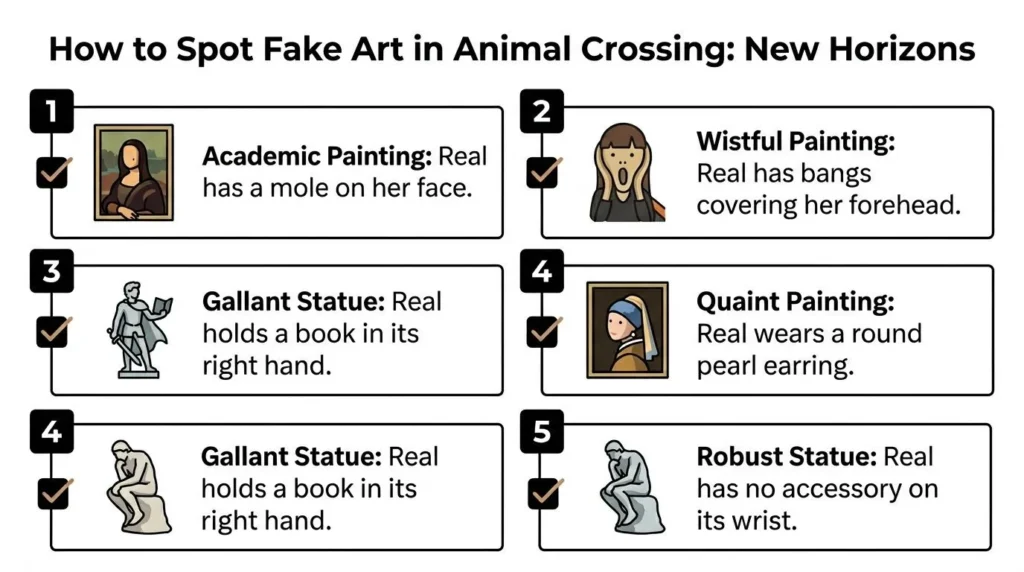
What the fake versions usually change
Redd’s forgeries are rarely random. They often alter one visible feature that you can spot if you stop rushing. In practice, the changes often fall into a few categories:
Facial differences
A smile becomes strange, eyes change, or hair shifts.Missing or added accessories
An earring disappears. A necklace gains an extra detail. A wrist item appears when it should not.Object changes
A statue may hold the wrong item, or a prop may be missing.Color or framing issues
Paintings can have the wrong background tone or an odd-looking frame.
That is why broad advice like “compare it to genuine art” only gets you halfway there. You need to compare the right detail.
A beginner-safe inspection method
Most mistakes happen because players look at the whole artwork and not the one altered feature. Use a simple routine every time:
- Stand in front of the piece and interact with it
- Zoom in
- Look at the face first
- Check jewelry, hands, books, beads, or wrist details
- Scan the background and frame
- Only then decide
The game then turns into a detective exercise. The fake is usually convincing at a glance. It falls apart under close inspection.
Tip: If a piece feels “almost right,” that is the moment to slow down. Redd’s fakes often rely on that exact feeling.
A useful example from the verified material is the Mystic Statue, where the fake has an extra necklace bead. That kind of detail tells you what to look for in statues generally. Accessories matter.
What a reliable checking process looks like
The most practical approach is not memorizing every artwork at once. It is building a habit that catches common traps.
Here is a quick comparison table you can keep in mind:
| What to inspect | Why it matters | Common result |
|---|---|---|
| Face and expression | Paintings often change here first | Easy fake catch |
| Jewelry or accessories | Small details are a favorite trick | Medium difficulty |
| Hands and held items | Statues often differ here | High-value clue |
| Background elements | Paintings may hide changes here | Good confirmation |
| Frame or silhouette | Helps with final verification | Best as a last check |
After you build this habit, individual examples become easier to remember.
A video walkthrough can also help if you learn better by seeing examples in motion:
Why players get fooled anyway
Even experienced players make bad buys. Usually it happens for one of three reasons:
- They assume a familiar piece is safe.
- They forget that a subtle statue change can matter more than the overall shape.
- They rush because they are excited to finally see Redd.
That last one gets almost everyone.
A calm routine beats confidence. If you inspect the same way every time, your odds improve because you stop relying on memory alone. You start relying on process.
A Curator’s Guide to Notable Artworks
Some artworks become much easier to remember once you attach them to a story or image. That is how many longtime players learn them. Not as a giant list, but as a handful of memorable “tells.”
Paintings that teach good habits
Take the Wistful Painting. Many players remember it because the face is so recognizable. That makes it a strong training piece. You learn very quickly that portrait paintings often hide their fake clue around the head, hair, or expression.
The Quaint Painting is another excellent teacher. Its identifying detail is small, which trains your eye to stop treating accessories as decoration. In Redd’s shop, tiny accessories can be the whole answer.
The same goes for the Academic Painting. It reminds you to inspect the face carefully, even when the artwork looks famous and familiar.
Statues demand slower viewing
Statues punish rushing more than paintings do. Their silhouette can look correct, while the fake detail is tucked into the hand, wrist, or neckline.
The Gallant Statue is a good example because the held object matters. If you only glance at the pose, you can miss the clue entirely. If you check the hands, you get a much clearer read.
The muscular statue teaches another useful lesson. A statue can look solid and convincing from far away, but one added accessory can expose the fake. That is why experienced collectors always inspect statues from the detail outward, not the silhouette inward.
Curator’s note: If you are ever unsure, statues deserve the extra minute. They are where many expensive mistakes happen.
Why these examples stick
The best way to remember Redd art is to pair each piece with one “anchor detail.” Not the whole painting. Not the artist history. Just the one thing that breaks the fake.
A few strong anchors work better than trying to memorize everything in one sitting:
- Wistful Painting. Think hair and face.
- Quaint Painting. Think earring.
- Gallant Statue. Think hand and held object.
- For the muscular statue. Think accessory check.
- Mystic Statue. Think necklace bead.
That method feels slow at first, but it becomes fast surprisingly quickly. After a while, you walk into the trawler and your brain starts sorting pieces by “what detail do I inspect first?”
That is when animal crossing redd stops feeling intimidating and starts feeling like a game of observation you know how to win.
Advanced Strategies for Efficient Art Collection
If your goal is a full museum, patience helps. Strategy helps more.
The biggest shift is mental. Stop treating Redd as a solo weekly event and start treating him as part of a wider collecting system. The museum’s art wing is slow by design. Players who finish it efficiently often use planning, extra accounts, or community coordination.
The best efficiency gains come from routine
According to the Animal Crossing Fandom page on Redd, a pre-buy inspection protocol focused on asymmetries can yield 90% accuracy. The same source states that multi-account farming on shared islands hits 4-genuine hauls 35% faster than solo, with solo rates benchmarked at 1.2 per week. It also notes Redd art trading on Nookazon at 5-10x retail for verified reals and describes 1.2M+ daily ACNH engagements in major markets around this activity.
You do not need to play at that level, but the lesson is clear. Serious collectors use systems.
A practical system looks like this:
Use extra player profiles wisely
Because purchases are limited per player, additional resident profiles can increase how much you can buy from a strong visit.Coordinate with friends
If someone spots a real piece they already own, that can become your chance.Keep a museum checklist
The moment duplicates pile up, confusion follows.Inspect before every purchase
Efficiency only works if accuracy stays high.
Community play changes the pace
The art wing is one of the few museum projects that naturally pushes players toward trading. Fossils eventually flood in. Bugs and fish are seasonal. Art stays dependent on Redd.
That is why shared islands, friend visits, and player marketplaces became part of the meta. If you already enjoy planning hybrid flowers and other long-game island projects, the logic feels familiar. The same kind of steady, methodical thinking that helps with Animal Crossing flowers also helps with art collecting.
Tip: The fastest museum collectors are not always the luckiest. They are usually the most organized.
When advanced play is worth it
Not everyone needs multi-account buying or active trading. If you enjoy the slow museum drip, keep it slow. Redd works well that way too.
Advanced methods make sense if:
- you are close to a full collection
- you keep seeing duplicates
- you enjoy trading with friends
- you want to reduce wasted visits
Once you hit that point, the art hunt becomes less about surprise and more about logistics. For some players, that is where the fun really begins.
The Lore and Legacy of This Cunning Fox
You step onto Redd’s boat, hear the sales pitch, and feel that familiar mix of excitement and suspicion. That feeling is his whole legacy. Redd has lasted for so long because he turns a simple shop visit into a judgment test, and that test says a lot about how Animal Crossing has changed over the years.

Redd works like the mischievous cousin of every honest shopkeeper in the series. His fox design, his polished grin, and his too-friendly language all point to the same idea. He is charming on purpose, and the game wants you to notice that charm can be part of the trick.
As noted earlier, his design pulls from Japanese fox folklore, which fits him perfectly. In stories, fox characters often rely on disguise, wit, and misdirection. Redd carries those traits into a softer, sillier setting. He is never framed as a villain on the scale of a final boss. He is the neighborhood hustler, the seller who makes you check the label twice.
That role gives Animal Crossing an unusual tension. Blathers treats art like history that should be protected and studied. Redd treats art like inventory. Put those two characters side by side, and the museum wing starts to feel less like a checklist and more like a little ethics lesson about trust, patience, and appearances.
His history across the series also matters. In older games, Redd was already the shady dealer with exclusive goods and a membership-like barrier to access. In New Leaf, he became tied more directly to the museum through the art system many players now associate with him. In New Horizons, the Treasure Trawler gave him a stage that fits his personality better than ever. Walking onto a hidden boat to inspect suspicious masterpieces feels more theatrical than buying from a normal stall, and that presentation helped cement him as one of the series’ most memorable recurring visitors.
Fans remember Redd because he creates stories, not just transactions.
A fossil is either the fossil you need or it is not. A fish is either in season or it is not. Redd’s art sits in that murkier space where knowledge beats impulse. You study the eyebrows on a statue, compare hand positions, second-guess yourself, and then wait for Blathers to confirm whether you saw the clue. That small drama is why veterans still talk about their worst fake purchases and their luckiest finds years later.
His legacy also grew because players turned him into a community event. Across message boards, friend groups, and trading circles, Redd became a shared puzzle. One player spots a real painting. Another already owns it. Someone else needs it for the museum. That social layer pushed his role beyond character lore and into the player-made meta, which is a big reason he stands out in the series’ history.
If you enjoy that slow, methodical style of progress, the same habit of careful planning shows up in other life sims too. Guides built around patient farm and town optimization in Stardew Valley tap into a very similar rhythm.
Even his visual design helps sell the memory. The bright fur, the confident pose, and the shop-apron look make him easy to read at a glance. You see him and immediately know what kind of visit this will be. Not a relaxing shopping trip. A test.
This is a primary reason Redd lasts. He gives Animal Crossing a little dose of uncertainty in a series built on routine, and he does it with enough style that players keep coming back, even after he fools them once.
Frequently Asked Questions About Redd
What should I do with fake art?
You cannot donate a fake to Blathers. If you accidentally buy one, treat it as decoration, storage clutter, or a lesson for next time. Many players use fakes in haunted rooms, ruins, or odd museum-themed builds.
Can friends buy from Redd on my island?
Yes, island visitors can interact with Redd and make a purchase if the conditions allow it. The main thing to remember is etiquette. Ask before inviting buyers, and communicate clearly about which piece someone plans to take.
Does Redd always bring at least one real artwork?
No. As covered earlier, a full fake lineup is possible in New Horizons after your first guaranteed authentic purchase.
Why does completing the art wing feel slower than other museum collections?
Because it is tied to a limited visitor, a one-purchase rule, and visual verification. Fossils eventually flood in. Art stays constrained.
Is it better to buy nothing than risk a fake?
Often, yes. Walking away is part of smart play. A missed week hurts less than wasting Bells and waiting for the mail just to learn you guessed wrong.
If you like practical game guides written in plain English, visit maxijournal.com for more approachable articles across gaming, arts, entertainment, and beyond.
Discover more from Maxi Journal
Subscribe to get the latest posts sent to your email.