You leave the Great Plateau feeling sturdy enough. Then a stronger enemy spots you, you take a hit or two, and suddenly the game reminds you that early confidence is not the same thing as real durability.
That moment is where most players start looking up fairy fountains botw guides. Not because the fountains are optional trivia, but because they control one of the biggest power jumps in the whole game. Better armor upgrades mean more room for mistakes, safer exploration, and far less panic when a fight goes sideways.
Your Journey to Invincibility in Hyrule
My own turning point came after one of those fights where I thought food alone would carry me. I had decent weapons, enough courage, and absolutely not enough defense. A brutal enemy encounter sent me straight back to the loading screen, and the lesson was simple. I did not need more bravery. I needed better armor.
The Great Fairy Fountains are the answer. They are the places where Link stops being paper-thin and starts feeling prepared for Hyrule’s harder regions.
A lot of players treat them like a checklist. Find the fountain, pay the fee, move on. That works, but it misses the true value. These fountains are also an economy puzzle. Every rupee you spend on awakening a fairy is a choice not to buy arrows, armor pieces, or other useful supplies.
That is why smart players think about timing, not just location.
If you enjoy practical game breakdowns in this style, the wider gaming category at Maxi Journal has more approachable reads on how systems like this shape the way games feel moment to moment.
What makes fairy fountains botw so satisfying is that they reward patience. You can stumble onto one early and feel a small boost, or you can build a full plan for upgrades, materials, and rupee spending that changes the entire middle of the game.
Tip: If you keep dying in fights that feel “almost winnable,” the problem often is not your weapon. It is your armor level.
Once you understand how the fountains work, the game becomes less punishing and much more flexible. You stop hoarding armor sets you never improve. You start choosing upgrades with purpose. And you feel the difference almost immediately.
What Are Great Fairy Fountains and Why They Matter
Great Fairy Fountains are not the same as the small fairy spots where you grab a healing companion and leave. In Breath of the Wild, they are large, hidden fountain sites where powerful Great Fairies sleep inside sealed flower buds.
They stay dormant until Link restores their power with rupees. There are four Great Fairy Fountains, and the awakening fees rise as you progress: 100, 500, 1,000, and 10,000 Rupees, according to Zelda Dungeon’s Great Fairy Fountain guide.
Why armor upgrades matter so much
Think of each Great Fairy like a blacksmith license. Awakening one does not just wake up another character on the map. It expands how far your armor can be improved.
That is the part many new players miss.
The fountain is not selling armor. It is unlocking your ability to develop armor you already own. A basic set that seems mediocre early on can become far more useful once upgrades are available.
A stronger defense changes the whole rhythm of the game:
- Fights become forgiving: You survive mistakes that would have ended a fight instantly before.
- Exploration feels freer: You can test rough areas without every encounter feeling fatal.
- Set bonuses become realistic goals: Some armor sets only show their full value after serious upgrading.
Why the fountains feel hidden on purpose
The four fountains sit in very different parts of Hyrule. One is near the woods of Necluda. Another is tied to snowy territory. Another pulls you toward Akkala. The last sits out in the Gerudo Desert.
That spread matters. The game implies that armor growth is tied to exploration.
If you only stay near your safest roads, you will delay your survivability. If you roam, save rupees, and wake the fairies in a thoughtful order, your gear starts catching up with the danger curve.
The easiest way to think about them
A simple analogy helps. Treat Great Fairy Fountains like upgrade checkpoints for your whole adventure.
Weapons break. Meals get eaten. Arrows run out.
Armor upgrades stay with you. They are one of the most stable investments you can make.
So when players ask whether fairy fountains botw are worth prioritizing, my answer is always yes. Not because they are flashy, but because they improve nearly everything else you do.
A Complete Map to All Four Fairy Fountain Locations
Finding the Great Fairies can feel harder than it should because the game rarely points straight at them. They are tucked off the obvious path, often just far enough from a road or tower that you can miss them even when you are close.

If you like world navigation systems in games, the way players map routes in Zelda has a similar “learn the terrain” appeal to planning layouts in Animal Crossing flower guides. Landmarks matter more than raw coordinates.
Cotera near Kakariko Village
Cotera is the first fountain most players should find. She is near Kakariko Village in Necluda, and she is the easiest one to fold into your early route.
The simplest approach is to start from Kakariko and head toward the woods behind the village area. If you are already following the village’s early quest flow, this fountain fits naturally into your progress.
This is why Cotera matters so much. She shows up early enough that the upgrade system starts helping while your armor materials are still common and manageable.
Mija on Piper Ridge in Hebra
Mija is located on Piper Ridge in Hebra. This region is much less welcoming if you arrive underprepared.
Cold resistance becomes part of the trip, which means some players delay this fountain longer than they should. That is understandable, but it also means they postpone one of the game’s most useful progression tools.
When you head into Hebra, think of the trip as an investment run. You are not just exploring for scenery. You are moving toward another layer of armor growth.
Kaysa near Tarrey Town in Akkala
Kaysa sits near Tarrey Town in Akkala. Akkala often feels like a mid-game commitment because reaching it asks more of you than the early village routes.
That is also why this fountain feels rewarding to unlock. By the time you are working this far out, your armor choices start becoming more specialized. Maybe you want stronger general defense. Maybe you want to lean into a favorite set. Kaysa supports that transition.
Akkala also has that classic Breath of the Wild feeling where every hill seems to hide something useful. The fountain fits right into that mood.
Tera in the Gerudo Desert
Tera is the one players most often leave for last, and that makes sense. She is inside a giant fossil in the Gerudo Desert.
The route itself adds friction. Heat management matters, desert travel slows you down, and visibility can become part of the challenge. This fountain feels less like a casual stop and more like a deliberate expedition.
That tone suits her role. By the time you go after Tera, you are usually thinking in larger progression terms, not just survival from one road to the next.
Field advice: Mark a destination before crossing difficult terrain. In desert and mountain routes, confidence disappears fast when the terrain stops giving obvious direction.
Quick reference for all four
| Great Fairy | Region | Landmark clue |
|---|---|---|
| Cotera | Necluda | Near Kakariko Village |
| Mija | Hebra | On Piper Ridge |
| Kaysa | Akkala | Near Tarrey Town |
| Tera | Gerudo Desert | Inside a giant fossil |
The biggest mistake here is overcomplicating the search. You do not need to roam every nearby hill hoping to get lucky. Use roads, towers, villages, and obvious biome clues.
The fountains are hidden, but not random. Once you start thinking like the map designers, fairy fountains botw become much easier to track down.
Understanding the Rupee Costs and Upgrade Tiers
The hardest part of the Great Fairy system is not understanding what the fountains do. It is accepting how much they ask from your wallet later on.
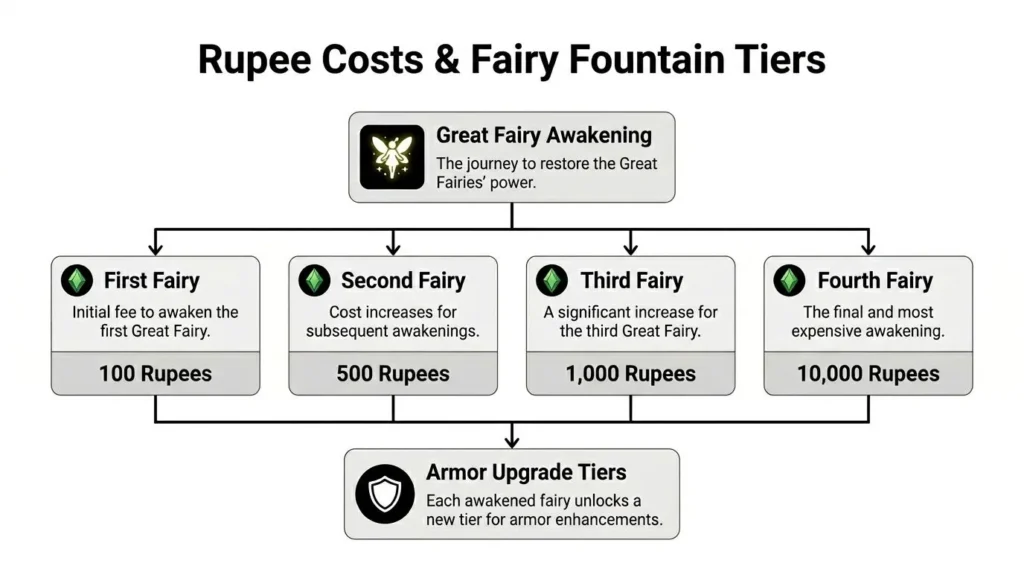
The pricing follows a clear progression. The first awakening costs 100 Rupees, the second 500 Rupees, the third 1,000 Rupees, and the fourth 10,000 Rupees. The full total is 11,600 Rupees, and New Atlas’s Great Fairy locations guide describes this as a soft gate that pushes players toward side content and farming.
Why the cost curve matters
That jump to the final fountain changes your priorities.
The early fees are manageable enough that many players unlock them without much planning. The final fee is different. It forces a real choice. Do you spend aggressively on short-term comfort, or do you save for long-term armor power?
This is why I call the fairy system an economy challenge. The game is not just checking whether you found the fountain. It is checking whether you managed your resources well enough to capitalize on it.
What each awakening really unlocks
Every awakened Great Fairy expands your armor upgrade ceiling. You are not paying for a single piece of gear. You are paying for access to stronger enhancement tiers across your wardrobe.
That distinction helps explain why the fees rise so sharply.
A simple way to view it:
- First awakening: You finally enter the upgrade system.
- Second awakening: Your favorite everyday sets become much more reliable.
- Third awakening: Specialized gear starts feeling worth the materials.
- Fourth awakening: Endgame optimization becomes realistic.
The practical budgeting mindset
Most players waste rupees by treating every purchase as equally urgent.
It helps to separate your spending into two buckets:
| Spending type | How to think about it |
|---|---|
| Short-term convenience | Arrows, quick buys, impulse gear |
| Long-term power | Great Fairy awakenings and armor progression |
If rupees are tight, long-term power usually wins.
That does not mean you should never buy anything else. It means you should know the tradeoff. Buying one helpful item now can be smart. Repeated casual spending can delay a major progression spike.
Key takeaway: The first few fountain costs feel like errands. The last one feels like a savings plan. Treat it that way.
A lot of frustration with fairy fountains botw disappears once players stop asking, “Can I afford this right now?” and start asking, “What does this unlock for the rest of my run?”
That small shift changes everything.
Strategic Armor Upgrading for Maximum Benefit
Unlocking fountains is only half the job. The other half is deciding which armor deserves your materials first.
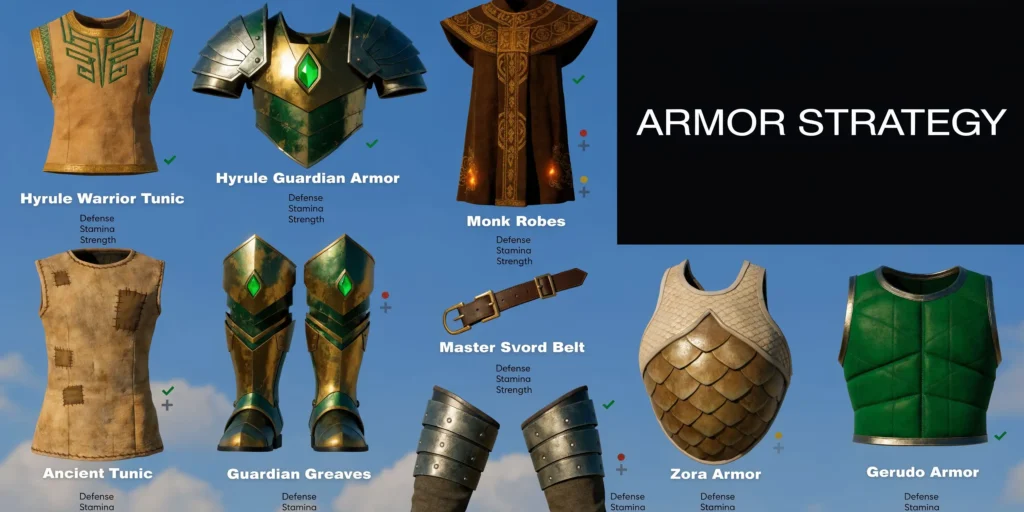
A lot of players spread upgrades too thin. They improve a little of everything, run out of parts, and end up with several half-finished sets that never become fully dependable. A better approach is to pick armor based on what your next stretch of the game demands.
According to RPG Site’s Great Fairy guide, activating Cotera first is the most efficient strategy because it gives early access to upgrades with common low-level materials, and that route can save 5 to 10 hours compared with inefficient progression.
Best early priority for most players
For a broad, forgiving start, I like upgrading your dependable everyday gear first.
The reason is simple. General-purpose armor helps in more situations than niche gear. If you are still learning enemy timing, exploring uneven regions, and taking fights you maybe should not, broad defense pays off constantly.
Good early logic looks like this:
- Daily wear first: Upgrade the set you keep equipped most often.
- Common materials are your friend: If a set uses items you already collect naturally, it rises in value.
- Delay vanity upgrades: Looking good can wait. Surviving cannot.
For players who enjoy practical progression paths in other games too, these Stardew Valley tips hit a similar principle. Early efficiency compounds.
Mid-game choices depend on your habits
Once a couple of fountains are active, your decisions should reflect your playstyle.
If you climb constantly and avoid direct combat, mobility-focused gear may deserve attention. If you prefer open fights and direct pressure, combat-oriented sets become more attractive. If you spend lots of time crossing varied terrain, utility sets can do more work than flashy damage options.
The mistake is assuming there is one “best” armor set in all cases. There is not. There is only the set that solves your current problem best.
A useful visual walkthrough can help if you want to compare upgrade priorities in motion.
A simple decision rule
When you cannot decide what to upgrade next, ask one question:
What am I dying to, or struggling with, most often?
If the answer is direct combat, strengthen your main defensive set.
If the answer is travel friction, support movement or environmental utility.
If the answer is a difficult region, upgrade the gear that makes that region manageable.
That is the core strategy behind fairy fountains botw. Do not upgrade randomly. Upgrade with a problem in mind.
Common Mistakes and Advanced Fountain Tricks
The Great Fairy Fountains do more than improve armor. They are also the best spots for collecting wild fairies; experienced players use this opportunity to squeeze extra value from every visit.
Game8’s Great Fairy guide notes that each Great Fairy Fountain can spawn up to 4 wild fairies, and that players can use inventory manipulation to stockpile as many as 21 fairies.
The mistake most players make with wild fairies
They rush.
Wild fairies drift away quickly, and if you charge straight at them, you often scare them off. Slow movement helps. Approaching carefully or using the environment to control your angle gives you a much better chance of catching them.
The larger lesson is that a fountain visit should not be treated as a single transaction. It is not just “upgrade armor and leave.” It is also a chance to refill emergency healing.
Why stockpiling fairies matters
Fairies are a safety net. They let you make mistakes and keep moving.
That is especially valuable in rough fights where menus, food, and pressure all collide at once. A stocked inventory makes dangerous exploration less punishing.
Common errors to avoid
- Spending rupees without a plan: Players sometimes wake fountains as they find them, then feel broke when more urgent needs appear.
- Selling rare materials too early: Fast cash now can become upgrade regret later.
- Ignoring fairy collection: Leaving a fountain without checking for fairies wastes a strong defensive bonus.
- Over-upgrading low-priority armor: If you never wear a set, do not feed it scarce materials just because you can.
Practical rule: Every fountain stop should answer two questions. What armor am I improving, and am I leaving with any fairies I can safely collect?
The advanced mindset
The best players treat Great Fairy Fountains like supply stations.
You arrive, make an upgrade decision, check your healing cushion, and leave stronger than when you came in. That repeatable loop is a big reason fairy fountains botw matter so much beyond their first dramatic cutscene.
Frequently Asked Questions about Fairy Fountains
Does the order of discovery change which fairy costs what
No. The costs scale by how many Great Fairies you have awakened, not by which specific one you visit first. The smart order still matters for efficiency, but the fee progression follows your total unlock count.
Which fountain should I unlock first
Cotera near Kakariko Village is the most practical first choice for most players. She is easier to work into an early route, and early upgrades usually line up better with common materials.
Do I need all four fountains right away
No. You can get useful value from the early fountains and come back for the later ones when your rupee supply is healthier. The final fountain is the big financial hurdle, so many players treat it as a later goal.
Are Great Fairy Fountains only for armor upgrades
No. They are also valuable for collecting wild fairies near the fountain area. Those fairies can save a run that would otherwise end in a sudden defeat.
Why can’t I upgrade a piece even after finding a fountain
Usually because you are missing the required materials for that armor piece. The fountain unlocks the upgrade service, but each item still has its own material requirements.
Should I save rupees or spend them as I go
If survival is your main issue, saving toward fountain progress and key upgrades is often the stronger long-term move. If a purchase solves an immediate problem, it can still be worth making. The best choice depends on what is blocking you right now.
Is the giant fee for the last fairy worth it
Yes, if you plan to keep pushing deeper into the game and want your armor to keep scaling. It is a painful payment, but it opens the last stretch of your upgrade potential.
Conclusion The True Power of Hyrules Guardians
The Great Fairy Fountains are not side decoration. They are one of the clearest examples of how Breath of the Wild turns exploration into meaningful growth. When you invest rupees in them, you are buying breathing room, confidence, and stronger options for the fights and regions ahead.
If you treat fairy fountains botw as an economic strategy instead of a simple scavenger hunt, the whole system makes more sense. Wake the right fountain at the right time, upgrade with intent, and Hyrule starts feeling far less hostile.
If you enjoy clear, practical game guides and approachable commentary across gaming and beyond, visit maxijournal.com. It is a great place to read fresh articles, discover new topics, and explore opportunities if you are interested in writing or contributing too.
Discover more from Maxi Journal
Subscribe to get the latest posts sent to your email.