We have mapped only about 10% of marine life, yet researchers working through the Ocean Census have already identified 866 new marine species with help from over 800 researchers across 400 institutions (Ocean Census reporting). That single fact changes how we should think about a newly discovered shark.
A new shark is not a biological oddity popping up from nowhere. It is often a sign that scientists are still sorting out life in places humans fish, dive, and manage every day. That is what makes Sphyrna alleni, a newly described small hammerhead from the Caribbean and Southwest Atlantic, so compelling. It is exciting science, but it is also a management problem. The moment researchers recognize a distinct species, old catch records, protection rules, and conservation assumptions can become outdated.
As an educator, readers often get tripped up by this. People hear “new species” and assume scientists found a dramatic creature in some unreachable trench. Sometimes that happens. Often, the full story is subtler. A shark that looked familiar turns out not to be the shark everyone thought it was. The discovery is less like opening a treasure chest and more like realizing one drawer in your filing cabinet has been mislabeled for years.
The Ocean’s Unseen Majority
Only a small share of marine life has been formally documented so far, even as large international efforts are rapidly adding new species to the record, as noted earlier. That combination sounds contradictory at first. It is really a sign of how ocean science works. Researchers are surveying an enormous living system with tools that keep improving, while many animals remain easy to miss or easy to mislabel.
The result is a quiet but accelerating correction of the ocean’s family tree.
Programs such as Ocean Census make that trend easier to see because they bring taxonomists, geneticists, fisheries scientists, and regional experts into the same effort. A shark is collected, photographed, measured, compared with museum specimens, and often tested genetically. What looked like one familiar species can turn out to be two. The process works less like discovering a brand-new invention and more like finding out two near-identical keys in your drawer open different doors.
That helps explain why sharks can stay scientifically unrecognized for so long. Sometimes the differences are subtle enough that field crews or fisheries observers would reasonably group them together. In other cases, the animals live along reef edges, muddy coasts, or other places where sampling is patchy. Records can flatten that complexity even further by placing several similar sharks under one common name.
A newly described shark, then, is rarely an isolated curiosity. It is part of a broader wave of marine exploration that is happening faster than policy can usually respond.
Discovery changes responsibility: once a species is recognized, fisheries managers, governments, and conservation groups have to ask whether old catch records, quotas, and protected-status decisions still apply to the right animal. That creates a systemic problem. The science can move from uncertainty to clarity in a paper, but management systems often move slowly, and sharks do not get a pause button while agencies catch up.
This is why species discovery now carries two stories at once. One is exciting. Scientists are still revealing major pieces of ocean biodiversity in waters people already use. The other is sobering. Some species enter the scientific record already exposed to fishing pressure, habitat loss, or weak monitoring.
That pattern extends well beyond sharks. Many researchers studying new species of fishes and other marine animals are running into the same challenge: every new name improves our map of life in the sea, but it also exposes how incomplete our management systems still are.
Introducing the Carolina Shovelbill Shark
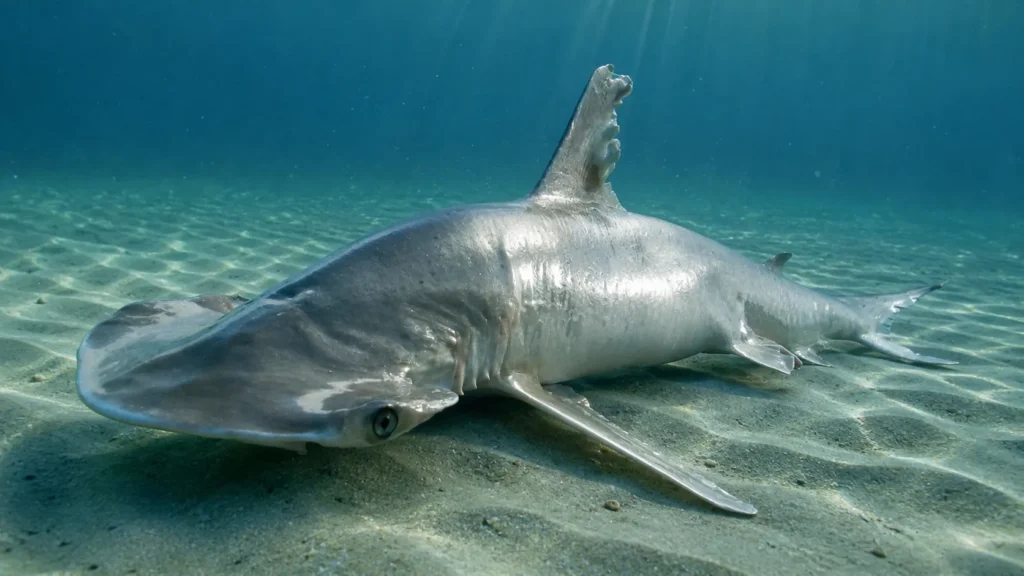
Sphyrna alleni is a newly described species of small hammerhead shark. Marine biologists formally identified it as distinct from the common bonnethead, Sphyrna tiburo, and reported that it reaches maturity at less than 1.5 meters in total length and is endemic to the Caribbean and Southwest Atlantic (report on the formal description).
Its common name, the Carolina shovelbill shark, helps people picture it. “Hammerhead” can make readers think of large, iconic sharks seen in documentaries. This one is smaller. Its story is not about size or spectacle. It is about careful observation.
A discovery in familiar waters
One of the most surprising parts of this story is location. This was not a shark pulled from a mysterious abyss beyond ordinary human reach. It belongs to waters that people already study, fish, and travel through.
That matters because it reminds us that even in relatively well-trafficked marine regions, scientists can still find species that have been lumped together under the wrong name. In practical terms, a fishery, a field guide, or a conservation plan may have been tracking a mixed category rather than a single species.
Why the name matters
Readers sometimes ask why a name change is important. It matters because species names are not just labels for scientists. They connect directly to:
- wildlife laws
- catch records
- conservation assessments
- trade monitoring
- habitat protection decisions
If Sphyrna alleni was long confused with bonnetheads, then some historical records for bonnetheads may include this separate shark instead. That creates a ripple effect. A management plan built around one species may turn out to describe two.
The human side of the discovery
I like this discovery because it shows science as patient detective work rather than dramatic revelation. Researchers noticed that some sharks did not fit the expected pattern. They compared body form, checked the details, and followed the evidence until a clearer picture emerged.
The most interesting discoveries are often corrections. Science advances when someone says, “Wait, this does not quite match.”
In that sense, Sphyrna alleni is not just a new entry in a catalog. It is a reminder that nature often hides complexity inside what looks familiar.
What Distinguishes This New Hammerhead
At first glance, Sphyrna alleni might look like a bonnethead to a casual observer. That is why the discovery is so instructive. The important differences are real, but they are not cartoonishly obvious.
The head shape tells the story
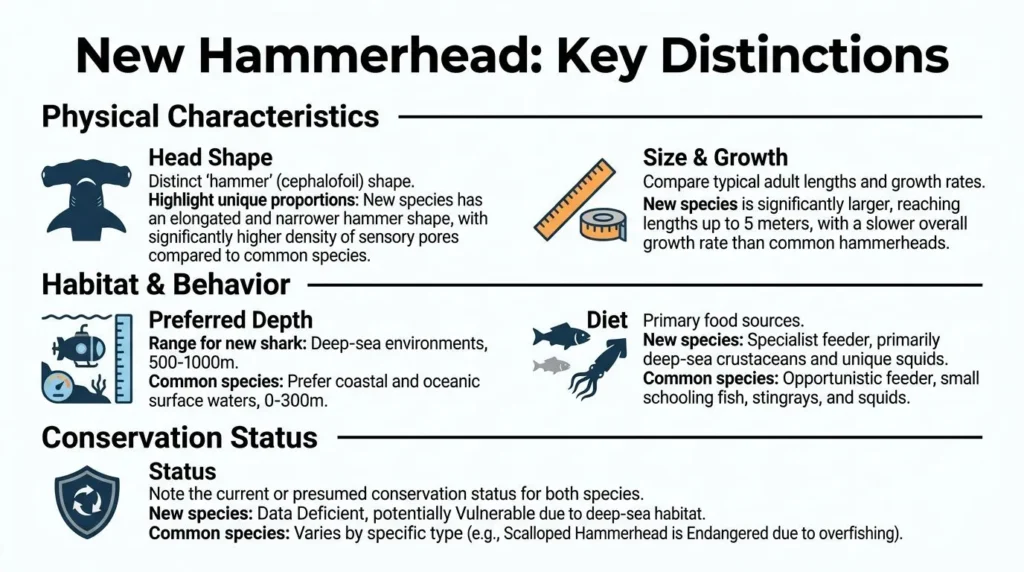
The defining feature is the shape of the head. Sphyrna alleni has a flat, shovel-shaped head without indentations on its anterior edge. By contrast, Sphyrna tiburo has a more rounded front margin and posterior lobules.
A simple analogy helps here. Think of two garden tools laid side by side. One has a broad, flattened leading edge, like a compact shovel. The other has a softer, rounded front with more sculpted contours. To a specialist, that difference is not cosmetic. It is diagnostic.
Small hammerheads are a crowded group
Before this species was identified, four small-bodied hammerhead species under 1.5 meters were recognized as endemic to the Americas: Sphyrna tiburo, Sphyrna tudes, Sphyrna corona, and Sphyrna media. The addition of S. alleni changes that picture and forces scientists to revisit assumptions about the group.
Here is a simple comparison focused on the feature readers are most likely to remember.
| Feature | Sphyrna alleni (New Species) | Sphyrna tiburo (Common Bonnethead) |
|---|---|---|
| Head shape | Flat, shovel-shaped head with no indentations on the front edge | More rounded front margin with posterior lobules |
| Status in science | Newly formally described as distinct | Long recognized species |
| Maturity size | Less than 1.5 meters at first maturity | Small-bodied hammerhead, discussed as a close lookalike |
| Range | Caribbean and Southwest Atlantic | Closely related comparison species with overlapping public familiarity |
Why visual confusion happens
Many sharks are identified quickly in the field. That is normal. Fishers, survey teams, and even trained observers often work under time pressure, rough weather, or low visibility.
A shark that is small and generally “bonnethead-like” may get logged under the familiar option. That does not mean people were careless. It means species boundaries are sometimes finer than field labels suggest.
In biology, “looks similar” and “is the same species” are not the same statement.
This is exactly why newly discovered shark stories matter. They teach us that biodiversity is not only about finding exotic creatures. It is also about learning to see distinctions that were already in front of us.
The Scientific Detective Work Behind the Discovery
Scientists do not confirm a new shark species based on a hunch alone. They build a case. The process looks a lot like detective work. One clue comes from anatomy, another from location, another from genetics, and the conclusion has to hold together.
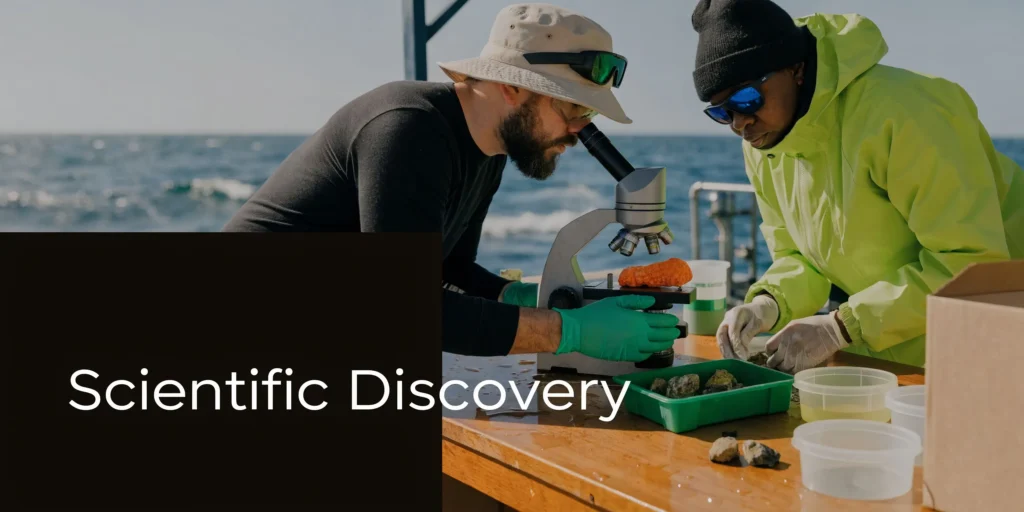
A useful comparison comes from another recent shark find. Discoveries such as the West Australian Lanternshark, Etmopterus westraliensis, often begin with major research voyages. In that case, a CSIRO-led voyage on the RV Investigator collected specimens using deep-sea equipment from depths up to 610 meters, and researchers then used morphology and increasingly DNA analysis to confirm that the shark represented a new species (CSIRO account of the research process).
Step one is collecting real specimens
Science starts with bodies, tissues, measurements, and records. Researchers need specimens they can examine closely.
For a shark, that may include:
- Head proportions that separate one species from a close relative
- Fin placement and body shape that remain consistent across multiple individuals
- Tissue samples used for genetic comparison
Many readers get confused here. DNA does not replace anatomy. It works with it. Morphology tells scientists what they can see. Genetics tests whether that visible difference reflects a distinct evolutionary line.
DNA works like a biological fingerprint
A good plain-language analogy is a fingerprint plus a family tree. A fingerprint helps identify an individual pattern. A family tree shows relatedness. Genetic analysis gives researchers evidence about both distinct identity and relationship to nearby species.
If you want a broader primer on how scientists turn genetic data into biological insight, this overview of https://maxijournal.com/what-is-bioinformatics/ is a useful companion.
Here is a short visual break that captures the field-and-lab rhythm behind marine species work.
Why modern taxonomy is slow on purpose
Taxonomy can feel cautious because it is. Scientists must rule out the simpler explanation first. Is this just variation within a known species? Is it a juvenile form? Is it a regional population with minor differences?
Only after that process can they say, with confidence, that the newly discovered shark is distinct. That caution is a strength. It is why a new species description carries weight once it is published.
A New Shark on the Brink
Discovery can sound like good news. In conservation, it often arrives with bad timing.
For Sphyrna alleni, there are immediate concerns. No population estimates or post-description IUCN assessment exist yet, and evidence from Belizean fisheries indicates that up to 20% of Sphyrna catches previously logged as bonnetheads may have been this newly described species, which points to a need for updated management quotas (report on the fisheries concern).
Why misidentification becomes a policy problem
A mislabeled shark is not just a data error. It can distort the whole management picture.
If catch records fold two species into one category, regulators may not know:
- whether one species is declining faster than the other
- whether nursery areas overlap with fishing hotspots
- whether current quotas protect the wrong biological unit
That is especially serious for hammerheads as a group. The formal description of Sphyrna alleni also raised broader concern because hammerhead sharks in the family Sphyrnidae are among the most threatened shark groups globally, largely due to overexploitation, and nearly all species in the family are listed by the IUCN as Vulnerable, Endangered, or Critically Endangered in the reporting on the discovery.
The conservation gap starts immediately
A new species enters the world of policy with almost no paperwork. It may have no dedicated population estimate, no specific management plan, and no species-specific public awareness.
Governments and fisheries managers then face a difficult question. How do you protect what you have only just learned to identify? Broader environmental pressures also matter here. Warming seas, shifting habitats, and changing coastlines complicate local management. For readers wanting context on those larger environmental drivers, https://maxijournal.com/what-is-climate-change/ gives a clear overview.
The clock starts ticking as soon as a species gets a name. Recognition does not create the risk. It reveals the risk that was already there.
Some newly discovered shark species may be rare, heavily fished, or poorly protected long before the public ever hears their names.
Why One New Shark Changes Everything
A single shark species can reshape several fields at once. That sounds exaggerated until you follow the consequences.
Once a shark is split from a lookalike, biodiversity maps change. Fishery records may need revision. Conservation assessments may need to be redone. Habitat priorities may shift. Even tourism messaging can change if a region turns out to host more unique wildlife than previously recognized.
Discovery improves the map
Large scientific collaborations matter here because they provide the baseline information that policy depends on. Reporting on the Ocean Census notes that collaborations involving 400 institutions supply foundational data for international conservation policy, sustainable fisheries management, and marine tourism industries that depend on healthy ocean ecosystems.
That point is easy to miss. Science is not just collecting names for museum shelves. It is building the reference system that lets societies decide what to protect and how.
Local impacts can be surprisingly broad
Consider what a newly recognized hammerhead means in practice:
- A fishery manager may need different species categories on catch forms.
- A conservation scientist may need to revisit old specimens or genetic samples.
- A tourism operator may suddenly be working in waters known for an endemic shark.
- A government agency may have to update risk assessments.
None of that happens because the shark changed overnight. It happens because our understanding became more accurate.
Why this should matter to non-specialists
People who never study sharks still depend on sound ocean management. Coastal economies rely on healthy marine ecosystems. So do food systems, education programs, and many forms of tourism.
Every new species is a correction to the story humans tell about the living world. Better corrections lead to better decisions.
That is why Sphyrna alleni matters beyond shark enthusiasts. This newly discovered shark is one more sign that exploration, taxonomy, and conservation are tightly connected. If one part lags, the others inherit bad assumptions.
How to Support the Future of Ocean Discovery
You do not need to be a marine biologist to help. The most useful support is often practical and steady.
Start with informed attention
Follow credible science reporting on marine biodiversity and conservation. Newly described species can vanish into the news cycle quickly, even when their management implications are urgent.
Support organizations that do field science and conservation
Research voyages, specimen collections, lab analysis, and long-term monitoring all cost time and money. Institutions that combine discovery with conservation work are especially valuable because they connect naming species to protecting them.
Make ocean choices that match your curiosity
If you eat seafood, ask where it comes from and how it was caught. If you travel, choose operators who respect local wildlife rules and do not market sharks as props or stunts.
A few habits go a long way:
- Read beyond the headline. A “newly discovered shark” story is often also a fishery and policy story.
- Value taxonomy. Naming species may sound obscure, but it underpins conservation.
- Share accurate information. Public understanding shapes support for marine science.
The biggest lesson from Sphyrna alleni is simple. Discovery is not the end of the story. It is the point where responsibility begins.
Frequently Asked Questions About Newly Discovered Sharks
Readers usually have a few practical questions after a story like this, especially when the shark involved is a hammerhead relative.
Quick Answers
| Question | Answer |
|---|---|
| Is Sphyrna alleni a large hammerhead? | No. It is a small hammerhead species that reaches maturity at less than 1.5 meters. |
| Where does it live? | It is endemic to the Caribbean and Southwest Atlantic regions. |
| Why was it missed for so long? | It resembles the bonnethead closely enough that it could be misidentified without careful anatomical and genetic work. |
| Does “newly discovered” mean it recently evolved? | No. It means scientists recently recognized and formally described it as distinct. |
| Is it already protected? | The conservation picture is still developing, and the discovery has created immediate management questions. |
Are newly discovered sharks dangerous to people
Usually, that is the wrong first question. The more useful question is what role they play in ecosystems and whether humans are putting them at risk before we fully understand them.
Why do scientists keep finding new sharks
Because the ocean is still under-documented, and some sharks differ in subtle ways that require specimen-based research and genetic analysis to confirm.
Does a new species name really change anything
Yes. Names connect directly to law, monitoring, conservation status, and fisheries records. If the name changes because the species was split from another one, management often has to change too.
Could there be more sharks like this still unrecognized
Very likely. Marine biodiversity research keeps showing that familiar-looking animals can contain hidden diversity, especially in the sea.
If you enjoy clear, approachable writing on science, technology, education, and the natural world, visit maxijournal.com for more articles that make complex topics easier to understand.
Discover more from Maxi Journal
Subscribe to get the latest posts sent to your email.