You’ve saved a dozen beach boards, compared sunset photos, and started a guest list that may or may not survive the airfare conversation. Then the practical question arrives: can you legally marry in Aruba, and what will the celebration cost once everyone has to travel?
An Aruba destination wedding can be beautiful, intimate, and easier to enjoy than a large traditional wedding at home. It can also become a paperwork project with international documents, apostilles, translations, permits, contracts, and guests arriving on different schedules. My advice is simple: choose Aruba for the experience, but plan it like a legal and logistical production rather than a beach escape.
Why Aruba Works for a Destination Wedding
A couple often starts with the postcard version of Aruba. They see bright water, open sand, and a ceremony setup that appears to require little more than an arch and two chairs. That vision is valid, but it only covers the ceremony backdrop. The actual planning begins when you decide whether the ceremony will be legally recognized, how many guests can realistically travel, and who will coordinate every moving part on the island.
Aruba has several practical advantages. Its resort infrastructure supports weddings, English is widely used, and the island’s trade winds can make outdoor celebrations feel comfortable. Couples also value its reputation for reliable sunshine and the range of resorts, restaurants, beaches, and activities available to visiting families. If beach scenery is central to your decision, compare Aruba with other destinations through this guide to the most beautiful beaches in the world, but don’t choose a location on scenery alone.
The appeal and the workload
A resort can simplify accommodation, reception space, catering, and coordination. A private villa can offer more privacy and personality. A symbolic ceremony can remove much of the civil-document burden. A legal ceremony gives you the convenience of marrying where you celebrate, but it requires careful preparation.
The island’s wedding market is substantial. A 2017 Wedding Economic Impact Study commissioned by the Aruba Tourism Authority found that weddings represented 6.1% of all room nights, with an average of 47.5 guests per wedding staying 6.3 nights. The study estimated direct spending from Aruba’s weddings market at US$107.3 million. Those figures show why hotels and local suppliers have developed structured romance and wedding services, but they don’t mean every package is good value for your particular guest list. (Aruba Tourism Authority wedding economic impact study)
Planner’s view: Aruba is easy to love and easy to underestimate. The scenery is simple. The administration isn’t.
Expect to manage civil filings, document certification, vendor schedules, guest transportation, weather contingencies, and time-zone communication with suppliers at home. Start with the ceremony type, guest count, and legal requirements. The venue should follow those decisions, not replace them.
Legal Requirements and Paperwork for an Aruba Wedding
A couple can exchange vows beside the Caribbean Sea and still lose the week to one missing certificate. An Aruba legal ceremony is a documentation project first and a beach event second. Non-resident couples typically submit civil documents about 6 to 8 weeks before the ceremony, including passports, birth certificates with apostille where applicable, proof of freedom to marry, and divorce or death certificates if either person was previously married. Civil ceremonies also require at least two adult witnesses, while a beach ceremony may need a separate permit. Check the official Aruba wedding requirements guidance before ordering documents.
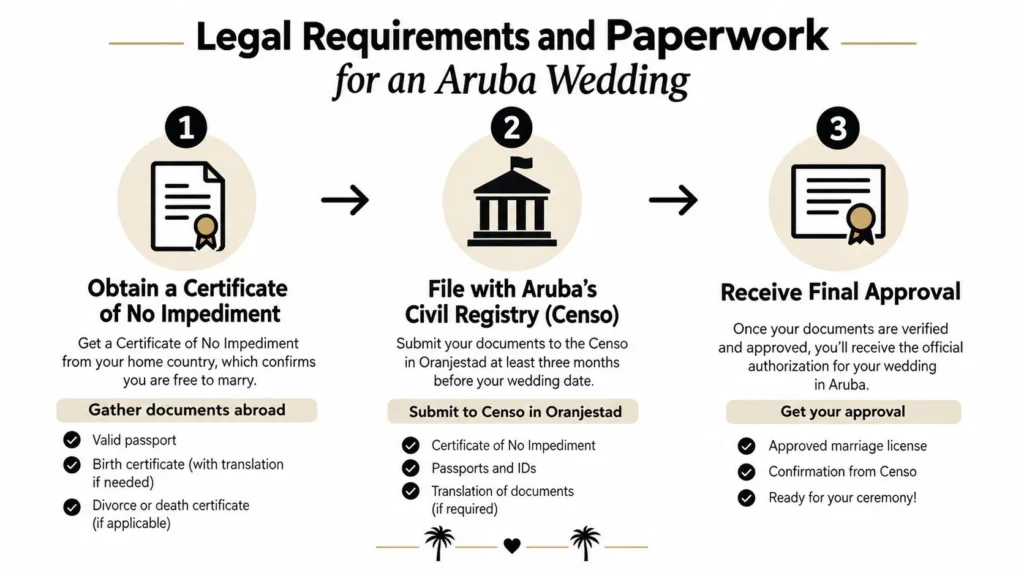
Build the document file first
Request long-form birth certificates rather than abbreviated extracts. Check passport validity and collect the appropriate divorce decree or death certificate for any previous marriage. A proof-of-freedom-to-marry document may have a different name in your home jurisdiction, so ask Aruba’s Civil Registry, known locally as Censo, which version it accepts before you place an order. Aruba wedding requirements and document guidance provides a useful preparation reference, but Censo’s current instructions control your submission.
An apostille authenticates a public document for use abroad. The issuing authority depends on the country and, for couples from the United States, may depend on the state. Canadian, U.K., and EU couples should confirm whether Aruba requires apostilles, certified copies, translations, or a combination. English-language paperwork does not automatically avoid translation requirements. Ask both Aruba’s Civil Registry and your local issuing authority what applies.
Separate legal and symbolic choices
A symbolic ceremony usually suits couples who want the vows, photographs, and reception in Aruba without making the island responsible for the civil marriage. Complete the legal marriage at home, then hold the meaningful celebration on the island. This removes the risk that a missing certificate or late apostille disrupts the wedding week.
Couples choosing an Aruba legal marriage need assigned owners and deadlines for every document. Keep scanned copies, a physical file, and written notes on expiration dates and issuing rules. Arrange the two adult witnesses early. A resort may coordinate them, but that should be confirmed in writing rather than assumed.
The cost tradeoff is clear. A symbolic micro-wedding can keep the legal work and guest logistics smaller, while a full guest-list affair may justify local coordination but adds witness planning, document tracking, and more moving parts. Choose the ceremony type before signing venue or package contracts.
Verify requirements directly before booking flights, because procedures can change. A planner can coordinate submissions, but you should know what each document proves and which authority issued it.
Keep health paperwork separate from the marriage file. Review this travel vaccination requirements guide as part of your travel preparations, and do not let unrelated documents hide a missing civil certificate.
Choosing the Right Time of Year
Aruba’s climate is one of its strongest wedding advantages. The island generally feels warm throughout the year, and trade winds often make outdoor conditions more manageable than couples expect from a tropical destination. The lower hurricane exposure compared with many Caribbean destinations is reassuring, but it isn’t a substitute for a rain plan or event insurance.
The date affects more than weather. Peak travel periods can put pressure on hotel availability, airfare, restaurants, and popular vendors. Lower-demand periods may offer more choice, but guests with school schedules, work restrictions, or limited travel budgets may find those dates harder to attend.
Compare the planning tradeoffs
| Season | Typical Weather | Hotel & Flight Costs | Crowd Level | Best For |
|---|---|---|---|---|
| Mid-December through April | Dry, breezy, and popular for outdoor events | Usually stronger pricing pressure | Higher | Couples prioritizing guest comfort and date demand |
| May and November | Often a useful balance between popular and quieter periods | Potentially more manageable than peak dates | Moderate | Couples seeking flexibility without choosing the quietest window |
| June through October | Warm, with periods that can feel more humid | Often more availability, depending on demand | Lower to moderate | Smaller groups and couples prioritizing venue choice |
Treat this table as a planning framework, not a promise of a particular forecast. Ask your venue about prevailing wind exposure, ceremony shade, sunset timing, and indoor alternatives for your exact date.
Protect the guest experience
Avoid choosing a date solely because the package looks attractive. Check major island events, Carnival programming, sailing regattas, restaurant operating schedules, and local transportation demand. A busy week can create atmosphere and entertainment, but it can also make dinner reservations and transfers more complicated.
For an outdoor ceremony, schedule the couple’s portraits and guest seating around heat and wind rather than forcing everyone into formal clothing during the harshest part of the day. Give guests a clear itinerary with free time. Aruba works best when the wedding feels like part of a vacation, not a three-day transport exercise.
Picking a Venue That Fits Your Wedding Style
The right Aruba venue depends on how much coordination you want to own. A resort package can remove decisions from your week. A villa can give you privacy and design freedom. A boutique hotel can create a more personal atmosphere without requiring the full operational setup of a private home.
| Criterion | Beach Resort | Private Villa | Boutique Hotel |
|---|---|---|---|
| Guest capacity | Often suited to structured group events | Depends on property rules and usable event space | Usually better for intimate celebrations |
| On-island logistics | Coordinators and established systems may be available | Couple or planner may manage more suppliers | Often more personal, with fewer built-in services |
| Ceremony formats | Beach, terrace, ballroom, and package formats may be available | Flexible, subject to property permissions | Often tailored to the property’s layout |
| Vendor policy | May require preferred or in-house suppliers | External vendors may be possible, with conditions | Policies vary and need written confirmation |
| Spend exposure | Easier to forecast, less flexible | More line items can sit outside the rental fee | Moderate, depending on inclusions |
Match the property to your priorities
Choose a beach resort when guest convenience matters most. Room blocks, dining, ceremony space, and reception services can sit close together, which reduces transfer needs. The tradeoff is limited customization and possible restrictions on outside photographers, florists, DJs, or caterers.
Choose a private villa when privacy and atmosphere outrank convenience. The setting may feel more distinctive, but the rental price is only one part of the budget. Catering, rentals, staffing, cleanup, power, sound, permits, and transport may all require separate coordination. Ask whether the property permits weddings at all, not just overnight stays.
A boutique hotel can suit a couple who wants a smaller celebration with character. It may offer fewer rooms and fewer event configurations, so confirm whether your guests can stay on-site and whether the venue can handle both ceremony and reception without disrupting other visitors.
Inspect the site like a producer
Palm Beach tends to feel more resort-centered and active, while Eagle Beach is often chosen for a more open, spacious beach setting. Neither location guarantees privacy. Public beach ceremonies may involve other visitors, wind, passing activity, and restrictions on structures or sound.
During a site inspection, ask for the rain plan, sound limits, vendor access windows, setup and breakdown rules, lighting restrictions, guest restroom access, and a map showing where suppliers can unload. The beautiful view is only one line in the venue decision. The operational details determine whether your ceremony feels calm.
Vendors, Packages, and Contract Basics
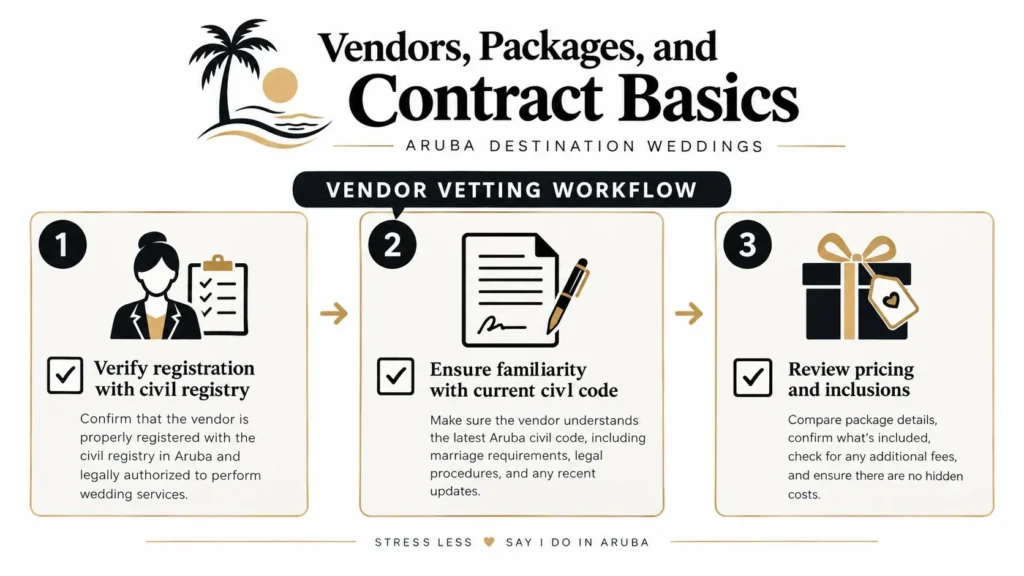
Aruba’s wedding vendors need to understand more than flowers and photographs. For a legal ceremony, ask planners and officiants how they handle current civil requirements, document coordination, witness arrangements, and communication with Censo. A vendor who gives vague answers about legal paperwork isn’t the person to manage your ceremony file.
Use a three-stage vetting process before you pay a deposit.
Check competence before style
First, request proof of relevant registration or authorization where applicable, along with recent examples of comparable weddings. Second, ask direct questions about civil-code familiarity, permits, venue access, backup plans, and supplier substitutions. Third, compare the written proposal with the conversation. If the proposal omits an answer that mattered during the call, ask for it to be added.
Read package pricing line by line
Resort packages often combine flat fees with per-guest charges. Identify which items change when attendance falls below the contracted minimum, whether unused meals are refundable, and whether the package requires a minimum room commitment. Ask for the price of photography, floral upgrades, additional décor, transportation, cake changes, extra reception hours, and vendor meals before you compare proposals.
A low base price can become expensive when the couple adds the details visible in the inspiration photos. Request a complete sample invoice, not just a brochure. The invoice should show taxes, service charges, gratuities, delivery, setup, breakdown, and any outside-vendor fees.
Protect the contract
Pay close attention to deposit rules and cancellation schedules. Weather clauses should distinguish between an ordinary forecast concern and an official closure or safety decision. Force majeure language should explain what happens if travel disruption, severe weather, or a government restriction prevents the event.
Also clarify vendor accommodation requirements, meal charges, overtime, replacement staff, photo delivery timelines, and responsibility for damaged rentals. For popular dates, secure key vendors at least 6 months ahead so you aren’t choosing from whoever remains available.
Contract rule: If a cost, deadline, substitution right, or cancellation condition matters to you, it belongs in the contract, not in a reassuring phone call.
Breaking Down the Real Cost of an Aruba Wedding
You can approve a ceremony package and still be far from your final budget. The full bill may include the couple’s travel, guest flights, rooms, legal administration, photography, flowers, transportation, welcome events, meals outside the reception, gratuities, and a reserve for changes.
Start by choosing the wedding format. Recent Aruba wedding material discusses celebrations under US$15,000, while estimates for a small symbolic ceremony can range from US$1,500 to US$3,000, depending on what the couple includes. Treat those figures as planning reference points, not quotes for a legal ceremony with traveling guests. Aruba wedding package discussion
Aruba’s romance-tourism analysis gives a broader benchmark of an average destination wedding costing about US$28,000. It also reports that roughly 24% of weddings are destination weddings, that 9 out of 10 couples identify weather as a key factor, and that 80% of destination-wedding couples have been married before. These figures help explain the market for symbolic renewals and smaller celebrations, but they do not price your event. Aruba romance tourism analysis
Compare three workable scenarios
| Cost Category | Symbolic Micro, 2 to 10 guests | Mid-Size Legal, 25 to 40 guests | Full Destination, 60+ guests |
|---|---|---|---|
| Venue or package | Small ceremony package or private setting | Resort or hotel package with reception | Large venue, reception, and expanded production |
| Legal administration | Usually limited if marriage occurs at home | Civil documents, certification, translations, and registry coordination | Same legal exposure, plus more coordination |
| Travel and rooms | Couple and a small circle | Couple plus a group with varied budgets | Major guest affordability and room-block challenge |
| Photography and floral | Focused coverage and modest design | Full-day coverage and custom décor | Multiple locations, larger installations, and more staffing |
| Welcome events | Optional meal or gathering | Useful for guest orientation | Often becomes a separate hosted event |
| Contingency | Protects against small changes | Needed for guest and supplier adjustments | Required because more suppliers create more failure points |
A symbolic micro-wedding gives you the most control. Keep the ceremony focused, choose a smaller dinner, and avoid asking a large group to absorb international travel costs. Put the savings toward a better photographer, a private meal, a boat experience, or a post-wedding shoot instead of a large reception.
A legal mid-size wedding is the difficult middle ground. You have enough guests for a memorable celebration, but not always enough scale to secure the strongest group terms. Create a separate administrative budget line for document handling and legal coordination. Before approving the design, ask your planner to identify every government, translation, certification, permit, and service charge.
A full guest-list wedding can deliver a larger shared celebration, but it leaves the least room for error. Guests will have different budgets, schedules, and tolerance for transfers. Share accommodation and flight information early, and direct families to practical resources such as Aruba travel deals for families while they calculate the wider trip cost.
Make the guest list justify its cost. If the priority is a polished island experience, Aruba usually works better as a micro-wedding with premium moments than as a large event built around an attractive package headline.
Timeline, Guests, and On-the-Ground Logistics
Give yourself a long runway for a legal ceremony. A symbolic event can move faster, but the moment Aruba’s Civil Registry and foreign documents enter the plan, early action protects you from document replacement, apostille delays, translation problems, and unavailable dates.
A practical planning sequence
At the earliest stage, decide whether the ceremony will be legal or symbolic, establish the guest target, and contact Censo or a qualified local coordinator about the current document list. Secure the ceremony date and venue before you build invitations around an assumption that hasn’t been confirmed.
Around 9 to 12 months before travel, reserve the venue, begin the civil-document process, and send save-the-dates. If documents must be mailed to the Census Office in Oranjestad, use a tracked service and retain copies of everything. Couples planning their broader schedule can use Explore Effortlessly’s destination wedding guide as a general planning reference, then adapt it to Aruba’s civil requirements.
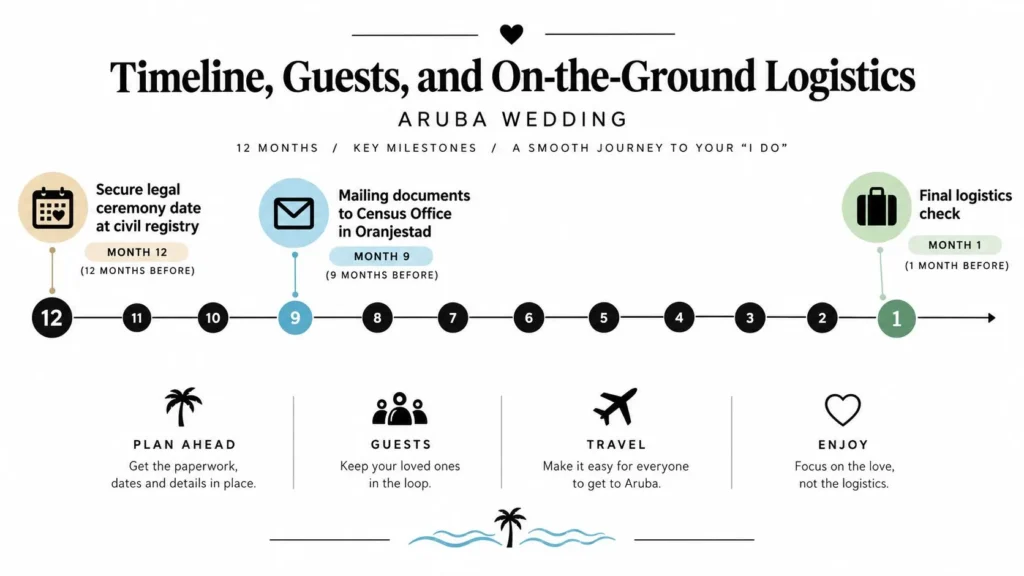
At roughly 6 months, lock in the photographer, florist, entertainment, makeup team, transport, and ceremony rentals. Confirm outside-vendor policies with the venue before signing supplier contracts. At 6 to 8 weeks, finalize the guest count and review the civil file against the latest instructions, since this is the typical submission window cited for non-resident civil documents. (Aruba document timing guidance)
Make arrival easy for guests
Create one wedding website with the airport transfer plan, hotel details, ceremony attire guidance, weather expectations, emergency contacts, and a simple day-by-day schedule. Don’t make every guest solve transport independently. Offer coordinated airport transfers and clear meeting instructions, especially for arrivals spread across several days.
When discussing a room block, ask for a flexible attrition clause and a deadline for releasing unused rooms. For flights, compare group options through common departure hubs such as Newark or Miami, but let guests book according to their own needs. Use this guide to find cheap flights and airfare deals without promising that one booking method will suit everyone.
Keep the rehearsal dinner separate from the legal appointment unless your planner confirms the timing works. Before departure, check:
- Documents: Passports, long-form birth certificates, apostilles, certified copies, translations, divorce decrees, or death certificates where applicable.
- Travel protection: Insurance that addresses medical needs, cancellations, delays, and weather-related disruption.
- Guest support: Airport transfers, room assignments, emergency contacts, and welcome information.
- Ceremony operations: Witnesses, permits, vendor arrival times, rain-plan location, and payment schedule.
- Final payments: Confirm accepted payment methods, gratuities, vendor meals, overtime, and outstanding balances.
The best Aruba weddings don’t eliminate logistics. They make those logistics invisible to the guests because the couple and planner resolved them early.
Maxijournal.com publishes approachable travel guidance and practical commentary for readers planning trips, celebrations, and everyday decisions. Visit maxijournal.com for more useful destination-planning articles and clear, reader-focused advice before you book your Aruba wedding.
Discover more from Maxi Journal
Subscribe to get the latest posts sent to your email.