You’re checking your passport, comparing flight dates, and wondering whether “recommended” means “required.” Perhaps your itinerary includes a safari in East Africa, a connection through another tropical country, or a visit to the Amazon. A travel clinic has given you a long list of vaccines, but you’re mainly worried about one practical question: could an airline or border officer stop you?
The answer depends on separating health advice from legal entry rules. Most travel vaccines are recommended to reduce your chance of becoming ill. Yellow fever is the only disease for which proof of vaccination may be required as a condition of entry under the International Health Regulations, and the proof must appear on an International Certificate of Vaccination or Prophylaxis, commonly called an ICVP. (CDC Yellow Book guidance)
What Travel Vaccination Requirements Actually Mean
A travel-health appointment can produce a long vaccine list, while border officials may care about only one document. Hepatitis A, typhoid, rabies, and other vaccines may be recommended because your destination, activities, and medical history raise the chance of illness. That advice concerns protecting your body. It does not automatically create an immigration requirement.
A legal requirement has a different function. It links vaccination evidence to entry, much like a ticket check links a boarding pass to access. Under the International Health Regulations, yellow fever is the only disease for which a state party may require proof of vaccination at the border. The proof must be recorded on an International Certificate of Vaccination or Prophylaxis, or ICVP. (CDC Yellow Book guidance)
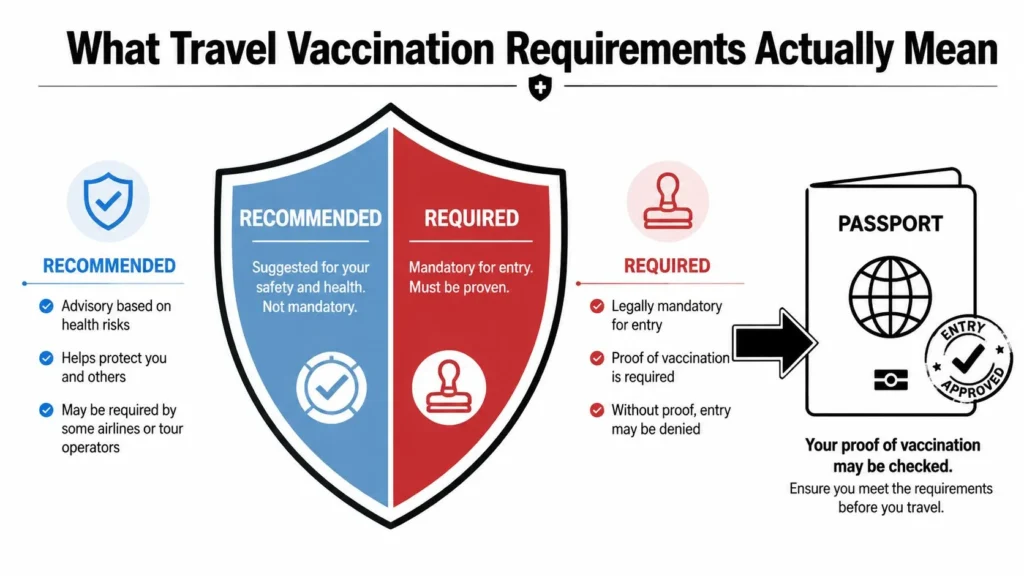
Two questions, not one
Separate the health decision from the border decision:
- What could make me ill during or after this trip? This identifies medical recommendations.
- What documentation might I need to enter or transit through this country? This identifies border requirements.
A rural itinerary might lead a clinician to discuss hepatitis A, typhoid, rabies, or Japanese encephalitis. Those vaccines may matter for your health without becoming immigration conditions. Yellow fever has a distinct legal role because countries can use its certificate as a condition of entry in situations allowed by the International Health Regulations.
A trip to Africa or South America does not automatically mean yellow fever proof is required. WHO explains that rules can concern countries or areas where yellow fever transmission occurs, and may also apply to travelers arriving from risk locations. (WHO travel vaccination guidance)
Why itinerary details matter
Your final destination is only one part of the decision. A country may ask for proof from travelers arriving from a place with yellow fever transmission risk, passing through such a place, or spending time in transit there. The exact rule can depend on the route.
Check the exact route, including connections, airport stays, and recent travel history, rather than searching only for “vaccines for Kenya” or “vaccines for Brazil.” Border planning answers the certificate question. A personalized travel-health consultation addresses the wider vaccine risks.
Required Versus Recommended Vaccines
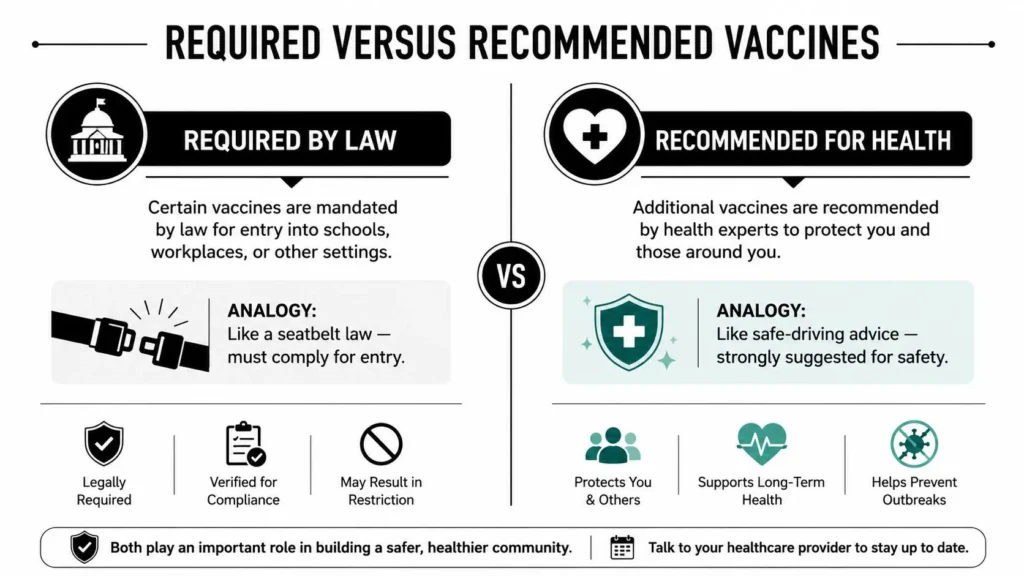
A traveler can arrive with every sensible health recommendation completed and still face a border problem if a required certificate is missing. The reverse is also possible: a country may require no vaccine proof while a clinician recommends several vaccines for the itinerary. These are separate tracks, like a legal entry document and safety advice for the journey.
Required vaccination documentation can affect entry. Yellow fever is the main vaccine with this legal role under the International Health Regulations. Depending on the destination and route, a traveler without acceptable documentation may be denied entry, quarantined, or asked to revaccinate at the border. The International Certificate of Vaccination or Prophylaxis, or ICVP, must be completed correctly and validated with the administering center’s official stamp, as described in CDC Yellow Book guidance.
A recommended vaccine serves a different purpose. It lowers the chance of infection during the trip when food, water, animals, insects, healthcare access, or planned activities create risks. Hepatitis A, typhoid, rabies, and Japanese encephalitis can be medically relevant without becoming immigration conditions. A recommendation is health advice, not automatically a border rule, and airlines do not normally inspect every vaccine a clinician suggests.
What the certificate proves
The ICVP is an internationally recognized record, not a clinic receipt or handwritten note. Border staff check whether the document was issued and authenticated by an authorized vaccination center. In practical terms, document validity is the item being checked.
For yellow fever, the certificate becomes valid 10 days after vaccination, allowing time for protection to develop. Reaching a border before that point can leave the traveler without an acceptable certificate. Keep the original ICVP with your passport and other travel documents. An appointment record cannot replace it.
Pet owners encounter a similar distinction in another setting. For trips involving an animal, Passpaw pet travel compliance explains why vaccination records and official certificates are not interchangeable.
Common Destination-Specific Vaccines
A traveler may stay in a city hotel, visit a rural homestay, or cross several countries on one trip. Those itineraries do not create the same vaccine questions. Begin with each destination, then consider activities, length of stay, contact with animals, and access to medical care.
Yellow fever risk areas
Yellow fever is the main vaccine-related border issue because countries can enforce entry requirements for it under the International Health Regulations. The disease occurs in parts of Africa and South America. Vaccination is recommended for travelers aged 9 months or older going to risk areas, but the medical recommendation and the border requirement are separate decisions.
A traveler entering a risk area may therefore face two different questions. Is vaccination advisable because transmission is possible? Does the destination require an international certificate because of the arrival country or the route? A country may require proof from travelers arriving from a risk country, including travelers whose transit creates an entry condition. The answers depend on the itinerary and current rules.
Food and water exposure
Hepatitis A and typhoid often arise during consultations for destinations where contaminated food or water may expose visitors to infection. These are generally health recommendations, not universal border requirements. A short city stay, a rural visit, and a multi-country journey can lead to different advice.
A clinician will also review previous vaccinations and underlying health conditions. The same destination can produce different recommendations for different travelers, much like the same road may require different equipment depending on the vehicle and weather.
Rural and animal-contact itineraries
Japanese encephalitis may become more relevant during some rural or extended stays in parts of Asia. Rabies deserves closer attention when a traveler expects animal contact, remote travel, wildlife work, or limited access to urgent care after a bite.
These vaccines do not belong to the ICVP-based yellow fever entry system. They protect the traveler rather than serving as routine border documents, so the decision should reflect exposure and how quickly medical treatment would be available.
Pilgrimage travel
Travelers attending the Hajj should check meningococcal ACWY documentation because Saudi Arabia requires it in that pilgrimage context. Review the current official instructions for the required paperwork and timing before departure.
The clearest mental model is this: yellow fever raises the certificate question, while other destination-specific vaccines usually raise the personal health question. A travel clinic can help keep those two lists separate, especially when a route includes transit or a last-minute change.
How to Check Official Sources for Your Destination
Your itinerary includes a connection through a country with yellow fever risk. The airline asks for a certificate, while a travel website lists only recommended vaccines. That confusion is common because entry rules and health advice answer different questions. Check official sources separately: one establishes what a border may require, and the other helps assess risks to your health.
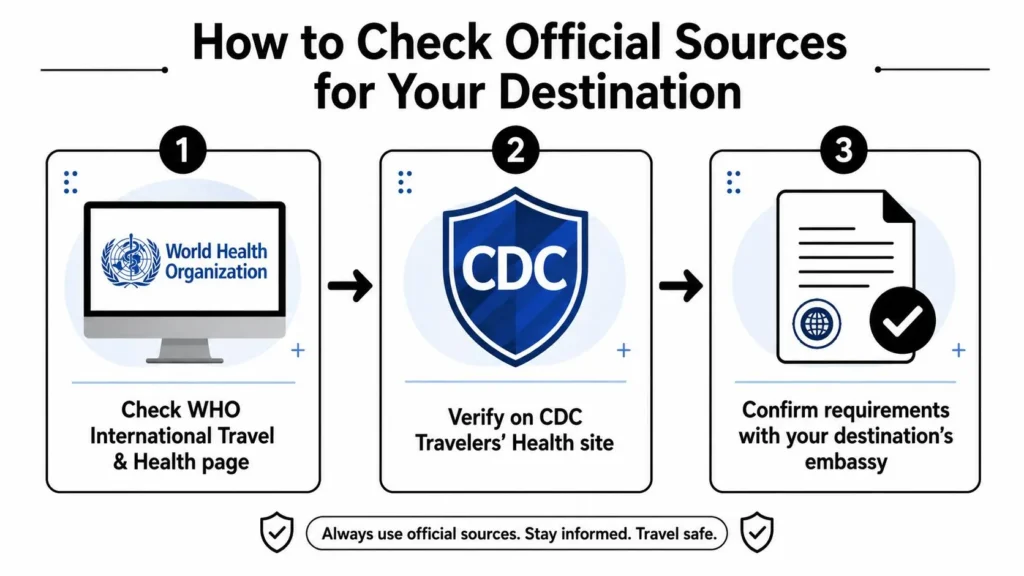
Start with WHO for entry rules
The WHO country information lists yellow fever entry requirements and recommendations. Use its guidance to check whether your destination asks travelers arriving from risk countries for proof, whether transit through a risk country counts, and whether the rule applies to every arrival or only to particular routes.
Treat the route like a chain. A weak link, such as a connection, can change the document question even if you remain inside the airport. The CDC explains that some countries apply yellow fever requirements after transit through a risk country for more than 12 hours, while others use different arrival categories. (CDC country-specific yellow fever information)
Use CDC for medical recommendations
After checking the legal entry rule, review CDC Travelers’ Health information and Yellow Book material for medical advice. This second review may cover food and water exposure, rural travel, animal contact, insects, and other risks created by your itinerary. These recommendations protect your health, but they usually do not replace a yellow fever entry certificate when a country requires one.
For any online travel-health page, check who issued it, when it was updated, whether it addresses your destination, and whether it separates recommendations from requirements. The same method applies to finding credible sources for research.
Confirm unusual or changing cases
Routes with several countries, long airport connections, or recent changes deserve direct confirmation. Contact the destination’s embassy or consulate, and ask an authorized travel clinic to review every country, airport, and transit duration. A general country list may not reflect the details of your final route.
Save the official guidance you consulted and your clinic’s contact details. If an airline employee questions your documents, organized records can help identify whether the problem concerns certificate validity, route eligibility, or a misunderstanding. WHO guidance can support the initial check, while the embassy or carrier can clarify a rule that appears to have changed.
Timing, Boosters, and the 2016 Lifetime Change
Your yellow fever certificate may look outdated even though it remains valid. A traveler vaccinated years ago might see an old date, assume the document expired, and book an unnecessary appointment. Check the certificate before arranging another dose.
On 11 July 2016, the International Health Regulations changed yellow fever ICVP validity from 10 years to the lifetime of the vaccinated person. The change also removed booster vaccination as an entry condition and applies to certificates issued before 2016. The WHO and CDC discussion of the IHR change explains this transition.
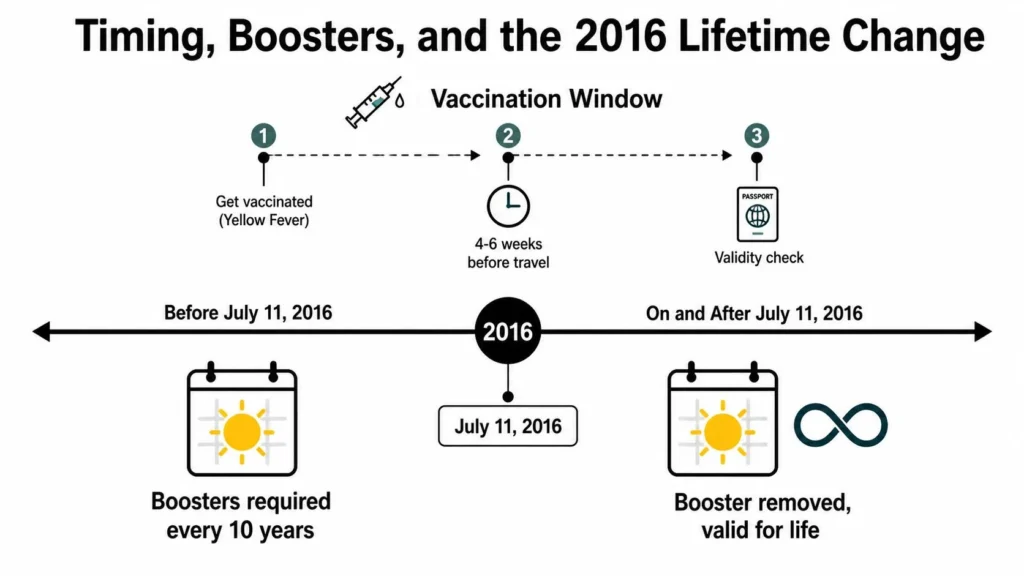
A last-minute departure
A flight leaving fewer than 10 days after vaccination creates a timing problem. The certificate is not yet valid for entry during that interval, as described in the CDC 2026 Yellow Book guidance.
Your clinician may advise changing the departure date or route rather than relying on uncertain documentation. Airlines can check travel documents before boarding, so an issue may stop the trip before you reach the border. Confirm the timing before leaving for the airport.
When vaccination isn’t appropriate
Yellow fever vaccination is not suitable for every traveler. Pregnancy, immunocompromising conditions, and other medical circumstances call for an individualized discussion with an authorized clinician. The appropriate plan might involve rescheduling, changing the itinerary, avoiding a risk area, or requesting a medical waiver.
An authorized clinician can issue a medical waiver on the ICVP when vaccination is contraindicated. Destination authorities may or may not accept it, so verify that rule before depending on the waiver. The CDC 2026 Yellow Book also addresses this decision and the documentation involved.
A waiver is a border document, not a guarantee that every country will accept your medical explanation.
What the lifetime rule doesn’t change
Lifetime validity does not remove the need to check current destination requirements. A certificate may still be required for a new itinerary, a connection through a risk country, or an arrival category that did not apply on an earlier trip.
The rule also does not prevent a clinician from discussing another dose for medical reasons. Its practical meaning is narrower: routine revaccination solely because the certificate is old isn’t the default entry solution. Verify the route and ask a qualified travel-health professional about your circumstances.
Where to Get Vaccines, Costs, and Insurance
Start with a travel-health clinic, primary care office, or pharmacy that provides travel services. Availability differs by location, and not every provider stocks every travel vaccine. Call before scheduling if your itinerary includes less commonly requested vaccines, because the clinic may need to arrange supplies.
For yellow fever, choose an authorized vaccination center. The center that administers the vaccine and validates the ICVP matters because an ordinary receipt or an unofficial record may not satisfy entry checks.
Planning the financial side
Travel vaccination costs vary by provider, region, consultation model, vaccine, and the number of people traveling. Some clinics charge separately for the appointment and each vaccine, while others use a bundled travel consultation. Ask for an itemized estimate before the visit so you know what the consultation, administration, certificate, and any follow-up involve.
Insurance coverage also varies. Many domestic health plans don’t cover vaccines given solely for international travel, although some preventive services may be covered under an individual policy. Ask your insurer before the appointment, and check whether your plan permits payment through an HSA or FSA.
For broader trip preparation, review guidance on choosing travel insurance for international trips. Insurance won’t replace a required certificate, but it can be part of a sensible plan for medical care and travel disruption.
Pack for health, not just entry
A small medical kit can complement your vaccination plan with supplies for routine problems, wound care, and personal medications. If you’re comparing options, you can browse the Travel Series kit from Adventure Medical Kits as one example of a travel-oriented kit.
Bring your vaccination history, medication list, allergy information, and planned route to the appointment. That information helps the clinician distinguish what you already have from what your trip may require.
Pre-Trip Checklist and Common Border Questions
A traveler can have the right vaccine and still face a border problem if the route, certificate, or timing does not match the destination’s rule. Use this checklist to separate an entry document from general health preparation:
- Confirm the full route: Record every destination, airport connection, and transit period. A stopover may affect yellow fever requirements, depending on the country’s rules.
- Check official guidance: Review the applicable entry requirements and destination health recommendations. As noted earlier, yellow fever is the vaccine requirement most directly tied to international entry rules.
- Book the appointment early: Allow time for clinical advice, vaccination, certificate processing, and any follow-up.
- Check the validity window: A yellow fever ICVP becomes valid 10 days after vaccination. A last-minute appointment may therefore leave an entry gap.
- Protect the original: Carry the stamped ICVP with your passport. Store a photocopy and a secure digital image separately.
- Ask about exceptions: Discuss pregnancy, immune conditions, children, medical waivers, and changed routes with an authorized vaccination center.
- Know how to replace records: If the certificate is lost, contact the clinic or authorized center that issued it and ask about verification or reissuance.
The certificate works like a key for a specific border rule. It does not replace routine medicines, food and water precautions, or other health planning. A broader guide to staying healthy while traveling can help organize those preparations.
At the border, present the original certificate with your passport. If an officer questions it, ask whether the issue concerns the stamp, vaccination date, route, or destination category. For documents and practical departure tasks, consult Expat Global Medical’s relocation tips.
maxijournal.com publishes approachable guidance on health, travel, science, and everyday topics. Visit maxijournal.com for practical explanations that support informed trip planning.
Discover more from Maxi Journal
Subscribe to get the latest posts sent to your email.