About 20% to 21% of new U.S. businesses fail in the first year, about 49% to 50% fail within five years, and roughly 65% to 65.3% fail within 10 years. A useful business startup checklist helps reduce avoidable risk by moving in order: validate the opportunity, formalize the business, control finances, prepare operations, build the launch system, and review results.
Turn a Startup Idea Into a Launch Plan
A startup checklist matters because business tasks depend on one another. Choosing expensive software before confirming demand, hiring before defining the offer, or accepting payments before setting up records can waste cash and create legal or operational problems. The failure benchmarks commonly summarized from U.S. Bureau of Labor Statistics data show why early discipline matters, with cash flow, compliance, and customer validation carrying more weight than a polished idea alone (Chamber of Commerce small-business statistics).
This guide treats the checklist as an operating document, not a motivational worksheet. You’ll create a validation brief, a dated compliance folder, a startup budget, a launch calendar, and a risk log. Requirements vary by country, state, city, industry, and business structure, so use this plan to organize questions for qualified legal and tax professionals rather than treating it as jurisdiction-specific advice.
The order is deliberate. Customer evidence should shape the offer, the offer should inform the legal and financial setup, and the operating system should work before you promote it widely. Each step below includes a practical deliverable, a decision, a timing cue, and a warning about what commonly goes wrong.
1. Validate the Business Idea and Define the Customer
Demand evidence should shape the offer before branding or product development. Define the problem, the specific customer affected, the alternatives they use, your proposed solution, and the first offer a buyer can understand quickly.
Use this one-sentence validation brief:
Customer: [specific audience]
Problem: [recurring, costly, or frustrating problem]
Promise: [specific result or experience]
Next step: [inquiry, signup, preorder, or paid pilot]
Interview people who match the audience, not only supportive friends. Record their exact objections, current workarounds, urgency, buying authority, and reasons for delaying. For example, maxijournal.com could compare reader interest across science, technology, health, business, arts, and entertainment before selecting its first editorial categories.
Choose one validation signal
Select a signal that matches the action the business needs. A qualified inquiry tests a service, a preorder tests a product, and a signup tests interest in a publication or newsletter. Positive comments are useful context, but they are not commitments.
Set a decision date before research begins. At that point, continue, narrow the audience, change the offer, or stop. A defined deadline keeps research from replacing the commercial decision.
Create a spreadsheet with columns for person or organization, customer segment, problem mentioned, current alternative, objection, requested outcome, and next action. Keep the first test small enough to complete quickly. Do not build a full website or complex product until the chosen signal appears. The deliverable is a completed validation brief, interview log, and decision record that can guide the next setup tasks.
2. Choose the Legal Structure and Complete Registration
Once the direction is clear enough to test commercially, formalize the venture. Compare a sole proprietorship, LLC, corporation, partnership, or another available structure with a qualified attorney or accountant. The right choice depends on liability exposure, ownership, tax treatment, funding plans, administrative burden, and where the business operates.
Registration is only one part of readiness. Your compliance folder should contain formation documents, registrations, permits, tax identifiers, contracts, insurance records, website terms, privacy documentation, and renewal confirmations. The IRS startup checklist also highlights practical setup questions involving an EIN, payroll, I-9 and W-4 processes, and the choice of a tax year.
Build a compliance calendar
List every jurisdiction where you operate, sell, hire, store data, or deliver services. Then assign an owner and due date for each filing, renewal, report, payment, and review. A shared calendar is useful, but it shouldn’t replace stored evidence that a filing or renewal was completed.
For an independent web publication, this may include contributor agreements, website terms, privacy documentation, advertising disclosures, and records of registrations. Keep personal and business records separate from the beginning, even if the operation is small.
Don’t copy a generic online template into a high-risk contract without review. Have a qualified professional examine agreements involving employees, intellectual property, customer data, regulated services, equity, or unusual liability terms.
3. Build the Financial Control System and Startup Budget
A startup budget isn’t a wish list. It’s a cash-control model showing what you must pay, when money arrives, which assumptions support the forecast, and how long the business can operate if sales take longer than expected.
Separate one-time setup costs, recurring expenses, variable costs, taxes, payment fees, contractor or contributor payments, and expected revenue. For a publication, hosting, software, contributor payments, promotion, and sponsorship income should be modeled separately rather than collapsed into one revenue line.
Use three spending columns:
- Essential now: Costs required to operate legally or deliver the initial offer.
- Useful later: Purchases that improve capacity but aren’t launch blockers.
- Optional: Items that can wait until demand justifies them.
Review planned, committed, and paid expenses each week during the launch period. Document the assumption behind every forecast, including customer volume, price, payment timing, refund exposure, and supplier cost. Ask an accountant about local tax obligations instead of guessing.
A focused business plan guide can help organize the model, but it shouldn’t replace a live cash-flow sheet. The same discipline supports growth and compliance for UAE startups, where founders also need clear records and jurisdiction-specific guidance.
Set up the money trail before launch
Open suitable business banking, choose bookkeeping software, create an expense categorization policy, and decide who approves payments. Reconcile transactions on a defined schedule. A spreadsheet can work at the beginning if someone maintains it consistently, but disorganized records become expensive when tax filings, payroll, partners, or investors enter the picture.
4. Protect the Brand, Content, Data, and Intellectual Property
A business can own its name and still lose control of its content. Before publishing, commissioning, or distributing material, define who owns the work, what license the business receives, how attribution works, whether editing is permitted, and whether the creator can reuse the material elsewhere.
Create a rights record for every important asset. Store the contributor agreement, invoice, permission email, license terms, source URL, attribution requirements, and approval notes with the article, campaign, design, photograph, video, or audio file.
Add rights checks to the production workflow
A practical content-rights checklist asks:
- Ownership: Who created the asset, and who owns it after payment?
- Permission: Is commercial use, editing, distribution, and republishing covered?
- Attribution: What credit must appear, and where?
- Evidence: Can the team locate the permission or license later?
- Escalation: Who handles a complaint, takedown request, or dispute?
Contributor agreements should also address payment, deadlines, revisions, rejection, confidentiality, and reuse. Train contributors not to copy material or use images without permission just because an asset appears online.
Protect brand assets by recording approved logos, names, design files, and usage rules. Protect customer and contributor data by limiting access to people who need it. Complex ownership disputes, trademark questions, privacy incidents, and takedown demands deserve qualified legal advice rather than an improvised response.
5. Set Up the Website, CMS, Security, and Core Operations
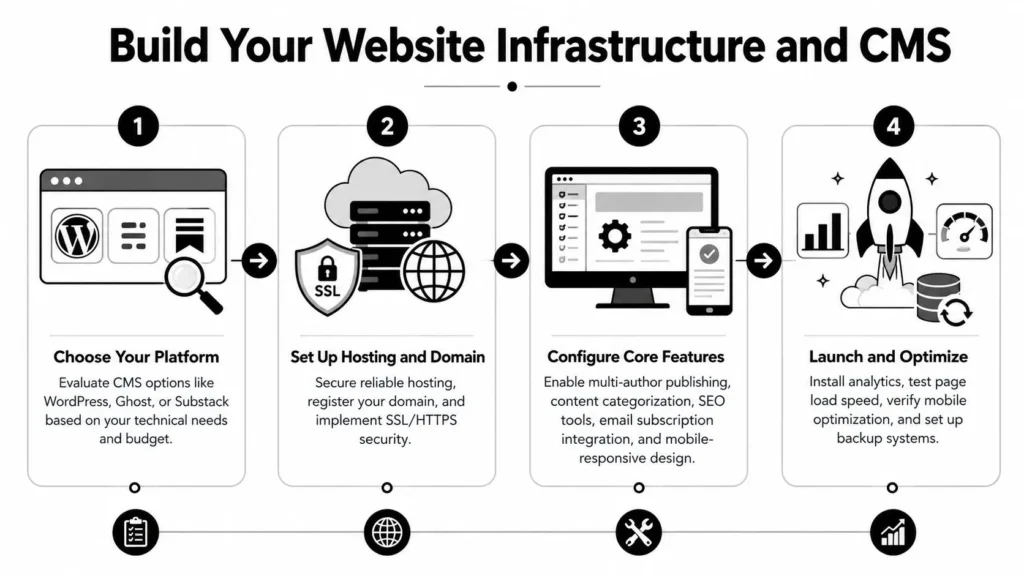
Build the smallest system that can deliver the initial offer reliably. A content management system should match the workflow, not the founder’s preference. WordPress.org may suit a flexible publication with many integrations, Ghost may fit a publication-centered workflow, and Substack may suit a newsletter-first model. A lean site can validate demand before advanced features add maintenance work.
Map the complete path from idea or order to delivery and support. Identify where a customer submits information, where a team member approves it, how payment is processed, how an email is sent, and what happens when something fails.
Test the critical path
Before public promotion, test:
- Forms and payments: Submit real test entries and confirm notifications, receipts, and records.
- Mobile pages: Check navigation, typography, media, checkout, and signup on a phone.
- Email delivery: Verify confirmation, welcome, password-reset, and support messages.
- Analytics readiness: Confirm that important actions are recorded without collecting unnecessary data.
- Backups: Restore a backup in a test environment rather than assuming backup status means recovery is possible.
- Access control: Remove unused accounts and restrict administrative permissions.
Use the fewest plugins, integrations, and permissions necessary. Write a short incident checklist for an outage, broken form, compromised account, or failed payment. Website privacy work should be specific to the data collected and the audiences served. This GDPR compliance guide for websites can help frame that review, but local requirements still need professional interpretation.
6. Prepare the Offer, Delivery Workflow, and Quality Standards
Customers don’t experience your business plan. They experience the offer, the delivery process, the quality of the result, and the way you handle problems.
Define the minimum viable offer in one page. State what the customer receives, what isn’t included, how long delivery takes, how revisions work, what information the customer must provide, how payment works, and who owns each approval. For a publication, the equivalent may include submission, editing, fact-checking, image-rights review, formatting, scheduling, publishing, and corrections.
Run one complete test cycle
Use a real or representative case and move it through every stage. Record the time required, missing information, unclear instructions, avoidable rework, and points where ownership is ambiguous. Then revise the checklist before accepting broad demand.
A useful quality standard defines what must be true before delivery or publication:
- Accuracy: Required facts, names, links, and claims have been checked.
- Completeness: The agreed scope is present, and exclusions are clear.
- Consistency: Formatting, tone, file naming, and customer communications follow the same rule.
- Approval: The designated owner has reviewed the final version.
- Recovery: The team knows how to correct, refund, replace, or republish when something goes wrong.
Assign one person to every approval step. Shared responsibility often means no one notices a missed check. Keep a change log for recurring errors, and turn repeated mistakes into workflow rules rather than relying on memory.
7. Recruit Contributors, Suppliers, or Delivery Partners
External relationships become launch dependencies as soon as someone else controls a deliverable, deadline, payment, or customer-facing experience. Choose contributors, suppliers, contractors, and delivery partners against written criteria instead of selecting the first available option.
Create a partner sheet with the organization or person, role, scope, contact details, agreement status, payment terms, deadlines, dependencies, and backup option. Provide a written brief for every assignment. It should explain the audience, outcome, format, acceptance criteria, delivery date, revision process, rights, and payment.
Protect the launch from single points of failure
Start with a small group that matches the initial offer. A large network can create coordination overhead before demand exists, while too few partners can leave the launch exposed if one person becomes unavailable.
Set response and review timelines before accepting work. Pay and credit people according to documented terms. For sales-led startups, a clearly defined SDR hiring process can support prospecting, but the role should be added only after the offer, target customer, qualification rules, and follow-up process are clear.
Practical rule: If a launch-critical task has no named owner and no backup, it isn’t ready.
Keep onboarding simple. Give each partner access only to the files, systems, and customer information needed for the assignment. Review performance against quality, reliability, communication, and commercial fit, not just output volume.
8. Create the Marketing, Newsletter, and Community Launch System
Don’t open every channel at once. Choose one primary audience, one core message, and one conversion action for launch. That action might be a newsletter signup, consultation request, purchase, submission, or qualified inquiry.
Build a short launch calendar around the same core promise. Adapt the presentation to each channel, but don’t create separate strategies that the team can’t maintain. A publication might begin with a weekly digest, then adapt science or technology stories for professional networks and use visual formats for arts, fashion, or entertainment audiences.
Prepare the retention path
Write the welcome email, confirmation message, support response, and follow-up sequence before promotion starts. Define who answers community questions, what topics require escalation, and how objections are recorded for future content.
Keep survey and feedback requests short. The provided benchmarks indicate typical response rates of 20% to 25% for email, 20% to 30% for in-app surveys, and about 35% for SMS, while surveys with one to three questions can reach 83.34% completion (Census Business Formation Statistics). Treat these as planning benchmarks, not guarantees. Use the channel your audience checks regularly, and ask only what you’ll use.
A focused digital marketing plan for startups can help define channel roles, content production, and conversion paths. Track questions and objections in the same research file used during validation. Marketing should improve your understanding of demand, not merely produce activity.
9. Set Launch-Day Controls and Run a Soft Launch
Launch day should be a controlled release, not the first system test. Complete a final readiness review covering the offer, website, forms, payments, support coverage, legal notices, analytics, communications, and contingency contacts.
Run the complete path yourself. Discover the business, read the key page, submit a form or place a test order, receive the confirmation, access the delivery, and contact support. For a publication, test article links, newsletter signup, contributor forms, mobile layouts, and analytics before announcing broadly.
Release to a limited audience first
A soft launch gives the team a contained environment for finding broken links, confusing instructions, missing emails, weak quality checks, and unanswered questions. Record each issue with a timestamp, owner, severity, and next action.
Assign one person to monitor operations and another to handle communications when possible. Prepare a short status message for delays or errors. Don’t change several major variables during the first test, or you won’t know which change affected the outcome.
Keep a launch log with decisions, incidents, fixes, customer questions, and unresolved risks. Expand only after the critical path works consistently enough to protect customers and the team from avoidable confusion.
10. Measure Results, Improve the Model, and Avoid Common Pitfalls
The first launch cycle should test assumptions and produce decisions. Compare customer response, conversion, delivery quality, engagement, cash movement, support requests, and retention signals with the validation brief and startup budget.
Set decision metrics before launch. A publication can track category engagement, newsletter response, contributor submissions, correction requests, and sponsorship inquiries. A service business can track qualified inquiries, accepted proposals, delivery time, revisions, payment timing, and repeat requests. Record each metric, its data source, review owner, and threshold for action.
Turn findings into decisions
Classify each issue as urgent, important, or experimental. Assign an owner and next action, then decide whether to continue, fix, stop, or test. Qualitative feedback belongs beside the numbers. A low-volume objection may expose a serious positioning, quality, or compliance problem.
A busy launch does not prove demand. Customers must understand the offer, take the intended action, receive the promised value, and remain willing to return or recommend it.
Review the budget against actual cash movement. Recheck pricing, delivery effort, acquisition path, and operating burden. Recent startup commentary points to product-market-fit problems, difficulty reaching cash-flow positive, fundraising constraints, and fragile AI-native models without defensible data advantages (startup failure rates in 2025). Add a pricing test, distribution test, and moat review using a business impact assessment framework, rather than relying on a static business plan.
Run a weekly operating review and a deeper monthly review. Keep a decision log with results, assumptions changed, costs approved, and experiments deferred. Document what you will not pursue yet. That boundary protects cash, quality, and attention while the model is still being tested.
10-Point Startup Checklist Comparison
| Stage | Implementation complexity | Resource requirements | Expected outcomes | Ideal use cases | Key advantages |
|---|---|---|---|---|---|
| Validate the Business Idea and Define the Customer | Low–Medium, interviews & hypothesis tests | Low, time for interviews, basic tools | Demand signal, refined target, testable offer | Early-stage idea validation, pre-launch market fit | Reduces risk of building unwanted product; sharper messaging |
| Choose the Legal Structure and Complete Registration | Medium, legal choices and filings | Medium, fees, professional advice, admin time | Registered entity, compliance records, contracts | When formal operations, banking, or partners are needed | Legal protection, clearer obligations, banking readiness |
| Build the Financial Control System and Startup Budget | Medium, forecasting and bookkeeping setup | Medium, accounting tools, possible accountant, time | Cash-flow forecast, budget, bookkeeping workflows | Launch budgeting, fundraising readiness, cash management | Prevents cash shortages; prioritizes spending decisions |
| Protect the Brand, Content, Data, and Intellectual Property | Medium–High, agreements and monitoring | Medium, legal review, rights-tracking tools, staff time | Ownership records, permission workflow, takedown process | Multi-author publications, licensing, third-party assets | Reduces disputes; enables licensing; clarifies contributor rights |
| Set Up the Website, CMS, Security, and Core Operations | Medium–High, technical configuration & testing | Medium, hosting, developer or specialist, security tools | Live CMS, secure hosting, backups, analytics | Publishing platforms, storefronts, multi-contributor sites | Reliable delivery, discoverability, repeatable workflows |
| Prepare the Offer, Delivery Workflow, and Quality Standards | Medium, SOPs and approval processes | Low–Medium, documentation time, process tests | MVP offer, SOPs, quality checks, delivery rules | Service delivery, editorial production, subscription offers | Consistent quality; easier delegation; less rework |
| Recruit Contributors, Suppliers, or Delivery Partners | Medium, sourcing and onboarding processes | Medium, recruitment time, contracts, compensation | Contributor pipeline, documented roles, backup coverage | Scaling content production, outsourcing, specialist services | Expands capacity and expertise; reduces single-person dependence |
| Create the Marketing, Newsletter, and Community Launch System | Medium, strategy, content, and channel setup | Medium, content production, ESP, possible ad spend | Audience pipeline, conversion flows, engagement plan | Audience acquisition, subscriber retention, community growth | Measurable acquisition; direct relationships; repeatable campaigns |
| Set Launch-Day Controls and Run a Soft Launch | Low–Medium, readiness checks and staged release | Low, test audience, monitoring, contingency plans | Verified readiness, issue log, controlled public rollout | First public launch, risk-managed releases, product launches | Identifies failures early; enables fixes before broad exposure |
| Measure Results, Improve the Model, and Avoid Common Pitfalls | Medium, analysis, reviews, experiment backlog | Low–Medium, analytics, review time, documentation | Prioritized improvements, validated assumptions, 30/60/90 plan | Post-launch iteration, growth optimization, retention work | Data-driven decisions; prevents premature scaling; repeatable rhythm |
Your First 90 Days Start With the Next Checkbox
A business startup checklist becomes useful when it controls decisions. Begin by writing the validation brief, identifying the customer, defining the first testable offer, and choosing the signal that will determine whether you continue. Don’t spend heavily on branding, advanced technology, or broad promotion before you know what the audience understands and values.
Next, formalize the legal and financial base. Choose a structure with qualified guidance, complete the registrations and permits relevant to your activities, create the compliance folder, open appropriate banking, establish bookkeeping, and document taxes, payment timing, and spending assumptions. The business should be able to explain who owns the work, who can approve payments, which filings are due, and how customer or contributor data is handled.
Then build the minimum reliable operation. The website, CMS, forms, payments, email, backups, support process, offer, quality checks, and delivery workflow should work together before the public launch. An intricate stack won’t compensate for unclear ownership or an untested process. If a simple system delivers the offer safely and consistently, keep it simple until real demand justifies complexity.
Prepare the audience and launch controls after the operating path is ready. Select a primary conversion action, write the welcome and support messages, create the launch calendar, assign channel owners, and run a soft launch. Record defects rather than hiding them, fix the highest-impact problems first, and avoid changing multiple major variables at once.
Create one tracker with these columns:
- Task: The specific deliverable, not a vague intention.
- Owner: The person responsible for completion.
- Dependency: The task that must happen first.
- Due date: A realistic date tied to launch needs.
- Status: Not started, active, blocked, or complete.
- Evidence: The file, receipt, approval, or test result proving completion.
- Risk: What happens if the task slips.
Identify the three tasks that block everything else and schedule them first. Then put the first post-launch review on the calendar before launch day arrives. Compare actual customer behavior, delivery quality, cash position, support requests, and retention signals with the assumptions you recorded during validation and budgeting.
The early failure benchmarks are a reminder to manage preventable risk, not a forecast of your individual outcome. A checklist won’t create demand or remove competition, but it can stop a founder from overlooking registration, tax setup, cash control, rights management, security, quality, or customer follow-up. Requirements depend on your business and jurisdiction, so seek professional legal and tax advice where the consequences of guessing are serious.
Start with the next checkbox today. Write the validation brief, assign its owner, set the decision date, and refuse to add the next expense until the first evidence-based question has an answer.
maxijournal.com offers an independent web-based magazine, journal, and blog covering business alongside science, technology, health, arts, education, tourism, entertainment, and other categories. Visit maxijournal.com to explore publishing opportunities, discover practical business content, or consider how a contributor and editorial workflow could support your startup’s online presence.
Discover more from Maxi Journal
Subscribe to get the latest posts sent to your email.