You’re trying to launch a report, reconcile a customer list, or answer a compliance question, and three different teams hand you three different versions of the truth. One file lives in a shared drive, another in a dashboard nobody fully trusts, and the third sits in a spreadsheet with no owner and no explanation. That’s the moment data governance frameworks stop being an abstract idea and start looking like the difference between control and confusion.
A good framework gives business teams a way to know what data exists, who can use it, how it should be handled, and how problems get fixed. It also matters more now because governance has to work across internal systems, partner ecosystems, and AI workflows, not just inside one database. If you need a practical starting point for the compliance side of that reality, the guide on GDPR compliance for websites shows how governance questions surface in day-to-day operations.
Trust is the outcome. If people can’t trace a dataset, classify it correctly, or understand who owns it, every report built on top of it becomes harder to defend.
Why Data Without Governance Quickly Becomes a Liability
A business can run for a long time on inherited spreadsheets, informal naming habits, and a few heroic employees who “just know where everything is.” Then a launch gets delayed because sales, finance, and operations each have a different customer count. Or a compliance review starts, and nobody can explain which copy of a file is the approved one.
That’s not a tooling problem first. It’s a governance problem. A data governance framework exists to turn scattered data handling into a repeatable operating model, so teams stop guessing which dataset is current, sensitive, or ready to use.
The pressure is bigger than internal reporting. Organizations also have to handle privacy obligations, security review, lineage questions, and, increasingly, AI use cases where training data, prompts, and outputs all create new accountability concerns. Without a framework, each team invents its own rules, and those rules rarely line up.
Governance matters because the cost of uncertainty grows every time data moves. A file passed from one team to another, or from a company to a partner, can lose context fast. Once that happens, the business spends more time defending numbers than using them.
If your organization is already dealing with inconsistent definitions, missing ownership, or a scramble before audit season, you’re not late to governance. You’re in the exact place where a framework becomes useful.
What Data Governance Frameworks Are and How They Work
A finance team is trying to reconcile customer records, while the sales team is using a different export, and a partner still has last quarter’s file. A data governance framework exists to stop that kind of drift. It gives the organization a shared way to define data, assign responsibility, set rules, and verify that the rules are being followed.
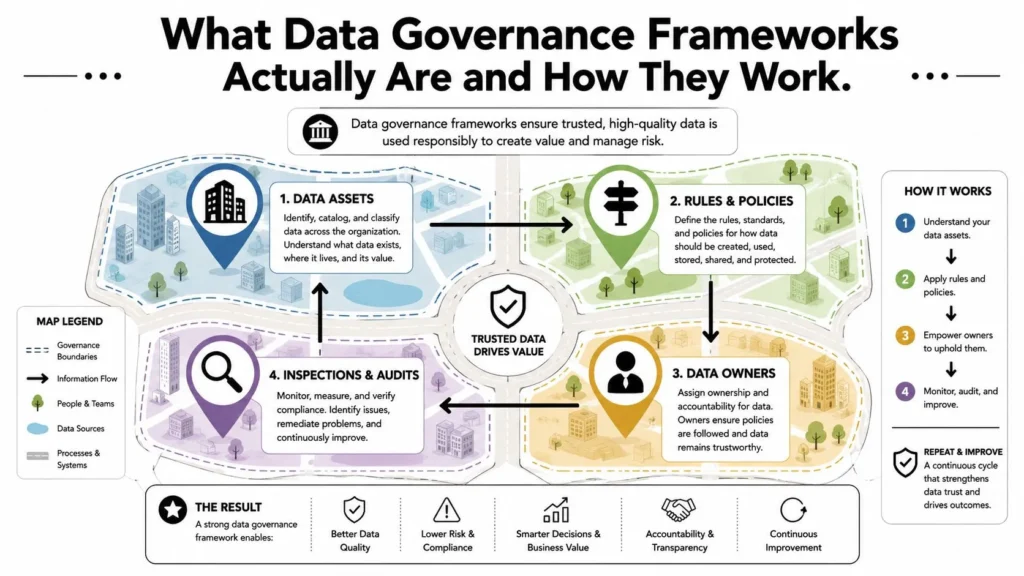
The point is broader than housekeeping inside one department. Frameworks usually grow from specific legal, policy, or institutional needs, which is why the United Nations system’s comparison of data governance frameworks is useful. It shows that the field is made up of different approaches, not a single universal template, and that organizations tend to anchor governance to the rules and obligations that apply to them (UN comparison of data governance frameworks).
What a framework governs
A framework is more than a policy memo. It usually brings privacy, security, stewardship, lineage, and accountability into one operating model, because those concerns overlap in daily work. If customer data is classified as sensitive, that label should shape access, retention, sharing, and audit handling.
Scope has to be explicit. If a framework does not say what it governs, people will fill the gap in different ways. One team may apply it only to structured tables, while another assumes it also covers documents, logs, and AI training data.
That wider scope matters in partner workflows too. Data often moves between vendors, agencies, and platforms, so governance has to work across organizational boundaries, not only inside one company. The same logic applies to AI systems, where training data lineage, prompt handling, and model compliance all need clear ownership and review.
For a practical look at how this shows up in product-heavy environments, the retail PIM DAM use cases page is a useful reference because it ties governance to product and digital asset workflows instead of treating it as a purely abstract policy exercise.
Why scope and anchors matter
Strong frameworks start with anchoring documents, the policies, standards, or mandates that justify the rules. That is how teams keep the framework tied to business and legal reality, instead of letting it drift into a document nobody can apply.
Practical rule: if two teams can read the same framework and walk away with different data scopes, the framework is too vague to govern anything reliably.
That is the useful mental model. A framework is the rule system, the operating map, and the accountability layer all at once. If one of those pieces is missing, you do not have governance, you have documentation.
Core Building Blocks Every Strong Framework Shares
The strongest frameworks usually fail or succeed for the same reason, they either turn policy into controls or they don’t. A document that names principles but never reaches workflows, metadata, and audit evidence won’t hold up when teams need to act. A technically sound data governance framework is usually built around a closed-loop operating model: discovery, definition, application, and measurement (Imperva on data governance).
The five control domains that make governance real
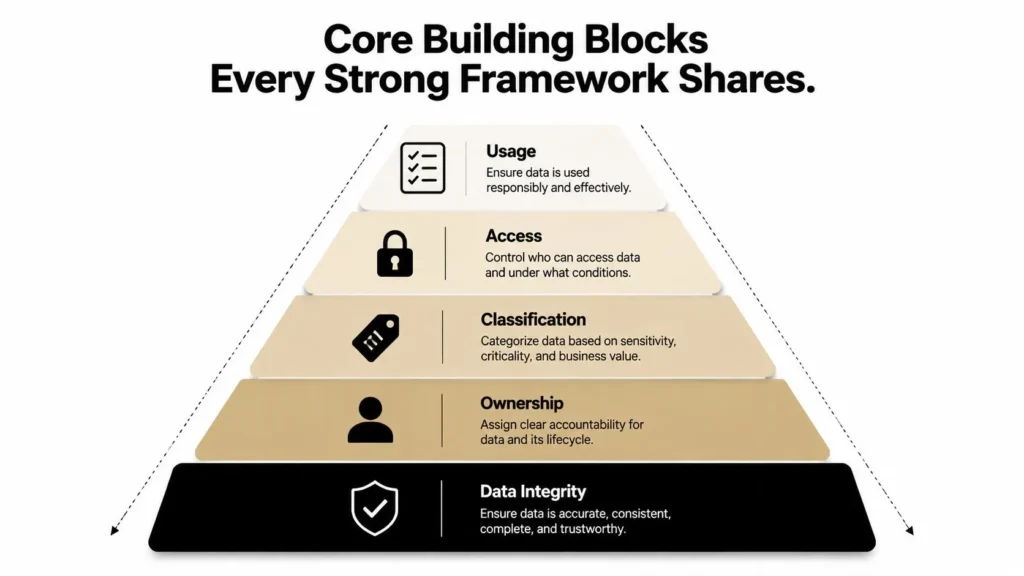
High-performing frameworks consistently require explicit control domains at the asset level: ownership, classification, access, usage, and integrity (Dataversity on data governance frameworks).
- Ownership names who is accountable when a data asset changes, breaks, or needs approval.
- Classification labels sensitivity and business importance, which then shapes handling rules.
- Access decides who can see or change the data.
- Usage defines what the data may be used for, which matters when data gets repurposed across teams.
- Integrity checks whether the data is trustworthy enough for analytics, reporting, or regulatory use.
Those controls are linked. Classification drives access. Integrity drives validation. Ownership drives escalation. If one control is missing, the others get weaker because no one knows who should act.
The operating loop behind the controls
Discovery means mapping what you have, not what people think exists. Definition turns that inventory into policies, taxonomies, and ownership rules. Application embeds those rules into the systems and workflows where people work every day. Measurement checks whether the rules are being followed and whether the data outcomes are improving.
That loop matters because it keeps governance from turning into a binder on a shelf. Governance works when a business user requests access, a steward reviews the request, the system applies the rule, and the result can later be audited.
For a deeper look at how quality and integrity concerns show up in practice, the Resultplan data integrity analysis is a useful companion piece because it treats integrity as an operational issue, not just a theoretical one.
Comparing Leading Data Governance Frameworks and When to Use Each
Choosing a framework is less about finding the fanciest name and more about matching the model to your operating reality. A regulated enterprise, a data-mesh organization, and a partner ecosystem need different levels of structure, speed, and coordination. The useful question is not “Which framework is famous?” It’s “Which framework fits our maturity, risk profile, and sharing model?”
A high-level comparison helps, because frameworks tend to differ on how much they prescribe roles, controls, and standards. The core control domains still matter, but some models lean toward broad guidance while others are more operational and measurement-heavy (Dataversity on data governance frameworks).
| Framework | Primary Focus | Best Fit |
|---|---|---|
| DAMA-DMBOK | Broad governance knowledge, roles, and data management disciplines | Large organizations that want a common language and wide coverage |
| DGI Framework | Governance operating model, accountability, and decision rights | Teams that need strong role clarity and organizational alignment |
| DCAM | Capability maturity and assessment | Organizations that want to benchmark and improve governance over time |
| Government-anchored models | Policy alignment, mandate-driven scope, and compliance traceability | Public-sector or highly regulated environments |
| AI-layered governance | Data standards plus model training, lineage, and compliance exposure | Teams building AI on top of governed data |
The Averta tool policies framework is worth reviewing if your governance problems sit close to platform controls, since it shows how policy can be translated into product and tooling rules instead of staying at a policy-only level.
How to read the tradeoffs
A broad framework helps when your organization is still agreeing on terms. A more prescriptive one helps when you already know the domain owners, the sensitive data categories, and the approval flow. In other words, maturity changes the answer.
If your business runs a mixed environment, with central standards and local execution, a federated approach usually fits better than a rigid top-down model. That’s also why the AI governance compliance guide matters here, because AI programs need data governance underneath them before AI-specific controls can work.
Decision filter: choose the framework that matches your weakest operational gap first, not the one with the most impressive brand name.
That approach keeps the selection grounded. If your main issue is ownership, don’t start with a maturity model that assumes ownership already exists. If your biggest challenge is AI lineage, don’t settle for a framework that stops at traditional database controls.
Putting a Framework Into Practice Without Overcomplicating It
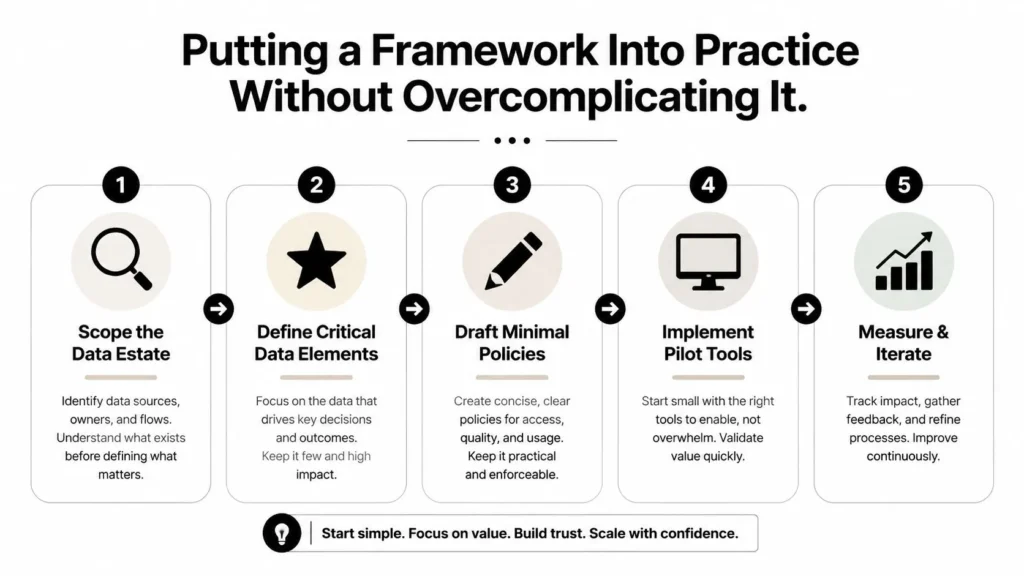
Many teams overbuild governance at the start. They create long policy libraries, too many committees, and a vocabulary nobody outside the data team uses. A simpler rollout works better, especially when the goal is to prove value before asking for more structure.
Start with the data that causes friction
Begin with the data estate that shows up in reporting, compliance, customer operations, or AI projects. If the business cannot agree on a customer record, a product attribute, or a supplier field, that is the right place to start. A small, visible win teaches people that governance removes friction instead of adding it.
From there, define the minimum set of business terms and roles. Owners approve decisions, stewards maintain definitions and resolve issues, and custodians handle the technical environment. The roles should be clear enough that people can point to them in a real workflow, not just in a policy document. A good test is simple: if a dataset changes, can everyone tell who decides, who updates the definition, and who maintains the system?
Embed rules where people already work
Policies do not matter much if users have to leave their tools to apply them. Put the rules into catalogs, access workflows, data quality checks, and approval steps. That way, people do not need to memorize the framework to follow it.
The editorial model in a publisher like maxijournal.com maps cleanly to this structure. The editor is the owner, because the editor has final accountability for what gets published. The contributor is the steward, because that person keeps the content accurate and resolves issues in the draft. The reviewer is the custodian, because the reviewer applies the process checks that keep the system consistent. The comparison works because each role has a distinct decision point, and the process only holds when those decision points are visible. The same logic applies to data, only the content is tables, records, and lineage instead of articles.
Make measurement part of the system
Track whether the framework is improving how data moves through the organization. If the business keeps reopening the same issue, or if people still do not know who owns a dataset, the framework is not embedded enough. Measurement should tell you where the next correction belongs.
A major review found that inter-organizational data governance remains under-researched, which is a reminder that internal rollout alone is not enough (ACM review on inter-organizational data governance). Many programs stop at the company boundary, even though suppliers, platforms, and partners shape the same data lifecycle. That matters because governance has to cover shared definitions, shared controls, and shared accountability across organizations, not only inside one team.
AI adds another layer. If training data lineage is unclear, or if model compliance is handled separately from data governance, the framework leaves a gap where risk can hide. Strong practice keeps those controls connected, so the same governance logic covers the records people use, the datasets models learn from, and the decisions made with them.
Common Pitfalls That Stall Governance Programs and How to Avoid Them
The biggest mistake is treating governance as proof that a policy exists. Policy alone doesn’t tell you where data lives, whether it’s classified, or who is responsible when a dataset changes. Real governance starts earlier, with visibility.
Recent market and adoption data show that in 2026, only 23% of organizations reported using formal data governance or data quality frameworks, with adoption dropping to 14% in financial services and 13% among on-premises organizations (2026 data governance adoption reporting). Those numbers matter because they suggest many teams still haven’t built the minimum control plane for scale.
The warning signs to look for
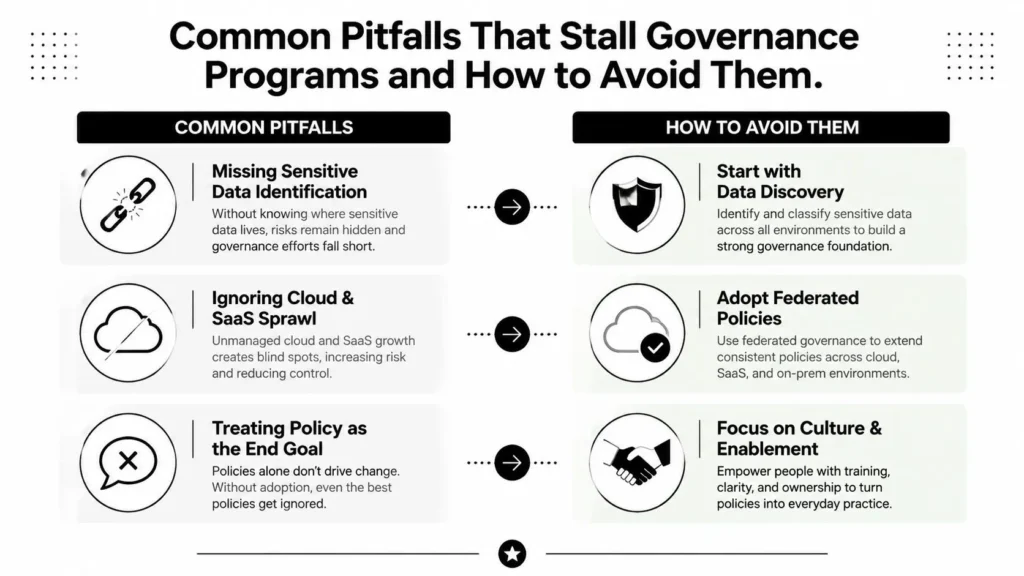
- Missing sensitive data identification means teams can’t confidently say what should be protected.
- Ignoring cloud and SaaS sprawl means data lives in more places than the governance team can see.
- Treating policy as the end goal means the organization celebrates documentation while day-to-day behavior stays unchanged.
Those patterns are common because they feel like progress. A policy goes live, a steering group meets, and a slide deck gets approved. But if nobody can classify the data or connect the policy to actual workflows, the program stalls.
What to do instead
- Start with data discovery so the team knows what exists and where it sits.
- Adopt federated policies when domains need local responsibility under shared standards.
- Focus on culture and enablement so people understand how to use the framework instead of working around it.
Practical rule: if your governance program can’t explain how it handles training data, shared data with a partner, or a dataset stored in a SaaS tool, it’s incomplete.
AI makes the gaps more visible because model training data depends on traceable inputs, and partner ecosystems make ownership less obvious because no single company controls every copy. The teams that avoid trouble usually get ruthless about inventory and classification first, then layer on tooling second.
Your Next Steps to Choosing and Evolving the Right Framework
The right framework isn’t the one with the longest checklist. It’s the one your people can use to make decisions, resolve conflicts, and prove accountability. That’s especially true now that data governance supplies the base layer of standards, ownership, and lineage while AI governance adds AI-specific risk and compliance obligations (data governance and AI compliance).
If you’re a mid-size firm with messy reporting, start with scope, ownership, and classification before buying more tooling. If you’re building AI products, make lineage and training-data handling part of the framework from day one. If you work across suppliers or platforms, design for shared accountability instead of pretending one company can control the full chain.
A simple scorecard helps. Ask whether the framework covers inventory, roles, control domains, workflow enforcement, and measurement. If any of those are missing, the framework may look complete on paper but still fail in practice.
For teams that want a structured way to compare options and make choices, the decision-making frameworks guide offers a useful parallel for evaluating tradeoffs without getting lost in jargon. The same habit helps with governance, because good framework selection is really disciplined decision-making applied to data.
Start small, measure accurately, and revise the framework as the business changes. That’s the fastest path to governance that people trust.
If you want more plain-language guidance on governance, compliance, and practical decision-making, visit maxijournal.com for approachable articles that connect strategy to day-to-day work. You’ll find clear explainers that help business teams, authors, and operators make sense of complex topics without the jargon.
Discover more from Maxi Journal
Subscribe to get the latest posts sent to your email.