A sponsor once offered an online magazine a generous campaign, with one condition. The magazine could keep the money only if it softened a reported piece that mentioned the sponsor’s product problems.
That decision is where editorial independence stops being an abstract value and starts becoming a test of character.
Why Editorial Independence Is Your Publication’s North Star
For a digital publication, the hardest choices rarely arrive wearing a villain’s costume. They often show up as a practical compromise. Adjust the headline. Delay the story. Remove one paragraph. Let a partner review the draft “for accuracy.”

A new contributor may look at that situation and think, “Isn’t this just how publishing works?” Sometimes the confusion comes from a reasonable instinct. Publications need revenue. Writers need editors. Editors need tools, platforms, and distribution. None of that is wrong.
The problem begins when the publication stops serving readers first.
The real question behind every editorial choice
Editorial independence means the people responsible for content decide what to publish, how to frame it, when to run it, and what standards it must meet. They make those decisions because of editorial judgment, not because an advertiser is unhappy, an owner wants a pet topic promoted, or a platform’s incentives subtly influence the newsroom off course.
That’s why I call it a north star. It doesn’t remove hard tradeoffs. It gives you a fixed point when tradeoffs appear.
Consider three common online magazine situations:
- A brand partnership request: The sponsor wants a listicle that looks like an article but reads like an ad.
- A founder preference: An owner asks editors not to cover a topic that conflicts with outside business interests.
- A traffic panic: The team starts choosing stories mainly because a platform might reward them, even when those stories are thin or misleading.
Each case asks the same thing. Who is the publication for?
Practical rule: If a reader would feel misled after learning how a piece was commissioned, edited, or promoted, your editorial independence is already under strain.
Why this matters more for online magazines
Independent online magazines live close to the edge of competing pressures. They don’t have the protective distance that some large legacy organizations built over time. A small team might handle editing, audience growth, partnerships, newsletters, and analytics in the same week.
That makes independence easier to erode by accident.
What protects you isn’t bravado. It’s clarity. You need a working definition, a visible line between editorial and commercial decisions, and a habit of asking who benefits from each change. When that discipline is missing, trust fades. When it’s present, readers can feel it, even if they never use the phrase “editorial independence.”
Understanding the Core of Editorial Independence
The simplest way to understand editorial independence is to picture a firewall. On one side sits the editorial team. On the other side sit revenue, sponsorships, ownership interests, marketing goals, and operational pressures. Both sides matter. But they do different jobs.
If the wall is weak, every commercial concern starts leaking into story judgment. If the wall is too vague, no one knows who has final authority. Then the publication begins drifting. It may still publish often. It may still look professional. But its voice is no longer its own.
What the firewall separates
Editors decide what deserves coverage. They weigh relevance, evidence, fairness, clarity, audience value, and timing.
Publishers and business staff decide how the operation stays alive. They work on sponsorships, subscriptions, partnerships, budgets, and growth.
Advertisers buy access to an audience’s attention under disclosed terms. They do not buy veto power over coverage.
That distinction sounds obvious until someone says, “We’re only suggesting a small wording change.” Small wording changes can carry large ethical consequences.
A publication that curates material especially needs this clarity because selection itself is editorial power. If you work in digital publishing, even deciding what to highlight, summarize, aggregate, or contextualize is an editorial act. That’s one reason discussions about content curation and editorial judgment matter so much.
What editorial independence is not
It isn’t hostility to the business side. Good editors should understand the publication’s economics. Good publishers should respect the publication’s editorial process.
It also isn’t a license for sloppy judgment. Independence doesn’t mean editors can ignore legal review, correction procedures, style standards, or audience feedback. It means those processes exist to improve accuracy and integrity, not to let outside interests reshape the substance of coverage.
A quick comparison helps:
| Function | Proper role | Improper role |
|---|---|---|
| Editorial | Selects, edits, headlines, schedules content | Adjusts coverage to satisfy sponsors or owners |
| Business | Funds operations, sells ads, manages partnerships | Directs story outcomes or suppresses coverage |
| Audience | Offers feedback, criticism, corrections | Determines facts by popularity alone |
The healthiest publications don’t pretend commercial realities are irrelevant. They make sure commercial realities don’t decide what is true, publishable, or newsworthy.
Where people often get confused
The confusion usually comes from collaboration. Editorial and business teams can speak to each other. They should. A sales team can tell editors that a sponsor wants branded content. Editorial can then say yes, no, or yes with strict labeling.
The firewall doesn’t ban communication. It bans control across the line.
The Pillars of Trust and Long-Term Credibility
A publication’s most valuable asset isn’t its CMS, mailing list, or social reach. It’s the belief that readers can trust its judgment. Once that weakens, every headline has to work harder, every correction feels heavier, and every partnership looks suspect.
That’s why editorial independence isn’t a decorative principle. It’s a durable business asset.
Trust is built through visible restraint
Readers notice when a publication refuses easy wins. They may not know the internal debate behind a rejected sponsor demand or a delayed partnership. But they can tell when coverage feels consistent. They can tell when the same standards apply to favored subjects and inconvenient ones.
Contributors notice this too. Strong writers want to publish where their work won’t be bent by hidden interests. Editors want a place where standards are stable. If you create that environment, you attract people who value rigor over noise.
Credibility depends on freedom from outside influence
European media policy gave this principle unusually clear language in the Council of Europe’s 2018 Recommendation CM/Rec(2018)6, which described editorial independence as a “sacrosanct principle” essential for pluralism and stressed that media organizations must be free from external influence by owners, governments, or advertisers, as stated in the Council of Europe recommendation summarized in the verified data.
That wording matters because it frames independence as more than a private preference. It treats it as part of the public conditions that make honest journalism possible.
Why long-term brands defend short-term discomfort
An independent publication sometimes disappoints people with power. That may mean refusing sponsor edits, publishing a correction that embarrasses the team, or keeping reported context that a partner wishes would disappear.
In the short run, that can feel costly. In the long run, it gives the brand a spine.
Three practical benefits follow from that spine:
- Reader loyalty: People return when they know the publication won’t change standards depending on who is involved.
- Contributor quality: Serious writers prefer venues where editorial decisions aren’t for sale.
- Institutional memory: A principled publication makes future decisions faster because it already knows what lines it won’t cross.
A magazine that protects its judgment is also protecting its future archive. Every honest decision today becomes part of the publication’s reputation tomorrow.
For online magazines, especially broad-interest ones, this matters even more. A site covering science one day, business the next, and entertainment after that needs one consistent rule beneath all categories. That rule is simple. The reader must never be the last person to learn whose interests shaped the content.
Identifying Modern Threats to Your Independence
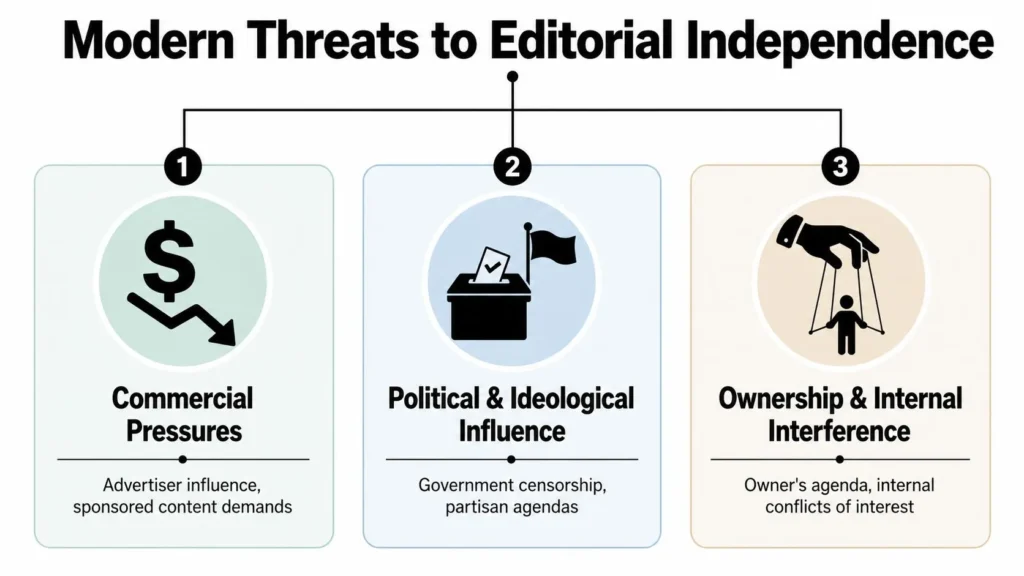
Threats to editorial independence rarely arrive one at a time. They overlap. A publication can face financial pressure, platform pressure, and owner pressure in the same month. If you want to protect your standards, you need to name the threats clearly enough to recognize them in daily work.
Commercial pressure
This is the oldest problem, and it still catches teams off guard. Commercial pressure isn’t limited to a sponsor directly demanding favorable coverage. It also appears as self-censorship.
Editors may avoid a legitimate topic because they know it could upset an advertiser. Writers may soften criticism because a brand funds an event series. Publishers may ask for “alignment” that effectively turns articles into sales support.
The danger is cumulative. Once exceptions become normal, staff stop knowing where the line is.
Common warning signs include:
- Sponsor review requests: A commercial partner asks to approve wording in a reported piece.
- Blended formats: Advertising is designed to resemble editorial work without clear labeling.
- Revenue-led commissioning: Stories are assigned mainly because they suit current business relationships.
Political and ideological pressure
Not every publication covers elections or public policy, but any publication can face pressure from organized interests. That pressure may come from public officials, advocacy groups, donors, or highly motivated online factions.
Sometimes the interference is blunt. Remove this piece. Don’t quote that critic. Promote this message. More often it takes the form of reputational intimidation. Flood the inbox. Accuse the publication of bias. Demand loyalty tests.
A young editorial team often gets stuck here. They confuse fairness with appeasement. Fairness means applying standards consistently. It does not mean adjusting the truth to reduce backlash.
A useful reminder sits below:
If an outside group can make you change coverage without improving the facts, they’re not helping your standards. They’re training your newsroom.
To ground this discussion, it helps to hear how media pressure is discussed publicly in practice:
Digital-age pressure
Many online magazines find themselves most exposed. The threat isn’t only about what gets published. It’s also about how content is surfaced, summarized, ranked, and monetized after publication.
The RSF World Press Freedom Index 2025 reported that 65% of news media globally are caught between preserving editorial autonomy and financial survival, and the verified data also notes that digital platform and AI pressure compounds that vulnerability as publishers deal with systems that can reorder, summarize, or repurpose content without editorial intent, as reflected in the RSF 2025 framing and related digital pressure context.
For an online magazine, that means dependence can creep in through discovery systems as much as through ownership.
The hidden technical risk
Automated editorial systems create a subtler form of influence. If a platform, data broker, or internal technical team controls the input layer, it can shape what editors see in the first place. Exclude certain signals, weight others heavily, and the published outcome changes even if no one openly overrules an editor.
Think of a homepage recommendation tool. If it privileges engagement above all else, sensational material may keep rising. The editor still clicks publish. But the system has already narrowed the field of what feels visible, urgent, or successful.
That’s why modern editorial independence has to include platform awareness, AI awareness, and data governance. If you only guard against obvious sponsor interference, you’ll miss the quieter systems that steer judgment before the formal editorial meeting even begins.
How to Build an Unbreakable Editorial Firewall
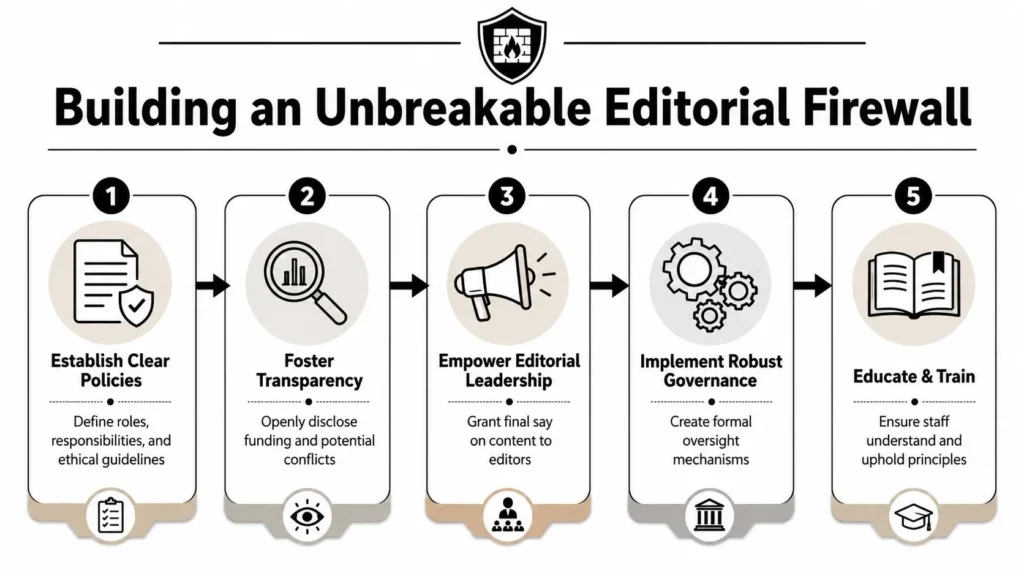
Good intentions aren’t enough. A publication protects editorial independence by turning values into structure. If the rules only live in someone’s head, they’ll disappear the first time revenue dips, a powerful person complains, or a legal scare rattles the team.
Give one role final editorial authority
In journal publishing, the cleanest operational model is an authority boundary. Best-practice guidance states that the editor-in-chief must have full authority over article selection, editorial boards, and publication timing, while owners or publishers should not interfere in accept or reject decisions, as explained in guidance on maintaining editorial independence in scholarly publishing.
Online magazines should borrow that principle directly.
If everyone can overrule editors, no one is accountable for editorial quality. Final authority should be explicit, written, and known to all staff.
Put policy in writing before conflict arrives
A clear governance document should answer practical questions, not just noble ones. For example:
- Who approves sponsored content labels
- Who can request corrections
- Who handles complaints from advertisers or outside organizations
- Who can remove or revise archived content
- Who reviews conflicts of interest for contributors
If your team is building from scratch, a practical operations resource on starting an online magazine with clear publishing systems can help frame the workflow side of those decisions.
Separate complaints from content control
Every publication needs a way to hear concerns. Not every concern deserves a content change.
That distinction matters most when someone wants a story edited, hidden, or removed. Publications should have a documented review path for complaints involving factual errors, privacy concerns, legal risk, or fairness. They should also resist informal pressure that bypasses those standards. For teams thinking through these edge cases, guidance on protecting reputation with article removal is useful because it shows how requests can be made professionally without assuming the newsroom owes compliance.
Build routines, not just rules
A firewall becomes real through repeated habits. Try a simple governance model like this:
| Area | Responsible party | Non-negotiable boundary |
|---|---|---|
| Story selection | Editor-in-chief or delegated editor | No owner or sponsor veto |
| Sponsored content | Business team plus editorial standards review | Clear labeling, no disguise as reported work |
| Corrections | Editorial leadership | Changes based on facts, not pressure |
| Contributor conflicts | Assigning editor | Disclosure before publication |
| Archive changes | Senior editorial review | Documented reason and audit trail |
Editorial test: Ask of every disputed change, “Would we make this same decision if no advertiser, owner, platform, or pressure group were involved?”
Train contributors like they are part of the system
Freelancers, guest authors, newsletter writers, social editors, video producers, and audience managers all affect editorial integrity. A contributor handbook should explain conflicts of interest, sourcing expectations, labeling rules, and who to contact when someone tries to bypass the process.
This is especially important for smaller digital magazines, where one person may file copy, upload it, choose the social framing, and respond to outside messages. Independence can fail at any of those steps.
A publication becomes sturdier when every participant knows two things. First, what they’re allowed to decide. Second, what they must escalate.
Practical Policy Language for Your Magazine
Policies fail when they sound lofty but can’t guide a real decision. Good policy language is short, plain, and usable on a stressful day. The clauses below are written in a form an online magazine can adapt.
For editors and leadership
These clauses define authority and process inside the organization.
Editorial authority clause
The editorial team has sole authority over topic selection, assignment, editing, headlines, publication timing, corrections, and removal decisions for editorial content. No owner, advertiser, sponsor, donor, partner, or business staff member may require the publication, suppression, or revision of editorial content except through the publication’s formal correction or legal review process.
Conflict review clause
Editors must disclose any personal, financial, or professional relationship that could reasonably create a conflict of interest in a coverage decision. When a conflict exists, a different editor will supervise the assignment, edit, or publication decision.
That kind of wording works best when paired with a plain public standards page. If you’re drafting one, examples of website disclaimers and policy language can help you separate legal notices from editorial commitments.
For contributors and freelancers
Contributors need rules that fit the way they work. They often pitch quickly, write remotely, and may also have outside clients.
Use direct language like this:
Contributor disclosure clause
Contributors must disclose any financial relationship, employment, advisory role, sponsorship, family connection, or other relevant tie to the subjects they cover. Undisclosed conflicts may lead to revision, rejection, correction, removal, or termination of the contributor relationship.
Sponsored work boundary
Contributors may not present sponsored, paid, or partner-directed material as independent editorial work. Any paid collaboration must be clearly labeled according to the publication’s advertising and sponsorship standards.
For readers and the public
A public-facing policy should reassure readers without sounding defensive.
- What you decide independently: story choice, framing, editing, and corrections
- What you disclose: sponsorships, material conflicts, affiliate relationships if relevant
- How readers can respond: correction channel, complaint process, standards page
A concise statement might read:
We publish editorial content according to independent editorial judgment. Commercial relationships, sponsorships, and outside interests do not determine our reporting, reviews, recommendations, or commentary. When financial relationships are relevant, we disclose them clearly.
For automated and data-driven publishing
This is the clause many online magazines still don’t have, and they need it. In automated or data-driven editorial systems, the verified research base identifies the main technical risk as control over the input layer. If a platform or internal team shapes what data are available, excluded, or weighted, it can indirectly shape what gets published, which is why algorithmic transparency and input-layer safeguards matter.
A policy clause for that risk could read:
Data and algorithm integrity clause
No internal or external party may alter editorial input data, ranking criteria, recommendation signals, or automated publishing rules in order to favor commercial, political, or personal interests without documented editorial review. Material algorithmic criteria affecting editorial visibility or selection must be known to designated editorial leadership.
That clause does something important. It recognizes that modern editorial independence isn’t only about who edits copy. It’s also about who shapes the systems that decide what the editors see and what the audience receives.
Upholding Independence in a Digital First World
Editorial independence isn’t a framed statement in an About page. It’s a repeated act of professional discipline. It shows up when a sponsor asks for special treatment, when a platform tempts a team to chase distortion, when a contributor forgets to disclose a conflict, and when a leader chooses process over convenience.
For independent online magazines, the challenge is sharper because the pressure points are everywhere at once. Ownership, audience analytics, search visibility, social distribution, partnerships, AI summaries, and internal tools can all affect judgment if nobody draws the line.
The answer isn’t isolation. It’s governance, transparency, and courage that survives ordinary workdays.
A trustworthy publication doesn’t become independent by saying it is. It becomes independent when its people can prove, through policy and practice, that editorial decisions belong to editorial leadership and that readers are never treated as the easiest party to mislead.
If you publish, edit, or contribute online, maxijournal.com is worth exploring for its broad mix of approachable writing across science, technology, health, business, arts, travel, entertainment, and more. It’s a useful example of the kind of digital magazine ecosystem where clear editorial standards, contributor guidance, and reader-facing policies matter every day.
Discover more from Maxi Journal
Subscribe to get the latest posts sent to your email.