You buy a moisturizer because your skin feels tight after cleansing or acne treatment. By day three, your forehead looks shinier, a few clogged bumps show up around your chin, and your cheeks sting when you apply anything at all. So you switch to something “oil-free.” That one disappears fast, but your skin still feels hot, dry, and strangely rough underneath the surface.
That cycle is common when you have acne-prone and sensitive skin. One side of your skin wants light textures and low congestion. The other side wants calm, cushion, and as few irritants as possible. A product can seem perfect for one problem and make the other worse.
The good news is that finding the best moisturizer for acne prone sensitive skin doesn’t have to be a guessing game. You don’t need a giant product list. You need a filter. Once you know how to judge texture, ingredient list, and how a moisturizer behaves next to your acne treatments, you can evaluate almost any formula on the shelf with much more confidence.
The Search for the Right Moisturizer
A lot of people with difficult skin end up in one of three camps.
First, there’s the rich cream that feels comforting for about an hour, then starts to feel heavy. Makeup slides. Sunscreen pills. You keep touching your face because it never quite settles. Second, there’s the watery gel that feels refreshing at first, but by lunchtime your skin feels tight again. Third, there’s the “treatment moisturizer” that sounds smart on paper and leaves your skin red, prickly, or suddenly dotted with new bumps.
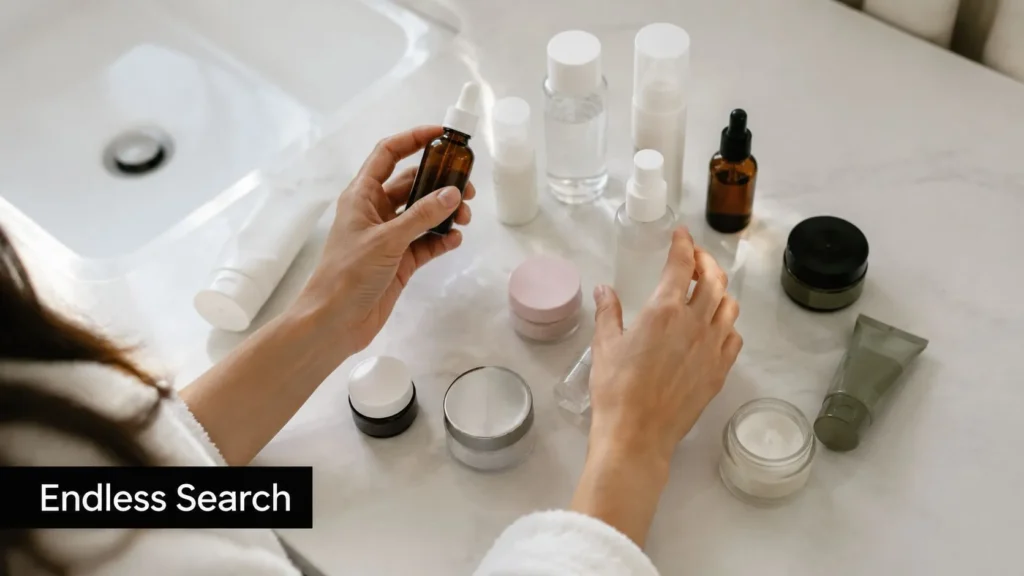
If that sounds familiar, you’re not doing skincare wrong. You’re dealing with a skin type that has conflicting needs. Acne-prone skin often reacts badly to heaviness, while sensitive skin often reacts badly to “active” or highly fragranced formulas. That puts you in a narrow lane.
Sometimes the problem doesn’t start with the moisturizer at all. A stripping cleanser can leave your skin so reactive that even a decent moisturizer burns on contact. If your routine starts with a harsh wash, it helps to review what a gentler cleanser looks like before you judge the moisturizer itself. A practical place to start is this guide to face washes for different skin needs.
The right moisturizer should make your skin feel less dramatic, not more confusing.
The goal isn’t to find the fanciest jar. It’s to find a formula that consistently does its job every day. It should reduce that tug-of-war between breakouts and irritation so your routine finally feels stable.
Understanding the Acne and Sensitivity Paradox
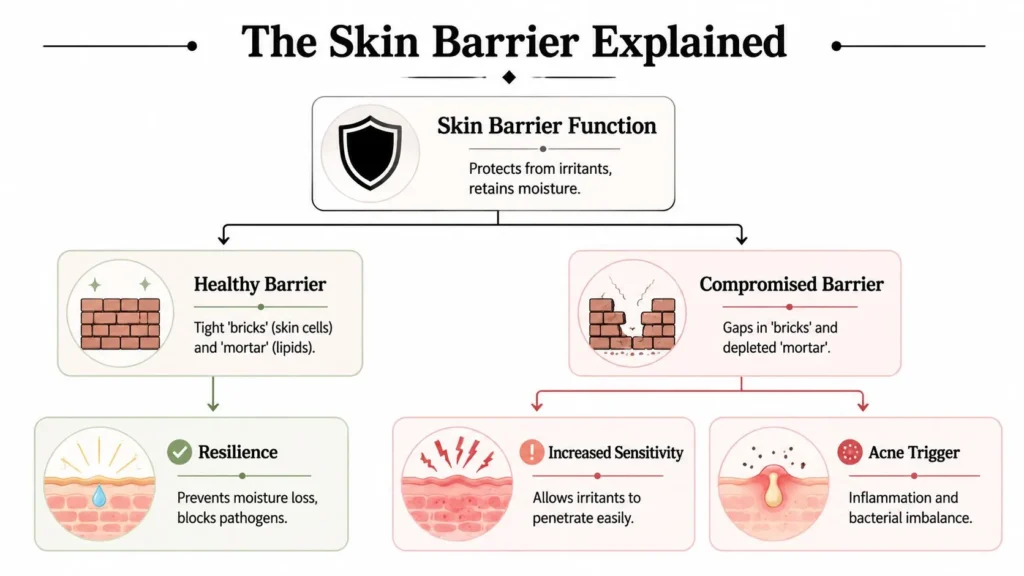
Think of your skin barrier like a brick wall. The skin cells are the bricks. The lipids that hold everything together are the mortar. When the wall is intact, it keeps water in and irritants out. When that wall develops gaps, your skin loses moisture more easily and reacts faster to things it used to tolerate.
What a damaged barrier feels like
A compromised barrier doesn’t always look dry in the way people expect. It can look shiny and oily while feeling tight. It can break out while also stinging. It can flake around the nose while developing inflamed pimples on the chin.
Those mixed signals confuse people. They assume oily skin can’t be dehydrated, or acne-prone skin shouldn’t be moisturized. But acne and barrier damage often overlap.
A simple breakdown looks like this:
| Skin state | What you notice | What may be happening |
|---|---|---|
| Healthy barrier | Skin feels comfortable after cleansing | Water is being held in well |
| Compromised barrier | Stinging, redness, tightness, rough texture | Irritants get in more easily and moisture escapes faster |
| Acne-prone and compromised | Breakouts plus sensitivity | Inflammation and poor tolerance happen together |
Why drying out acne often backfires
For years, a lot of acne advice focused on stripping oil away. That approach can make sensitive skin spiral. When you keep removing water and damaging the barrier, your skin becomes less able to tolerate cleansers, serums, spot treatments, and even plain moisturizers.
That’s one reason moisturization is no longer treated as optional in acne care. A 2014 NIH review of moisturizers marketed for acne found that 92% included anti-inflammatory properties, reflecting a shift toward routines that support the barrier instead of just drying the skin.
Practical rule: If your acne routine leaves your skin raw enough that moisturizer stings, the problem usually isn’t that you “need less moisture.” It’s that your barrier needs more support.
If you want a helpful plain-English companion to the brick-wall idea, the Skinsation Aesthetics Inc. skin barrier guide explains damaged barrier signs in a way many people find easy to recognize in their own skin.
What moisturizing really does
Moisturizing acne-prone sensitive skin isn’t about making the face oily. It’s about helping the wall hold together. A good moisturizer reduces friction, water loss, and irritation so that your skin can better tolerate the parts of your routine that specifically target acne.
That mental shift matters. You’re not adding “extra product.” You’re reinforcing your skin’s defense system.
Decoding the Moisturizer Ingredient List
Ingredient lists look intimidating until you stop reading them like chemistry homework and start reading them by job description. For acne-prone sensitive skin, every ingredient falls into a few practical categories. Some pull water in. Some support the barrier. Some calm irritation. Some make reactive skin much harder to manage.
The ingredients worth looking for
A useful moisturizer for this skin type usually does three jobs at once: hydrate, support the barrier, and reduce the chance of irritation.
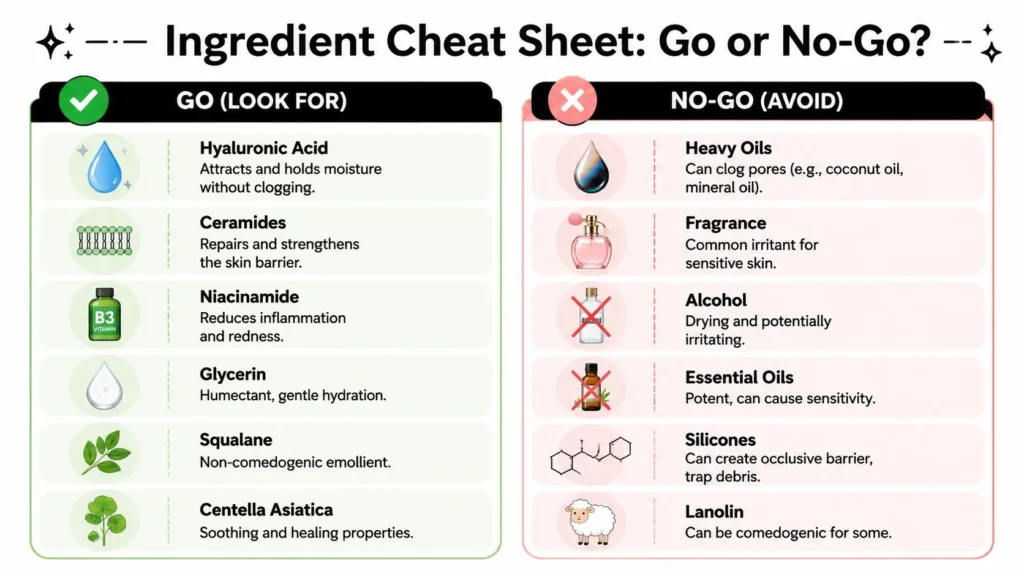
According to Paula’s Choice guidance for oily and acne-prone skin, ingredients to prioritize include hyaluronic acid for hydration, licorice and allantoin for soothing, and niacinamide for helping regulate oil and pore appearance. The same guidance warns against fragrance and drying alcohols because they can disrupt the skin barrier.
Here’s a simple cheat sheet:
- Humectants like hyaluronic acid and glycerin help pull water into the skin. They’re useful when your skin feels dehydrated but you don’t want a heavy finish.
- Barrier-support ingredients like ceramides help reinforce the “mortar” in that brick wall analogy.
- Niacinamide is often appealing because it can support a more balanced look without feeling greasy.
- Soothing ingredients like allantoin and licorice are helpful when your skin is red, easily irritated, or stressed from acne treatments.
- Ectoin is another ingredient many sensitive-skinned users look for when they want hydration that feels less aggressive.
If you want a basic refresher on what humectants do, Livaclean’s hyaluronic acid guide gives a straightforward explanation without drowning you in jargon.
A related ingredient you may also see in calming formulas is beta-glucan. If you’re curious how it compares with more familiar hydrators, this overview of beta-glucan for skin is a helpful add-on.
The ingredients that commonly complicate things
Now for the part that saves people the most frustration. A moisturizer can have one or two good ingredients and still be a poor fit because the overall formula is irritating.
Watch for these:
- Fragrance can be a problem even when a product smells “clean” or “fresh.”
- Essential oils may sound botanical and gentle, but sensitive skin often disagrees.
- Drying alcohols can make a light formula feel elegant at first, then leave the skin more reactive.
- Too many actives in one product can turn a moisturizer into a stealth treatment step, which is risky if your barrier is already struggling.
This quick video can help you think more critically about moisturizer labels and formulation choices.
Read for function, not marketing
A jar that says “for blemish-prone skin” doesn’t automatically mean it’s a good moisturizer for acne-prone sensitive skin. Ask better questions:
| Label claim | Better question to ask |
|---|---|
| Oil-free | Does it still include enough barrier support? |
| Acne-fighting | Will reactive skin tolerate the active ingredients? |
| Calming | Is it actually free of fragrance and other common irritants? |
| Lightweight | Does it hydrate long enough, or does it vanish too fast? |
A good ingredient list isn’t the one with the most famous names. It’s the one that gives your skin the fewest reasons to panic.
Choosing the Right Texture and Formulation
Texture matters more than many people realize. Even when two moisturizers contain similar ingredients, the way they’re built can make one feel breathable and the other feel suffocating.
How gels, lotions, and creams usually behave
Gels tend to feel cool, quick, and barely there. They can work well for very oily skin, especially in humid weather. The downside is that some gels don’t give enough lasting comfort if your barrier is stressed.
Lotions usually sit in the middle. They’re lighter than creams but often more substantial than a clear gel. For many people with acne-prone sensitive skin, this is a comfortable everyday category.
Gel-creams often hit the sweet spot. They spread like a light cream but feel more water-based and less greasy on the finish. That balance is why many dermatology offices point people in this direction first.
What the label should suggest
Dermatology guidance from Riverchase Dermatology on moisturizers by skin type suggests that the ideal formula for this skin type is a lightweight, water-based gel-cream labeled non-comedogenic, with barrier-support ingredients like ceramides, a short ingredient list, and no fragrance or exfoliating acids such as salicylic, lactic, and glycolic acid.
That last point trips people up. They assume adding more exfoliating acids to a moisturizer will help with breakouts. If your skin is already sensitive, that can be too much traffic in one lane.
How to interpret common marketing terms
Use label language as a clue, not a guarantee.
- Non-comedogenic means the product is intended not to clog pores. It’s useful, but it doesn’t promise your skin won’t react.
- Oil-free can be a good starting point if rich textures break you out, but oil-free doesn’t automatically mean soothing.
- Fragrance-free is usually more meaningful for sensitive skin than claims like “natural” or “clean.”
- Short ingredient list often helps when your skin reacts easily, because there are fewer moving parts.
If a moisturizer feels slick, coated, hot, itchy, or strangely tight after it dries, your skin is already giving you feedback about the formulation.
A practical test is simple. After application, your skin should feel comfortable for hours, not just for ten minutes. Comfortable is underrated, but it’s often the best sign that you chose the right texture.
Integrating a Moisturizer with Acne Treatments
The hardest part of this skin type isn’t choosing a moisturizer in isolation. It’s getting that moisturizer to coexist with acne treatments that are effective but often irritating.
Why treatment routines fail
A lot of people quit a good acne treatment because the surrounding routine is too harsh. The active gets blamed, but the barrier has been deteriorating for days or weeks.
That pattern is common enough to matter. Up to 40% of patients with acne-prone sensitive skin stop their acne treatments because of stinging and irritation, and 35% report breakouts after using “acne-fighting” moisturizers, a pattern often linked to micro-inflammation rather than simple clogging, according to the source provided in the brief via Sephora’s acne-prone moisturizer category page.
That tells you something important. A moisturizer doesn’t become better for sensitive acne just because it contains an acne active.
The sandwich method and other useful habits
If you use a strong treatment and your skin gets reactive, buffering can help. One common strategy is the sandwich method:
- Apply a thin layer of moisturizer.
- Apply your acne treatment.
- Finish with another light layer of moisturizer if needed.
This can reduce the harsh “direct hit” feeling some people get from retinoids or other strong formulas.
Other ways to reduce friction:
- Use fewer treatment nights at first instead of forcing daily use too soon.
- Keep your moisturizer simple on active nights so you’re not layering treatment on top of more treatment.
- Apply actives to fully dry skin if your clinician has advised it, since damp skin can make some products feel more intense.
- Avoid stacking multiple exfoliating steps in the same routine when your barrier is already complaining.
If your routine also includes extra treatment layers, it helps to think about the whole system, not just one bottle. This guide to serums for oily skin can help you decide whether a serum is supporting your moisturizer or making your routine harder to tolerate.
Why “acne-fighting moisturizers” can be tricky
For resilient skin, a moisturizer with salicylic acid may be fine. For reactive skin, it may be one more source of low-grade irritation. That doesn’t mean these products are bad across the board. It means your skin may do better when moisturizer and treatment have separate jobs.
A good split often looks like this:
| Product type | Main job |
|---|---|
| Moisturizer | Hydrate, cushion, support barrier, reduce irritation |
| Treatment | Target breakouts with actives |
| Cleanser | Remove oil, sunscreen, and debris without stripping |
When each step has a clear role, your routine becomes easier to troubleshoot. If something burns, pills, or causes bumps, you can identify the likely culprit faster.
Your Smart Selection and Testing Framework
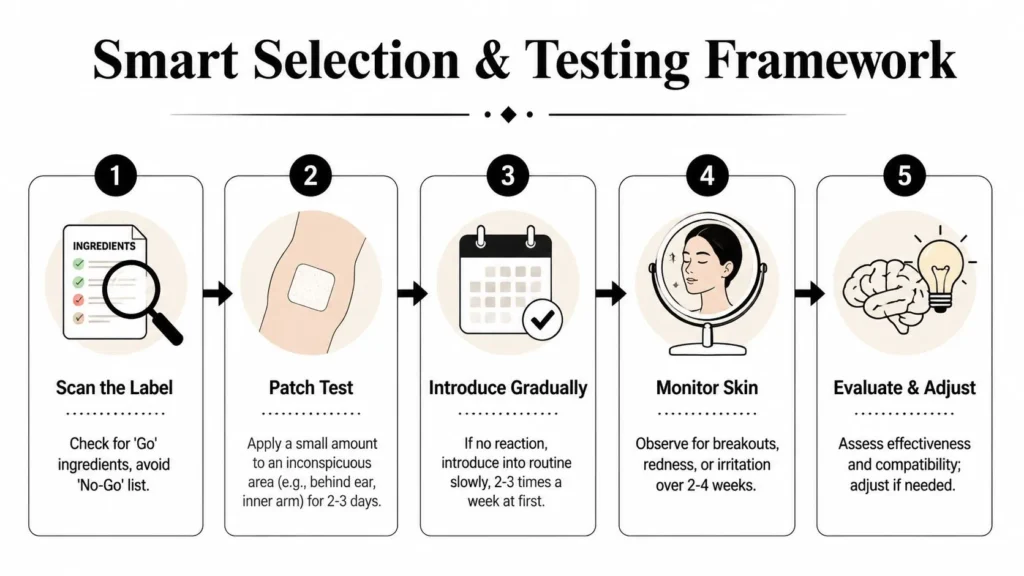
Once you stop shopping by hype and start shopping by pattern, choosing moisturizer gets easier. You don’t need perfection on day one. You need a repeatable process.
Step one through three
Start with the box, bottle, or product page.
- Scan for the basics. “Non-comedogenic,” “fragrance-free,” and “lightweight gel-cream” or “lightweight lotion” are encouraging signs.
- Check the ingredient rhythm. You want hydration and barrier support. You don’t want a moisturizer trying to double as a peel.
- Keep the formula simple if your skin is currently flaring. When skin is angry, minimalism helps.
Then patch test. Not just on your wrist. Facial skin is different. Apply a small amount near the jawline or behind the ear for several days. That area gives you a more realistic preview of how your face may respond.
Don’t judge a moisturizer by first application alone. Some formulas feel elegant for one night and become irritating after repeated use.
Step four and five
If the patch area stays calm, introduce the product gradually. Use it a few times a week first, especially if the rest of your routine contains strong treatments.
Watch for these differences:
| What you notice | Likely interpretation |
|---|---|
| Skin still feels tight but not irritated | The product may be too light or not sealing hydration well enough |
| Burning, redness, or itching | The formula may be irritating |
| Tiny bumps or a congested feel after repeated use | The texture or overall formulation may not suit you |
| Skin feels calmer and more comfortable | You may have a good match |
Give a moisturizer enough time to show its pattern, but don’t force it if your skin is clearly protesting. There’s a difference between “not hydrating enough” and “actively making my skin worse.”
A short shopper’s checklist
Before you buy, run through this:
- Texture check. Is it a gel-cream or light lotion rather than a rich heavy cream?
- Barrier check. Does it include supportive ingredients like ceramides or soothing components?
- Irritant check. Is it free of fragrance and obvious extra actives?
- Routine check. Will it play nicely with the treatment you already use?
That framework is how you find the best moisturizer for acne prone sensitive skin without relying on luck.
Frequently Asked Questions About Moisturizing Difficult Skin
Why does my non-comedogenic moisturizer still seem to cause breakouts
Because non-comedogenic is a helpful label, not a promise. Your skin may be reacting to the full formulation, the texture, the amount you apply, or the way it interacts with the rest of your routine. Sometimes what looks like clogging can be irritation and micro-inflammation.
Is it ever okay to use face oils
Sometimes, but cautiously. If your skin is very reactive, a few drops of a simple oil might feel comforting. But if you’re acne-prone, oils are rarely the easiest starting point. A light gel-cream or lotion is usually easier to judge and easier to pair with treatment products.
How long should I test a new moisturizer
Long enough to see a pattern, but not so long that you ignore obvious irritation. If your skin burns, becomes red, or feels increasingly inflamed, stop sooner. If it feels under-moisturized, you may need a richer texture rather than abandoning the brand entirely.
What are signs that I should see a dermatologist
Make an appointment if your acne is painful, widespread, scarring, or not improving with a careful routine. Also seek help if your skin barrier seems persistently damaged, everything stings, or you can’t tell whether you’re dealing with acne, dermatitis, or another condition. Sensitive, breakout-prone skin can overlap with issues that need a professional diagnosis.
Should my moisturizer contain acne actives
Not necessarily. For many people with reactive skin, it’s smarter when the moisturizer’s job is support and the treatment’s job is treatment. That separation makes routines easier to tolerate and easier to troubleshoot.
If you like practical, readable guides that help you make smarter decisions without the hype, visit maxijournal.com. It’s an independent online magazine and blog with approachable writing across health, science, technology, fashion, travel, entertainment, education, and more.
Discover more from Maxi Journal
Subscribe to get the latest posts sent to your email.