A freelance writer turns in a glowing review of a new wellness app. The draft is clean, persuasive, and ready to schedule. Then an editor learns the writer’s sibling works in marketing for the app’s parent company. Nothing may be wrong with the review itself. But the question arrives fast: should that relationship have been disclosed before assignment, during editing, or to readers at publication?
That’s the publishing version of a conflict of interest problem. It often doesn’t look dramatic. It looks ordinary. A free product sample. A newsletter sponsor who also wants editorial coverage. A peer reviewer asked to evaluate a submission by a former co-author. A columnist writing about a startup they advise on weekends.
In publishing, trust is the product behind every product. Readers may come for reporting, reviews, essays, or commentary, but they stay because they believe your decisions weren’t subtly influenced by money, loyalty, or access. That’s why many teams look for practical conflict of interest policy guidelines when they start formalizing editorial rules. The same instinct appears when a publication gets serious about systems, audience expectations, and growth, much like the planning involved in starting an online magazine.
Your Guide to Conflict of Interest Policies
A conflict of interest exists when a person’s outside interests could influence, or appear to influence, their professional judgment. In publishing, that usually means a writer, editor, fact-checker, or reviewer has some tie to the subject they’re covering or evaluating.
The part that confuses people is this: a conflict doesn’t mean someone acted with deceit. It means there’s a condition that could distort a decision, or make readers reasonably wonder whether it did. That difference matters. A policy isn’t an accusation. It’s a traffic rule.
Why publishing teams trip over this
Editorial people often think in terms of intent. “I can stay objective.” “I’d never let that affect my judgment.” “Everyone knows I’m fair.” Those statements may be sincere, but policy works differently. It asks whether an outside observer would need that relationship disclosed to fairly assess the work.
A good policy protects honest contributors from avoidable suspicion, not just dishonest ones from punishment.
For publishers, the recurring trouble spots are easy to recognize once you name them:
- Freebies and perks: Review copies, travel, event tickets, product loans, affiliate relationships.
- Personal ties: Friends, partners, relatives, former colleagues, mentors, rivals.
- Professional overlap: Advisory roles, consulting work, paid speaking, sponsorship deals, board seats.
- Competing loyalties: An editor balancing audience trust against advertiser pressure.
That’s why conflict of interest policies need to be written in plain language. If contributors need a lawyer to understand the rules, they’ll hesitate, guess, or stay silent. If the policy uses everyday examples from publishing, people are more likely to disclose early, before the awkward email chain starts.
Why These Policies Are Your Publication’s Shield
A publication can survive a typo. It can survive a late issue. It may not survive the slow erosion of credibility. That’s what conflict of interest policies are built to protect.

Think of a policy as a shield, not a sword. It doesn’t exist so management can catch people making mistakes. It exists so editors, contributors, and reviewers have a shared method for spotting risk before it hits the published page.
Your real asset is reader confidence
Most readers never see your assignment process, your editorial meetings, or your reviewer instructions. They judge your standards by what becomes visible. If a hidden relationship comes out later, readers don’t just question one article. They start questioning your judgment across the board.
That’s why formal policies matter even in fields outside publishing. A 2012 JAMA study found that 98% of major research institutions had conflict of interest policies, but only 14% of investigators publicly disclosed their financial ties. Among pharma-funded trials, 45% of investigators had significant financial interests, and only 22% of these were disclosed in reports. The lesson is uncomfortable but useful: having a policy on paper isn’t enough. Teams need a process people use.
A shield against three kinds of damage
Conflict of interest policies help protect a publication from:
- Reputational damage: A hidden tie can make careful work look compromised.
- Internal confusion: Editors make inconsistent calls when no one knows the rule.
- Avoidable disputes: Contributors feel singled out when decisions seem ad hoc.
A publication that already uses visible reader-facing protections, such as clear website disclaimer examples, will recognize the same principle here. You don’t add safeguards because you expect bad faith every day. You add them because clarity prevents preventable harm.
Practical rule: If your team would want to know about a relationship before assigning, editing, or publishing a piece, your policy should require disclosure of it.
A policy also protects contributors
This often gets missed. Writers and editors are vulnerable when standards are unwritten. One editor says a free sample is fine. Another says it should have been disclosed. A reviewer accepts a manuscript involving a former collaborator because nobody told them the boundary.
A written policy removes guesswork. It tells contributors when to disclose, who decides next, and what management options exist. That makes the environment fairer, calmer, and more professional.
The Three Flavors of Conflict
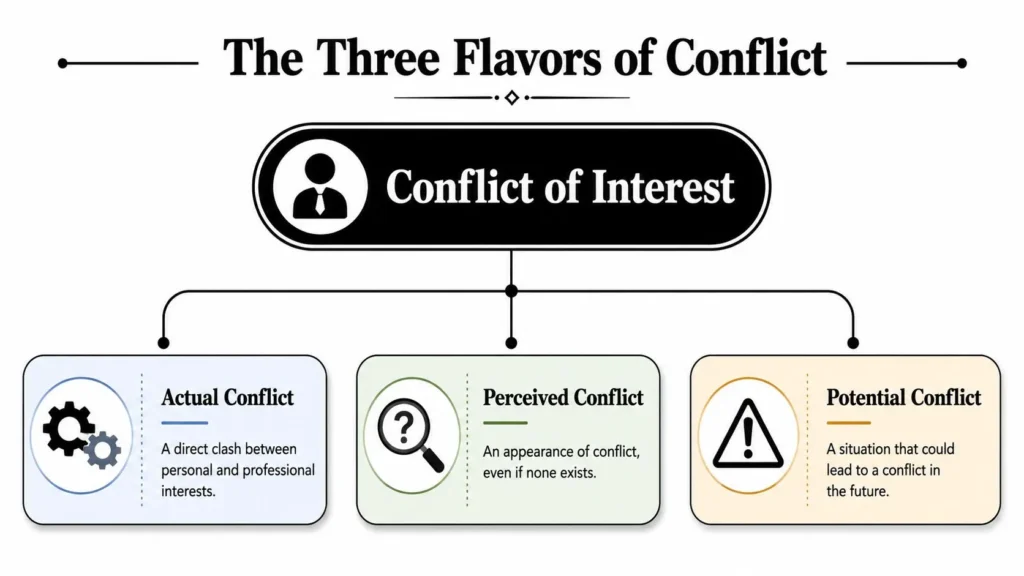
People usually recognize the obvious conflict. They miss the quieter forms. A useful policy names all three.
The easiest analogy is fire.
An actual conflict is the fire itself. A potential conflict is the smoldering ember that could ignite later. A perceived conflict is the smell of smoke. Even if nothing is burning, people have a reason to worry.
A robust policy must cover actual, potential, and perceived conflicts, because policies that focus only on actual conflicts miss where reputational and governance risk often begins, as noted in this discussion of policy design.
Actual conflict
This is the direct clash. The person has a concrete outside interest tied to the matter in front of them.
A publishing example is straightforward: an editor assigns and edits a feature about a company in which they personally hold stock, or a reviewer evaluates a manuscript written by a business partner. In those cases, the overlap is immediate.
Actual conflicts usually call for the clearest management steps. Disclosure alone may not be enough. Recusal, reassignment, or a supervisory review often makes more sense.
Potential conflict
This one hasn’t ripened yet, but it could. That’s why people overlook it.
Maybe a contributor is in talks to join a company they’re covering. Maybe a section editor has started consulting in an adjacent industry. Maybe a writer’s spouse has just taken a job at a firm that appears regularly in the publication’s reporting beat. The contributor may not have done anything biased, but the conditions for future pressure are now present.
Perceived conflict
This is the category that sparks the most resistance because people hear it as unfair. “But there isn’t any real conflict.” Maybe. The question is whether a reasonable reader, author, or colleague would see a connection that could cast doubt on the decision.
Here’s a simple comparison:
| Type | What it means in plain language | Publishing example |
|---|---|---|
| Actual | The interest directly overlaps with the task | Reviewing a book published by your own client |
| Potential | The overlap could develop soon | Negotiating freelance work with a subject you cover |
| Perceived | It looks questionable from the outside | Editing a friend’s op-ed on a contested issue |
If a relationship would require an explanation after publication, it usually deserves a disclosure before publication.
For editorial teams, this framework reduces arguments. Instead of debating whether someone is ethical, you classify the situation and manage it accordingly.
Anatomy of a Strong Policy
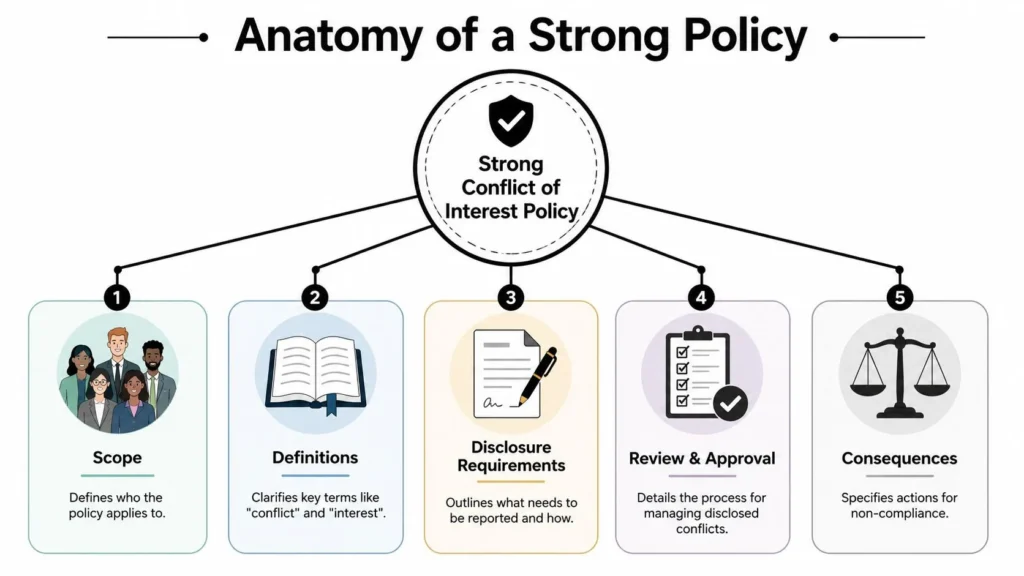
A strong policy works like a machine. If one part is missing, the whole system rattles. A publisher doesn’t just need a paragraph saying “please disclose conflicts.” It needs a complete operating model.
Scope and definitions
Start by saying who the policy covers. In publishing, that usually includes staff editors, freelancers, columnists, peer reviewers, guest contributors, editorial board members, and sometimes podcast hosts or video producers.
Definitions matter just as much. If the policy uses terms like “financial interest,” “personal relationship,” “gift,” or “competing commitment,” define them in plain English. Don’t make contributors guess whether an affiliate link, speaking fee, or startup advisory role counts.
A short policy table can help:
| Policy part | What it answers |
|---|---|
| Scope | Who must follow the policy |
| Definitions | What counts as a conflict or related interest |
| Disclosure rules | What must be reported, when, and to whom |
| Review process | Who decides how to handle the disclosure |
| Consequences | What happens if someone doesn’t comply |
Disclosure rules
This is the engine room. If disclosure timing is vague, people wait too long.
Effective policies usually require annual declarations plus event-driven disclosures, because onboarding-only attestations are weak. Strong systems also cover imputed interests, meaning ties that arise through a spouse, child, or business partner, not just direct personal ownership or payment, as explained in this overview of conflict policy structure.
For a publisher, event-driven disclosure should kick in when:
- A new assignment arrives: The writer or editor checks for relevant ties before work starts.
- A relationship changes: A spouse takes a job, a consulting role begins, or a sponsor becomes an editorial subject.
- A submission enters review: Reviewers and editors disclose before handling it.
Review and management
Disclosure isn’t the finish line. Someone has to review the issue and decide what to do.
That decision-maker should be named in the policy. At a small publication, it might be the editor-in-chief or managing editor. At a larger journal, it may be an ethics committee, editorial board chair, or designated compliance lead.
Management options should be spelled out:
- Recusal: The person steps away from the assignment or vote.
- Role adjustment: They can contribute, but not edit, approve, or select reviewers.
- Approval with safeguards: The work proceeds with oversight, a note to readers, or an independent second review.
Enforcement and records
A policy without consequences is a suggestion. But consequences don’t need to sound theatrical. They should be proportional and clear.
That can include correction of missing disclosures, reassignment, withdrawal from review, suspension of contributor privileges, or contract consequences for repeated noncompliance. Keep records too. If your team can’t show who disclosed what and who approved the management plan, the process will collapse under stress.
The strongest policy isn’t the harshest one. It’s the one people can follow consistently, and managers can document without improvising.
Sample Policy Language for Publishers
You don’t need ornate legal prose to write a workable policy. You need language that contributors can read once and understand. The samples below are meant to be adapted, not copied blindly.
One principle should sit underneath all of them: conflicts aren’t all-or-nothing problems. The NCBI guidance on conflict assessment notes that conflicts should be evaluated by severity, likelihood of influence, and potential harm, and that some relationships can continue with safeguards when benefits outweigh risks. That’s especially useful in publishing, where specialist expertise and outside work often overlap.
For authors and contributors
Use language that catches both money and relationships.
Disclosure duty
“Contributors must disclose any financial, professional, or personal relationship that could reasonably influence, or appear to influence, the content of a submitted work.”Examples adapted for publishing
“Disclosable interests include payment, consulting work, advisory roles, affiliate relationships, sponsorship ties, gifts, free products, travel support, close personal relationships, family employment, or public advocacy directly related to the subject of the piece.”Timing clause
“Disclosure must be made when the work is pitched, assigned, submitted, or whenever a relevant relationship arises during editorial review.”
That last line matters because many publishing conflicts arise midstream. A writer starts a piece with no issue, then accepts a speaking engagement from the company being covered a week later.
For editors and staff
Editors need stronger language because they control assignments, framing, and publication decisions.
Editors should never be left to invent their own exceptions in private.
Try wording like this:
“Editors and editorial staff must disclose any interest that may affect article selection, assignment, editing, fact-checking, headline writing, peer review administration, or publication decisions. Any editor with a disclosed conflict may be removed from decision-making on the affected matter and replaced by an unconflicted editor.”
For advertising pressure, include a firewall clause:
“Commercial relationships, sponsorship agreements, affiliate revenue arrangements, and partnership discussions must not control editorial coverage. Where overlap exists, editorial leadership shall document the management steps used to preserve independence.”
For peer reviewers and advisory reviewers
Reviewers often forget they can have competing loyalties even when no money is involved.
Sample language:
“Reviewers must decline or disclose any relationship with the author, institution, product, organization, or disputed issue under review that could affect impartiality. Such relationships may include collaboration, mentorship, direct competition, personal dispute, or financial interest.”
A proportionate management clause can help:
- If the risk is low: The reviewer may continue with notice and oversight.
- If the risk is meaningful: The reviewer is reassigned.
- If confidence would be damaged by participation: The reviewer must decline.
That structure keeps the policy realistic. Not every overlap requires a ban. But every overlap deserves an honest look.
A 5-Step Checklist to Implement Your Policy
A policy becomes real when it enters the workflow. If it lives only in a shared folder, your team will remember it right after a problem appears.
A simple rollout plan works better than a grand launch with no follow-through.
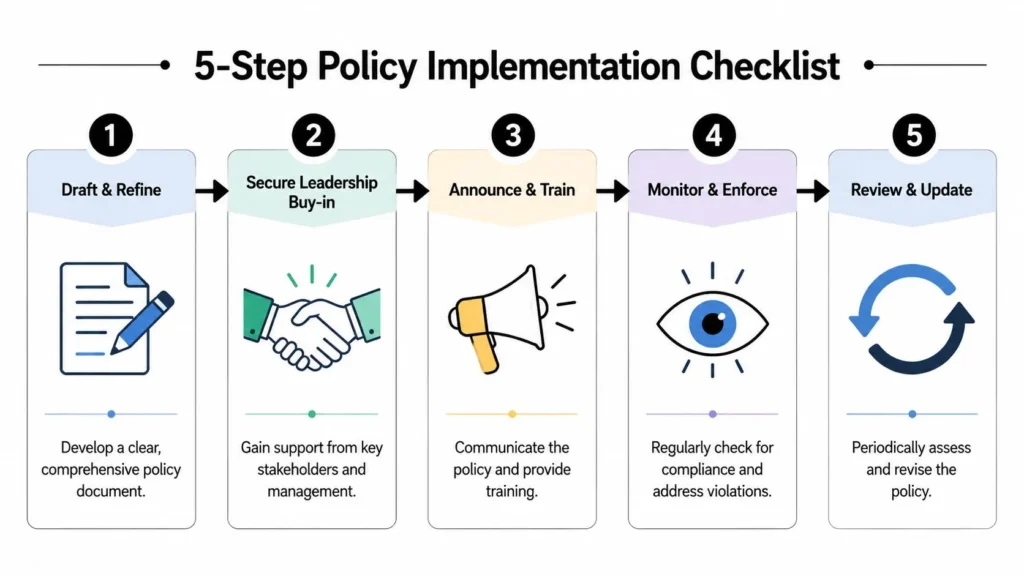
The five steps
Draft and refine
Build the first version around real editorial situations. Start with assignments, reviews, sponsorship overlap, family ties, and gifts. If your publication has employee-facing rules elsewhere, this broader guidance on employee handbooks for businesses is a useful reminder that policies work best when roles, expectations, and consequences are written clearly.Secure leadership buy-in
Editors, publishers, and board members need to agree on who reviews disclosures and who has final authority. If leadership hesitates, the policy will become optional in practice.Announce and train
Walk people through examples. Don’t just send a PDF. Show a book reviewer what to do if they received an advance copy and accepted travel from the publisher. Show an editor what to do if a sponsor appears in a reported feature.
Here’s a short explainer you can share during rollout:
Integrate into workflow
Add disclosure questions to pitch forms, contributor contracts, reviewer invitations, and editorial checklists. If disclosure depends on memory, people will forget.Review and update
Modern policies are moving toward broader, more routine reporting, sometimes requiring disclosure of all professional relationships over a rolling 24-month period with no minimum financial threshold, as reflected in this example of expanded disclosure practice. Publishing teams should review their own policy regularly because new forms of influence keep appearing, including creator partnerships, affiliate commerce, and cross-platform brand work.
What implementation often misses
- Small teams assume trust replaces process: It doesn’t.
- Freelancers get left out: They often face the messiest conflicts.
- Disclosure forms ask too little: A yes-or-no checkbox rarely captures the actual issue.
Build disclosure into the moment when a person can still step aside gracefully. That’s before assignment lock, not after publication.
Common Scenarios and Contributor FAQs
Editors and contributors usually don’t struggle with the obvious cases. They struggle with the ones that sound small.
Do I need to disclose a free product I received for review
Principle: If the item relates to the subject of the piece, disclose it.
Answer: Yes, usually. A free product doesn’t automatically bar coverage, but it can affect judgment or appear to. Your editor can then decide whether a note to readers, a reassignment, or an additional review makes sense.
What if my spouse works for a competitor of the company I’m writing about
Principle: Family ties can create indirect conflicts.
Answer: Yes, disclose it. Even if you have no direct financial tie, your publication should know about relationships that could shape, or seem to shape, your framing of the story.
What amount is “significant” enough to disclose
In regulated research, the U.S. PHS rules define a significant financial interest as more than $10,000 in income or equity from a single entity, and the FDA uses $25,000 for certain payments under its trial-related disclosure framework, as summarized in these federal conflict standards at 42 CFR 50.603. Publishing isn’t required to copy those thresholds, but the lesson is useful: vague ethics language works better when a policy turns it into a clear disclosure rule.
What if I’m not sure whether a relationship counts
Principle: Uncertainty is a reason to disclose, not a reason to stay quiet.
Answer: Tell the assigning editor early and briefly. A one-line note before work begins is much easier to manage than an explanation after readers complain. If your publication accepts outside contributors through an open process, that expectation should appear anywhere contributors review submission rules, including pages like creative writing submissions.
Is disclosure always enough
No. Sometimes disclosure solves the problem. Sometimes the safer choice is recusal or reassignment. The key question is whether the relationship can be managed without undermining confidence in the work.
If you publish, edit, or contribute online, clear standards make better work possible. For approachable publishing guidance, contributor information, and editorial-friendly resources, visit maxijournal.com.
Discover more from Maxi Journal
Subscribe to get the latest posts sent to your email.