You’re probably doing this already without naming it. You see a post in your feed, a chart in a newsletter, a screenshot in a group chat, or a confident claim in an AI summary. Something about it feels wrong, but not wrong enough to dismiss instantly. So you pause. Who said this first? Is that screenshot real? Is this quote in context? That pause is the start of source verification.
The phrase often brings to mind investigative reporters, fact-checking desks, or clinical auditors. But the habit matters just as much when you’re choosing what to share, what to believe, what to cite, or what to publish. In a digital environment crowded with reposts, cropped images, synthetic media, and context-free claims, source verification has become basic literacy.
Why Source Verification Is Non-Negotiable in 2026
A familiar situation: you’re scrolling late in the day and a post claims a public figure said something outrageous. The post includes a quote card, a logo you recognize, and thousands of approving replies. You could accept it, reject it, or do the harder thing and verify it.
That harder thing matters more than it used to. The World Economic Forum’s Global Risks Report 2024 says misinformation and disinformation were ranked among the top short-term global risks in 2025, and the same report notes Microsoft’s 2024 research warning that generative AI has significantly lowered the cost and increased the speed of producing convincing false content. Falsehood now arrives faster, looks cleaner, and often imitates trusted formats.
What source verification actually means
In plain language, source verification means checking whether a claim traces back to a reliable original source, and whether that source supports the claim being made.
That sounds simple until you try it on real examples:
- A screenshot of a headline might be edited, cropped, or stripped of date and context.
- A reposted chart might come from a serious report, or from an anonymous account with no methodology.
- An AI-generated answer might sound fluent while blending solid facts with invented details.
- A quote in a social post might be paraphrased so aggressively that it no longer means what the speaker said.
Why this matters beyond newsrooms
If you write online, verification protects your credibility. If you read online, it protects your attention. If you teach, study, or work with research, it protects your judgment.
It also changes how you interpret expertise. A polished post isn’t proof. A familiar brand mark isn’t proof. A lot of engagement definitely isn’t proof.
The modern question isn’t just “Is this true?” It’s “Where did this come from, and can I follow it back to the origin?”
This is especially important in fields where the public depends on translation from experts to general audiences. Good science communication depends on accurate sourcing because readers can’t evaluate every technical claim from scratch. They rely on writers to do that work carefully.
Source verification isn’t paranoia. It’s discipline. It helps you slow down just enough to separate an original record from a rumor, a report from a remix, and evidence from presentation.
Understanding the Core Principles of Verification
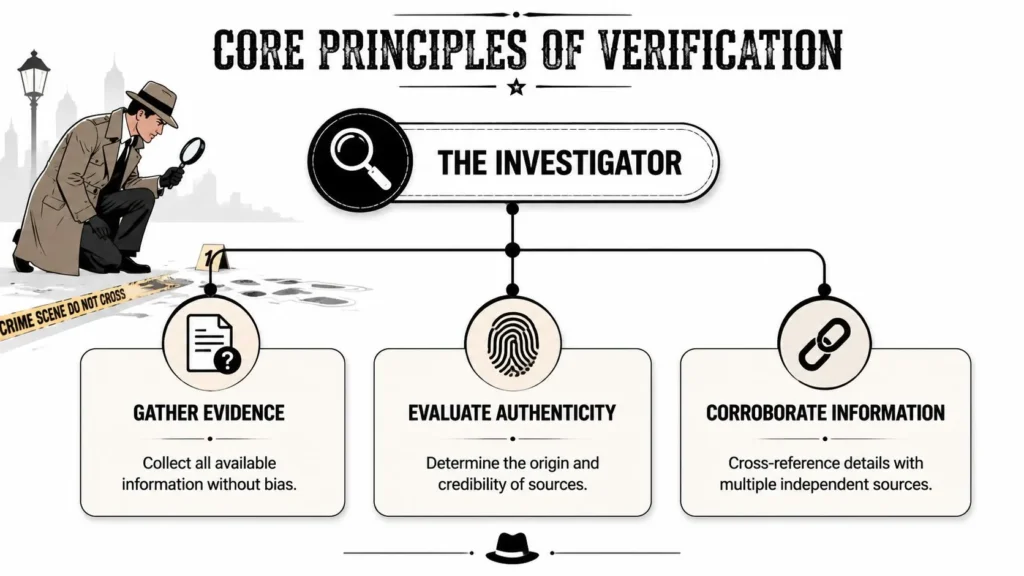
Think like a detective at a scene. You don’t start by trusting the loudest witness. You gather evidence, inspect where it came from, and compare one piece against another. That same mindset makes source verification less mysterious.
Primary, secondary, and tertiary sources
A lot of confusion starts here. People hear “good source” and assume that means any polished article. It doesn’t.
Here’s the basic hierarchy:
| Source type | What it is | Simple example | Best use |
|---|---|---|---|
| Primary | Original material created closest to the event or claim | Court filing, interview recording, official database entry, raw study paper, direct statement | Confirming what was actually said, recorded, or issued |
| Secondary | Analysis or reporting about a primary source | News article analyzing a report, essay explaining a study | Understanding context and interpretation |
| Tertiary | Summary of summaries | Encyclopedia entry, topic page, study guide | Orientation and quick background |
A primary source isn’t automatically correct in every respect, but it is where verification usually begins. If a post says a mayor announced a policy, you want the speech, transcript, official release, or direct video. If a writer says a study found something, you want the study itself before the commentary built around it.
The three-part test
In professional environments, the principle is even stricter. In clinical research, source data verification compares reported entries against original records to confirm that the data are accurate, complete, and verifiable, which is treated as essential to trial integrity and patient safety, as explained in this clinical trials overview of source data verification.
Those three words are useful far beyond research:
- Accurate means the claim matches the original.
- Complete means key context hasn’t been omitted.
- Verifiable means someone else could trace the same path and inspect the same evidence.
Practical rule: If you can’t tell where a claim started, you’re not evaluating the claim yet. You’re evaluating packaging.
A quick way to classify what you’re reading
When a source lands in front of you, ask three questions:
- Is this the original record, or commentary on the record?
- If it’s commentary, does it link or point clearly to the original?
- Can I inspect the original without relying on the commentator’s summary?
That habit will improve your reading fast. It also sharpens your writing, because you stop leaning on summaries that may have already introduced errors. For contributors doing research-heavy work, this guide on finding credible sources for research is a good companion to the verification mindset.
How Verification Builds Trust for Writers and Readers
Trust online is fragile. A reader may forgive a typo. They usually won’t forgive a misquote, a shaky citation, or a claim that falls apart when checked. Source verification is how writers avoid borrowing authority they haven’t earned.
For writers, verification isn’t a bureaucratic extra. It’s part of the craft. If you cite a report you didn’t read, summarize a thread you didn’t trace, or repeat a statistic from an infographic with no origin, you’re asking the audience to trust your confidence instead of your process.
What writers gain from doing this well
Reliable writers build a pattern. Readers learn that when those writers make a claim, there’s a trail behind it.
That trail can include:
- Original documents such as reports, filings, transcripts, and official statements
- Clear attribution that tells readers exactly who said what
- Context checks that prevent selective quoting
- Limits stated plainly when a claim can’t yet be fully confirmed
Credibility doesn’t come from sounding certain. It comes from showing your work.
This matters even more when people use AI tools in drafting and research. Those tools can speed up collection and synthesis, but they can also launder errors into smooth prose. Teams thinking seriously about optimizing AI content workflow often end up at the same conclusion: speed only helps if verification remains built into the process.
What readers gain from understanding verification
Readers don’t need to become professional fact-checkers. They do need a working filter.
A reader who understands source verification starts noticing the difference between:
| Weak signal | Stronger signal |
|---|---|
| Screenshot with no origin | Document or post linked to original issuer |
| Quote card | Full interview, transcript, or recording |
| Viral claim repeated widely | Independent confirmation from separate outlets or records |
| Summary with no citation | Summary that points to source material you can inspect |
Readers also become harder to manipulate. They’re less likely to confuse repetition with proof, visuals with authenticity, or confidence with evidence. That’s one reason content curation matters. Good content curation isn’t just collecting links. It’s choosing material with traceable origins and honest framing.
Trust works both ways. Writers earn it by verifying before publishing. Readers protect it by checking before believing.
A Practical Guide to Verification Methods
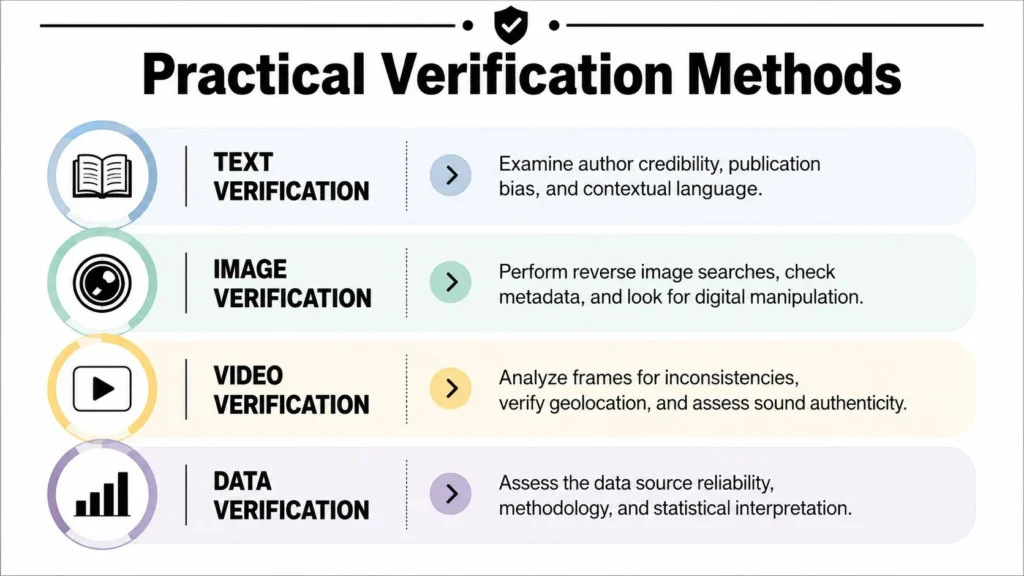
Different evidence types fail in different ways. A document can be forged. An image can be old but recirculated as new. A video can be authentic footage paired with false captions. A human source can be sincere and still be mistaken. Good source verification adjusts the method to the material.
Verifying documents and text
Start with the basics. Who authored the document, where was it published, and can you find it in its original location? A copied PDF in a random folder is weaker than the same document on an official institutional site.
Look closely at signs of legitimacy and signs of manipulation:
- Check provenance. Is there a clear publisher, issuing body, or named author?
- Inspect formatting carefully. Strange typography, inconsistent logos, broken spacing, or missing dates can signal a doctored file.
- Compare versions. If the document is important, look for the same text elsewhere in official archives or mirrored records.
Verifying images and video
Visual content persuades people quickly, which is why it needs slow handling.
For images, reverse image search often reveals whether a “current” photo appeared months or years earlier in another context. For video, pause on key frames and inspect details like signage, weather, uniforms, language, landmarks, and whether audio matches what the visuals suggest.
A practical routine:
- Search the image itself using Google Images or TinEye.
- Check whether the earliest appearances match the claimed date and place.
- For video, review frame by frame and look for cuts, overlays, or mismatched sound.
- Read captions skeptically. A real image can still carry a false explanation.
Verifying people and credentials
Sometimes the claim is about who a person is, not what a file contains. That’s where Primary Source Verification, or PSV, offers a useful model. In healthcare, PSV is considered the gold standard for checking credentials directly with the issuing institution, and major accrediting bodies such as The Joint Commission and NCQA require it, as described in this overview of primary source verification in healthcare.
The lesson transfers well to everyday verification. If someone claims a degree, license, board certification, or official appointment, the strongest check is direct confirmation from the issuer, not a screenshot, not a résumé, and not a reposted bio.
When the stakes are high, don’t verify through copies of claims. Verify through the body that created the record.
Verifying testimony from human sources
People are sources too. They can offer firsthand knowledge, but memory, bias, fear, status incentives, and confusion all affect what they say.
Use a few simple tests:
- Corroboration. Does another independent witness or record support the account?
- Specificity. Does the person provide details that can be checked?
- Position. Were they close enough to know, or are they repeating someone else?
Verification isn’t one trick. It’s a match between method and material.
Your Source Verification Checklist
Verifying every detail of every encountered post is neither practical nor advisable. Professional verification systems learned this too. In clinical research, teams distinguish between complete verification and targeted verification, shifting toward risk-based review that focuses on critical data rather than manually checking everything, as described in this discussion of complete and targeted verification.
That’s a useful model for everyday life. A joke post needs a lighter touch than a medical claim, a breaking-news allegation, or a career-related credential.
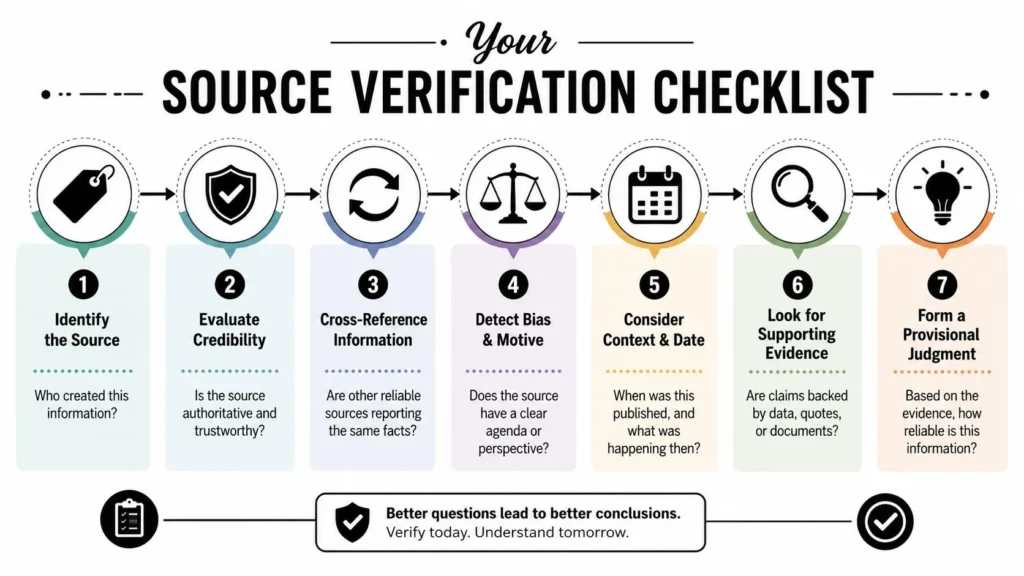
The quick check
Use this when the stakes are low but you still want to avoid spreading junk.
- Identify the source. Who created this? A named reporter, an institution, an anonymous account, a reposting page?
- Check the date. Old material often returns as if it were new.
- Read past the headline. Many false impressions come from reacting to framing instead of content.
- Look for the original. Can you find the full statement, document, or video?
- Notice motive. Is the post trying to inform, sell, provoke, or recruit?
If a claim fails these basics, don’t share it yet.
The deeper check
Use this when a claim could affect someone’s reputation, health, money, safety, or understanding of an important event.
- Find the earliest traceable version. Reposts distort. The first available version often answers what later copies hide.
- Seek independent confirmation. Not repetition from accounts echoing each other, but separate reporting or separate records.
- Examine what’s missing. Cropped screenshots, cut clips, and partial charts often omit the key detail.
- Check whether the source is primary, secondary, or tertiary. Weight it accordingly.
- Label uncertainty accurately. Sometimes the right conclusion is “unverified” rather than “false.”
A simple risk-based habit
Here’s a useful way to decide how much effort a claim deserves:
| Claim type | Verification level |
|---|---|
| Meme, joke, low-stakes opinion | Quick check |
| Consumer advice, travel rules, event claims | Quick check plus original source |
| Health, science, legal, finance, or reputational claims | Deep check |
| Breaking news with fast-moving facts | Deep check plus caution about what’s still unknown |
If the cost of being wrong is high, your verification standard should rise with it.
A final point matters. Verification isn’t always about reaching certainty. Often it’s about improving your confidence level and resisting premature conclusions. That habit alone will make you a sharper reader and a more trustworthy writer.
Essential Tools and Case Studies for Fact-Checkers
You don’t need a newsroom budget to verify a lot of digital material. A few public tools can take you far, especially when you use them in sequence instead of as isolated tricks.
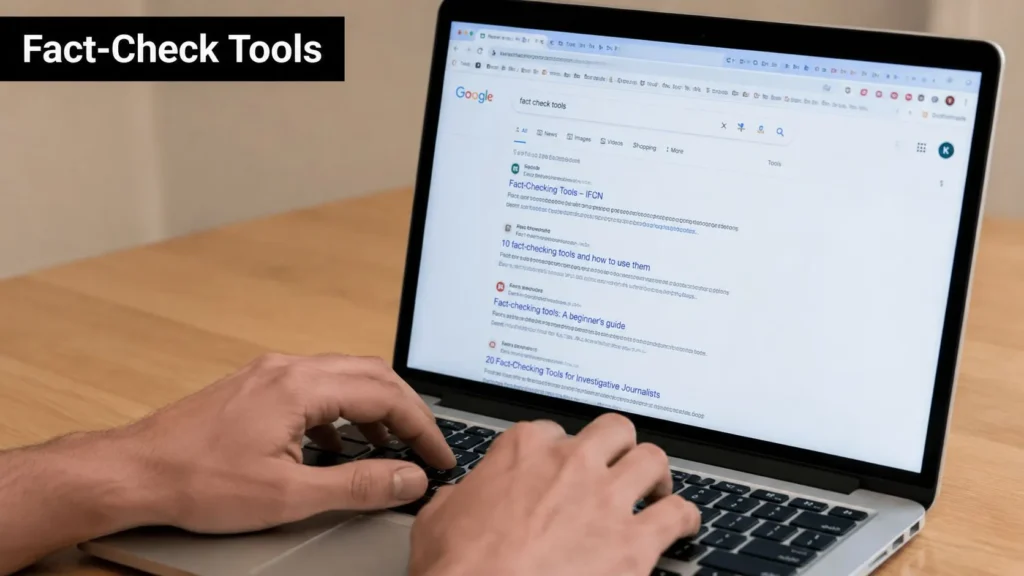
A small toolkit that covers a lot
Start with practical, widely available tools:
- Google Images for reverse image searching
- TinEye for tracing earlier appearances of an image
- Metadata viewers for checking file details when metadata is available
- Maps and street-level imagery for matching visible landmarks
- Archived pages for seeing whether a page changed over time
If the claim involves a person rather than media, basic open-source techniques can help you verify identity trails, affiliations, and public records. This overview of OSINT methods for identity verification is useful for understanding how investigators approach that kind of check responsibly.
A simple case study
Say a viral post claims to show a photo from a protest that happened “today” in a specific city. The image is dramatic, and people are sharing it as proof of escalating events.
You don’t start by debating the caption. You start with the image.
First, run a reverse image search. If you find the same photo posted much earlier, the “today” claim is already in trouble. If the earliest versions point to a different country or event, you’ve found a context problem rather than an image-authenticity problem.
Second, inspect the photo itself. Street signs, storefront language, weather, vehicle markings, and architecture often reveal whether the claimed location fits. Even a partial landmark can narrow things down.
Third, compare the image with local reporting or verified on-the-ground footage. If the protest is real but the image is recycled from another event, the post is still misleading. That distinction matters.
A real photo can carry a false claim. Verification checks both the media and the caption attached to it.
Why tools don’t replace judgment
Tools help surface clues. They don’t make decisions for you. Reverse image search may fail if the image is heavily cropped. Metadata may be missing. A map may suggest a location without proving the exact moment.
That’s why strong verification uses a chain of evidence. One clue raises a question. Several clues pointing in the same direction build confidence. The goal isn’t cleverness. It’s disciplined interpretation.
The Future of Verification in the Age of AI
The hardest verification problems aren’t always fake images or fabricated quotes. Sometimes the challenge is more subtle. You find a claim in a database export, a licensing portal, or an automated record system and ask a fair question: does this count as a primary source, or just a polished intermediary?
That question is getting more important as institutions move away from direct phone and fax confirmation toward digital portals and third-party systems. As Atlas Systems notes in its discussion of primary source verification and digital records, a major challenge now is defining a “primary source” when legacy channels are replaced by portals and automated databases. That creates ambiguity about whether an exported database is as authoritative as direct institutional contact.
The new ambiguity
Many guides stop too early. They tell you to “go to the original source” without helping you decide what counts as original in a digital-first environment.
A useful approach is to ask:
- Who controls the record?
- Is the portal an official publishing mechanism of the issuing body?
- Can the record be audited or traced back to the institution responsible for it?
- If the institution no longer exists, what successor archive or official repository preserves the record?
Those questions matter for journalists, editors, researchers, hiring teams, and ordinary readers trying to sort solid evidence from polished interfaces.
What won’t change
AI will keep changing the speed and style of misinformation. Detection tools will improve too. But the durable part of source verification is older than any platform.
You still need to ask where a claim came from. You still need to separate original evidence from commentary. You still need to notice what’s missing, what’s cropped, what’s conveniently unsourced, and what can’t yet be confirmed.
The strongest habit isn’t cynicism. It’s disciplined curiosity. You don’t have to become suspicious of everything. You have to become better at tracing, checking, and pausing before you pass something along as true.
If you want more approachable guides on writing, research, media literacy, and publishing across science, technology, health, arts, business, and everyday digital life, explore maxijournal.com. It’s a useful place to read clearly explained articles and to learn what strong, trustworthy online publishing looks like.
Discover more from Maxi Journal
Subscribe to get the latest posts sent to your email.