You’re probably here because you’ve already had at least one gel manicure go wrong at home. The color looked glossy at first, then the edges lifted, the surface dulled, or one stubborn thumb stayed weirdly soft no matter how long it sat under the lamp. That usually sends people shopping for a “stronger” lamp.
That’s where most buyers get misled.
The best gel nail light isn’t the one with the biggest wattage printed on the box. It’s the one that cures your gel line evenly, predictably, and safely. In practice, that means paying attention to wavelength, bulb layout, timer behavior, and most of all whether your specific gel formula reaches a real cure instead of just looking dry on top.
Early in my own testing, I learned that a lamp can feel bright and still under-cure darker shades, builder layers, or thumbs that sit at a bad angle. A lamp can also be compact and affordable yet perform beautifully if it matches the gels you use. That’s the difference between buying marketing and buying a tool.
Here’s the quick comparison that matters most before you start narrowing options:
| What to Compare | What Actually Matters | What Misleads Buyers |
|---|---|---|
| Compatibility | Matching the lamp to the gel system you use most | Assuming any lamp cures any gel |
| Light output | Wavelength range and even bulb placement | Chasing wattage alone |
| Real performance | Consistent cure across all five fingers, especially thumbs | Judging by brightness |
| Usability | Timer presets, sensor, interior space, removable base | Fancy display screens |
| Safety | Proper cure time, smart hand placement, limited unnecessary exposure | Fear-based claims about all nail lamps |
Why a Great Gel Nail Light Matters
A failed gel manicure rarely fails because the polish color was bad. It usually fails because the cure was incomplete, uneven, or rushed. You can prep well, apply thin layers, and still end up with peeling if the lamp doesn’t deliver the right light to the whole nail.
That’s why a good lamp changes everything. It doesn’t just speed up your manicure. It makes your results repeatable. When a lamp cures consistently, base coat grips better, color stays smoother, and top coat hardens the way it should. The whole service feels less fragile.
The real cost of a weak lamp
The obvious issues are often noticed first:
- Premature lifting because the lower layers never cured properly
- Soft centers under darker or thicker gel shades
- Thumb problems because the lamp shape or bulb placement leaves one side shaded
- Wasted product when you keep adding more coats to “fix” a cure problem that’s really a lamp problem
The frustration builds fast. You remove everything, try again, and blame your technique.
Practical rule: If the same products behave differently from one finger to the next, the lamp is often the first thing to question.
A good lamp buys confidence
The best gel nail light gives you something more valuable than speed. It gives you trust. You know how long your base needs, how your milky pink behaves, whether your black gel needs extra attention, and how to place your thumb so it cures fully.
That confidence matters whether you do your nails once in a while or work through clients back to back. At home, it saves you from wasted evenings and disappointing wear. In a salon setting, it protects service quality.
A great lamp doesn’t need to be flashy. It needs to be reliable, comfortable to use, and honest about what it can cure well.
Understanding Gel Lamp Technology LED vs UV
If you strip away the marketing, gel lamps do one job. They expose gel to a light range that activates the product’s photoinitiators so the coating hardens properly. The important distinction is how that light is delivered.
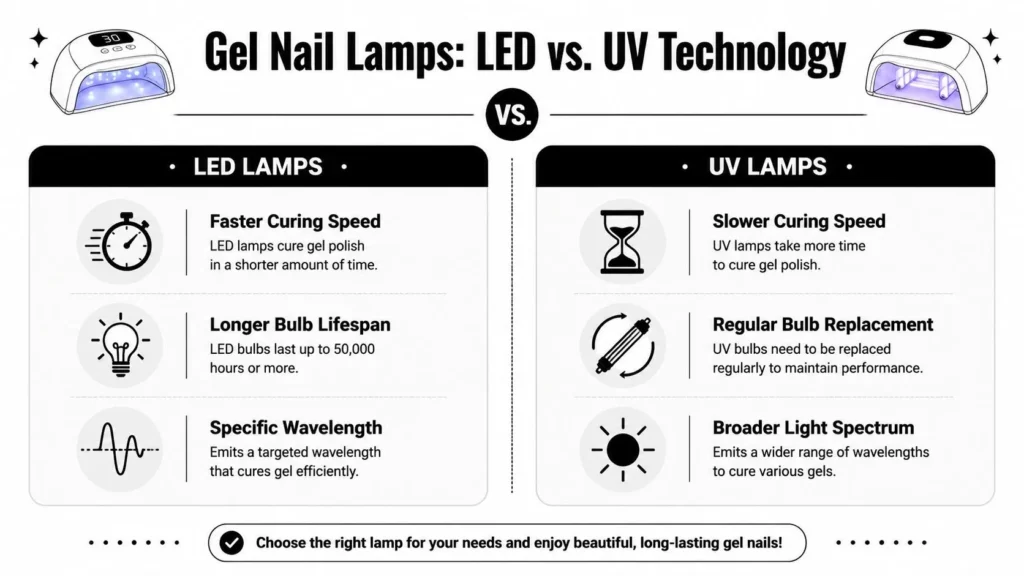
Why LED took over most modern setups
Older UV lamps use a broader light spectrum. LED lamps are more targeted. That targeted output is one reason LED systems became the default choice for many users.
A published comparison notes that LED nail lamps can cure in 15 to 30 seconds, while older UV lamps may take 2 to 10 minutes, and another comparison from the same source says LED systems often fully cure gel nails in about 60 seconds and can last up to 50,000 hours compared with roughly 4,000 hours for UV bulbs, which is a major practical advantage for replacement and downtime in this UV vs LED lamp comparison.
For a home user, that means less waiting and less fiddling with old bulbs. For a busy tech, it means faster cycles and fewer interruptions.
What the technology difference feels like in use
Think of UV lamps as a floodlight and LED lamps as a focused spotlight. The floodlight covers more broadly. The spotlight hits more precisely. Neither is automatically “better” in every situation. It depends on what your gel was designed to respond to.
That’s why some gels cure beautifully in one lamp and stay soft in another. The polish isn’t reacting to brightness alone. It’s reacting to the right wavelength.
| Lamp Type | Typical Strength | Typical Weakness |
|---|---|---|
| LED | Fast curing, long lamp life, efficient for many modern gels | Not automatically compatible with every gel formula |
| UV | Broader cure compatibility in some cases | Slower curing and more bulb maintenance |
Why this matters more than the box label
A lot of shoppers still ask, “Should I get UV or LED?” The better question is, “Which lamp technology matches the gels I use?”
If your routine is built around modern gel polish lines that respond well to LED or dual-wave lamps, LED usually gives the smoother experience. If you use mixed systems or older formulas, broader compatibility becomes more important than pure speed.
A fast cure isn’t useful if the gel never fully cures through the entire layer.
That’s the foundation for every buying decision that follows.
Key Features to Evaluate in a Gel Nail Light
Most product listings try to sell you on wattage first. That’s convenient for marketing, but it’s not how experienced users judge a lamp. The strongest buying filter is cure compatibility.
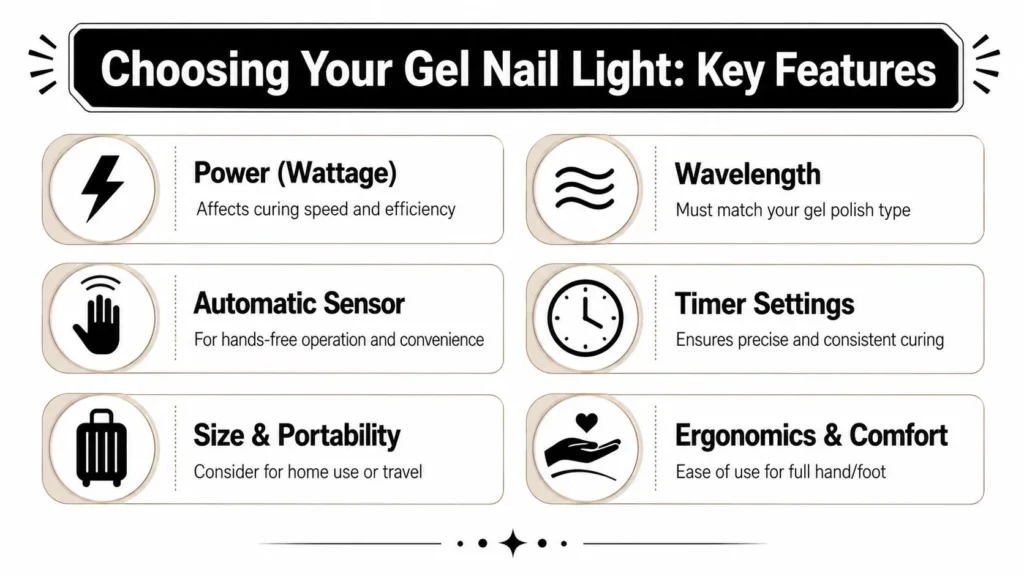
Guidance from nail education sources is clear on this point. There isn’t one unit that cures all gels perfectly. A dual-wave lamp can cure most gels, but the best practice is to match the lamp to the product line you use most, while prioritizing power, wavelength range, and bulb placement for even exposure as explained in this lamp buying guide.
Wavelength matters more than hype
If you use a single gel brand most of the time, start there. Check whether the brand recommends LED, UV, or dual-wave curing. That tells you more than any giant wattage number.
A lamp can advertise high output and still perform poorly with your collection if the wavelength range doesn’t line up with your gels’ photoinitiators. That’s why buyers who bounce between random products often do better with a dual-wave lamp than with a lamp chosen only for speed claims.
Bulb placement tells you how even the cure will be
This is one of the most overlooked features on product pages.
Look inside the lamp. Ask yourself:
- Are bulbs placed along the sides as well as the top so the sidewalls of the nail get light?
- Is there dedicated coverage near the thumb area so your thumb isn’t half-shadowed?
- Does the interior shape let your hand sit naturally instead of forcing a cramped angle?
A lamp with poor internal layout can leave front edges or thumbs underexposed even if the specs look strong. That’s why I pay close attention to interior photos and not just the front of the device.
Small convenience features matter in real life
A lamp can have solid curing performance and still be annoying to use. These details affect day-to-day satisfaction:
- Timer presets help you keep curing consistent rather than guessing.
- Automatic sensors make application smoother when both hands are busy.
- Removable bases are useful if you also cure toes.
- Interior size matters if your thumbs touch the top or side while curing.
- Low-heat modes can make dense gels more comfortable.
For cordless or rechargeable models, battery convenience can be appealing, much like the appeal of portable tech in other categories such as everyday rechargeable gadgets, but portability only matters after the curing basics are solid.
Buyer’s filter: First match the lamp to your gel. Then check bulb placement. Only after that should you care about extra features.
Safety and Nail Health Considerations
People often ask whether nail lamps are safe, and that’s a fair question. The useful answer is balanced, not alarmist. Nail lamps do emit UV radiation, mostly UVA, but typical use is generally discussed as relatively low risk when compared with much stronger UV sources.
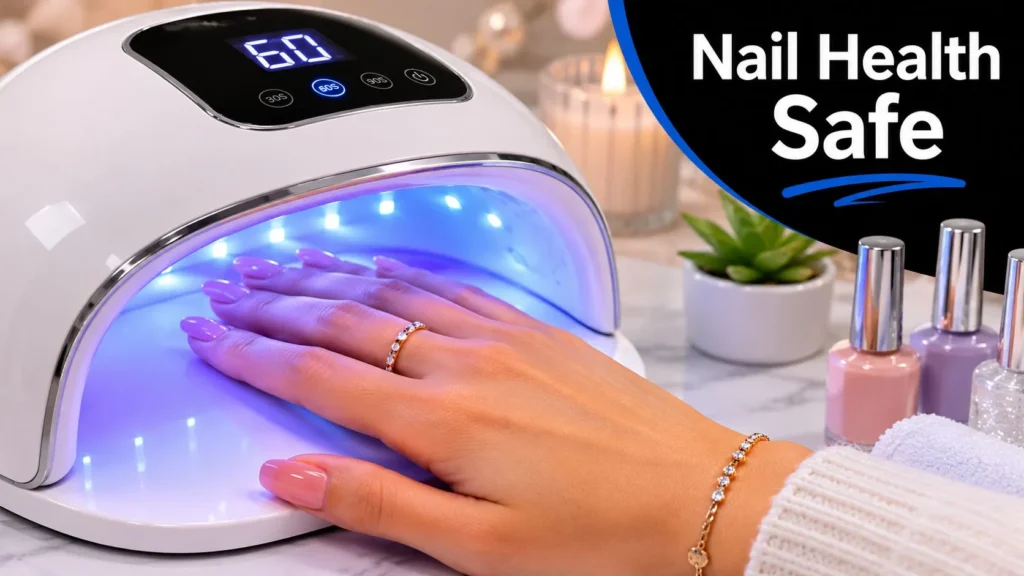
The Skin Cancer Foundation notes that even intense nail lamp devices present only a moderate UV risk, far lower than UV tanning devices. A review discussed there also estimated the risk of non-melanoma skin cancer from nail lamps to be 11 to 46 times less than overhead sunlight and 3 to 12 times less than mid-angle sunlight for equivalent exposure durations, with measured exposures generally below thresholds for acute damage at recommended distances in the Foundation’s guidance on nail lamp safety.
Sensible ways to reduce exposure
You don’t need to panic, but you should be smart.
- Use the lamp only as long as needed for a proper cure. Don’t keep hands inside while you organize bottles.
- Apply sunscreen to the hands before a manicure if that fits your routine.
- Try fingerless UV gloves if you want added coverage while leaving the nails exposed.
- Keep the hand positioned correctly so you don’t repeat cure cycles because of poor placement.
Nail health is bigger than lamp exposure
In practice, nail health problems more often come from rough removal, over-filing, repeated peeling, or wearing product that never fully cured. Under-cured gel can be a bigger day-to-day problem than the lamp itself because it leaves uncured product closer to the skin.
If you’re trying to build healthier habits around manicures overall, resources like Peela for conscious nail health can be useful for thinking beyond color payoff and toward long-term nail condition.
The skin around the nails matters too. If your hands get dry or irritated from frequent prep and removal, broader skin-barrier support becomes part of the conversation, which is why some readers also look into topics like supporting the skin barrier with beta-glucan.
If you cure carefully, limit unnecessary exposure, and avoid rough removal habits, nail lamp use fits into a practical low-risk routine for most people.
How to Achieve a Perfect and Safe Cure
Buying a decent lamp is only half the job. The key skill is knowing whether your gel is properly cured, not just shiny on the surface.
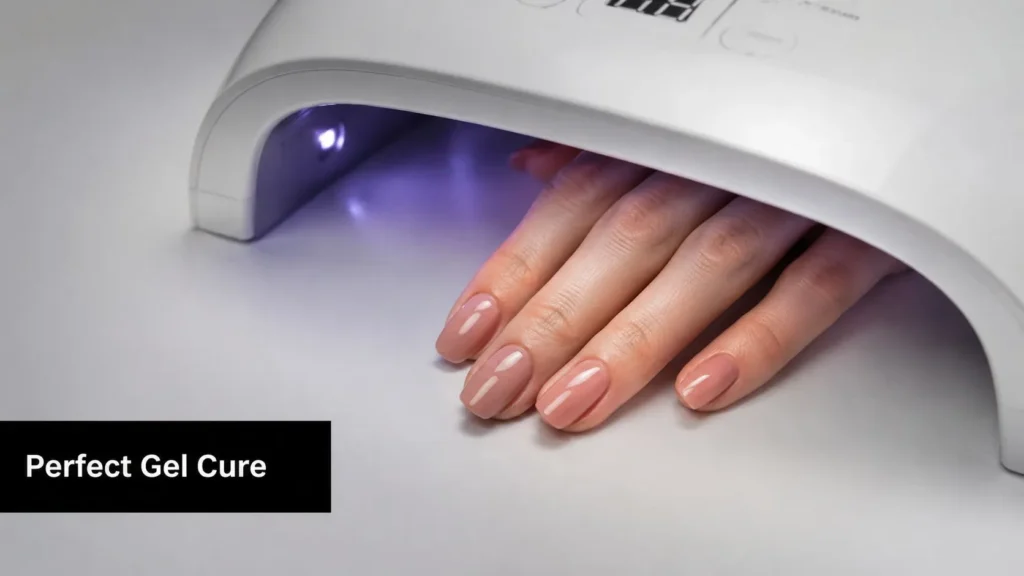
Many manicures fail because people trust the bottle label, hit a short preset, and assume the job is done. But expert analysis of UV and LED performance recommends treating a 60-second full cure as a safer default for many products because under-curing is a real risk. The same analysis contrasts a lower-performing lamp that needs about 4 minutes to reach a safe cure level with a stronger hybrid pro lamp that can do the same in 60 seconds in this expert lamp performance review.
Why I trust a consistent cure routine
Bottle instructions are useful, but they don’t account for all the variables that show up in real use:
- Pigment load changes how light passes through the gel
- Coat thickness changes whether the lower layer hardens fully
- Hand placement affects whether the thumb and sidewalls get enough exposure
- Lamp quality changes how efficiently the product cures
That’s why a disciplined curing routine beats guessing. I’d rather cure a thin coat thoroughly than rush a thick one through a short cycle.
How to verify cure at home
This is the part too many guides skip. You don’t need lab equipment, but you do need observation.
Use a simple verification checklist:
Apply very thin coats. Thick gel is the easiest way to trap uncured product underneath a hard-looking top surface.
Watch your thumb placement. Many users angle the thumb away from the strongest light. If your lamp allows it, cure thumbs separately when testing a new product.
Compare similar shades. Highly pigmented colors, milky shades, and dense glitters often need more caution than sheer colors.
Check cure consistency after top coat. If one nail repeatedly dents, wrinkles, peels early, or feels different during removal, assume the cure process needs adjustment.
Test one gel line at a time. Don’t evaluate a new lamp using five unrelated brands in one manicure.
Studio habit: The best lamp is the one you’ve personally tested with your own base, color, builder, and top coat, not the one with the loudest claims.
A helpful visual walk-through is below. Use it as a companion, not a substitute for testing your own products carefully.
What works and what doesn’t
What works:
- Thin, even application
- A full timed cure instead of random extra flashes
- Separate thumb curing when needed
- Testing dark shades before trusting them for a full set
What doesn’t:
- Using thickness to get opacity faster
- Relying on brightness as proof of performance
- Assuming tackiness always means under-cure when some gel systems have an inhibition layer
- Switching lamps and gels constantly without rechecking performance
The safest manicure is usually the least rushed one.
Top Gel Nail Lights for Every User in 2026
I’m not going to pretend there’s one universal winner for everyone. The right lamp depends on how you use gel, how many product lines you own, and whether you need compact convenience or salon-style coverage. The main rule is simple: the best gel nail light is the one you’ve tested with your own system.
Many buying guides still miss that point. Neutral guidance from nail supply education stresses that cure performance depends on gel formula, pigment load, coat thickness, and hand placement, and that the best lamp is the one proven with your own products rather than the highest-wattage option in this practical guide to UV lamp buying.
2026 Gel Nail Light Recommendations
| Model | Best For | Type | Wattage | Key Feature |
|---|---|---|---|---|
| SUNUV SUN4 | Home hobbyists | UV/LED dual light | 48W | Reliable timer options and roomy hand fit |
| SUNUV SUN2C | Sensitive users | UV/LED dual light | 48W | Low-heat style curing and easy presets |
| Gelish 18G Plus | Brand-matched users | LED | Qualitatively high-output professional lamp | Strong choice if you already use Gelish systems |
| Kiara Sky Beyond Pro | Aspiring pros | LED | Qualitatively high-output professional lamp | Rechargeable salon-style design |
| Le Mini Macaron Lamp | Travel and quick touch-ups | LED | Compact travel output | Easy to pack and simple for one-hand use |
| MelodySusie professional-style dual lamp | Mixed brand users | UV/LED dual light | Varies by model | Good flexibility when you rotate brands |
Best for home hobbyists
If you mostly do your own nails and want one lamp that handles common gel polish routines well, a dual-wave full-hand lamp is the safest place to start. Models like the SUNUV SUN4 or SUNUV SUN2C are popular because they’re easy to use, roomy enough for full-hand placement, and practical for people still learning how different gels behave.
These lamps make sense when your collection includes a mix of base coats, color gels, and top coats from more than one brand. The broad compatibility is the point.
Best for aspiring pros
If you’re doing frequent sets, builder applications, or practicing on others, look at more professional-grade salon-style models such as the Kiara Sky Beyond Pro or a professional Gelish lamp matched to the gel system you use most.
The trade-off is flexibility versus certainty. A dedicated brand lamp can be excellent when you stay inside one ecosystem. A dual-wave pro-style lamp is often better if you test multiple lines.
If you want fewer surprises, buy the lamp that was designed around the products you’ll reach for most often.
Best for travel or small spaces
Travel lamps have a place, but they’re easy to overestimate. A compact model like the Le Mini Macaron Lamp is fine for quick single-color maintenance, one-hand curing, or occasional use. I wouldn’t make it my main lamp for dense colors, full builder work, or routine full sets unless I had already verified every product with it.
If you like compact beauty tech in general, the same practical mindset used for portable devices and personal gadgets applies here too. Small format is great when it doesn’t compromise the task.
How to choose from this shortlist
Pick based on your real behavior:
- Mostly one gel brand: choose the matching lamp first.
- Mixed gel collection: choose a full-hand dual-wave lamp.
- Frequent dark shades or builder use: favor interior space and even light coverage.
- Travel only: choose compact size, but test every product before trusting it.
The lamp isn’t the manicure. Your testing process is.
Frequently Asked Questions about Gel Nail Lights
Why is my gel still sticky after curing
Sticky doesn’t always mean under-cured. Many gels leave an inhibition layer that needs to be wiped after the final cure if the system calls for it. If the product seems soft underneath, wrinkles, or peels quickly, that points more toward under-curing.
Can I use any gel polish with any lamp
Not reliably. Some gels work well in a broad range of lamps, but compatibility isn’t universal. If you mix brands, test each gel line carefully before assuming your lamp cures it fully.
How do I clean cured gel off my lamp
Use the cleaning method recommended by the lamp maker if one is provided. In general, wipe the interior gently and don’t let spilled gel build up around the LEDs or reflective surface. Avoid scraping aggressively, especially near the diodes.
Should I cure longer than the bottle says
Sometimes, yes. A consistent full cure can be safer than blindly following a short bottle instruction, especially with darker shades, thicker layers, or a lamp you haven’t validated yet. The key is not endless curing. It’s controlled, repeatable curing.
Why do my thumbs fail first
Thumbs often sit at a poor angle and miss part of the light field. If your thumbs lift, wrinkle, or dull first, cure them separately while testing a new lamp or gel.
Is higher wattage always better
No. Wattage alone doesn’t tell you whether the lamp matches your gel formula or exposes the whole nail evenly. A well-matched lamp with smart bulb placement will outperform a badly matched high-wattage lamp.
What’s the simplest way to avoid under-curing
Keep coats thin, use a consistent timer, place the hand carefully, and test one product system at a time. That routine beats guesswork every time.
If you like practical, no-hype buying guides like this one, Maxi Journal is worth bookmarking. It’s an independent online magazine that publishes approachable writing across science, technology, health, fashion, business, entertainment, travel, and more, with the same focus on clear explanations over marketing noise.
Discover more from Maxi Journal
Subscribe to get the latest posts sent to your email.