A policy rate that once reached 45.00% and later fell to 2.00% tells you more about Brazil than any single “current rate” headline. The modern history of Brazil interest rates is a story of sharp policy shifts, inflation pressure, currency stress, emergency easing, and unusually restrictive real borrowing conditions. The Selic can be falling and still leave households, companies, and investors facing expensive credit.
Introduction to Brazil Interest Rates and Why They Matter
A saver visiting Brazil may notice something surprising. A local fixed-income product can appear to offer an attractive nominal return, while a business owner complains that financing remains difficult and a household postpones a major purchase because loan payments are too high. These experiences aren’t contradictory. They reflect the difference between the headline Selic, inflation, bank spreads, and the rate people pay or receive.
The Selic is Brazil’s benchmark interest rate and one of the most closely watched policy rates in Latin America. Brazil’s central bank uses it to influence inflation, credit, consumption, investment, and the exchange rate. A change in the Selic doesn’t stay inside a central-bank announcement. It can affect the attractiveness of Brazilian bonds to international investors, the cost of working capital for companies, and the return available to local savers.
For a foreign investor, the rate also helps frame the appeal and risk of Brazilian assets. High local yields may attract capital through carry-trade strategies, but currency movements can reduce or erase those gains. For a traveler or importer, the Brazilian real’s response to changing global and domestic rates can influence the local cost of goods and services.
The central question: Don’t ask only whether the Selic is high or low. Ask whether it is high or low relative to inflation, expected inflation, and the economy’s neutral rate.
That distinction matters especially in the current cycle. In September 2026, the Central Bank cut the Selic by 0.25 percentage points to 13.75%, after an earlier tightening period had taken it to 15.00%. Reuters also reported that the bank raised its inflation forecast for 2026 to 5.2% from 5.1% and for 2027 to 3.9% from 3.8%, while keeping its 18-month policy-horizon projection at 3.2%. (Agência Brasil)
The useful habit is to separate three questions: what the Central Bank is doing, why it is doing it, and how that decision changes real financial conditions. Readers who want a quick reference for the meaning of an interest-rate figure can check interest rate now before interpreting Brazil’s latest move.
How Brazil Interest Rate System Works
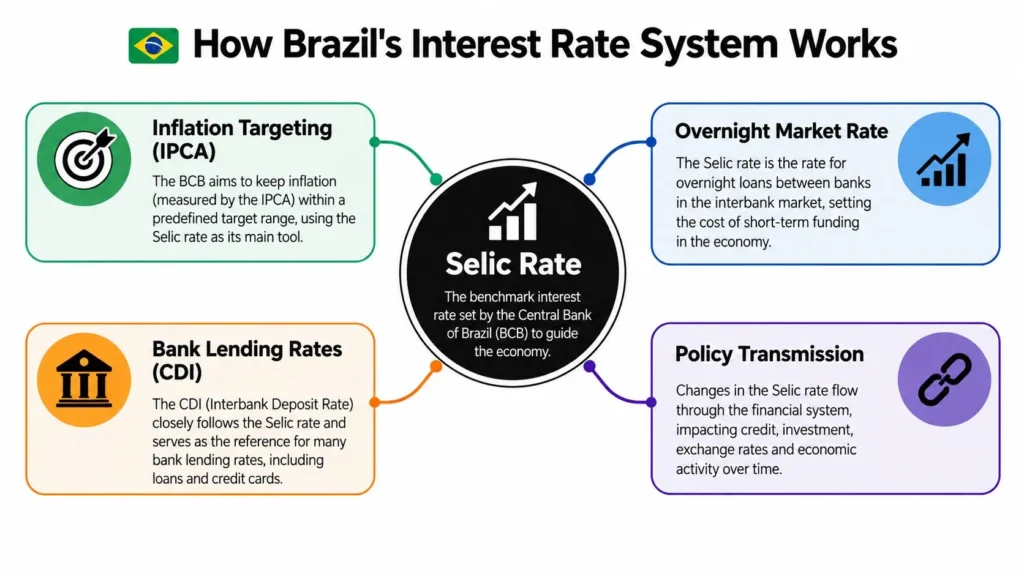
Think of the Selic as a thermostat for the economy. When inflation pressure builds, the Central Bank can raise the setting, making money more expensive and reducing demand. When inflation is under control and economic activity needs support, it can lower the setting, making financial conditions less restrictive.
The Selic is the starting point
The Selic is the Central Bank’s main policy instrument for keeping inflation, measured by the IPCA, under control. It isn’t the rate every borrower receives. Instead, it establishes the broad price of money in the financial system and guides overnight transactions involving government securities.
The transmission process has several stages:
- The Central Bank sets the policy direction. A higher Selic signals tighter monetary policy. A lower Selic signals easing, although the overall stance also depends on inflation expectations and the neutral rate.
- Money-market rates respond. The overnight market rate and closely related benchmarks adjust as financial institutions price short-term funding.
- Banks reprice products. Lending rates, deposit products, corporate credit, and consumer finance respond according to funding costs, risk, collateral, and bank margins.
- Households and firms change behavior. Expensive credit can delay consumption and investment. More attractive savings yields can encourage people to hold cash or fixed-income assets.
- Inflation and activity feed back into policy. The Central Bank evaluates whether demand, prices, and expectations are moving toward the desired path.
CDI is another important reference in Brazil’s financial market, particularly for bank investments and lending products. It shouldn’t be treated as identical to the Selic in every context, but it often moves closely enough to shape how investors compare returns. Anyone trading across markets should also understand how benchmarks affect trading costs, since a benchmark can influence more than the advertised policy rate.
The thermostat analogy has a limit. Monetary policy doesn’t produce an instant, uniform result. A mortgage, business loan, or consumer-finance contract may adjust at a different speed, and lenders may preserve wide spreads when they perceive credit risk as high. That is why a Selic cut can coexist with cautious banks and expensive borrowing.
History and Recent Levels of Brazil Interest Rates
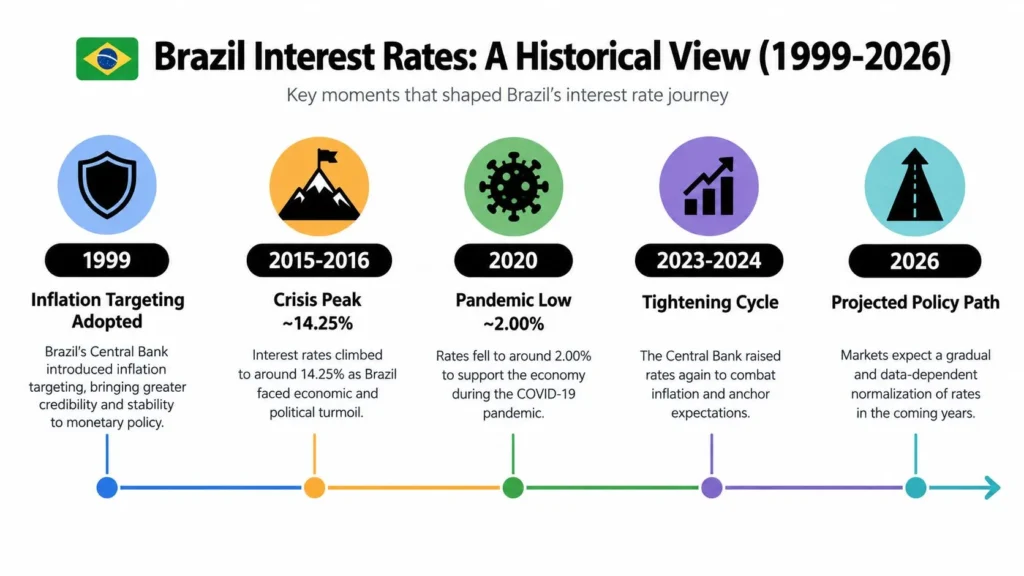
Brazil’s rate history is unusually useful because it shows why a single reading can mislead. One widely used historical series reports an average policy rate of 13.86% from 1999 through 2026, with a peak of 45.00% in March 1999 and a record low of 2.00% in August 2020. (Trading Economics)
Those endpoints represent very different policy environments. The 1999 peak belongs to a crisis-era effort to defend price stability during severe financial pressure. The 2020 low belongs to the pandemic easing cycle, when policymakers used exceptionally low rates to support an economy facing an extraordinary shock. The distance between those levels demonstrates that Brazil’s central bank has repeatedly moved forcefully rather than adjusting only in small, predictable increments.
What the recent cycle adds
The latest cycle shows that easing doesn’t automatically mean easy money. The Selic was cut from 15.00% to 14.25% in June 2026, then reduced to 13.75% in September 2026. (Agência Brasil)
A timeline helps put those moves in context:
| Period | Policy signal | What it illustrates |
|---|---|---|
| 1999 | Selic reached 45.00% | Crisis-era anti-inflation pressure |
| 2020 | Selic reached 2.00% | Pandemic-era monetary easing |
| June 2026 | Selic moved to 14.25% | Easing after a restrictive phase |
| September 2026 | Selic moved to 13.75% | Further easing, but still a high nominal rate |
The historical lesson isn’t that Brazil always has high rates. It is that the policy rate can move across a very wide range when inflation risks, currency conditions, and global shocks change. For investors, that volatility affects bond duration, currency exposure, and the timing of portfolio decisions.
The more important current question is the gap between the policy rate and the economy’s estimated neutral rate. Reuters and the IMF reported that market expectations placed the end-2026 policy rate around 13.5% to 14.0%, while the IMF estimated Brazil’s medium-term neutral rate at about 8%. (IMF country report) A policy rate can therefore decline while remaining substantially restrictive, which explains why borrowers may not feel relief immediately.
What Drives Brazil Interest Rate Decisions
The Central Bank’s decision isn’t based on the latest inflation reading alone. Policymakers look forward. They assess where inflation is likely to go, whether expectations are anchored, how quickly demand is growing, how fiscal developments affect confidence, and whether global financial conditions are putting pressure on the currency.
Inflation forecasts come first
The IPCA is the central inflation measure used in the policy framework. If forecasts move further from the desired path, the Central Bank may keep rates high for longer or tighten policy. If forecasts improve, policymakers may gain room to cut, but they still need to judge whether the improvement will last.
The September 2026 decision shows why forecasts matter. The Central Bank cut the Selic while raising its inflation forecast for 2026 to 5.2% and for 2027 to 3.9%, according to Agência Brasil’s account of the decision. A cut alongside higher near-term forecasts doesn’t necessarily mean policymakers are unconcerned. It can mean the bank is balancing current inflation risks against the accumulated restrictiveness of earlier rate increases.
Credibility changes the size of the response
Central banks need households, companies, and investors to believe that inflation will return toward the target over time. If people begin setting prices and wages based on persistently higher inflation, policymakers may need stronger action to restore confidence.
Fiscal conditions matter through this channel. Government borrowing needs, spending plans, and uncertainty about future policy can influence inflation expectations and the currency. A weaker currency can raise the local cost of imported goods, while a stronger currency can reduce some external price pressure. These effects don’t operate in isolation, so the Central Bank evaluates the combined picture.
Global conditions enter the calculation
Brazilian assets compete for international capital. When global investors can earn more in major markets, they may demand a larger return to hold Brazilian bonds or the currency. That can affect exchange-rate pressure and financial conditions even when domestic data hasn’t changed.
A 0.25 percentage-point move can therefore carry more meaning than its size suggests. It may confirm a gradual easing path, signal caution after a period of tightening, or reveal that policymakers see enough progress to reduce restriction while still guarding against renewed inflation.
For a broader explanation of the relationship between inflation and monetary policy, see this guide to interest rates and inflation. The key is to read the decision together with the forecast, the policy horizon, and the Central Bank’s assessment of risks.
How Brazil Interest Rates Affect Currency Borrowing and Investments
A Selic change travels through money markets in a chain. It affects the return investors seek, the exchange rate they accept, the funding cost banks face, and the price households and companies pay for credit. The final effect depends on the size and speed of the move, the contract involved, inflation expectations, and perceived risk.

Currency and carry trades
High Brazilian rates can attract foreign investors who borrow or hold funds in a lower-yielding currency and invest in Brazilian assets. The potential return comes from the interest differential, but the strategy carries exchange-rate risk. If the Brazilian currency depreciates sharply, currency losses can outweigh the extra yield.
A rate cut can reduce that differential, yet the currency may still offer attractive yields if Brazil’s policy rate remains high relative to alternatives. Investors also consider whether the Central Bank appears credible, whether inflation is falling, and whether fiscal or political risks could destabilize the currency.
Borrowing doesn’t follow the headline one-for-one
A borrower usually pays more than the benchmark because lenders add compensation for operating costs, default risk, liquidity, taxes, and profit. A household with unsecured credit may see little immediate relief from a small Selic cut, while a company with strong collateral and a floating-rate contract may benefit sooner.
The same principle applies to mortgages and business loans. A lower benchmark can improve the direction of travel, but the contract’s index, repricing schedule, and lender spread determine the actual payment. Borrowers should compare the total cost, not just the advertised annual rate.
Savings and asset prices
For savers, restrictive rates can make short-duration fixed-income products more competitive with riskier assets. For investors, higher discount rates can reduce the present value assigned to future corporate earnings, which can weigh on growth-oriented equities. Banks, exporters, commodity companies, and heavily indebted firms may respond differently because their revenues and financing structures differ.
A disciplined investor also separates nominal return from real return. If an investment earns a high nominal rate but inflation remains high, the increase in purchasing power may be much smaller. The IMF’s estimate of an approximately 8% medium-term neutral rate helps explain why a policy rate well above that level can keep financial conditions restrictive even during cuts. (IMF country report)
A practical introduction to evaluating personal investment choices is available in this guide on how to start investing money. The important step is to match the asset’s risk and time horizon to the rate environment rather than chasing the highest displayed yield.
Smart Strategies for Different Rate Environments in Brazil
The right response depends on whether you’re saving, borrowing, or investing. A restrictive real-rate environment rewards patience and liquidity, while an easing cycle can make it worthwhile to consider how today’s yields may change as instruments mature.
A decision matrix for practical choices
| Your priority | Restrictive real rates | Easing cycle |
|---|---|---|
| Preserve cash | Favor liquidity and review reinvestment terms | Avoid assuming today’s yield will remain available |
| Borrow for a purchase | Compare fixed and floating costs carefully | Consider whether refinancing terms could improve |
| Build fixed income | Match maturity to your horizon and risk tolerance | Evaluate longer maturities, with duration risk in mind |
| Hold equities | Examine debt burdens and earnings sensitivity | Watch for improving financing conditions, without ignoring inflation |
A saver shouldn’t lock away money needed for near-term expenses merely because the nominal return looks attractive. Liquidity has value, especially when policy can change and reinvestment rates may differ when a certificate or bond matures.
A borrower should stress-test the payment under less favorable conditions. If a floating-rate loan only works when the Selic keeps falling, the plan may be too fragile. Compare the full contract, ask how often the rate resets, and check whether a fixed-rate alternative provides useful certainty.
For investors, falling rates can support assets whose valuations depend on future cash flows, but the adjustment isn’t automatic. Inflation expectations, fiscal risk, currency volatility, and company balance sheets still matter. Fixed-income holders should also remember that longer maturities can gain when yields fall and lose when yields rise.
Risk check: A falling Selic improves the direction of financial conditions, but it doesn’t remove duration risk, credit risk, currency risk, or inflation risk.
Before changing a portfolio, write down the objective, time horizon, liquidity requirement, and maximum tolerable loss. Readers managing portfolios or balance sheets can also consult Visbanking risk management insights for a broader framework for thinking about exposure to rate changes. The best strategy isn’t the one that predicts the next meeting perfectly. It’s the one that remains workable if the next move arrives later than expected.
How to Track Brazil Interest Rates and Interpret Changes
Start with the Central Bank’s official Selic announcement, then read the accompanying explanation rather than relying on the headline alone. Check the decision, the inflation projections, the stated risks, and whether the language describes policy as restrictive, neutral, or supportive.
A simple monitoring routine can look like this:
- Record the new Selic. Note the direction and size of the change.
- Compare the inflation outlook. Look for revisions to the IPCA path and the policy horizon.
- Check market expectations. Compare expected year-end rates with the current policy rate.
- Estimate the monetary policy stance. Ask how far the policy rate sits above or below the medium-term neutral-rate estimate.
- Review your exposure. Revisit loan costs, bond maturities, currency holdings, and equity sensitivity.
Don’t treat a 0.25 percentage-point move as a complete story. A small cut can still leave policy highly restrictive if inflation expectations remain high or the neutral rate is much lower. Conversely, a larger move may just reverse earlier emergency tightening without creating easy financial conditions.
Use a separate source for inflation releases and a reputable market-expectations survey for forward views. For international comparison, a guide to China interest rates can help place Brazil’s policy choices beside another major emerging economy, but each country’s inflation regime and financial structure require separate analysis.
Review the routine after every decision and whenever your loan, savings product, or investment thesis changes. Rate tracking is most useful when it leads to a concrete question: should you preserve liquidity, refinance, extend duration, reduce currency exposure, or wait for better information?
Maxijournal.com publishes approachable writing across business, education, science, technology, and other everyday subjects, helping readers connect economic developments with practical decisions. Visit maxijournal.com to explore clear commentary and fresh articles that can add context to the financial stories you follow.
Discover more from Maxi Journal
Subscribe to get the latest posts sent to your email.