You step out of the shower, your hair is heavy with water, and the first pull of the brush makes that familiar snapping sound. That moment is why so many people start searching for the best brush for wet hair. They don’t just want a product recommendation. They want to stop the breakage, reduce the tugging, and get through wash day without feeling like they’re damaging their hair on purpose.
The hard part is that “safe for wet hair” gets simplified too much. A brush can be marketed for wet use and still be a poor match for your texture, density, or routine. The better question is this: what kind of tool creates the least tension on your hair in its weakest state, and when should you use it at all?
Your Guide to Brushing Wet Hair Without Damage
If your hair tangles right after washing, you’re not alone. Knots tighten fast when strands clump together with water, conditioner, and friction from a towel or pillowcase. Then the brush turns a simple detangling step into a fight between your hand and your hair.
That’s why choosing the best brush for wet hair starts with one principle. The tool should lower resistance, not overpower the tangle. A good wet-hair tool glides, bends, and separates. A bad one drags, catches, and forces hair to stretch.
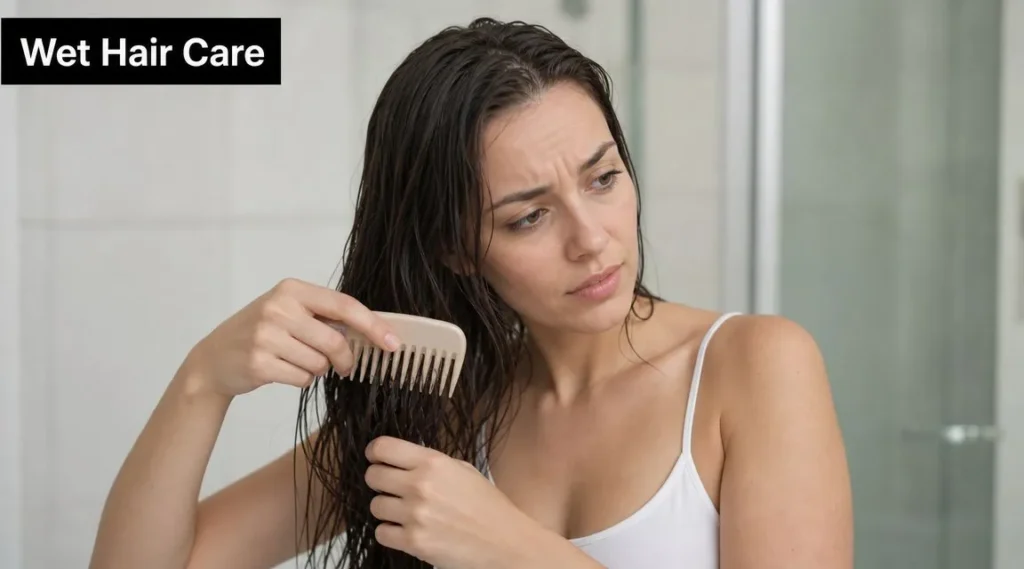
Many readers get stuck on the brush itself and forget technique. That matters, especially if you’re dealing with severe tangling or matting. If your hair is beyond a few post-shower knots, Morfose’s practical detangling guide is a useful read because it focuses on patient sectioning and reducing force, which is exactly the mindset wet hair needs.
Here’s a quick comparison before we get into the details:
| Tool | Best use on wet hair | Main strength | Main caution |
|---|---|---|---|
| Wide-tooth comb | Gentle detangling, especially with slip | Separates knots with low tension | Can feel slow on dense hair |
| Flexible detangling brush | Fast detangling for many hair types | Flexible bristles reduce snagging | Still needs a light hand |
| Paddle detangler | Long hair, smoothing, workflow convenience | Covers more hair quickly | Not all paddle styles are equally gentle |
| Boar or dense styling brush | Usually better on dry hair | Smoothing and polish later | Too much tension for fragile wet strands |
Practical rule: If a brush feels like it has to “win” against your knots, it’s the wrong tool or the wrong moment to use it.
The Science of Why Wet Hair Is So Fragile
Hair doesn’t behave the same way when it’s wet. That’s the root of the problem. A strand that feels normal and resilient when dry can become stretchy, swollen, and easier to over-pull after a wash.
Think of a hair strand as a fiber with an outer layer and an inner core. The cuticle is the outside, like overlapping scales. The cortex is the inner structure that gives the strand much of its strength. When hair takes on water, that structure changes enough that your usual brushing habits can become rougher than you realize.
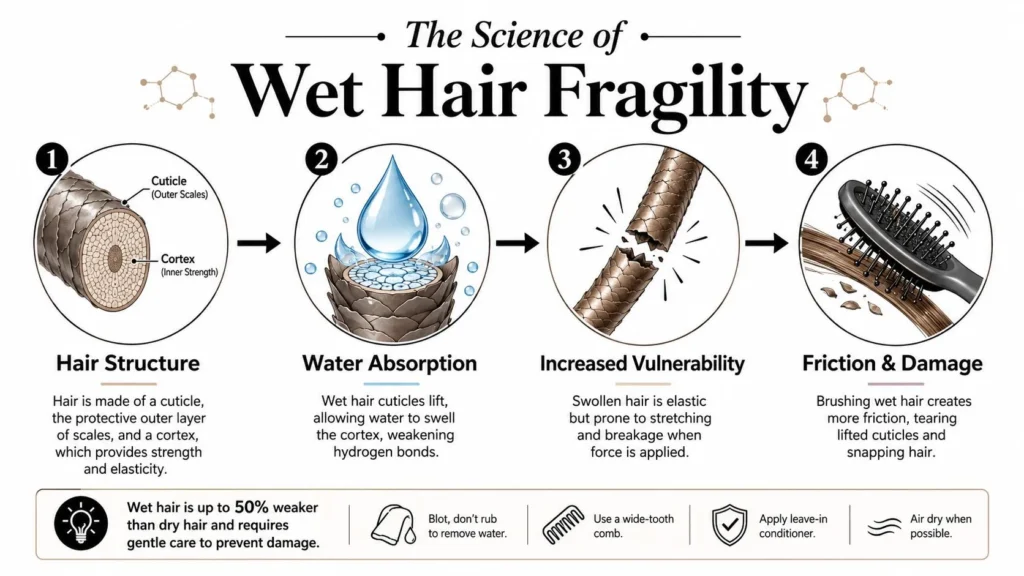
What water changes
Water can make hair more elastic. That sounds helpful, but it creates a trap. Stretchy hair can be pulled farther before it breaks, so you may not notice damage happening until the strand has already been stressed too much.
Once the cuticle is lifted and the strand is swollen, friction goes up. Hair catches on neighboring strands more easily, and a rigid brush can scrape through those weak points. If you already have chemically processed or heat-stressed hair, that extra force is even less forgiving.
A useful way to think about it is this:
- Dry hair often resists movement, but it’s structurally more stable.
- Wet hair moves more easily at first, then suddenly snags and over-stretches.
- Damp hair is often the safer middle ground because there’s still slip, but less water weight and less stretch.
Expert guidance emphasizes that for wet hair, the strongest technical criterion is a flexible detangling head with wide bristle spacing, because it lowers strand-to-strand friction and reduces the pulling force. The same guidance also recommends brushing when hair is damp rather than dripping in this detangling brush explainer from Luna London.
Why brush design matters more than people think
A stiff, densely packed brush doesn’t adapt much when it hits resistance. Your hand keeps moving, but the knot doesn’t. The force has to go somewhere, so it goes into the hair shaft.
That’s why flexible tools matter. They absorb some of that force before your hair does.
If your hair has been treated and you’re trying to preserve smoothness and strength, brushing technique should support the rest of your routine. That’s also why readers who are managing post-treatment hair often look into care methods like keratin treatment maintenance basics, where friction control matters just as much as product choice.
Wet hair doesn’t need more discipline. It needs less force.
A Comparison of Brushes for Wet Hair
The modern wet-hair category didn’t appear by accident. The commercialization of brushes built around ultra-flexible detangling bristles, later widely marketed as IntelliFlex bristles, helped move wet detangling from a niche salon move into common hair-care advice across multiple hair types, as discussed in this Wet Brush history and commentary piece. That shift changed what people expect from a brush. Less styling first. More damage control first.
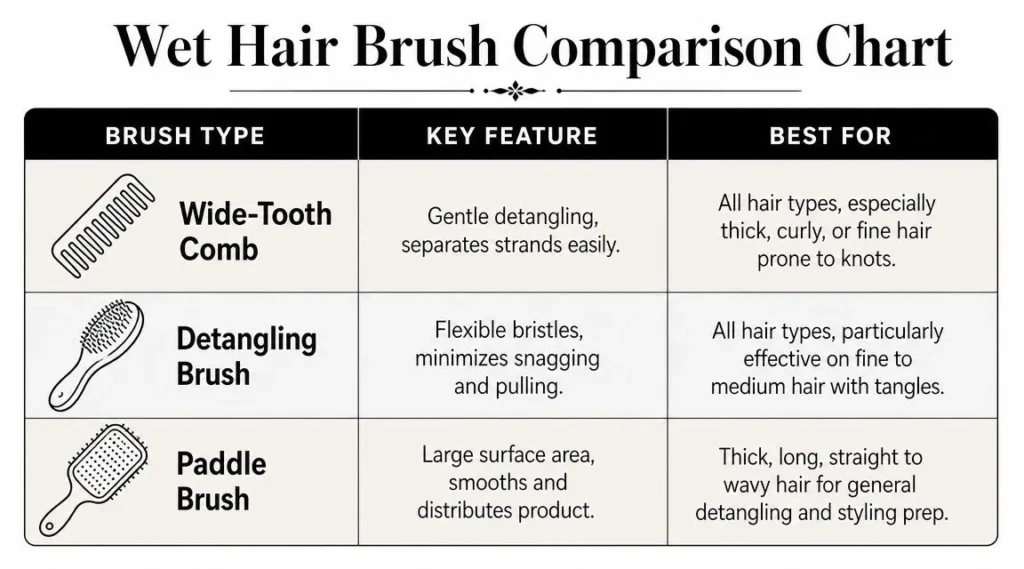
Quick side-by-side view
| Brush type | How it works | Best for | Use caution if |
|---|---|---|---|
| Flexible detangling brush | Bends around knots instead of forcing through them | Fine, medium, wavy, and many straight hair routines | You tend to rush and drag from roots down |
| Wide-tooth comb | Separates larger sections of hair with minimal crowding | Curly, coily, thick, fragile, or heavily conditioned hair | You want a polished finish in one step |
| Paddle detangler | Larger surface area with a detangling shape | Long hair, quick post-wash smoothing, blow-dry prep | Your hair is very fine or very breakage-prone |
| Dense styling brush | Smoother finish, more tension | Usually better after hair dries | You plan to detangle major knots while hair is wet |
A demonstration can help if you want to see how tool shape changes movement through knots:
The flexible detangling brush
This describes what is typically meant by “wet brush.” The main idea is simple. The bristles flex enough to move around resistance rather than pushing straight through it.
For many people, this is the best brush for wet hair because it balances speed and gentleness. It works especially well when hair is lightly blotted, coated with leave-in conditioner, and divided into sections. If you have fine to medium strands and ordinary post-shower tangles, this category is often the easiest daily option.
Its weakness is user behavior. A flexible brush can still cause damage if you start at the roots and yank downward.
The wide-tooth comb
A wide-tooth comb is less glamorous, but often more strategic. It doesn’t try to smooth everything at once. It separates hair with less crowding between teeth, which usually means less friction.
It’s especially useful for curly and coily textures, or for anyone detangling with conditioner still in the hair. It’s also a smart choice when your strands are compromised and you want maximum control over each pass.
The tradeoff is finish. A comb detangles well, but it won’t always leave hair as polished-looking as a brush.
The paddle detangler
This category is growing because many people want fewer tools on the counter. A paddle detangler can help with post-wash detangling and make the next styling step easier, especially on long, straight, or wavy hair.
The key point is that not every paddle brush belongs here. A traditional dense paddle brush can be too stiff for vulnerable wet hair. A paddle detangler is different. It needs enough give and spacing to behave like a detangling tool, not a tension tool.
Boar and hybrid brushes
These are usually better reserved for dry hair. Their strengths are smoothing, oil distribution, and finish. Those are valuable jobs, just not the first job your hair needs right after a wash.
If your routine involves a sleek blowout or polished ponytail, save this brush for later. Wet detangling should be the gentle phase. Styling tension comes after the hair is stable again.
The safest wet-hair tool often looks less impressive in the hand and performs better on the strand.
Key Features That Define a Great Wet Hair Brush
Shopping for the best brush for wet hair gets much easier once you stop looking at brand promises and start checking structure. A strong wet-hair brush doesn’t need flashy claims. It needs the right mechanics.
Consumer-focused expert testing puts the focus on damage reduction, not just styling. That testing prioritizes factors like ease of use, ease of cleaning, and especially grip when wet, because wet hair is more vulnerable to breakage. It also reflects a broad design consensus toward flexible, gentle tools over rigid ones in this Consumer Reports guide to detangling brushes.
The buyer’s checklist
- Flexible bristles or teeth matter most. If the bristles barely bend, the hair will take the force.
- Wide spacing helps strands separate instead of bunching into a tighter knot.
- Rounded tips can make the experience gentler on the scalp, especially if you detangle close to the roots.
- A secure handle matters more than people expect. Wet hands, slippery conditioner, and a twisting brush create accidental yanks.
- Easy cleaning is part of performance. A brush clogged with shed hair and product residue won’t glide the same way.
What to avoid
Some readers assume “more bristles” means a better brush. On wet hair, that often works against you. Dense bristle fields can increase contact points and drag.
Wooden bristles are also commonly avoided in wet detangling guidance. The safer direction is usually a purpose-built detangler or a simple wide-tooth comb that prioritizes movement and spacing over firmness.
If you want to browse examples and compare shapes before buying, it can help to shop quality hair detanglers and study the design details rather than only the marketing text. Look at spacing, flexibility, and grip first.
The simplest screening question
Hold the brush in your mind and ask: Will this tool glide through a knot, or will it try to overpower it?
That one question filters out a lot of bad options.
Matching the Best Brush to Your Hair Type
The best brush for wet hair isn’t one universal tool. It’s the tool that matches your strand strength, your texture, and the kind of tangle you get after washing.
One of the biggest gaps in wet-hair advice is when not to use a brush at all. Hair is mechanically weaker when wet, and fine, bleached, or curly hair often needs extra caution. In some cases, pre-drying with a gentle towel or using conditioner for slip matters more than the brush itself, as noted in this discussion of wet brushing limits.
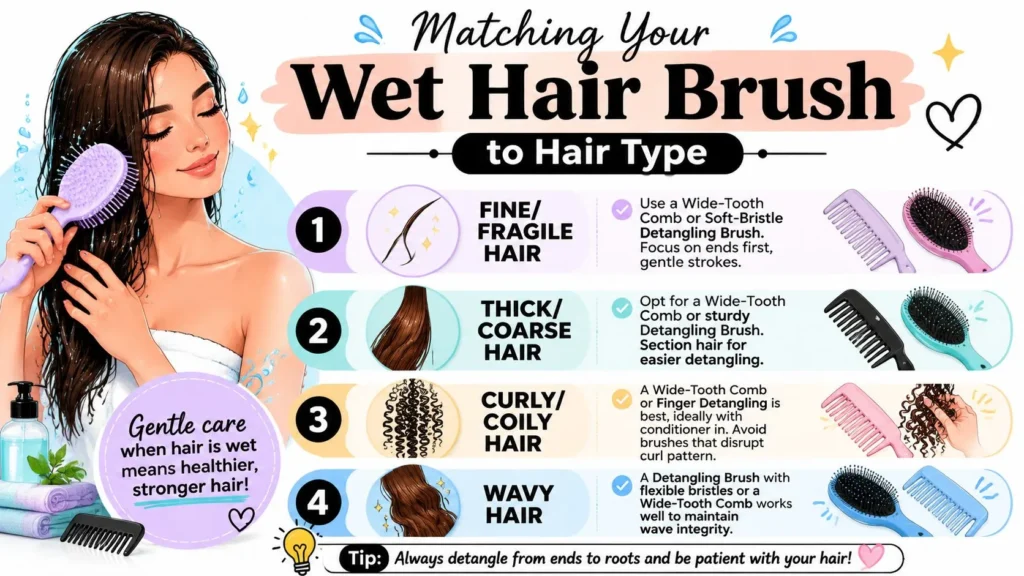
Fine or fragile hair
Fine hair usually needs the gentlest detangling path because it can snap before you feel major resistance. If your hair is also bleached or heat-damaged, be even more conservative.
A soft detangling brush or wide-tooth comb is often the best match. Work on damp hair, not soaking hair. If the ends are knotting badly, add slip first and detangle in small sections.
Good match:
- Most days use a very flexible detangler
- On rough days switch to a wide-tooth comb for more control
Bad match:
- Dense paddle brushes
- Any tool that makes you hear repeated snapping
Thick or coarse hair
Thick hair can handle more structure in the tool, but it still doesn’t benefit from brute force. The goal is to manage bulk without compacting tangles.
A sturdier detangling brush or wide-tooth comb usually works best. Sectioning matters a lot here. Many people with thick hair blame the brush when the issue is trying to detangle too much hair at once.
Helpful routine:
- Blot excess water.
- Divide hair into manageable sections.
- Add leave-in or detangling product.
- Detangle ends first.
Curly or coily hair
Curly hair creates a different challenge. You’re not only trying to avoid breakage. You’re also trying to avoid shredding the curl pattern with the wrong kind of brushing.
For many curly and coily heads, a wide-tooth comb works best on wet hair with conditioner or another moisturizing product in place. Some people do better with finger detangling first, then a comb. A brush can work for some curl types, but it should be chosen carefully and used with a lot of slip.
If your curl routine includes oils after wash day, readers often pair detangling choices with products that support glide and softness, such as argan hair oil guidance for smoother strands.
If your curls spring back better when you use your fingers first, trust that result more than any trend list.
Wavy hair
Wavy hair sits in the middle. It often tangles like straight hair but can frizz like curly hair. A flexible detangling brush usually works well here, especially if you want quick post-shower detangling without flattening the pattern too much.
Use less pressure than you think you need. Waves lose shape fast when they’re brushed too aggressively while saturated.
Color-treated or chemically processed hair
This is the group that most often needs a “don’t brush yet” rule. If the hair feels gummy, overly stretchy, or rough at the ends, don’t force a brush through it straight out of the shower.
Let it move toward damp. Add slip. Then decide whether a comb, fingers, or a very flexible brush makes the most sense. The best tool here is the one that preserves weak areas, not the one that finishes fastest.
The Correct Technique for Brushing Wet Hair
Even the best brush for wet hair can’t protect hair from bad technique. Most breakage happens because of sequence and force, not because someone chose a decent brush.
A safer detangling sequence
- Blot first, don’t rub. Use a soft towel or T-shirt and press out excess water. Hair that’s damp is easier to manage than hair that’s dripping.
- Add slip. Use a leave-in conditioner, detangling spray, or rinse-out conditioner if you’re detangling in the shower.
- Split hair into sections. Two sections may be enough for fine hair. Thick or curly hair usually needs more.
- Start at the ends. Clear the bottom few inches before moving upward.
- Hold the section above the knot. That protects the scalp and stops the tangle from tightening higher up.
- Use short passes. Long, forceful strokes are what turn a knot into breakage.
What people often get wrong
The biggest mistake is brushing from roots to ends on the first stroke. That pushes every small tangle into a larger one. The second mistake is trying to finish too quickly.
A conditioning routine also affects how much force you need during detangling. If your hair always feels rough after rinsing, it may help to review drugstore conditioner options that improve slip and softness before changing brushes again.
Brush less area per stroke, and your hair usually cooperates more.
Frequently Asked Questions About Wet Brushing
Can I use a wet brush for blow-drying?
Sometimes, but it depends on the brush type. The wet-hair category has expanded beyond one detangling brush shape. Retail assortments now separate classic detanglers from speed-dry and paddle formats, and best-seller lists include both Original Detangler and Ceramic Speed Dry models, showing that many users choose based on workflow rather than a single all-purpose tool, as seen in Wet Brush’s best-seller lineup.
If your brush is a classic detangler, use it for detangling first. If it’s a speed-dry or drying-assist model, it may be better suited to blow-dry prep. Don’t assume every brush made for wet hair is also ideal under heat.
Is a wide-tooth comb always safer than a brush?
Not always, but it often gives you more control. It’s especially helpful for curly, coily, very thick, or highly fragile hair. A flexible detangling brush can still be an excellent choice if it bends easily and you use it with a light hand.
The safer tool is the one that creates the least tension for your hair type.
How should I clean a wet-hair brush?
Remove shed hair first. Then wash away product buildup with warm water and a gentle cleanser. Rinse well and let it dry fully before the next use. A clean brush glides better and feels more predictable in the hand.
Should I brush in the shower or after?
That depends on your hair. Curly and coily hair often does best with conditioner in the shower. Fine hair may do better after blotting and applying a lightweight leave-in. If your hair stretches too much when fully soaked, wait until it’s damp.
When should I skip brushing entirely?
Skip it when hair feels overly stretchy, matted, or compromised from bleach or heat, and start with fingers or a wide-tooth comb plus slip. If the brush is making the tangle tighter, stop and reset.
Maxijournal.com publishes clear, approachable writing for readers who want practical insight across health, science, fashion, technology, and more. If you enjoy guides that explain the why behind everyday decisions, visit maxijournal.com for fresh articles and commentary.
Discover more from Maxi Journal
Subscribe to get the latest posts sent to your email.