Most advice on Dover Corporation stock starts and ends with the same shortcut: it’s a Dividend King, so it must be a safe long-term buy. That’s incomplete. A long dividend streak says a lot about corporate discipline, but it doesn’t tell you whether today’s buyer is getting a sensible entry price.
That distinction matters more with Dover than many investors realize. This isn’t a sleepy utility or a simple high-yield income name. It’s a large, acquisition-shaped industrial company with exposure to multiple end markets, a modest cash yield, and a valuation that can drift well ahead of what even good businesses usually deserve. If you’re looking at Dover Corporation stock in 2026, the key question isn’t whether the company is high quality. It’s whether that quality is already fully priced in.
What Is Dover Corporation and Why Does It Matter
Dover tends to get framed as a dependable industrial compounder. That description is directionally right, but it can also make investors too forgiving on price. Before treating DOV as a default quality holding, it helps to understand what the company is: a large, multi-industry manufacturer whose products sit inside the less glamorous but economically important parts of commerce, including fueling systems, refrigeration equipment, automation components, aerospace products, and other industrial hardware.
Founded in 1955, Dover trades on the NYSE under DOV and was ranked 448th on the 2024 Fortune 500, according to Fortune’s 2024 Fortune 500 list. That scale matters because Dover is large enough to influence how investors read industrial demand, but specialized enough that its performance is not a simple proxy for the broader economy.
Why Dover matters beyond its ticker
Dover matters because it occupies the middle layer of the economy. Consumers rarely notice the company, yet many commercial systems depend on the kinds of equipment its businesses make. That gives the stock a useful trait for investors. It provides exposure to industrial activity without tying the whole thesis to one product category or one end market.
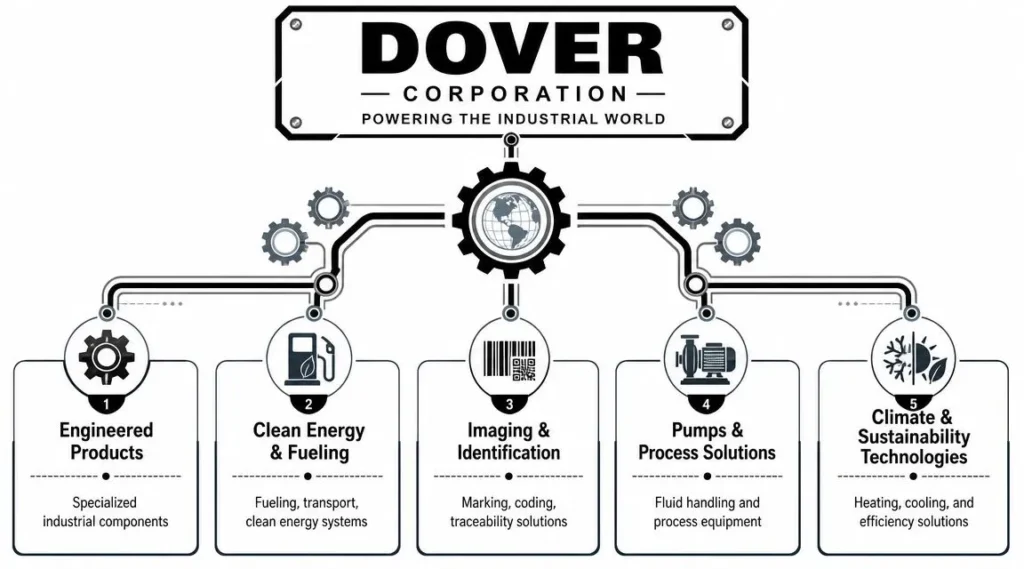
The company also spans five operating segments. That structure gives shareholders a bundled set of industrial exposures under one corporate parent. The practical implication is simple. A Dover investor is not just betting on one plant, one machine type, or one narrow customer base. They are buying a portfolio of engineered businesses that often serve recurring operational needs.
That distinction affects valuation. Diversified industrial platforms usually deserve steadier multiples than single-line manufacturers because their earnings base is less vulnerable to one weak cycle. The risk is that investors can take that logic too far and start paying a premium that assumes resilience will always outweigh cyclical pressure.
A useful frame for readers comparing companies of this size is this broader Guide to 2026 large cap investing, because Dover belongs in the large-cap quality discussion, not the turnaround category where weaker industrial names often sit.
What investors should take from Dover’s size
Size is not the whole story, but it changes the range of outcomes.
A company with Dover’s scale usually has better access to capital, more room to reshape its portfolio, and broader institutional coverage than a smaller industrial peer. Those advantages can support stability over time. They can also make the stock look safer than it really is if buyers focus on reputation more than on entry price.
That is the primary reason Dover matters. It is a serious industrial operator with breadth, market presence, and business diversity that many smaller rivals cannot match. But those same qualities are exactly why the stock can attract a premium that leaves less room for upside. For investors studying Dover Corporation stock, the right starting point is not admiration for its quality. It is a clear view of whether that quality is still being sold at a rational price.
Dover’s Business Model and Recent Stock Performance
Dover’s appeal starts with structure, not branding. The company operates as a collection of specialized industrial businesses rather than a single manufacturing line, with segments spanning engineered products, clean energy and fueling, imaging and identification, pumps and process solutions, and climate and sustainability technologies, as outlined in Dover’s investor relations overview.
That matters because diversification can make an industrial company look safer than its end markets really are. Dover sells into several niches with recurring replacement demand, service exposure, and entrenched customer relationships. Those are good traits. They can soften the hit from a downturn in any one product category. They do not remove cyclicality, and they do not guarantee that a premium stock price is justified.
Why Dover’s portfolio model deserves a closer look
Dover has spent years reshaping its portfolio through acquisitions, divestitures, and bolt-on deals. For investors, the key question is not whether that strategy sounds sensible. It is whether the mix now produces steadier returns on capital than a simpler industrial peer.
A multi-platform model usually helps in three ways. It spreads revenue across different industrial budgets. It gives management room to sell weaker assets and reinvest in better ones. It also increases aftermarket and consumables exposure in some businesses, which tends to be less volatile than original equipment demand.
The tradeoff is subtle but important. Portfolio complexity can hide weak spots for a while. A strong quarter in one segment can offset softness elsewhere, which makes consolidated results look smoother than the underlying demand picture. Investors who want to judge operating quality should track business-level trends, not just headline sales growth. That is the same logic behind using clear performance benchmarking indicators when comparing diversified companies.
Recent stock action points to caution, not capitulation
Price action has been relatively restrained, which fits the current debate around Dover. Financhill showed Dover trading at $196.07 compared with a 200-day simple moving average of $197.74 on its DOV technical analysis page.
A stock sitting near its 200-day average usually signals balance, not conviction. Buyers have not abandoned the name. They also have not pushed it into a clear momentum phase. For a company with Dover’s reputation, that matters. The market appears willing to pay for quality, but less willing to keep expanding the multiple without clearer evidence of accelerating growth.
That is a more interesting signal than a simple Buy or Sell label.
What investors should infer from this setup
Three conclusions stand out.
- The operating model still commands credibility. Dover’s breadth and portfolio design continue to support investor confidence.
- The market is treating quality as largely known. Recent trading suggests investors are waiting for incremental evidence, not discovering the story for the first time.
- Valuation risk remains tied to perception. If growth or margins merely hold steady, the stock can still underperform if investors decide they have been paying too much for stability.
That last point is the one many income-focused shareholders miss. Dover does not need a broken business model to become a weaker investment. It only needs a price that already reflects most of the advantages investors admire.
Analyzing Dover’s Financial Health and Key Metrics
Dover’s reputation for quality only matters if the numbers support it. For investors trying to decide whether the stock deserves a premium, the better question is not whether Dover is profitable. It is whether the business generates the kind of earnings quality that can justify paying up for an industrial name.
Revenue and earnings
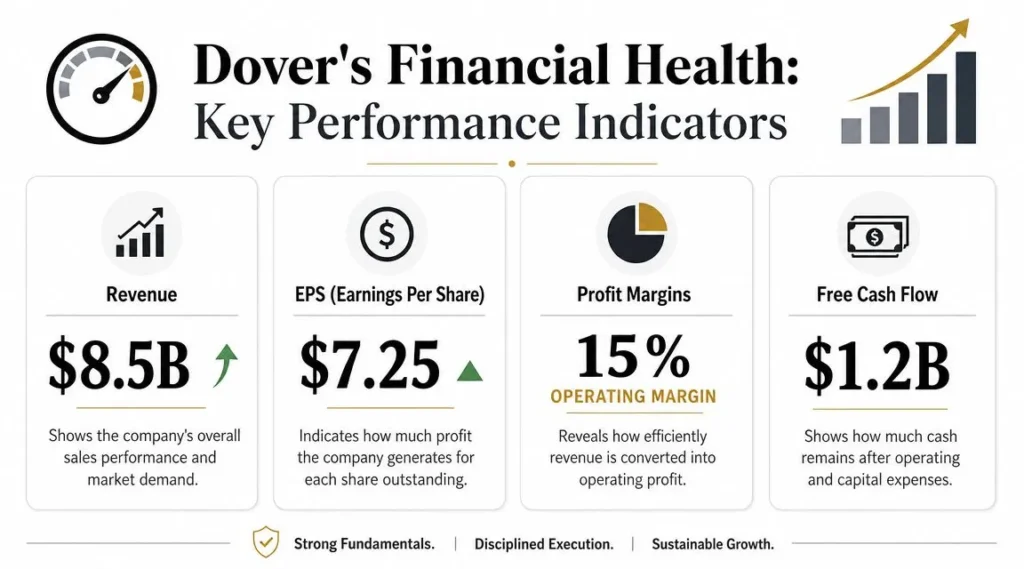
Dover produced multi-billion-dollar annual revenue, as noted earlier in the article. That matters because scale does two things in an industrial company. It spreads fixed costs across a larger base, and it reduces dependence on any single product cycle or customer category.
Operating income deserves more attention than raw sales. A large industrial company can post healthy revenue while still struggling with weak pricing, bloated overhead, or poor segment mix. Dover’s operating profit level indicates that a meaningful share of its sales is reaching the income statement before financing and one-time items enter the picture. For a diversified manufacturer, that is a better test of business quality than top-line size alone.
Per-share earnings add another layer. EPS matters because shareholders own claims on earnings per share, not on total company revenue. A business can grow in aggregate and still create mediocre shareholder outcomes if dilution, acquisition costs, or weak margins erode the benefit.
What investors should focus on
The key issue is not whether Dover is large. The market already knows that. The issue is whether revenue, operating profit, and per-share earnings point to a business with enough discipline to keep earning above-average returns through a slower industrial cycle.
That distinction affects valuation. Investors often accept a richer multiple for companies that combine diversification, margin stability, and steady per-share profitability. The risk is that a premium multiple can stay in place even after business quality stops improving. Anyone assessing Dover should track its results against a clear set of benchmarking performance indicators rather than relying on the company’s reputation alone.
Net income and what it does not prove
Net income can look impressive in isolation and still give a false sense of durability. Bottom-line results include accounting items, tax effects, and other factors that may not reflect the earning power of the core business in a given period.
That is why operating performance usually deserves more weight than a single net income figure when you review an industrial stock. Investors who focus only on the bottom line can miss an early change in margin quality, order mix, or cost pressure. Those shifts matter more for future returns than a headline profit number.
What to focus on: Dover’s financial profile supports the view that this is a capable, scaled industrial business. It does not settle the harder question of whether today’s stock price leaves enough room for upside.
This overview also pairs well with a visual explainer on how investors interpret financial reporting:
A practical checklist for readers
When you review Dover’s next filings or earnings updates, ask:
- Is revenue holding up across segments? Broad weakness would matter more than a temporary slowdown in one niche.
- Are operating margins stable or improving? That is one of the clearest tests of pricing power and cost discipline.
- Is EPS growth coming from the business itself? Investors should separate genuine profit improvement from accounting noise or financial engineering.
- Does the stock’s premium still look justified? A good business can still be a weak investment if the valuation already assumes most of the good news.
That framework keeps attention on what matters most. Business quality supports Dover’s case. Price discipline determines whether that quality translates into attractive returns.
The Dividend King A Closer Look at Shareholder Returns
Dover’s dividend record attracts attention, but the headline can distort what shareholders are receiving today. A company can be exceptionally reliable and still offer a fairly modest cash return at the current share price.
That distinction matters here.
Dover is widely treated as a dividend stock first and an industrial compounder second. For current investors, the order is probably reversed. The dividend still says something useful about management discipline, balance-sheet caution, and the company’s ability to stay profitable across cycles. What it does not say, on its own, is that the stock offers compelling income or obvious value at today’s valuation.
The practical issue is yield. As noted earlier, Dover’s trailing dividend yield is below what many income-focused investors expect from a stock with this reputation. That changes the investment case in a meaningful way. If the cash payout is relatively small, then a larger share of the expected return has to come from earnings growth and the price investors are willing to pay for those earnings.
In other words, the dividend story is less about income now and more about confidence in the business.
That is still useful. A company does not build a decades-long record of annual dividend increases by accident. Management has to protect margins, allocate capital with restraint, and avoid stretching the balance sheet in weaker periods. For an industrial manufacturer exposed to multiple end markets, that record signals durability.
Still, durability is not the same as attractiveness.
For shareholders evaluating Dover today, the dividend functions in three different ways:
- As an income source, it looks limited relative to higher-yielding alternatives.
- As a quality signal, it carries more weight because it reflects a long period of disciplined execution.
- As part of total return, it matters only alongside earnings growth, buybacks, and valuation.
That last point gets missed in a lot of coverage. Investors often hear “Dividend King” and assume shareholder returns are being driven primarily by a large and growing cash payout. Dover’s profile is more nuanced. The payout supports returns, but it is not large enough to do the heavy lifting. If someone buys the stock at an expensive multiple, a long dividend streak will not offset weak starting valuation.
This is why the label can be helpful and misleading at the same time. Helpful, because it points to a business with unusual consistency. Misleading, because it can encourage investors to pay a premium for the reputation without asking whether the current yield and future growth justify that premium.
A better way to read Dover’s shareholder return profile is this. The dividend confirms business quality. It does not settle the question of whether new buyers are getting enough return for the price they are paying.
Dover Stock Valuation Is It Overpriced in 2026
The hard part of analyzing Dover in 2026 is not deciding whether it is a good business. The harder question is whether investors are paying too much for that quality.
Valuation matters more here because Dover sits in an awkward middle ground. It is stronger and more consistent than many industrial peers, but it is still exposed to capital spending cycles, replacement demand, and shifts in customer budgets. A premium can make sense. An open-ended premium usually does not.
A useful way to frame the debate is simple. If a company can grow earnings steadily, protect margins, and keep returns on capital healthy, a higher multiple is justified. If the stock already assumes all of that will continue, upside narrows. At that point, even solid execution can produce average returns.
Why the multiple deserves more scrutiny
As noted earlier, one fair value framework places Dover below the multiple investors are currently paying. The specific number matters less than the gap. The market is attaching a quality premium to Dover, and that raises the bar for future performance.
That premium is easy to rationalize. Dover has a long operating history, a diversified industrial portfolio, and a reputation for disciplined capital allocation. Those traits reduce the probability of a permanent business impairment. They do not remove valuation risk.
That distinction gets lost in a lot of dividend-focused coverage. Investors often treat the company’s reputation as if it were a margin of safety. In practice, reputation can have the opposite effect. It can pull the stock price high enough that future returns depend more on multiple stability than on business improvement.
What has to go right from here
For a new buyer at a premium valuation, two things usually need to happen.
- Earnings growth must stay dependable. If profits merely hold steady rather than expand, the starting multiple becomes harder to defend.
- The market must keep rewarding quality. If investor preference shifts toward cheaper cyclicals or higher-yielding names, Dover can de-rate without any major operational failure.
- Macro conditions cannot work against the multiple. Higher financing costs and tighter liquidity often compress valuations across industrial stocks, which is why the broader backdrop for interest rates and inflation matters when judging entry points.
This is the part many investors skip. They focus on whether Dover can remain a good company. The valuation question is whether it can remain good enough to justify a premium price.
Bull case versus bear case
| View | What supports it |
|---|---|
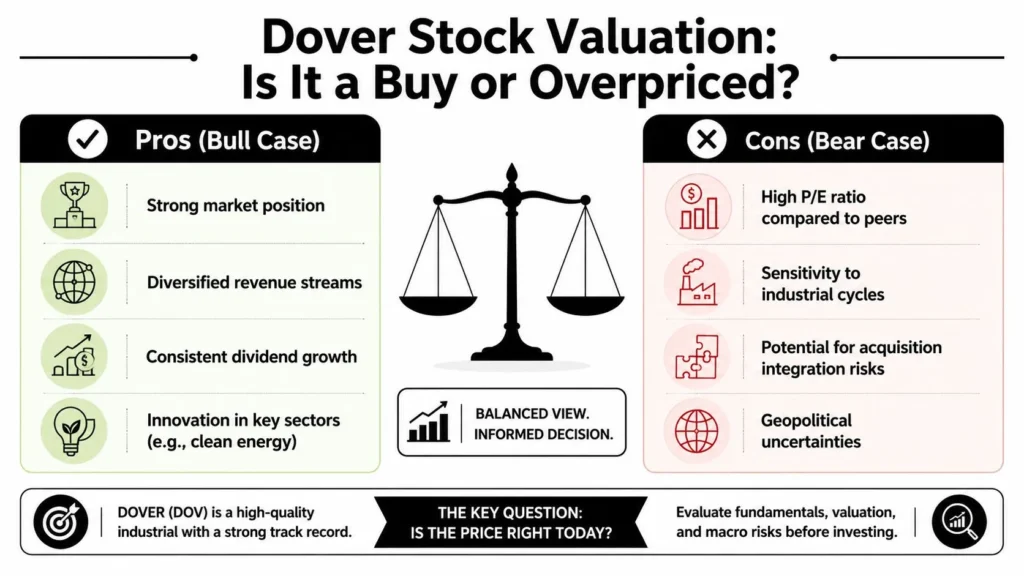
| Bull case | Dover owns durable niche businesses, has a record of steady execution, and deserves to trade above weaker industrial peers because its earnings base is more diversified and less fragile. |
| Bear case | The stock already reflects much of that quality, leaving less room for error if organic growth slows, end markets soften, or investors decide the premium has gone too far. |
The bear case is not that Dover is weak. The bear case is that a strong company can still be an ordinary investment when bought at the wrong price.
My read on the valuation
Dover looks priced for confidence, not for skepticism. That is fine for existing holders with a long time horizon and a lower tax basis. It is a tougher setup for fresh capital.
The non-obvious takeaway is that Dover’s quality can work against new investors. High-quality industrial companies often avoid the dramatic selloffs that create obvious bargains. As a result, buyers are left choosing between paying up for consistency or waiting for a more favorable entry after a cyclical wobble.
So is Dover overpriced in 2026? Relative to a plain-vanilla industrial stock, yes, it appears expensive. Relative to its own reputation, the better answer is more nuanced. The market is not misreading the business. It may be charging a full price for it.
Investment Catalysts and Risks for Dover Stock
Dover’s next 12 to 24 months will probably be decided less by headline growth and more by whether management can keep converting a complicated portfolio into steady earnings. That distinction matters. Investors are not paying for a turnaround or a cyclical rebound story. They are paying for consistency.
What could keep the premium intact
The strongest support for Dover stock is the way its businesses produce different kinds of revenue. Some units are tied to capital equipment demand, while others benefit from aftermarket parts, recurring service, software, and replacement cycles. That mix can reduce earnings volatility compared with an industrial company that depends mainly on large one-time orders.
A second catalyst is capital allocation discipline. Dover has spent years shaping the portfolio toward niches where pricing, service intensity, and installed base economics are better than in plain-vanilla industrial markets. If management continues to prune weaker assets and reinvest in higher-margin platforms, earnings quality can improve even without a major jump in economic growth.
That is the underappreciated part of the Dover story. The upside does not require a spectacular product cycle. It requires a series of small operating wins that add up.
Potential catalysts include:
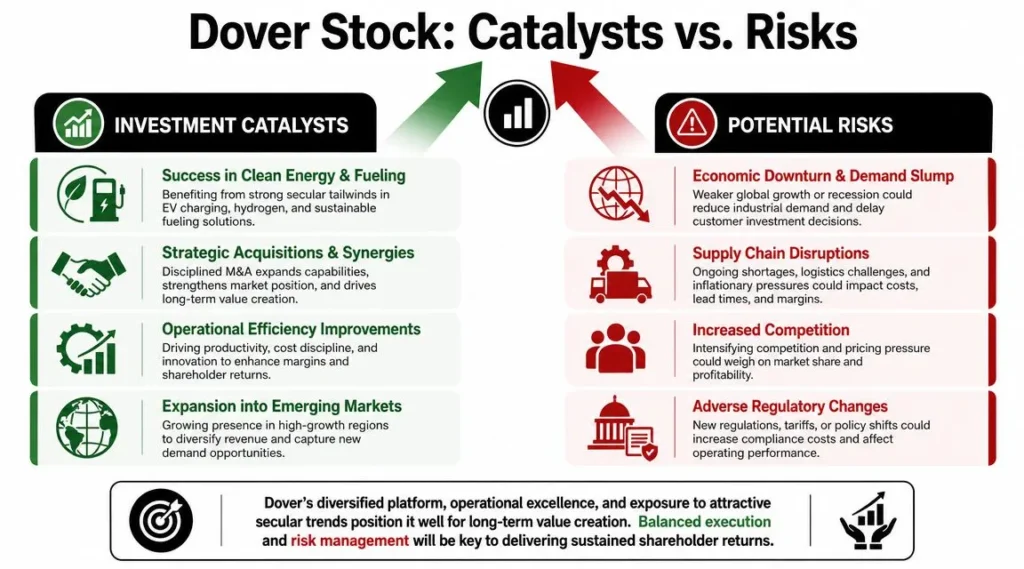
- Aftermarket and recurring revenue mix that can hold up better than new equipment orders during slower periods
- Portfolio reshaping if management keeps shifting capital toward businesses with stronger margins and more defensible customer relationships
- Exposure to replacement demand in areas linked to fueling, climate systems, engineered products, and process applications
- Execution on margins if pricing and productivity offset uneven volume trends across segments
Where investors can still get hurt
The main risk is not that Dover is low quality. The risk is that a high-quality industrial stock can still disappoint if growth slows to merely decent levels while the market is pricing in something better.
Dover remains tied to capital spending. If customers delay projects, reduce equipment purchases, or turn more cautious on maintenance and expansion budgets, the effect can show up across several segments at once. Diversification helps, but it does not remove economic sensitivity. It spreads it.
There is also acquisition and portfolio risk. A multi-business manufacturer often looks stable on the surface, yet integration mistakes, uneven end-market demand, or poor timing on deal activity can pressure returns. Those issues usually appear first in margin performance and management commentary, not in a dramatic headline.
Macro conditions add another layer. Industrial buyers respond to financing costs, replacement economics, and business confidence, which is why a clear grasp of how interest rates and inflation affect industrial demand helps when evaluating Dover.
A more useful peer lens
Dover sits in an awkward middle ground that matters for stock selection. It is not as cyclical as some traditional industrial names, but it also does not get the same valuation forgiveness that investors often grant to software-heavy compounders. That leaves the stock dependent on continued operational precision.
| Lens | Dover (DOV) | Why it matters |
|---|---|---|
| Revenue mix | Blend of equipment, parts, service, and some software-related exposure | Better resilience than a pure capital goods model, but still exposed to industrial spending pauses |
| End markets | Broad set of niche industrial categories | Reduces single-market risk, though broad slowdowns can still hit multiple segments together |
| Investor appeal | Quality, discipline, dividend history, portfolio breadth | Supports a premium reputation, which can also limit upside if expectations are already high |
| Key debate | Can steady execution outlast a full valuation? | This is the core question for new buyers |
That framing is more useful than labeling Dover a safe industrial. Safe businesses can still be expensive stocks.
The practical conclusion
Dover has real catalysts, but they are incremental. Better mix, disciplined capital allocation, and resilient aftermarket demand can support earnings even in a mixed economy. The risk is that those strengths are already widely recognized, leaving less room for error than the company’s reputation suggests.
For investors building a process around names like DOV, a broader 2026 stock investment guide can help frame position sizing, valuation discipline, and what to monitor if the thesis starts to change.
Your Next Steps for Researching and Tracking DOV
A sensible process for Dover Corporation stock starts with primary materials, not commentary. Investors should begin with the company’s investor relations resources, shareholder information, dividend materials, and SEC filings such as annual and quarterly reports. Those documents won’t make the decision for you, but they show how management describes segment demand, capital allocation, and shareholder returns in its own words.
If you want a broader framework before drilling into an individual stock, this 2026 stock investment guide gives a useful general checklist for sizing positions, setting expectations, and deciding whether a single stock belongs alongside index exposure.
What to monitor each quarter
For Dover, the most important updates usually aren’t dramatic headlines. They’re the smaller signals that reveal whether the premium valuation still has support.
- Segment commentary. Read management’s discussion of which businesses are improving, flattening, or softening.
- Margin direction. A quality industrial stock needs operating discipline to justify a quality multiple.
- Capital allocation choices. With an acquisition-shaped company, deal discipline matters as much as operating execution.
- Dividend posture. The dividend streak is part of the culture, but investors should still watch whether payout policy remains aligned with business conditions.
You can also complement company materials with market snapshots from screening platforms and plain-language business coverage. One factual option among many is Maxi Journal business coverage and trend tracking, which curates readable articles across business and adjacent categories.
A research routine that works
Many investors overcomplicate stock tracking. Dover doesn’t require a heroic model to follow responsibly. A workable routine is enough.
- Read official filings first. That keeps your thesis anchored to the company’s own disclosures.
- Compare the stock’s valuation to your required return. A good business can still be a weak buy if your entry point is too rich.
- Track end-market exposure, not just dividend headlines. Dover’s earnings durability depends on where industrial demand is holding up.
- Revisit your thesis after each major update. Ask whether the business got better, the stock got cheaper, or neither.
If your entire Dover thesis can be summarized as “Dividend King,” your research probably isn’t finished.
FAQ about Dover stock
| Question | Answer |
|---|---|
| Is Dover a beginner-friendly stock? | It can be, if the investor understands that it’s a diversified industrial business rather than a simple income stock. The business quality is easier to respect than the valuation is to justify. |
| Is Dover mainly an income investment? | Not really. Its reported yield is modest, so most of the appeal comes from business quality, dividend consistency, and potential long-term compounding rather than high current income. |
| Does Dover behave like a defensive stock? | Only partly. Its diversification helps, but its industrial exposure and market sensitivity mean it can still react to shifts in business spending and macro conditions. |
| What should matter more, the dividend streak or the valuation? | For a new buyer, valuation should carry more weight. The streak is valuable history. Your return depends on the price you pay now. |
| Is Dover better than an index fund? | That depends on your goal. A broad index offers diversification with less single-company risk. Dover may suit investors who want targeted industrial exposure and are comfortable judging valuation and cyclicality. |
The best way to follow Dover is to keep two ideas in your head at once. It’s a high-quality industrial company. It may also be the kind of stock where quality gets over-celebrated and overpaid for. Investors who separate those ideas tend to make better decisions.
If you want more plain-English market commentary, business explainers, and practical research articles, maxijournal.com publishes independent writing across business, technology, science, health, sports, arts, travel, entertainment, education, pets, fashion, and games.
Discover more from Maxi Journal
Subscribe to get the latest posts sent to your email.