More than 50% of music consumed on major platforms came from unsigned artists by 2025, and indie artists accounted for 35% of global recorded music revenues in 2024 according to Chartmetric’s indie music overview. If you still think independent music artists are waiting outside the industry gates, you’re looking at an old map.
I spent years looking at artists the way labels do. Songs, timing, audience fit, team strength, market potential. What changed over time wasn’t the need for great music. It was the business model around it. Today, many of the smartest artists don’t ask, “How do I get signed?” They ask, “How do I build something durable?”
That’s the right question.
If you’re an independent artist in 2026, you’re not just making records. You’re running a small company built around your catalog, your brand, your fan relationship, and your decisions. You are the founder. The music is the product. The audience is the market. Your rights are the assets. Your release strategy is the go-to-market plan.
That mindset doesn’t make the art less personal. It makes the career more stable.
What It Means to Be an Independent Artist in 2026
In 2026, being independent is less about staying outside the system and more about deciding which parts of the system you own.
The old image of indie music came from rebellion. In 1977, the Buzzcocks self-released Spiral Scratch, a major turning point that showed artists could release and sell music outside the major-label model, as noted earlier in the article. Back then, independence looked like a workaround. Today, it works more like a company structure.

Independence is a business model
A modern independent artist might be unsigned. They might also hire a distributor, freelance publicist, producer, manager, designer, or videographer. Independence does not mean isolation. It means you keep control of the business decisions, or you decide exactly who helps make them.
A simple comparison helps here. A franchise owner operates inside someone else’s system. A food truck owner builds the system as they go. The franchise usually gets more built-in support. The food truck owner keeps more freedom over the menu, hours, customer experience, and brand identity. Independent artists work much closer to the second model.
That is the CEO of You mindset.
Practical rule: If you do not know who owns the recording, who collects the income, and who controls access to fan data, you are not running a business yet. You are borrowing one.
Why the definition has changed
A lot of artists still hear independent and picture “unsigned and broke” or “do everything yourself forever.” That definition is outdated and too small for the market artists now work in.
A better definition is operational. An independent artist usually controls the core assets and the key decisions:
- You own or control key rights
- You decide release timing
- You build your own team
- You treat audience growth as part of the job
- You measure what works and adjust
That does not mean every artist has the same setup. Some stay lean and handle almost everything themselves. Others build a serious support team while keeping ownership and approval power. Both models can be independent if the artist remains the founder, not just the talent on the payroll.
If you want a feel for how artists study the market and learn from peers, a lot of them regularly read independent music industry blogs and resources as part of running their careers like a business.
Founder first, then performer
When I mentor artists, I ask them to separate two jobs that happen to live in one person.
One job writes, records, performs, and experiments.
The other job sets deadlines, reviews numbers, budgets for artwork, clears splits, approves metadata, plans releases, checks royalty statements, and follows up on payments.
Both jobs matter. The first creates value. The second protects it.
Many promising artists get stuck here. They treat rights, royalties, and distribution like paperwork. It is closer to inventory management and accounting in any other small business. Your masters are assets. Your songs are intellectual property. Your distributor is a delivery partner, not your marketing department. If that sounds dry, use a simpler comparison. Writing a song is building the product. Registering, releasing, and tracking the song is making sure the store can sell it and pay you correctly.
Careers usually do not fall apart because the artist lacked talent. They stall because no one was acting like the founder.
Navigating the Modern Indie Music Ecosystem
The indie ecosystem looks messy until you sort it into a few business functions. Once you do, it becomes manageable. I like to think of it as a blueprint with four load-bearing walls. If one wall is weak, the whole structure feels unstable.
Independent music represents 36.09% market share in Q1 2024, ahead of Universal Music Group’s 29.35% in that period, and indie revenues rose 16.1% in the prior year compared with 9% for the overall industry, according to Catapult’s summary of indie market performance. This isn’t a side lane. It’s a major operating environment.
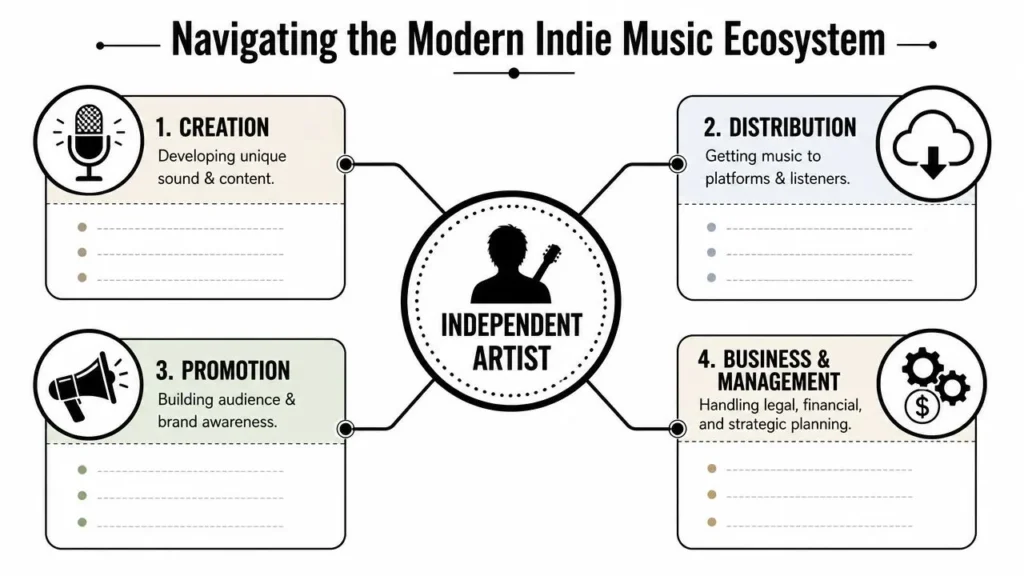
Distribution gets the product to market
Distribution is the pipe system. It moves your finished recording from your hard drive to streaming platforms and stores. Without it, your song is like a finished book sitting in a desk drawer.
Artists often confuse distribution with promotion. They aren’t the same. A distributor can place your music on platforms. That doesn’t guarantee listeners will find it.
Your distribution setup also affects practical details like release timing, metadata entry, territory handling, and sometimes payment flow. If your music shows up in the wrong place, under the wrong artist name, or with missing credits, your release loses momentum before the campaign even begins.
Monetization turns attention into income
Monetization is how the business collects money from the work. Streaming is part of it. So are merch, physical products, direct fan offers, and other artist-controlled revenue paths.
The mistake I see often is this: artists chase visibility before they build any path for a fan to support them. That’s like opening a shop, getting foot traffic, and forgetting to install a checkout counter.
For artists who want more ideas on discovery and release tracking, Maxi Journal’s guide to independent music blogs is one example of a resource that maps where listeners find new work.
Promotion creates repeated attention
Promotion isn’t posting randomly until something sticks. It’s the steady process of giving people reasons to notice, remember, and return.
That can include short-form video, visual branding, email, community building, local shows, collaborations, media outreach, playlist strategy, and content built around the song’s story. Promotion works best when it has one clear message. If the artist image says one thing, the music says another, and the social content says a third, the audience can’t place you.
A release campaign should answer one simple question fast. Why should this specific listener care about this specific song right now?
Rights management protects the asset
Rights management sounds abstract until money goes missing. Then it becomes very real.
Here’s the plain-language version. Your music business has property. The master recording is one piece of property. The songwriting is another. Distribution helps deliver the property. Rights management helps make sure ownership and payment lines are clear.
Use a housing analogy. Distribution is the moving truck. Rights management is the deed, the lease, and the record of who owns which room. If those documents are messy, arguments start later.
A healthy indie operation treats all four pillars as connected. Distribution without rights management creates confusion. Promotion without monetization creates noise without payoff. Monetization without good music and audience trust feels hollow.
Your Launch Plan From Studio to Streaming
A release shouldn’t feel like a mad dash to midnight. It should feel like a planned product launch. That doesn’t mean sterile. It means intentional.
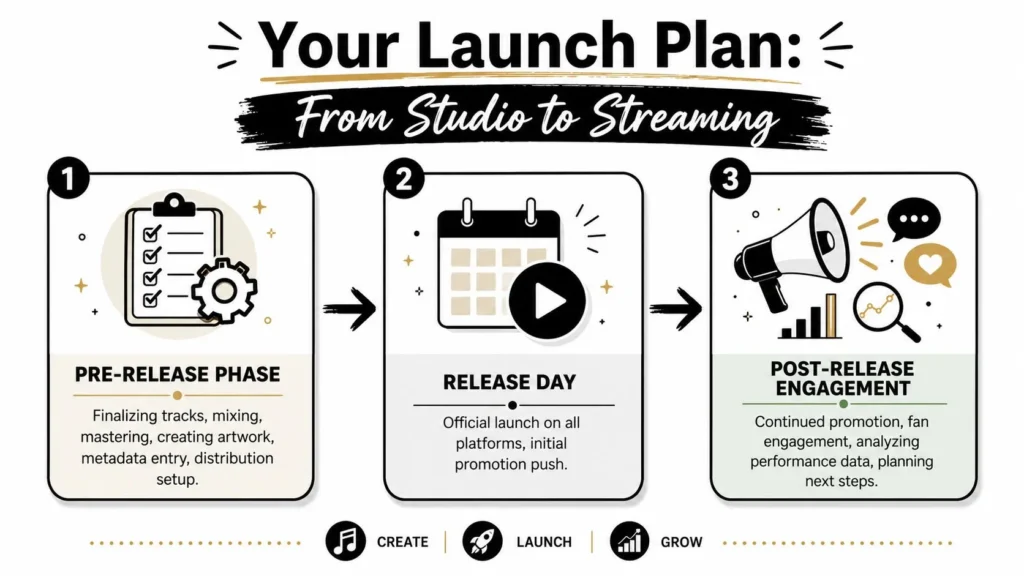
The strongest independent music artists repeat a cycle: prepare the asset, release it cleanly, then study audience response before making the next move. The useful edge here is data. Platform dashboards like Spotify for Artists, Apple Music, Bandcamp for Artists, and Pandora AMP expose metrics such as followers, listeners, streams, saves, playlist additions, audience demographics, and location, while tools like Soundcharts and Chartmetric combine cross-platform signals, with Soundcharts tracking 2,400+ FM/AM stations and Chartmetric covering airplay across 1,500 stations, as described in Soundcharts’ music analytics guide.
Before release day
Most campaigns fail early, not late. They fail when the song is still being revised after the artwork deadline, when nobody confirms metadata, when release assets are scattered across five folders, or when the artist has no idea what the first week of promotion should look like.
Start with a short pre-release checklist:
- Lock the audio so you aren’t changing the song while trying to market it.
- Prepare core assets such as cover art, clean artist photos, short clips, lyrics, credits, and release copy.
- Choose a distributor and upload early enough to avoid a rushed release.
- Build your story angle. Not a fake narrative. A real one. Why this song, why now, and for whom.
- Set up tracking so you can learn from the release instead of guessing afterward.
If you want a practical framework for promotion ideas, this indie artist marketing playbook is useful because it helps you connect content planning to an actual release campaign rather than treating marketing like a separate activity.
Release week
Release week is not the finish line. It’s the opening weekend of your store.
Use the first few days to focus attention, answer messages, repost fan reactions, and steer people toward the same core song or project. Too many artists split attention by promoting six things at once. One release, one message, one clear call to listen.
A strong release week usually includes:
- A clear listening path so fans know exactly where to find the song
- Content with variety such as performance clips, storytelling posts, lyric moments, or studio footage
- Direct fan contact through DMs, email, comments, or community posts
- A watch list for playlist adds, saves, and early geographic traction
Here’s a useful visual guide for the release rhythm:
After the release
Professionals separate themselves from hobbyists at this point. Hobbyists stop after launch. Founders review results.
Look at where listeners are located, which content pieces drove action, whether playlist additions led to sustained listening, and which markets deserve follow-up. If one city starts responding, don’t just celebrate. Act on it. Build local content, pitch local opportunities, or target future show planning there.
Don’t ask only, “Did it stream?” Ask, “What did this release teach me about my audience?”
For artists who want to keep an eye on current release patterns and how indie acts frame new drops, this roundup of new independent music releases can be helpful as a reference point.
Indie Success Stories and Common Pitfalls
I’ve seen two kinds of independent artists with similar talent take very different paths. The difference usually isn’t raw ability. It’s judgment.
One artist treats each release like a business decision wrapped around a creative act. The other treats each release like tossing a bottle into the ocean and hoping the tide does the work.
The artist who builds traction
Let’s call her Maya. She doesn’t live in Los Angeles, New York, or Nashville. That could’ve felt like a handicap, but she stopped comparing her setup to artists in major hubs.
She records efficiently at home, rehearses in community spaces, plays local gigs consistently, and collaborates remotely when she needs extra production or musicianship. That approach reflects the kind of location-specific strategy highlighted in SoundGirls’ advice for indie artists outside major music cities. She isn’t waiting for geography to validate her career.
Maya also avoids glamorous mistakes. She names files properly. She keeps split info organized. She knows what visual assets are needed before upload day. She follows up with listeners after release week instead of disappearing.
The artist who stays stuck
Then there’s Alex. Strong voice. Real potential. But each release starts late and ends early.
He uploads at the last minute. Metadata is inconsistent. Links are scattered. He posts once on release day, then gets frustrated when the song doesn’t “take off.” He never checks where listeners came from, which post drove traffic, or whether people saved the song after hearing it.
The hardest part is that Alex doesn’t think he’s making business mistakes. He thinks the music industry is ignoring him.
Sometimes that happens. More often, artists are sending weak signals into a crowded market.
Common pitfalls that cost artists momentum
These problems show up constantly:
- Messy metadata creates confusion around artist identity, credits, and catalog organization.
- No direct fan path means listeners can enjoy a song without ever becoming part of your community.
- Ignoring analytics leaves you guessing when the platforms are already telling you where traction lives.
- Overvaluing big-city myths makes artists overlook strong local or digital opportunities.
- Choosing help badly leads to paying for services that don’t match the stage of the career.
A better approach is boring in the best way. Clean systems. Clear goals. Consistent output.
If you want to study how emerging acts position themselves before they become obvious, this list of up-and-coming music artists can help you notice patterns in presentation, rollout, and identity.
Build from where you are. A smart local strategy beats a fantasy-industry strategy you can’t execute.
The Independent Artist Essential Toolkit
Tools don’t build careers. Decisions do. But the right tools make good decisions easier to execute.
When artists ask me what they need, I break the toolkit into categories: a distributor, analytics access, a direct-to-fan sales setup, content creation support, and some method for keeping business records clean. You don’t need the biggest stack. You need a workable one.
Choosing your distributor
Below is a simple comparison framework. The point isn’t to crown one platform. It’s to ask the right questions before you sign up.
| Platform | Pricing Model | Royalty Cut | Key Features |
|---|---|---|---|
| DistroKid | Varies by plan | Varies by terms | Fast release workflows, common choice for frequent releases |
| TuneCore | Varies by plan | Varies by terms | Broad platform delivery, release management tools |
| CD Baby | Varies by release and services | Varies by terms | Distribution plus optional add-on services |
| Ditto Music | Varies by plan | Varies by terms | Release tools for artists and labels |
| AWAL | Selective access model | Varies by terms | Distribution and artist services for approved acts |
Don’t skim the terms page. Read it like a founder reviewing a supplier agreement.
What your toolkit should actually solve
Your setup should answer practical questions:
- How does the music get delivered to streaming services and stores?
- Where do you review performance data after release?
- How can a fan buy something directly from you?
- How do you keep your brand consistent across audio, visuals, and social clips?
- Who handles the admin tasks when your workload grows?
Recent commentary in 2025 noted that Spotify’s Shopify integration lets artists sell CDs, vinyl, merch, and downloads directly from artist profiles while reducing some of the self-shipping burden, but independent artists still have to cover costs for producers, managers, and marketing, so control doesn’t automatically equal better net profit, as discussed in this 2025 commentary on the realities of staying independent.
That point matters. Revenue is not the same as profit.
The hidden cost problem
A lot of artists say, “I’d rather keep everything myself.” Fair instinct. But “everything” includes the bill.
If you’re paying for recording, mixing, mastering, design, visual content, release support, merch production, and fulfillment, your margin can shrink fast. That’s why independent music artists need to track costs by release, not by vague memory.
A simple founder habit helps here:
- Log every expense tied to a release
- Separate one-time costs from repeatable monthly tools
- Review what helped the campaign move
- Cut tools that feel impressive but don’t solve a problem
If you’re creating visuals in-house or on a tight budget, a practical resource like this guide to AI music videos for musicians can help you think through when low-cost video production makes sense and when it doesn’t.
The toolkit isn’t about looking professional. It’s about operating professionally.
Building a Sustainable Career Beyond One Hit
A one-song spike can feel life-changing. Sometimes it is. But a career can’t depend on one lucky wave.
Sustainable artists think like catalog builders. They release with purpose, learn from each cycle, improve the operation, and deepen the fan relationship over time. They don’t panic when one song underperforms. They review, adapt, and keep going.
What lasts longer than hype
The strongest long-term assets usually aren’t flashy:
- Owned recordings and songs that keep working for you over time
- Direct audience connection that isn’t dependent on one platform
- A repeatable release process that lowers chaos
- A clear artistic identity that makes each new release easier to place
- A team you chose well when the workload grows beyond one person
The CEO of You mindset pays off. A founder doesn’t measure the company only by one launch day. A founder looks at systems, assets, customer retention, and what the next year can support.
The career is the product line
Think of each release as one product in a growing catalog. Some products bring in new people. Others deepen loyalty. Some won’t land. That’s normal. The goal isn’t perfection. The goal is a body of work and a business structure that can survive normal fluctuations.
Make music like an artist. Review outcomes like an owner.
Independent music artists don’t need to chase someone else’s version of success. They need a model they can sustain. That might include streaming, merch, physical products, sync opportunities, community support, live shows, collaborations, or a mix that fits the artist’s real audience and real capacity.
The industry is crowded. It will stay crowded. But crowded doesn’t mean closed. It means random effort gets buried, and clear effort compounds.
If you’re building that kind of career, Maxi Journal is one place to keep up with approachable writing on music, culture, business, and related topics that shape how creative careers grow online.
Discover more from Maxi Journal
Subscribe to get the latest posts sent to your email.