You finished the song. The mix finally feels right, the chorus lands, and for the first time you can hear the track as something other people might care about. Then the hard question shows up fast. Not “is the song good?” but “what now?”
That moment is where a lot of talented musicians stall. They thought the hard part was writing and recording. In reality, finishing the music is the handoff from artist mode to operator mode. If you choose the independent path, you’re not just releasing songs. You’re building a small business around intellectual property, attention, audience relationships, and a workload that used to be spread across labels, managers, publicists, designers, and marketers.
That doesn’t mean independence is a bad deal. It means it’s a real one. For independent music artists, the appeal is obvious: more control, more ownership, and more say over the pace and style of the career. The trade-off is just as real: more labor, more risk, and more responsibility for decisions that have nothing to do with melody or lyrics.
Your Music Is Ready Now What
A common scene looks like this. You export the final master, send it to a couple of friends, and start thinking about artwork, Spotify, TikTok, maybe a video, maybe a live session, maybe an email list. By the end of the day, one song has turned into twenty jobs.
That’s the first mindset shift to make. Independence isn’t the absence of structure. It’s choosing to build your own structure. If a label deal is like joining an existing company, being independent is like starting one. You decide the brand, the product schedule, the budget, the partnerships, and the customer experience. In music, your “customers” are listeners, supporters, ticket buyers, subscribers, and anyone willing to pay attention twice.
Some artists resist this because they think business will dilute the art. Usually the opposite happens. Clear business thinking protects the art by giving it a delivery system. Without that system, even strong songs disappear into the pile of unfinished plans and late uploads.
What the next step actually means
Your next step usually isn’t “go viral.” It’s much more ordinary than that:
- Prepare the asset: final audio, cover art, credits, lyrics, metadata.
- Choose the route: distributor, release date, content format, launch timeline.
- Build a destination: artist pages, website, mailing list, simple fan path.
- Create follow-up: a second piece of content, a live clip, a behind-the-scenes post.
If you want a sense of how current artists package releases for discovery, browse recent independent music releases and pay attention to how often the release is paired with a story, visual identity, or clear niche.
Practical rule: Your song is finished when the audio is done. Your release is finished when the listener knows where to go next.
That’s the working attitude for 2026. Not dreamer versus businessperson. Both. The artist makes the record. The operator makes sure the record has a chance.
Defining the Modern Independent Artist
A lot of new musicians think “indie” means one thing: no label, no team, total DIY. That’s too narrow. Today, independent music artists exist on a spectrum.
At one end is the pure do-it-yourself artist. They write, record, distribute, design, post, pitch, and reply to emails themselves. At the other end is an artist who still owns a lot of control but works with an independent label, a freelance publicist, a distributor, a designer, or a sync rep. Both can still be independent.
Independence is about control, not isolation
A useful analogy is this:
- A fully DIY artist is like a solopreneur.
- An artist with outside help is more like a small business owner.
- A major-label act is closer to someone working inside a much larger company structure.
The mistake is assuming you only count as independent if you do every task alone. That’s not strategy. That’s overextension. The better question is: which decisions do you need to control, and which tasks should be delegated when possible?
This distinction matters because the independent sector is no longer a niche corner of music. According to IFPI’s 2025 State of the Industry report, indie artists comprised 35% of global recorded music revenues in 2024. The same source says that as of 2025, over 50% of music consumed on major platforms came from unsigned artists, and over 70% of newly released tracks now come from the independent sector.
That scale changes the conversation. Independence used to sound like an alternative route. Now it’s a major operating model.
What new artists usually get wrong
Many beginners frame the choice like this:
- Stay independent and keep freedom.
- Sign something and lose freedom.
Real life is messier. Some independent artists keep ownership but buy services. Some sign distribution deals without giving up masters. Some need help with cash flow, marketing, or project management more than they need a traditional label.
Visual content is a good example. You may not have the budget for a full production crew, but you still need assets that make a release legible online. If you’re exploring lower-cost video workflows, AIMVG’s guide to AI video is useful because it treats video as a practical release tool, not just a flashy extra.
Being independent doesn’t mean doing everything yourself. It means deciding deliberately what you own, what you outsource, and what you ignore.
That’s a healthier definition. It leaves room for ambition without forcing you into burnout by default.
Mapping the Indie Music Ecosystem
Most artists don’t struggle because they lack talent. They struggle because they’re trying to operate in a system they can’t yet see. The indie world feels chaotic until you break it into a few business functions.
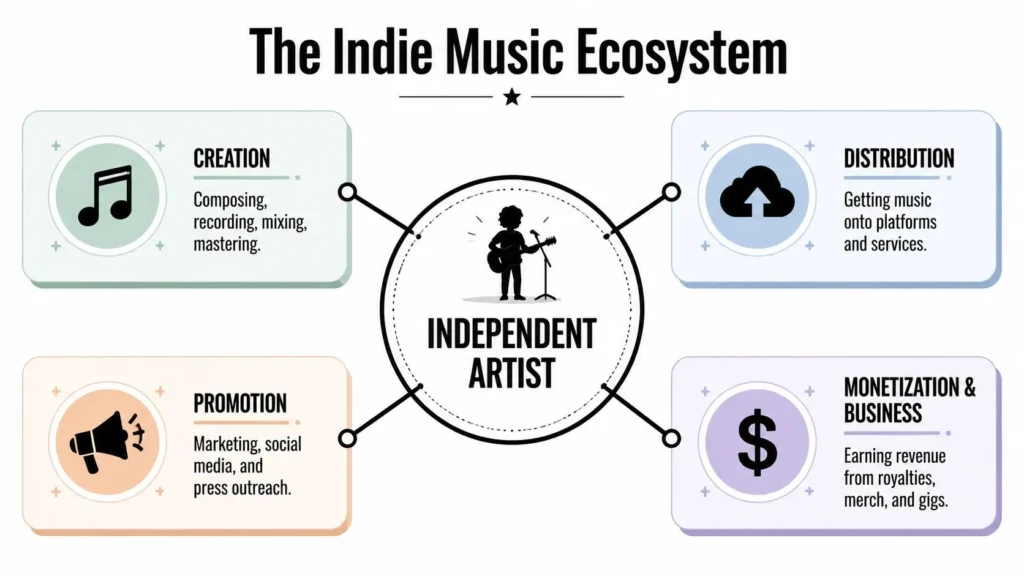
Think of your career like a small storefront. Writing songs is the product. But a store also needs shelves, signs, payment systems, and inventory control. For independent music artists, the equivalent system has four pillars.
Distribution
Distribution is how your music gets from your hard drive to streaming services and download stores. A distributor acts like a logistics partner. You upload the track once, and they deliver it to platforms, collect earnings, and pass reporting back to you.
This sounds simple, but distribution choices affect release timing, metadata quality, payout structure, and whether you can move quickly. If distribution fails, promotion gets wasted because listeners click and find nothing.
Monetization
Monetization answers a blunt question. Where does the money come from?
For a new artist, streaming is only one lane. The broader picture can include merch, direct sales, live shows, sync opportunities, fan support, and bundles. If you build only for streams, you’re building on a narrow base. If you build for fan support, you have more room to adapt.
Promotion
Promotion is not “post a clip and hope.” It’s the system that creates awareness and repeat attention. That includes short-form content, live performance clips, artist storytelling, playlist pitching, press outreach, collaborations, and social proof.
Promotion is where many artists burn the most energy because it never feels finished. That’s why a repeatable process matters more than constant improvisation.
Rights management
Rights management is ownership hygiene. It covers your recordings, songwriting splits, credits, registrations, contracts, and permissions. It’s boring until something goes wrong. Then it becomes urgent.
A missing credit line or sloppy split agreement can create stress long after release day. Rights work is administrative, but it protects the asset you’re building.
Why the market feels crowded
The ecosystem is large enough to create real opportunity and real confusion. MIDiA Research says nearly 13,000 labels and 7 million artists can theoretically reach listeners at scale in any country, but that discoverability and monetization are still constrained by fragmentation and uneven audience concentration across platforms.
That line about “in theory” is important. Global reach is available. Attention is not guaranteed.
| Pillar | Core question | Typical beginner mistake |
|---|---|---|
| Distribution | How does the music get live correctly and on time? | Uploading too late or entering weak metadata |
| Monetization | How will this release earn beyond plays alone? | Treating streams as the whole business |
| Promotion | How will new listeners find and remember it? | Posting randomly without a message or plan |
| Rights management | Who owns what, and is it documented? | Ignoring splits, credits, and paperwork |
Key takeaway: A release fails when one pillar is missing, even if the song itself is strong.
That’s why the indie artist’s real job isn’t only creating music. It’s coordinating a system where each part supports the others.
Your First Release A Practical Launch Plan
A first release feels intimidating because everything appears urgent at once. The fix is to treat it like a project with stages, not a burst of stress.
Start with the release package
Before you upload anything, gather the release assets in one folder:
- Final master: label the correct version clearly so you don’t upload a draft by mistake.
- Artwork: keep it visually simple and readable at thumbnail size.
- Credits: songwriter, producer, featured artists, mixer, mastering engineer.
- Lyrics and metadata: title spelling, artist name consistency, genre tags, release date.
- Short description: one paragraph that explains the song in plain language.
This package matters because every missing item creates friction later. If your credits are scattered across old text threads and notes apps, launch week turns into admin cleanup.
Choose a realistic release setup
You don’t need the perfect distributor. You need one that fits your budget, pace, and tolerance for admin. New artists often overthink this step and underthink the actual campaign.
Here’s a simple comparison framework you can use while evaluating options.
| Distributor | Pricing Model | Royalty Cut | Key Feature |
|---|---|---|---|
| DistroKid | Annual subscription | Varies by plan and terms | Fast repeat releases for frequent singles |
| TuneCore | Subscription-based release plans | Varies by plan and terms | Structured options for artists building catalogs |
| CD Baby | Per-release payment model | Varies by release terms | Useful for artists who prefer one-time release setup |
| Ditto Music | Subscription-style model | Varies by plan and terms | Designed for self-serve digital distribution |
Don’t treat this table as a verdict. Read each platform’s current terms before committing. Pricing and royalty structures can change, and some features only matter if you release often.
Build a small launch calendar
Most first releases don’t need a huge campaign. They need a clean sequence.
- Lock the date early. Give yourself enough time for upload, review, and prep.
- Claim your artist profiles. Make sure your platform pages look complete.
- Prepare three to five content pieces. A teaser, a talking clip, cover art reveal, lyric excerpt, live snippet, or studio moment is enough.
- Write one clear message. Not ten angles. One. What is the song, who is it for, and why should someone care?
- Set one listener action. Stream it, pre-save it, join your list, or watch the video.
A release should point somewhere. If every post asks for something different, attention scatters.
Use launch week to build an asset, not just a spike
New artists often miss the long game. They treat launch week as a finish line. It’s better to treat it as the first test of your audience system.
That means collecting contact permission where you can. If you haven’t started that process yet, this guide on how to build an email list is worth reading because email remains one of the few channels you can control directly.
Release week is not only about getting heard. It’s about learning who pays attention, who returns, and where to reach them again.
If your first song gets modest traction but brings in a few real supporters, that’s a better business outcome than a burst of passive listens with no next step.
Growing Your Audience and Your Income
A lot of artists chase streams because streams are visible. The dashboard updates, the graphs move, and the numbers feel like proof that something is happening. But visibility isn’t the same as business stability.
For long-term growth, your most valuable asset is usually not the platform metric. It’s the direct relationship. Christine Osazuwa argues this clearly in her piece on audience strategy: artists should prioritize first-party audience data by maintaining email and phone lists, running a dedicated website with a web store, and using tools like Spotify for Artists and YouTube Analytics to reduce dependence on algorithmic feeds and preserve direct fan access. You can read that full framework in her article on using data in indie artist marketing and audience strategy.
Build a fan path, not just content output
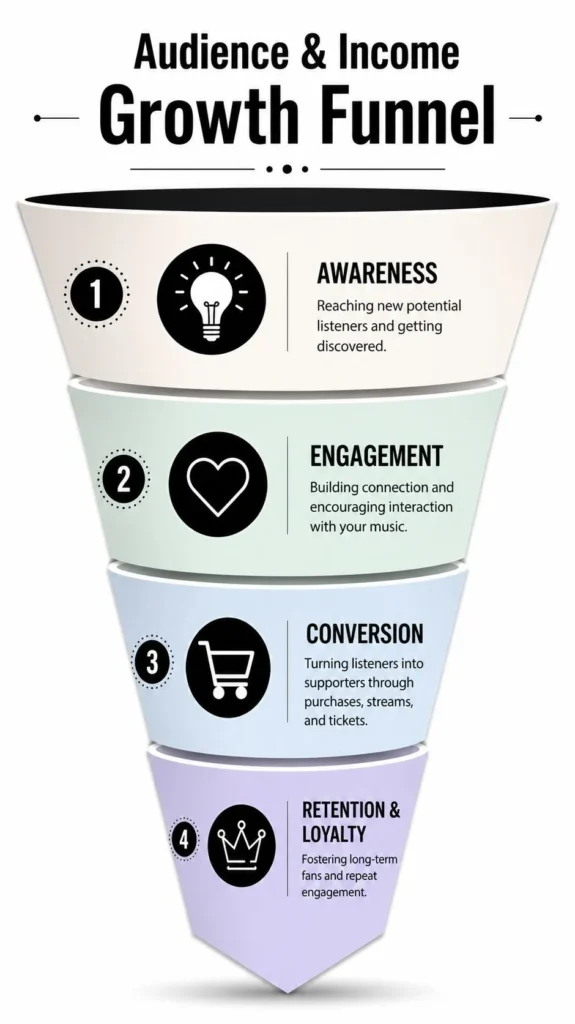
A useful way to think about growth is as a funnel:
- Awareness: someone discovers the song
- Engagement: they watch, comment, save, or follow
- Conversion: they buy, subscribe, join, or attend
- Retention: they return for the next release
That’s why “more content” by itself often fails. Content only helps if it moves people from one stage to the next.
A simple fan path might look like this:
- A short clip introduces the song.
- The caption points to your profile or site.
- Your site offers music, merch, and an email signup.
- Your follow-up message invites the fan to the next release, show, or drop.
This is a more useful goal than trying to impress the algorithm every day.
A quick visual can help frame the idea:
Diversify what support looks like
If all income depends on streams, then every career decision bends around platform behavior. That’s a fragile setup. Independent artists usually need multiple support lanes.
Some common options include:
- Merchandise: shirts, physical media, posters, or small collectible items tied to a release.
- Live income: local shows, house shows, support slots, livestream events, or ticketed online performances.
- Direct fan support: memberships, subscriber communities, tip jars, or gated extras.
- Licensing: non-vocal versions, alternate mixes, and clean metadata that make songs easier to place.
- Creator extensions: educational content, production breakdowns, or niche media formats.
For example, if you’re already comfortable speaking to an audience, audio formats can become part of your broader business mix. MaxiJournal also has a practical article on how to monetize a podcast, and the underlying lesson applies to musicians too: direct audience trust tends to monetize better than passive reach.
Own the relationship first. Revenue options get easier when people know where to find you without a platform acting as the middleman.
The strongest indie careers often don’t look glamorous from the outside. They look organized. A modest but reachable audience, a reliable release rhythm, and a few clear ways for supporters to spend money usually beat a large but shallow audience that disappears between singles.
Common Pitfalls and How to Avoid Them
Some mistakes are artistic. Most are operational. That’s why capable musicians can still sabotage their own releases without realizing it.
Treating a release like a one-day event
A song drops, friends share it, and then everything goes quiet. That pattern usually means the artist planned for release day but not for the weeks around it.
A better approach is to prepare supporting material before launch. One acoustic version, one talking-head clip, one lyric post, one short performance video, and one follow-up email can stretch a release into a campaign instead of a moment.
Ignoring metadata and documentation
Metadata feels tedious because it doesn’t sound creative. It still matters. Song title consistency, credits, and ownership details help your catalog stay organized and usable over time.
This is also where basic copyright awareness matters. If you’re still sorting out what protection steps are available before spending on legal help, LesFM has a practical breakdown of free music copyright methods that can help you understand the basics.
Building an inconsistent identity
If your cover art, bios, photos, and social pages all present different versions of who you are, new listeners won’t know what to remember. You don’t need a complex brand deck. You need coherence.
Ask three simple questions:
- Visual question: do your images feel like they belong to the same artist?
- Language question: does your bio sound like the same person who wrote the captions?
- Music question: does the presentation match the listener experience?
Confusion kills momentum. Clarity helps repeat discovery.
Assuming geography decides everything
Artists outside major music hubs often think they’re already behind. Geography still matters, but it doesn’t determine whether a career is possible. What changes is the operating model.
SoundGirls makes this point well in its article on tips for indie artists outside major music cities. The practical answer is a remote-first workflow: home recording where possible, digital collaboration, and location-based discovery tools that help offset thin local infrastructure.
If your city lacks industry infrastructure, don’t copy a big-city strategy badly. Build a smaller system that fits where you are.
That might mean fewer showcase-chasing trips and more emphasis on digital collaboration, direct fan communication, and destination shows where demand already exists.
Burning out by doing every job forever
The final pitfall is moral, not technical. Many independent artists believe that “real” independence means endless self-sacrifice. It doesn’t. If your release strategy requires you to be producer, editor, designer, social manager, booking agent, and accountant every week, the issue isn’t your discipline. The issue is the model.
You can stay independent and still simplify. Cut channels. Reduce posting frequency. Reuse visual templates. Hire small help when possible. Drop tasks that don’t produce results.
A sustainable artist business is not the one with the most hustle. It’s the one you can still run next year.
The Future of Independence Is Entrepreneurship
The modern indie path isn’t just a creative identity. It’s an operating model. You make the work, but you also manage release systems, audience pathways, rights, partnerships, and cash flow.
That’s why the most useful mindset shift is simple: your music is the product, and your business is the engine. If the engine is weak, even strong songs struggle to travel. If the engine is steady, a modest catalog can grow into a durable career.
For independent music artists, the opportunity is real. So is the workload. You’re not choosing between art and business. You’re choosing whether to run the business in a way that protects the art, supports your life, and gives your audience a clear way to stay with you.
Start smaller than your ego wants. Build cleaner than your stress wants. Repeat what works. Remove what drains you.
If you like practical breakdowns like this, MaxiJournal publishes approachable writing across music, business, technology, and culture, including articles that can help independent artists think more clearly about releases, promotion, and sustainable creative work.
Discover more from Maxi Journal
Subscribe to get the latest posts sent to your email.