You’ve probably had the same thought a lot of Zelda fans have. The Triforce would make an amazing tattoo, and the hand feels like the boldest possible place for it. It’s clean, iconic, instantly readable, and every time you reach for a controller, coffee mug, or car key, you’d see it staring back at you.
That’s exactly why this choice deserves more thought than a quick save-slot decision.
A Triforce hand tattoo can look incredible. It can also heal rough, fade faster than people expect, and force some uncomfortable conversations at work or with family if you haven’t thought through the visibility. Fan galleries usually stop at the fresh photo. They don’t spend much time on what that tattoo looks like after daily hand washing, sun exposure, friction, and normal life.
If you still want one after hearing the practical side, that’s a good sign. Visible tattoos work best when the decision survives the reality check.
The Call to Adventure Your Triforce Hand Tattoo
The usual version goes like this. You’ve loved Zelda for years, maybe since childhood, maybe since Breath of the Wild or Tears of the Kingdom pulled you in. You want something that doesn’t feel random or trendy. The Triforce makes sense immediately because it already carries meaning. It isn’t just game art. It stands for something you can live with.
Then the next thought hits. If you put it on your hand, this won’t be a private tattoo.
That’s the fork in the road. A hand tattoo is less like hanging art in your room and more like wearing the same ring every day for the rest of your life. You’ll see it when you type, shake hands, pay at a register, or sit in a meeting. Other people will see it too, often before they know anything else about you.
Practical rule: If you only love the idea of a fresh hand tattoo photo, wait. If you still want it after thinking about healing, fading, and visibility, you’re closer to being ready.
For Zelda fans, the appeal is obvious. The Triforce is one of those rare symbols that works on two levels. Other fans recognize it instantly, but even people who’ve never touched a controller can appreciate the geometry. That gives it unusual staying power as tattoo subject matter.
Still, the hand is one of the least forgiving placements you can choose. Small flaws show. Uneven healing shows. Bad line decisions show. If the design is too delicate, the hand usually wins.
A smart choice here isn’t about being less passionate. It’s about respecting the symbol enough to place it well, size it properly, and accept the maintenance that comes with wearing Hyrule on one of the hardest-working parts of your body.
Understanding the Triforce’s Power Wisdom and Courage
A Triforce tattoo works best when you understand what you’re putting on your skin. The symbol came from Nintendo’s The Legend of Zelda, first released in 1986, and its meaning has stayed remarkably consistent since then. It’s made of three equilateral triangles representing power, wisdom, and courage, and in Zelda lore it’s tied to the three Golden Goddesses, as summarized in Wikipedia’s Triforce overview.

That history matters because it keeps the tattoo from feeling disposable. A lot of fandom tattoos age poorly in a personal sense. The reference stops mattering, or the design was picked because it looked cool in the moment. The Triforce tends to avoid that problem because the core symbolism is broad enough to grow with you.
Why this symbol keeps working
The Triforce has unusual balance. It’s simple enough to read from across a room, but loaded enough to reward anyone who knows the games. It also adapts well to different tattoo styles because the underlying shape is so strong.
Wikipedia notes that its geometry helped make it “one of the most popular gaming tattoos,” and also points out its resemblance to the Sierpiński triangle, a recognizable fractal form. That explains a lot. The symbol already has visual order built into it. Tattoo artists like that because clean geometric shapes translate well when handled properly.
For fans who want to lean deeper into the world behind the symbol, it helps to revisit places where Zelda’s mythic side comes through strongest. Pieces on Hyrule’s atmosphere, like this look at Fairy Fountains in Breath of the Wild, can help you decide whether you want a pure Triforce or a design with a more mystical tone.
What your version should mean
Before you book, decide which of the three virtues matters most to you.
- Courage: Good fit if Zelda helped you through a hard period, a life reset, or a personal challenge.
- Wisdom: Better if the symbol feels tied to patience, learning, or restraint.
- Power: Best handled carefully. In tattoo terms, it usually reads strongest when balanced by the other two, not isolated as a solo flex.
The strongest fandom tattoos don’t need a long explanation. They already mean something when you look at them years later.
If your answer is “all three,” that’s fine. Individuals typically don’t get a Triforce because they want one triangle. They get it because the full set says something larger about balance.
From Minimalist to Master Sword Designing Your Triforce
The Triforce is simple. Designing a hand tattoo around it isn’t.
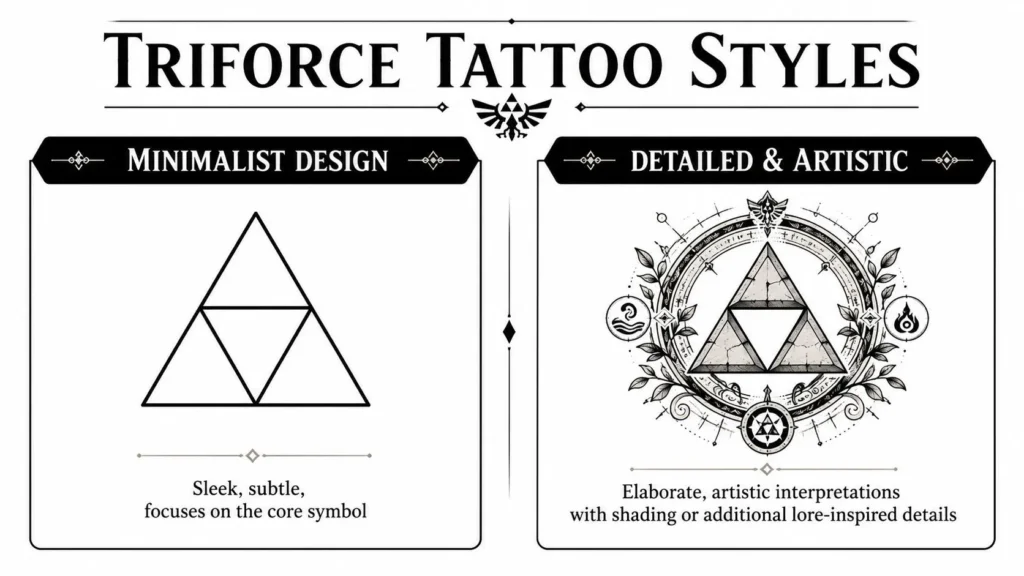
The hand punishes clutter, but it also exposes weak design choices. That means your best option usually sits somewhere between bare-bones and overloaded. Too plain, and the tattoo can look accidental. Too detailed, and the details can turn muddy faster than you’d like.
What ages best on the hand
Here’s the short version. Bold, readable design wins on hands. Fine decoration can work, but only when it supports the shape instead of competing with it.
| Style | What works | What usually fails |
|---|---|---|
| Minimal outline | Clean read, strong symbolism, easier to place | Very thin lines can weaken over time |
| Solid black fill | Strong visibility, holds shape well | Can look heavy if sized too large |
| Dotwork or geometric | Adds texture without chaos | Tiny micro-patterns may soften |
| Triforce plus Master Sword | Strong focal point if composition is simple | Vertical layouts can get cramped on smaller hands |
| Hylian Crest combo | Great for larger placements | Dense wings, flourishes, and tiny details can crowd the design |
A minimalist Triforce is generally a safe bet. Three clean triangles, either outlined or filled, fit the hand naturally. It stays legible and doesn’t ask the skin to hold too many tiny decisions.
A blackwork Triforce is stronger if you want punch. It’s especially effective on the back of the hand because the symbol stays readable in motion. The trade-off is that sloppy spacing becomes obvious, so your artist’s line discipline matters a lot.
When extra Zelda elements help
Adding the Master Sword, Hylian Crest, Sheikah-inspired geometry, or a soft aura can work. It just has to be structured around the Triforce, not piled onto it. Hand tattoos need hierarchy. The eye should know what the main symbol is immediately.
If you’re sketching ideas digitally before your consult, browsing graphic design software for beginners can help you organize references without overwhelming your artist with random screenshots.
Use these filters when editing your concept:
- Keep one focal point: If the Triforce is the star, everything else should support it.
- Respect negative space: The small gaps between the triangles are part of the design. Don’t let decorative fill erase that clarity.
- Avoid micro-detail on fingers: Finger spillover often looks cool on day one and less cool after healing.
- Match style to personality: A clean geometric Triforce feels very different from a weathered fantasy relic look.
Design test: Shrink the concept on your phone screen. If the Triforce stops reading instantly, the design is too busy for the hand.
The best hand tattoos look a little simpler in stencil form than people expect. That isn’t compromise. That’s good judgment.
Placement Pain and the Realities of Hand Tattoos
This is the part people skip when they’re caught up in the hype. A hand tattoo can be excellent, but it asks more from you than most placements do. If you want a Triforce on your hand, you need to care as much about healing, friction, fading, and visibility as you do about style.
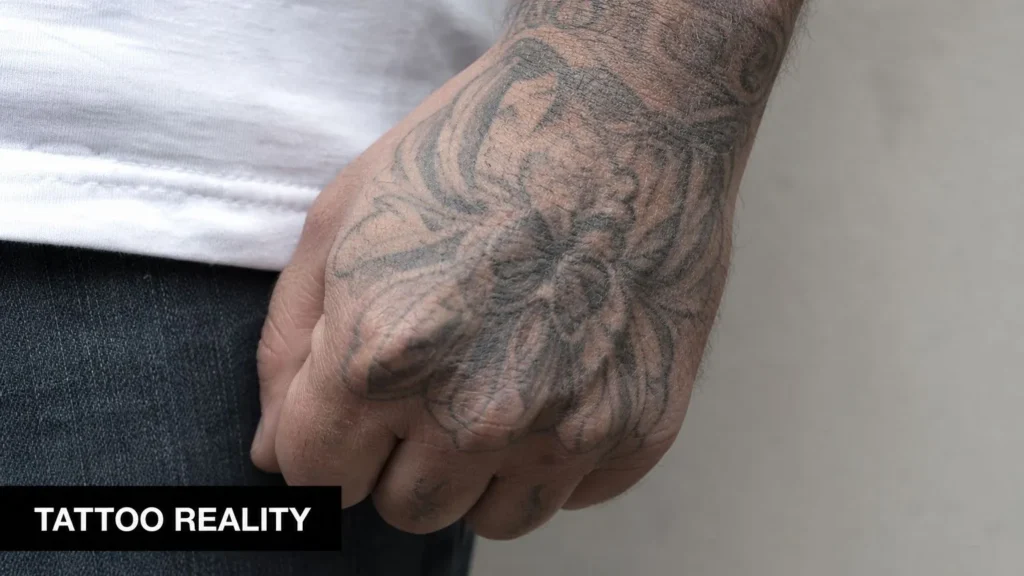
Public discussion around the phrase “triforce hand tattoo” tends to focus on fan reaction and design photos. The practical side is underserved. The useful reality is that hands are high-movement, high-friction areas that can be harder to heal and may need more touch-ups, as noted in this discussion of the gap around hand tattoo pain, healing, and job impact.
Where on the hand makes the most sense
The back of the hand is the classic choice for a reason. It offers the flattest, most readable canvas for a centered Triforce. If you want the clean iconic look, this is usually the strongest option.
Other placements come with more compromise:
- Thumb webbing: Visually interesting, but movement and stretching can be rough on clean geometry.
- Side of the hand: More private, less immediately visible, but less ideal for a perfectly balanced symbol.
- Fingers or knuckles: High wear, limited room, and not great for preserving the full Triforce shape.
- Near the wrist-hand transition: Easier to hide and often easier to live with professionally, though it loses some of the dramatic hand-tattoo impact.
Pain and what it actually feels like
Hand tattoos hurt differently than softer placements. There’s less padding, more bone, and a lot of nerve sensitivity. Those considering such a tattoo don’t need exaggerated warnings, but they do deserve honesty. If this is your first tattoo, a hand is not the gentlest introduction.
Pain also changes during the session. Linework over bonier spots can feel sharp and hot. Areas with repeated passes can get increasingly tender. A small Triforce won’t be an all-day endurance event, but the location still has bite.
For a grounded overview of how body area affects discomfort and healing, Think Tank Tattoo has comprehensive tattoo placement advice that’s worth reading before you commit.
The bigger issue is healing and fade
Pain is temporary. Wear is the lasting story.
Your hands get washed constantly. They rub against pockets, steering wheels, gym equipment, keyboards, tools, and sunlight. That daily abuse is why hand tattoos can lose crispness faster than tattoos in calmer areas. A design that looks perfect fresh may soften sooner if it’s too delicate.
That’s also why artist selection matters more here than in many placements. A hand tattoo needs enough structure to survive normal life.
A useful visual reference helps set expectations:
Job impact is part of the decision
Some readers won’t care. Others should care a lot.
A hand tattoo is hard to hide in customer-facing work, interviews, conservative workplaces, or family situations where visible body art still carries baggage. None of that means you shouldn’t get one. It means you should decide with open eyes. The tattoo won’t only show up in mirror selfies. It’ll show up in every handshake and every first impression.
If you’re hesitating because of professional visibility, that hesitation is worth respecting. A wrist or forearm Triforce can still feel personal without being unavoidable.
The smart move isn’t always the boldest move. Sometimes it is. But if you choose the hand, choose it knowing exactly what you’re signing up for.
Finding Your Artist and Preparing for Your Session
A Triforce sounds simple until you see a bad one. Then you realize how easy it is to mess up spacing, symmetry, line consistency, or placement. For a hand tattoo, you want an artist whose portfolio proves they can tattoo clean geometry on difficult skin, not just someone who likes Zelda.
What to look for in a portfolio
Don’t just ask whether the artist has done anime, gaming, or nerd-culture tattoos. Ask whether they’ve done hands well.
Look for these signs:
- Strong healed work: Fresh tattoos always look sharper. Healed examples tell the truth.
- Consistent line weight: Uneven triangle borders ruin the Triforce fast.
- Smart placement: Good artists use the natural shape of the hand instead of forcing the design.
- Restraint: If every piece is overloaded with details, that artist may not be the best fit for a durable hand tattoo.
If you can’t find healed hand work in the portfolio, ask for it. A professional won’t be offended.
What to bring to the consultation
A good consult is part design meeting, part reality check. Bring references, but don’t dump a folder of conflicting ideas on the artist and expect magic.
Bring:
- A few Triforce examples you like.
- One or two examples of line weight or texture you prefer.
- A photo of your own hand in natural position.
- A clear answer to whether you want pure Triforce or added Zelda elements.
Then listen. If the artist tells you a line is too thin, a placement is too small, or a finger extension won’t age well, that’s useful feedback, not resistance.
A solid tattoo consultation should make the design simpler, clearer, and more durable. If it only makes it more complicated, something’s off.
How to prep for the appointment
You don’t need a ritual. You do need common sense.
Eat before the session. Show up hydrated. Wear clothing that gives easy access and doesn’t rub the fresh tattoo on the way home. Don’t show up sleep-deprived and shaky. And if your artist gives pre-appointment instructions, follow them exactly rather than mixing advice from five different internet threads.
Also, plan your next few days realistically. If your work involves gloves, heavy lifting, constant hand washing, chemicals, or rough manual use, talk about timing before you book. A hand tattoo asks for cooperation from your schedule, not just your skin.
Triforce Tattoo Aftercare for a Long-Lasting Legend
The session ends fast. The healing phase is where people either protect the tattoo or unwittingly sabotage it. Hand tattoos need more discipline because you use your hands constantly, often without thinking.
What matters during healing
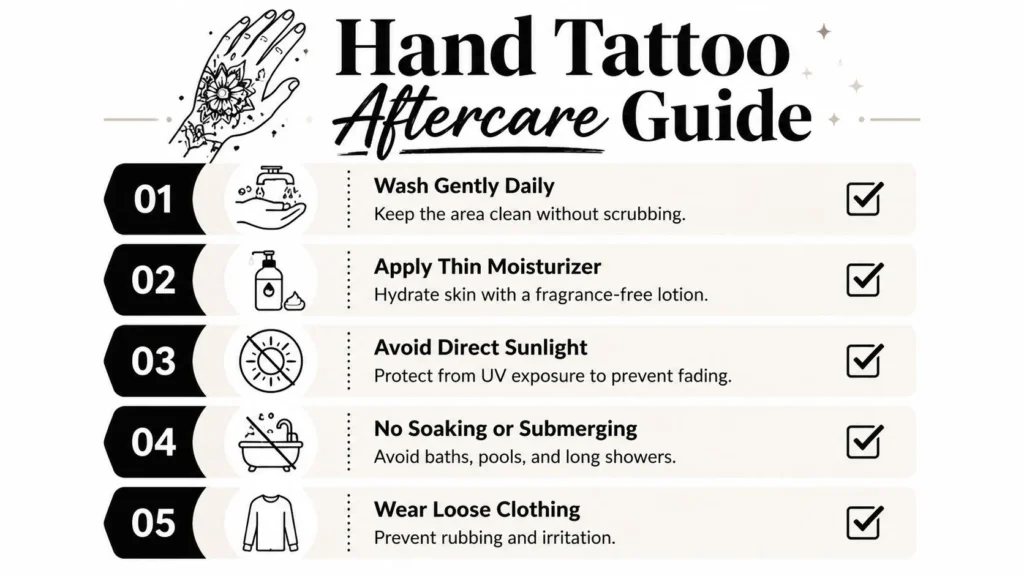
Your artist’s instructions come first, but the basic priorities are straightforward. Keep it clean. Don’t over-moisturize. Don’t pick at flaking skin. And don’t put the tattoo through avoidable friction while it’s trying to settle.
For a reliable general reference, Fountainhead New York shares expert tattoo aftercare tips that line up well with the basics most reputable artists emphasize.
A hand tattoo usually benefits from a simple routine:
- Wash gently: Use lukewarm water and a mild, fragrance-free soap. No scrubbing.
- Moisturize lightly: A thin layer is enough. If the skin looks greasy, you’ve used too much.
- Keep it out of soaking water: Long showers, baths, pools, and hot tubs are bad timing.
- Minimize rubbing: Be careful with pockets, gym grips, gloves, and rough fabrics.
Long-term care is where you keep the lines
Healing is only the first checkpoint. Longevity comes from habits.
Sun exposure is a major enemy of hand tattoos because hands spend so much time uncovered. Once the tattoo is fully healed, sunscreen becomes part of maintenance if you want the Triforce to stay crisp as long as possible. Dry, irritated skin also makes any tattoo look rougher, so basic skin care helps.
If you want to think about skin support more broadly, this overview of beta glucan for skin is a useful starting point for understanding barrier-friendly care.
Aftercare mindset: Treat the tattoo like a healing wound first, a piece of art second. During the early phase, cleanliness and restraint matter more than making it look shiny.
A final truth about hand tattoos. Even when you do everything right, touch-ups can still become part of the long game. That doesn’t mean the tattoo failed. It means the placement lives a harder life than most.
If you enjoy practical guides that respect both fandom and real-world trade-offs, explore more at maxijournal.com. It’s a solid place to find approachable writing on gaming, culture, health, and the everyday details people usually leave out.
Discover more from Maxi Journal
Subscribe to get the latest posts sent to your email.