You’re probably in one of two places right now. You’re standing in a ski shop staring at a wall of skis that all promise some version of power, playfulness, and versatility, or you’re deep in browser-tab purgatory trying to figure out why one skier swears by Fischer while another won’t touch anything but Armada.
That confusion is rational. “Best” doesn’t mean much in skis unless you attach it to a skier, a terrain preference, and a tolerance for replacing expensive gear sooner than you’d like. A race-bred carving ski can be brilliant for one person and miserable for another. A durable freeride ski can feel dead to someone who wants a lively, surfy ride.
The useful question isn’t which company makes the best ski brands in the abstract. It’s which brand consistently builds skis that match how you ski.
Navigating the Wall of Skis in 2026
A lot of buyers start with logos. They remember seeing Rossignol in rental shops, Head on race courses, or Armada in freeride edits, and they assume brand reputation will simplify the choice. It rarely does. Big ski brands often cover multiple personalities under one roof, from frontside groomer tools to loose, off-piste shapes that share almost nothing except a badge.
That’s why broad “top 10” lists often leave readers with the wrong kind of confidence. They tell you who is visible, not who is right for your skiing. A family planning mellow resort days will prioritize very different traits than an expert who spends every storm day hunting chopped powder and technical terrain. If your winter plans include destination research, guides to skiing in Slovenia for families can be more useful than gear hype because they reveal the kind of terrain and trip style your equipment needs to support.
The same goes for trip timing. If you’re still narrowing down where and when to ski, a broader seasonal travel guide like best places to visit in winter can help frame whether you need a narrower hard-snow ski, a versatile all-mountain model, or something wider and more forgiving.
Here’s the practical shift that makes ski shopping easier. Stop asking for a winner. Start sorting brands by three questions:
- How do you ski most days? Fast and directional, relaxed and cruisy, or playful and slashy.
- Where do you ski most often? Groomers, mixed resort terrain, park, trees, powder, or chopped leftovers.
- How long do you expect the ski to last? A season of hard use, or several winters of dependable service.
The best ski brand for you is usually the one whose design philosophy matches your mistakes as much as your strengths.
A skier who gets backseat sometimes needs a more forgiving shape. A technically strong skier may want a ski that rewards pressure and precision. Brand choice matters, but only after you define the use case.
How to Judge a Ski Brand Beyond the Hype
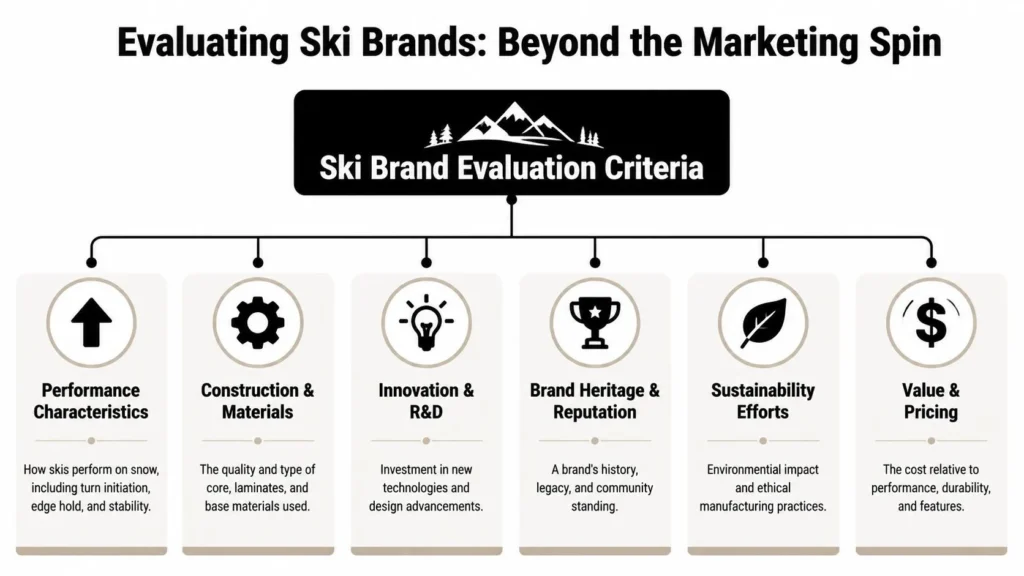
The cleanest way to compare the best ski brands is to judge them on the same few criteria every time. That stops marketing language from doing all the work.
| Criterion | What it tells you | Why it matters |
|---|---|---|
| Race and performance pedigree | Whether the brand proves itself in demanding competition settings | Useful for skiers who value edge hold, precision, and consistency |
| Construction and signature tech | How the ski is built and what design ideas define the brand | This shapes feel on snow more than the logo does |
| Terrain and skier focus | Who the ski is really for | Helps avoid buying a great ski for the wrong use |
| Durability and ownership value | How well the ski holds up over time | Important when skis are expensive and replacement cycles are long |
Performance pedigree matters, but only in context
Race success is one of the few objective signals in ski branding. It shows that a company can build equipment for the highest level of pressure, speed, and consistency. But race heritage doesn’t automatically make a brand ideal for a park skier or a soft-snow specialist.
That’s why pedigree is a filter, not a final verdict. If you love carving and technical skiing, it should carry real weight. If you ski switch, slash soft snow, or spend half your day in the air, it matters less.
Construction tells you how the ski will feel
Brand identities show up most clearly in construction choices. A ski with a more substantial, directional build tends to feel calmer and more planted at speed. A lighter-tip design can reduce swing weight, which makes quick direction changes easier and the ski less tiring in bumps or trees.
Treeline Review notes that Rossignol’s Air Tip reduces swing weight and improves maneuverability, while also contrasting that approach with ON3P’s durability-first reputation and the lower durability benchmarks associated with Faction and Line in that discussion of ski brands and use cases at Treeline Review’s ski brand analysis.
Durability is the missing buying criterion
A common failing of many roundup articles is that they identify the ski that feels best on a good test day, then ignore what happens after repeated resort laps, impacts, tunes, and travel. Community discussion shows buyers care about this more than mainstream gear coverage often admits. One thread explicitly frames ON3P as “most durable” while casting Faction and Line as less durable, which is why durability deserves a central place in any serious framework for the best ski brands, as seen in this Newschoolers durability discussion.
Practical rule: If you ski hard, travel with your skis, or keep gear for multiple seasons, durability should break ties between otherwise similar brands.
A great ski on day one isn’t necessarily a great buy over several winters.
The Legacy Titans All-Mountain & Carving Dominance
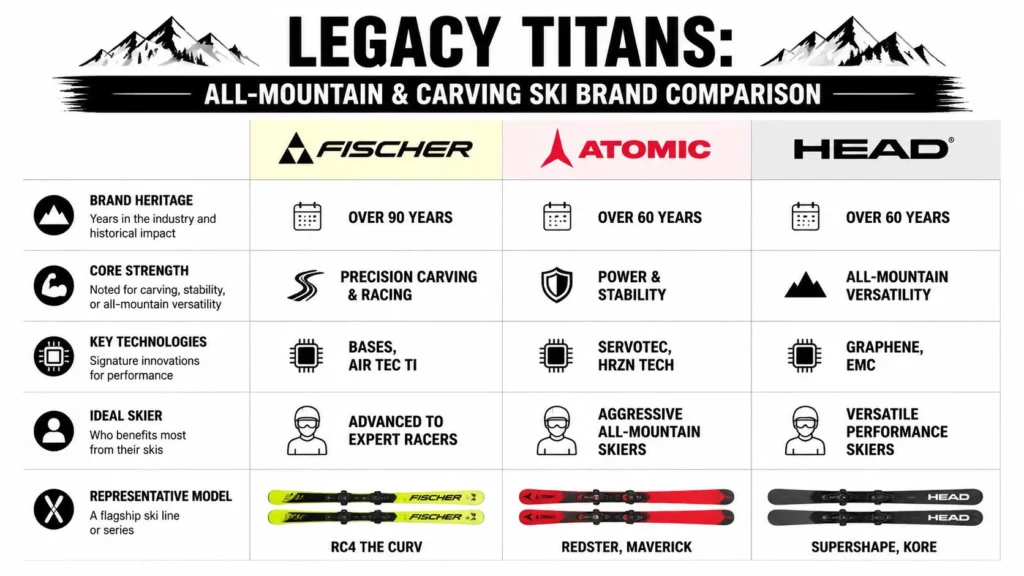
The most established alpine brands still own a big part of the conversation because they’ve spent decades refining skis for precision skiing. This group includes names like Fischer, Rossignol, Head, Atomic, and Völkl. Their strongest common trait isn’t nostalgia. It’s discipline. They tend to build skis with clearer purpose, stronger edge engagement, and a more directional feel.
Early in your search, these are usually the brands to examine if you care about frontside confidence, high-speed composure, and technical feedback underfoot.
Fischer sets the benchmark for pure race credibility
Among legacy brands, Fischer stands apart on one hard metric. In the 2023/24 seasonal standings reported by Ski Racing, Fischer led with 9,845.0 points, while Rossignol had 1,570.0, Madshus had 1,185.0, and Salomon had 410.0, according to Ski Racing’s World Cup brand standings report. Fischer’s total was more than 6 times Rossignol’s and more than 24 times Salomon’s.
That doesn’t mean every consumer Fischer ski is automatically better. It does mean Fischer’s engineering culture is strongly tied to elite-level performance under pressure. For the buyer, that often translates to a brand worth prioritizing if your ideal ski feels precise, serious, and built around edge hold.
Rossignol and Head are broader than their reputations
Rossignol is easy to pigeonhole as a heritage alpine name, but that undersells the brand. It has long-standing credibility in traditional categories while also using technologies like Air Tip to improve maneuverability. That gives Rossignol a wider appeal than many race-heavy brands. Skiers who want stability without a punishing feel often land here.
Head occupies a different lane. It’s one of the brands that repeatedly appears in upper-tier all-mountain and carving conversations because it tends to blend precision with a less singular race identity. A ski like the Kore line shows that Head isn’t confined to frontside skiing, even if the brand’s DNA still favors control and accuracy.
Atomic and Völkl reward commitment
Atomic and Völkl are often at their best with skiers who like to drive the ski rather than just steer it. They suit strong intermediates through experts who want feedback, not just forgiveness.
That matters because not every buyer wants a ski that flatters sloppy input. Some skiers improve faster on equipment that asks them to stay balanced and intentional. These brands often fit that profile.
| Brand | Strongest identity | Best for | Trade-off |
|---|---|---|---|
| Fischer | Race precision | Carving enthusiasts, ex-racers, technically strong skiers | Can feel demanding |
| Rossignol | Broad alpine competence with maneuverability-focused tech | Skiers who want stability without a dead feel | Not every model is equally energetic |
| Head | Controlled versatility | All-mountain skiers who still care about edge quality | Less playful than freestyle-led brands |
| Atomic | Powerful directional skiing | Aggressive resort skiers | Rewards good technique |
| Völkl | Strong edge hold and composure | Hard-charging frontside and mixed-terrain skiers | Can punish passive skiing |
One more point matters here. SnowTrex identifies Rossignol among the world’s best-known ski manufacturers alongside Atomic, Head, Fischer, and Nordica, and it also notes a newer milestone in the market with Armada, founded in 2002, becoming a leading modern freeski brand in the industry overview at SnowTrex’s ski manufacturer guide. That contrast explains a lot. The legacy brands earned trust through long manufacturing history and race influence. They still dominate when the buyer’s priorities are control, refinement, and technical depth.
The Freeride & Freestyle Innovators
If the legacy brands speak the language of edge angle and discipline, the freeride and freestyle brands speak the language of creativity. This group includes Armada, ON3P, Faction, and Line. Their influence on modern skiing is massive because they changed what many skiers expect a ski to do.
Instead of asking only how hard a ski carves, they ask different questions. Can it pivot quickly in tight terrain? Does it feel balanced in the air? Can it survive repeated impacts, rails, rough landings, and hard resort use?
Armada changed what a modern ski brand could be
Armada matters because it represents a different path to relevance. Unlike the old alpine houses, it didn’t build status through decades of race legacy. It built status through freeski culture. That distinction still shows up in the products. Armada skis often appeal to people who ski dynamically, value a more progressive stance, and want skis that feel alive rather than locked in.
That kind of skiing isn’t niche anymore. It has become central to how many advanced resort skiers move through the mountain.
ON3P leads the durability conversation
Among modern brands, ON3P stands out for a reason that gets less attention than rocker profile or waist width. Buyers repeatedly bring up durability. That’s not glamorous, but it’s one of the most useful brand signals in real ownership.
Treeline Review’s analysis contrasts Rossignol’s maneuverability-focused Air Tip with ON3P’s emphasis on durability, describing ON3P skis as known for resilience in harsh conditions while noting lower durability benchmarks for Faction and Line in that same comparison. That gives ON3P a very specific identity: not just fun, but built for abuse.
If you break gear, ski a lot of firm resort days, or hate replacing skis early, ON3P deserves a place near the top of your shortlist.
Faction and Line bring personality, with trade-offs
Faction and Line remain important because they helped define the playful side of all-mountain and freestyle skiing. They’re often attractive to skiers who want a ski that feels quick, loose, and expressive rather than planted and formal.
The trade-off is straightforward. A ski built for lower swing weight and easier release can be a better match for park laps, side hits, and soft-snow improvisation, but it may not be the brand you choose if lifespan is your first criterion. That doesn’t make these brands bad. It means their strongest selling point isn’t ownership conservatism. It’s riding feel.
Pick these brands for style, not generic prestige
Here’s the clean distinction between this category and the legacy titans:
- Choose Armada if you want a modern freeride identity with broad appeal and a less traditional feel.
- Choose ON3P if durability is central to your decision.
- Choose Faction or Line if you value a playful, more freestyle-oriented personality and accept the ownership trade-offs.
That’s a better way to think about the best ski brands than forcing all of them into one ladder. A highly durable freeride ski and a race-bred carving ski aren’t competing for the same buyer.
Finding Your Match Best Brands by Skier Type
Most skiers don’t need a brand ranking. They need a sorting system that narrows the field fast.
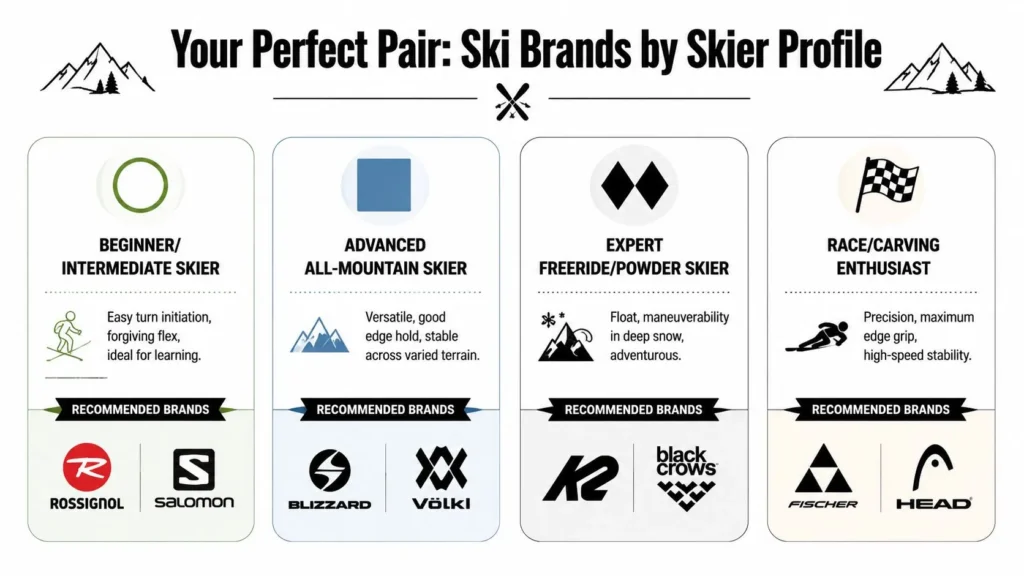
One useful visual primer on current ski categories and buyer thinking is this video:
For the hard-charging expert
If you ski fast, pressure the front of the boot, and care about edge confidence at speed, start with Fischer and Head.
Outdoor Gear Lab identified the Stöckli Stormrider 95 as the best all-mountain ski for experts in 2026 and described it as using a progressive tip and tail rocker with metal underfoot construction that supports durability and swing weight, while contrasting it with the Head Kore 100 Ti, which prioritizes torsional stiffness for high-speed carving in its category testing at Outdoor Gear Lab’s benchmark review. That comparison is revealing. Stöckli leans toward refined expert all-mountain performance with a polished feel. Head points more directly toward carving confidence and directional precision.
Best fit: Fischer if race pedigree pulls you in. Head if you want a powerful all-mountain ski that still feels accessible.
For the all-mountain skier who wants one ski to do most things
This skier should focus less on pure brand prestige and more on whether the brand has a strong middle of the lineup. Rossignol, Head, Völkl, and Blizzard usually deserve the longest look.
Stöckli also belongs in this conversation for advanced buyers, especially anyone who values composed suspension and premium construction. But for many skiers, the smarter move is to identify whether they want a slightly more planted, directional feel or a more relaxed, versatile one.
A useful rule is simple:
- More directional and technical: Head, Völkl, Fischer
- More balanced and approachable: Rossignol, Blizzard
- More premium and expert-skewed: Stöckli
For the park skier or playful freerider
Start with Armada, Line, and Faction. These brands make more sense when you ski with a centered stance, value maneuverability, and want a ski that feels willing to slash, pop, and release.
You’re not chasing the same virtues as a carving enthusiast. You’re prioritizing balance, freedom of movement, and a shape that supports tricks, switch skiing, or terrain creativity. In this category, “best” often means “most fun in the style I ski.”
For the skier who wants long-term value
Many best ski brands lists often overlook a key aspect. If you care about ownership value, durability should push ON3P higher than its mainstream visibility might suggest. It’s the brand that repeatedly enters the conversation when skiers ask which skis can take abuse.
That’s also where injury prevention and fatigue management matter more than people think. If you ski often, reducing avoidable strain through smarter setup choices matters as much as the ski itself. A general primer on how to prevent sports injuries is a useful complement to gear shopping, especially if you’re choosing stiffer or more demanding skis.
Buy for your most common ski day, not the fantasy day you get a few times a season.
That one rule eliminates a lot of bad purchases.
Essential Sizing and Buying Considerations
Once you’ve narrowed the brand, the next mistakes are usually sizing mistakes. A great ski in the wrong length or width is still the wrong ski.
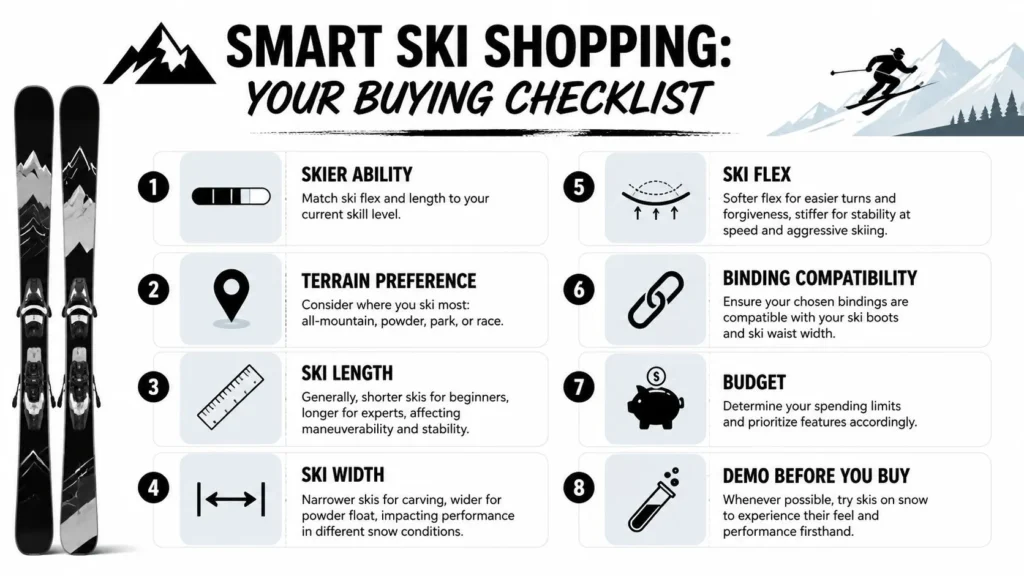
Length and width should match your habits
Shorter skis are usually easier to pivot and manage. Longer skis usually offer more stability, especially for stronger skiers or those who ski faster. Width is just as important. Narrower skis generally suit groomers and carving better. Wider skis generally help in softer snow and off-piste terrain.
Don’t choose length from ego. Choose it from your actual stance, speed, and confidence. A slightly shorter ski can make a progressing skier better. A slightly longer ski can make a strong skier calmer at speed.
Bindings and boots are part of the purchase
Bindings must match both your ski and your boot setup, and mounting should be done professionally. That’s not where to improvise. Boot fit, above all, matters more than almost anything else in the system. Skiers often obsess over skis and tolerate mediocre boots, which is backward.
If you’re trying to improve comfort or control before replacing boots entirely, well-chosen specialized ski boot inserts can help some skiers fine-tune fit and support.
A mediocre ski with an excellent boot setup is usually easier to enjoy than an excellent ski with a poor boot setup.
Demo when you can
No spec sheet can fully replace snow time. If you can demo two or three skis in the category you’re considering, you’ll learn more from a few runs than from hours of reading.
That principle applies across sports gear. Even outside skiing, the logic behind fit-first buying is similar to guides on how to choose running shoes for beginners. The right tool has to match the body using it, not just the reputation behind it.
Frequently Asked Questions About Ski Brands
Are expensive skis worth it?
Sometimes. Premium skis usually make sense for skiers who can feel the difference in damping, edge hold, or construction quality, and who ski enough to justify paying for that refinement. They make less sense for occasional skiers who would benefit more from better boots, lessons, or a versatile mid-tier setup.
Is one ski brand best for everyone?
No. That’s the main mistake in many best ski brands articles. Fischer may be the strongest answer for race credibility. ON3P may be the stronger answer for durability-focused buyers. Armada may be the better answer for a skier with freestyle instincts. The right answer changes with the skier.
What’s the real difference between men’s and women’s skis?
The most useful distinction isn’t the label. It’s the tune of the ski for size, weight, strength, and preferred input. Some women’s models are meaningfully distinct. Others are close relatives of unisex or men’s versions with different sizing and graphics. Focus on flex, length, mount point, and feel, not category assumptions.
Should I buy based on brand or model?
Model first, brand second. Brand helps you predict design philosophy, but skis live or die by the individual model. The most useful shortcut is this: use the brand to narrow the field, then choose the model that matches your terrain and style.
What if I want one ski to do everything?
Then accept that you’re buying a compromise on purpose. That’s not a flaw. It’s often the smartest choice. Look for a brand with a strong all-mountain lineup and decide where you want the compromise to lean. More carving precision, more off-piste looseness, or more durability.
MaxiJournal publishes approachable, thoughtful writing across sports, travel, health, science, business, and culture. If you enjoy practical guides like this one and want more clear, no-hype analysis, explore maxijournal.com.
Discover more from Maxi Journal
Subscribe to get the latest posts sent to your email.